
ENG 102 Midterm, Spring 2005
American University of Beirut · Enrichment Course in English · 6 pages

More ENG 102 files
Show the text of this exam
American University of Beirut
University Preparatory Program
antes
. ERICAN CNV nS:
Reading Midterm LIBRARY
Spring 2004- 2005 OF Rem
pee eetaieeacee
Safety Fears Over Europe’s Busy Skies
The swarms of brightly painted budget aircraft flying over Europe are busier, cheaper and
more plentiful than ever. But they are creating a painful headache for air traffic controllers,
who face a challenge in coping with skies packed with a record number of flights. At the
present rate of growth, Europe’s skies will become “full’ in little more than a decade, with
current procedures unable to cope, according to Europe’s top air traffic controller.
The warning will reopen fierce controversy over the safety of the continent’s congested
skies. It came just days ahead of the publication of an official report this week that is likely
to blame failures in air traffic control for one of the most devastating European air
disasters- a mid-air collision over Lake Constance two years ago that claimed 71 lives.
National control centres across the continent are coordinated by a network run bya
Brussels-based agency, Eurocontrol, which matches take-off and landing slots in 33
countries from Ireland to Ukraine. Eurocontrol looks after 29,000 flights in a typical 24-
hour period. Despite a slowdown in air travel after September 11, 2001, it predicts that
annual traffic across Europe will double to 16m aircraft by 2020.
Victor Aguado, director general of Eurocontrol, said last week: “In the middle of the next
decade, we will reach capacity using the present systems. Beyond that, we’ll need
something else, which today’s technology can’t provide.” To cope with the flight’s boom,
minimum height separation between aircraft has been cut from 2,000ft to 1,000f. Safety
experts are now working towards “self-separation” technology that will limit the role of
controllers by improving electronic equipment that allows aircraft to set safe paths away
from each other automatically.
At any daytime moment there are 3,500 aircraft over Europe, carrying some 400,000
people. One in ten is operated by low-cost airlines. To the consternation of experts, much
of the growth is forecast to come from east European states, where budget airlines are
looking for new destinations. Safety chiefs have warned that the quality of air traffic
control in Europe’s new member states is variable. Erik Merckx, Eurocontrol’s head of
safety enhancement, said: “If we don’t get these new states up to speed, with the increasing
traffic levels we’re predicting we will have a problem.”
Scores of companies have entered the no-frills market, including nine budget airlines based
in Germany alone. Next month a Hungarian carrier, Wizz, will enter the battle, offering
fights from Luton in England to Budapest and to Katowice in Poland, While annual growth
in traffic is set to be a modest 3% in Britain and 2.9% in France, a proliferation of services
a ee Sow
LIBRA KY
OF egyare
H
is forecast to increase flights over Ukraine by 7%, over Beralus by 5.5%, over Turkey by
5.9% and over Bulgaria by 5%.
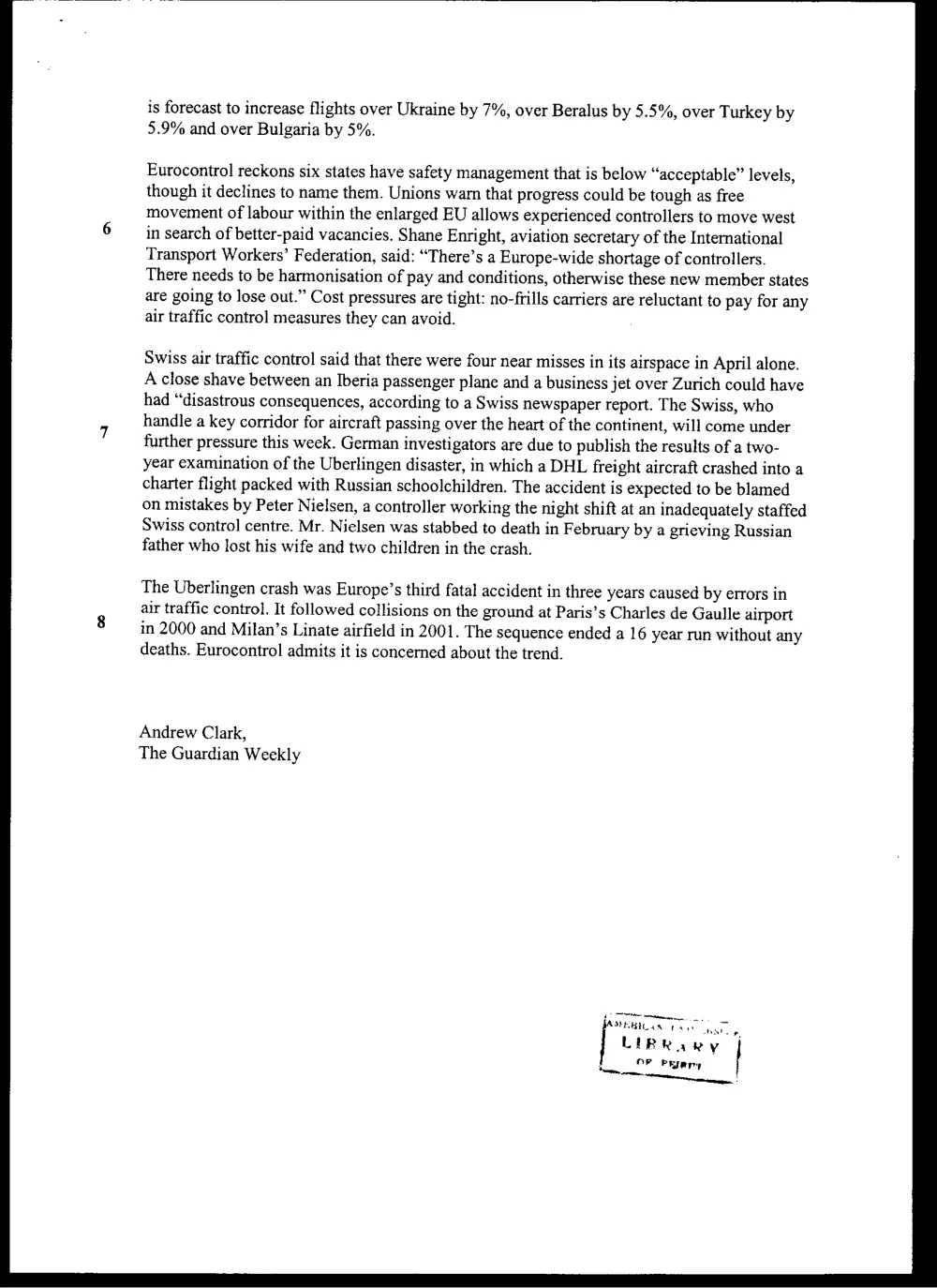
Eurocontrol reckons six states have safety management that is below “acceptable” levels,
though it declines to name them. Unions warn that progress could be tough as free
movement of labour within the enlarged EU allows experienced controllers to move west
in search of better-paid vacancies. Shane Enright, aviation secretary of the International
Transport Workers’ Federation, said: “There’s a Europe-wide shortage of controllers.
There needs to be harmonisation of pay and conditions, otherwise these new member states
are going to lose out.” Cost pressures are tight: no-frills carriers are reluctant to pay for any
air traffic control measures they can avoid.
Swiss air traffic control said that there were four near misses in its airspace in April alone.
A close shave between an Iberia passenger plane and a business jet over Zurich could have
had “disastrous consequences, according to a Swiss newspaper report. The Swiss, who
handle a key corridor for aircraft passing over the heart of the continent, will come under
further pressure this week. German investigators are due to publish the results of a two-
year examination of the Uberlingen disaster, in which a DHL freight aircraft crashed into a
charter flight packed with Russian schoolchildren. The accident is expected to be blamed
on mistakes by Peter Nielsen, a controller working the night shift at an inadequately staffed
Swiss control centre. Mr. Nielsen was stabbed to death in February by a grieving Russian
father who lost his wife and two children in the crash.
The Uberlingen crash was Europe’s third fatal accident in three years caused by errors in
air traffic control. It followed collisions on the ground at Paris’s Charles de Gaulle airport
in 2000 and Milan’s Linate airfield in 2001. The sequence ended a 16 year run without any
deaths. Eurocontrol admits it is concerned about the trend.
Andrew Clark,
The Guardian Weekly
fo i
ERIC AN Taus are 6
LIBRkaRy
OF Pan,
See nee {
Ae tereae,*
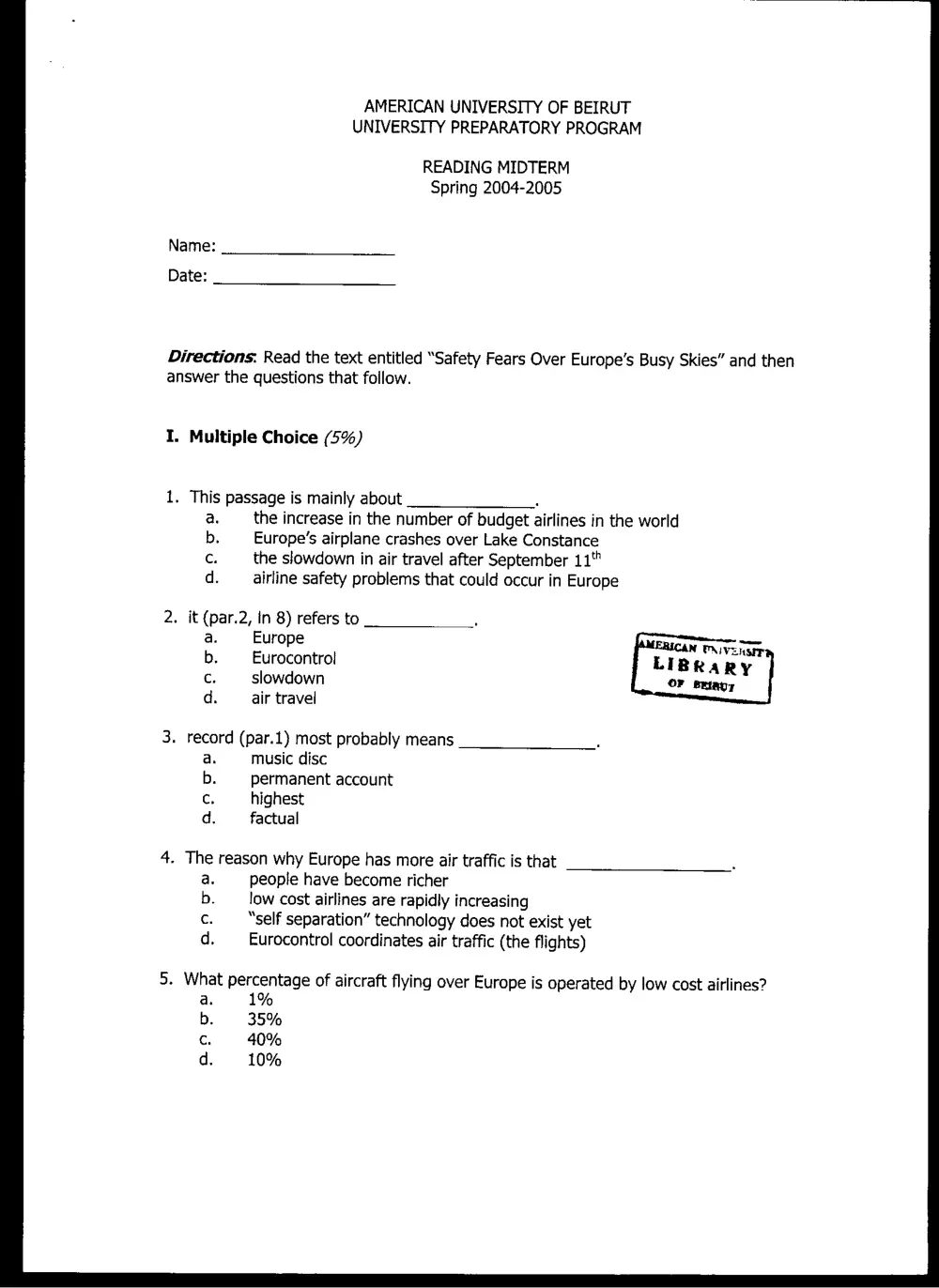
AMERICAN UNIVERSITY OF BEIRUT
UNIVERSITY PREPARATORY PROGRAM
READING MIDTERM
Spring 2004-2005
Name:
Date:
Directions. Read the text entitled “Safety Fears Over Europe’s Busy Skies” and then
answer the questions that follow.
I. Multiple Choice (5%)
1. This passage is mainly about .
the increase in the number of budget airlines in the world
Europe's airplane crashes over Lake Constance
the slowdown in air travel after September 11°
airline safety problems that could occur in Europe
ao om
2. it (par.2, in 8) refers to
a. Europe
b. Eurocontrol
on slowdown
d. air travel
3. record (par.1) most probably means
a. music disc
b. permanent account
[on highest
d. factual
4. The reason why Europe has more air traffic is that
a. people have become richer
b. low cost airlines are rapidly increasing
c. “self separation” technology does not exist yet
d. Eurocontrol coordinates air traffic (the flights)
5. What percentage of aircraft flying over Europe is operated by low cost airlines?
a. 1%
b. 35%
ron 40%
d.
10%
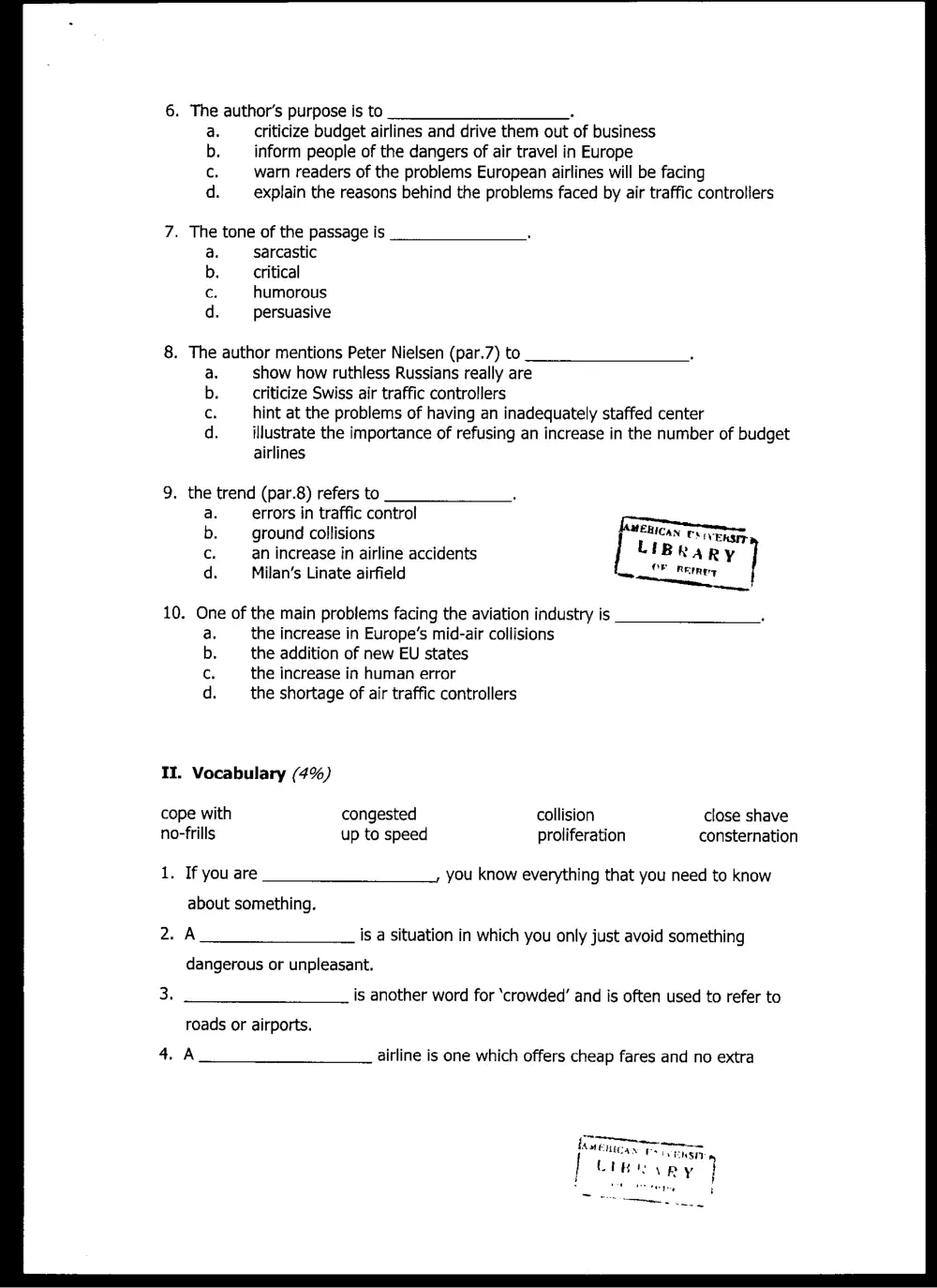
. The author's purpose is to .
a. criticize budget airlines and drive them out of business
b. inform people of the dangers of air travel in Europe
C warn readers of the problems European airlines will be facing
d. explain the reasons behind the problems faced by air traffic controllers
. The tone of the passage is
a. sarcastic
b. critical
on humorous
d. persuasive
8. The author mentions Peter Nielsen (par.7) to
a. show how ruthless Russians really are
b. criticize Swiss air traffic controllers
on hint at the problems of having an inadequately staffed center
d. illustrate the importance of refusing an increase in the number of budget
airlines
. the trend (par.8) refers to
a. errors in traffic control
b. ground collisions
(on an increase in airline accidents
d. Milan’s Linate airfield
10. One of the main problems facing the aviation industry is
a. the increase in Europe’s mid-air collisions
the addition of new EU states
b.
c. the increase in human error
d. the shortage of air traffic controllers
II. Vocabulary (4%)
cope with congested collision close shave
no-frills up to speed proliferation consternation
1. If you are , you know everything that you need to know
about something.
2. A is a situation in which you only just avoid something
dangerous or unpleasant.
is another word for ‘crowded’ and is often used to refer to
roads or airports.
4A airline is one which offers cheap fares and no extra
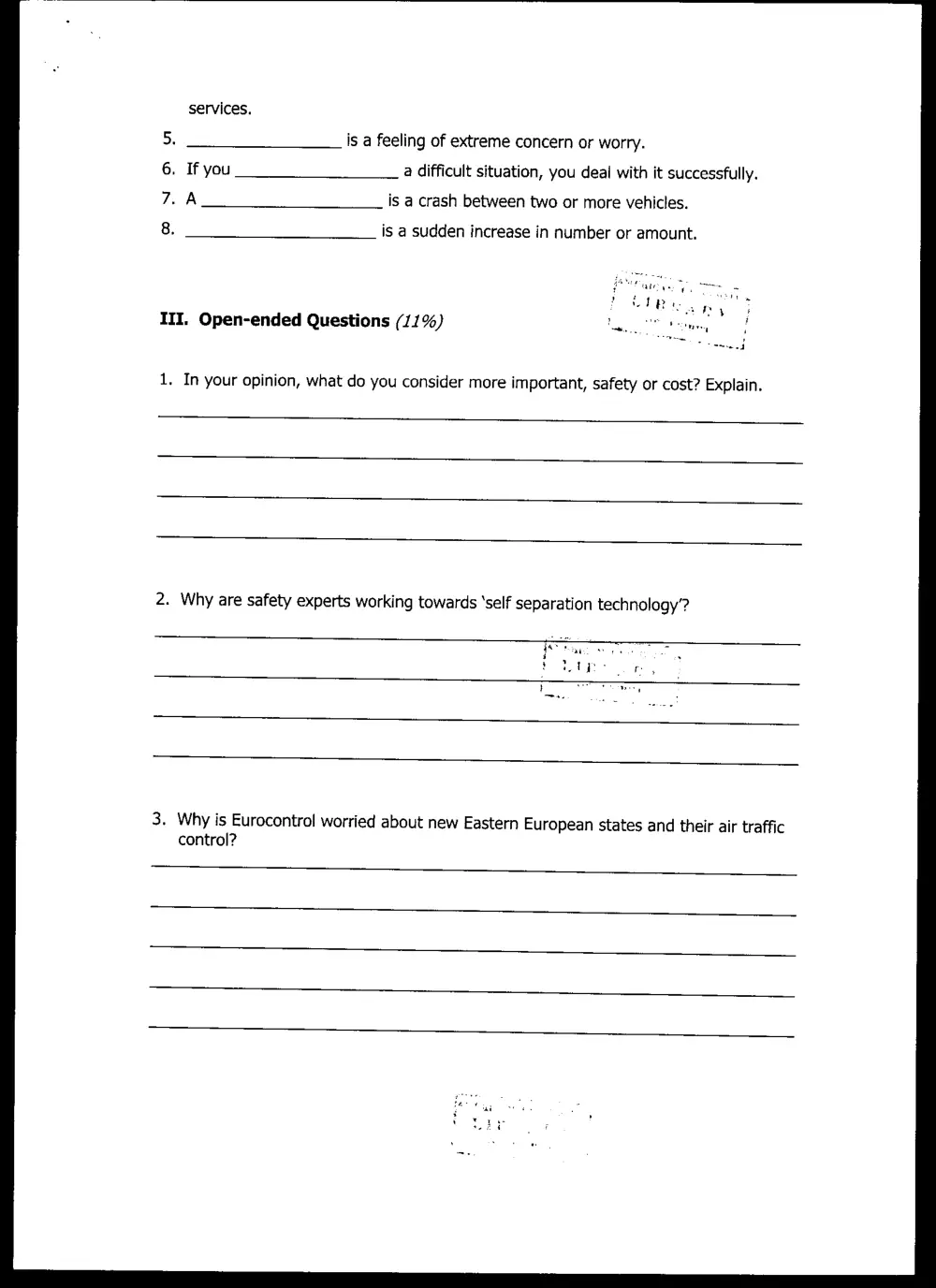
services.
5. is a feeling of extreme concern or worry.
6. If you a difficult situation, you deal with it successfully.
LA is a crash between two or more vehicles.
is a sudden increase in number or amount.
III. Open-ended Questions (11%)
ed
1. In your opinion, what do you consider more important, safety or cost? Explain.
2. Why are safety experts working towards ‘self separation technology’?
3. Why is Eurocontrol worried about new Eastern European states and their air traffic
control?
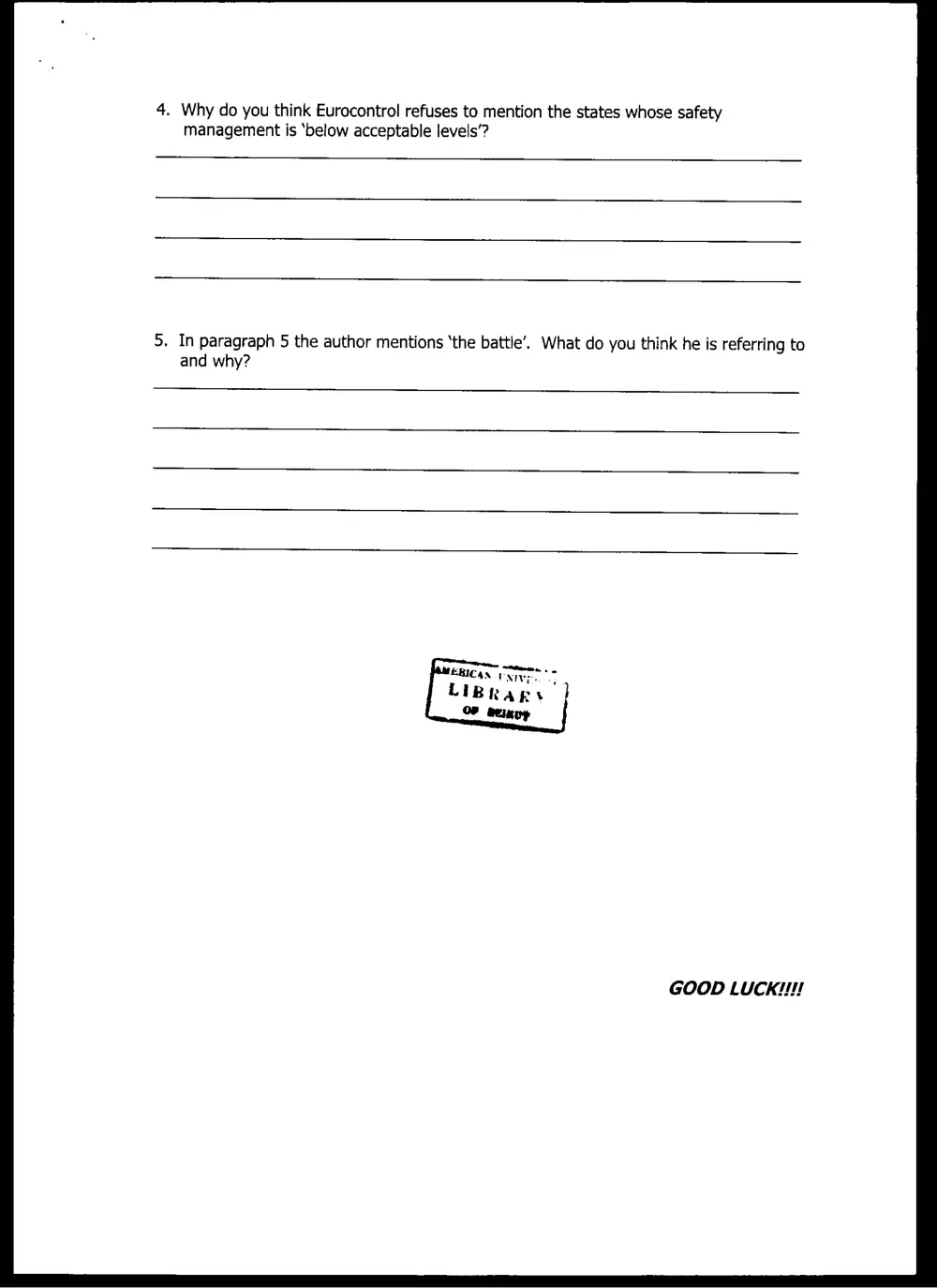
4. Why do you think Eurocontrol refuses to mention the states whose safety
management is ‘below acceptable levels’?
5. In paragraph 5 the author mentions ‘the battle’. What do you think he is referring to
and why?
GOOD LUCKII!!