
ENG 212 Final, Fall 2004
American University of Beirut · The Age of Shakespeare · 5 pages

More ENG 212 files
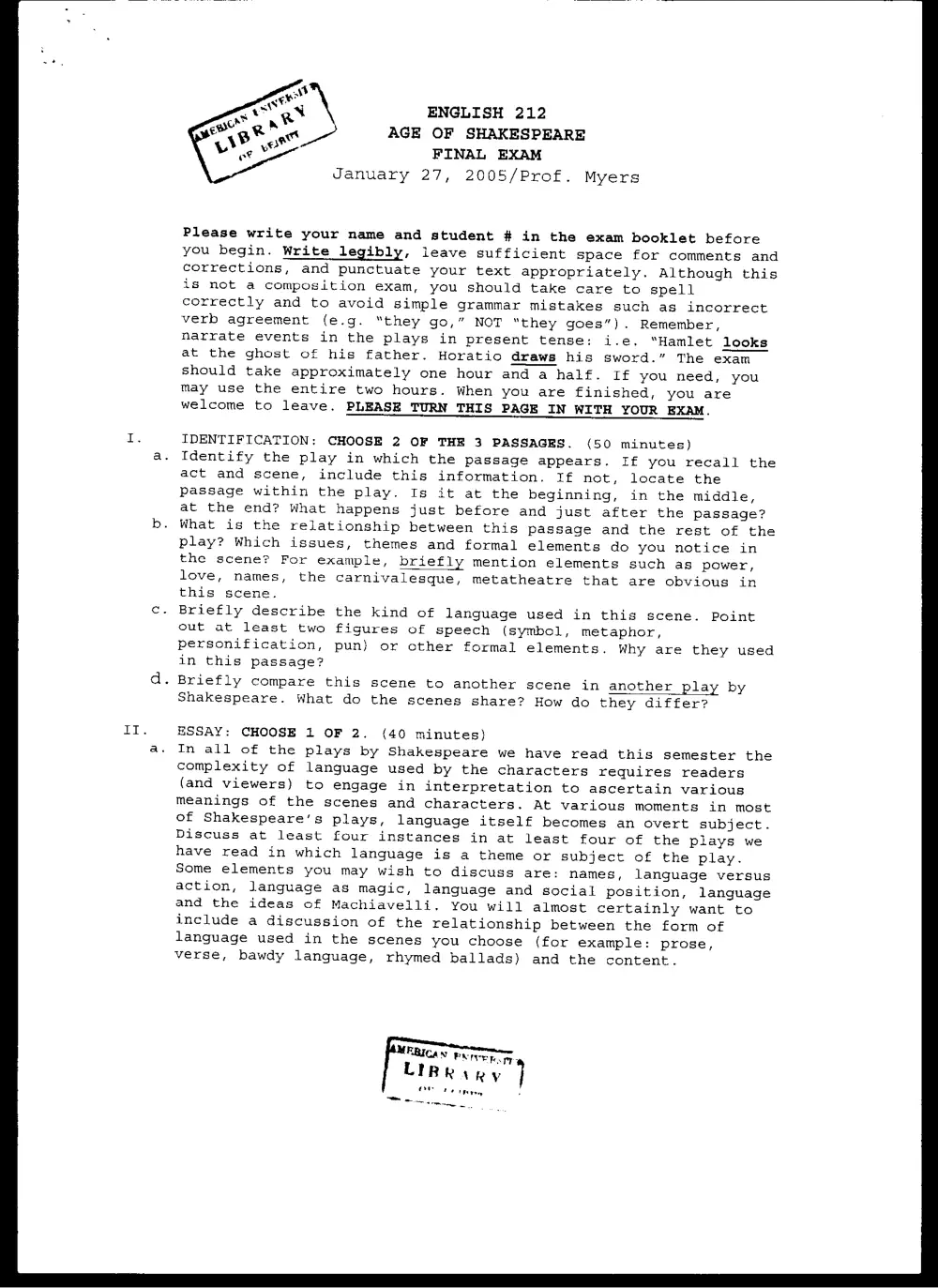
Show the text of this final exam
ENGLISH 212
AGE OF SHAKESPEARE
FINAL EXAM
January 27, 2005/Prof. Myers
Please write your name and student # in the exam booklet before
you begin. Write legibly, leave sufficient space for comments and
corrections, and punctuate your text appropriately. Although this
is not a composition exam, you should take care to spell
correctly and to avoid simple grammar mistakes such as incorrect
verb agreement (e.g. “they go,” NOT “they goes”). Remember,
narrate events in the plays in present tense: i.e. “Hamlet looks
at the ghost of his father. Horatio draws his sword.” The exam
should take approximately one hour and a half. If you need, you
may use the entire two hours. When you are finished, you are
welcome to leave. PLEASE TURN THIS PAGE IN WITH YOUR EXAM.
IDENTIFICATION: CHOOSE 2 OF THE 3 PASSAGES. {50 minutes)
Identify the play in which the Passage appears. If you recall the
act and scene, include this information. If not, locate the
passage within the play. Is it at the beginning, in the middle,
at the end? What happens just before and just after the passage?
What is the relationship between this passage and the rest of the
play? Which issues, themes and formal elements do you notice in
the scene? For example, briefly mention elements such as power,
love, names, the carnivalesque, metatheatre that are obvious in
this scene.
Briefly describe the kind of language used in this scene. Point
out at least two figures of speech (symbol, metaphor,
personification, pun) or other formal elements. Why are they used
in this passage?
Briefly compare this scene to another scene in another play by
Shakespeare. What do the scenes share? How do they differ?
ESSAY: CHOOSE 1 OF 2. (40 minutes)
In all of the plays by Shakespeare we have read this semester the
complexity of language used by the characters requires readers
(and viewers) to engage in interpretation to ascertain various
Meanings of the scenes and characters. At various moments in most
of Shakespeare’s plays, language itself becomes an overt subject.
Discuss at least four instances in at least four of the plays we
have read in which language is a theme or subject of the play.
Some elements you may wish to discuss are: names, language versus
action, language as magic, language and social position, language
and the ideas of Machiavelli. You will almost certainly want to
include a discussion of the relationship between the form of
language used in the scenes you choose (for example: prose,
verse, bawdy language, rhymed ballads) and the content.
- One of Shakespeare’s most notable achievements in his plays is
his ability to erase or re-define boundaries. Discuss at least
four instances in at least four of the plays we have read in
which Shakespeare’s plays transcend or re-shape existing
boundaries. Some of the elements you may choose to discuss are:
genre (tragedy, comedy, etc.), social class and the carnivalesque
(“high” and “low”), the role of monarchs, illusion (dreams vs.
reality; appearance vs. inner truth), direct address to the
audience (aside and soliloquy), dramatic irony and metatheatre.
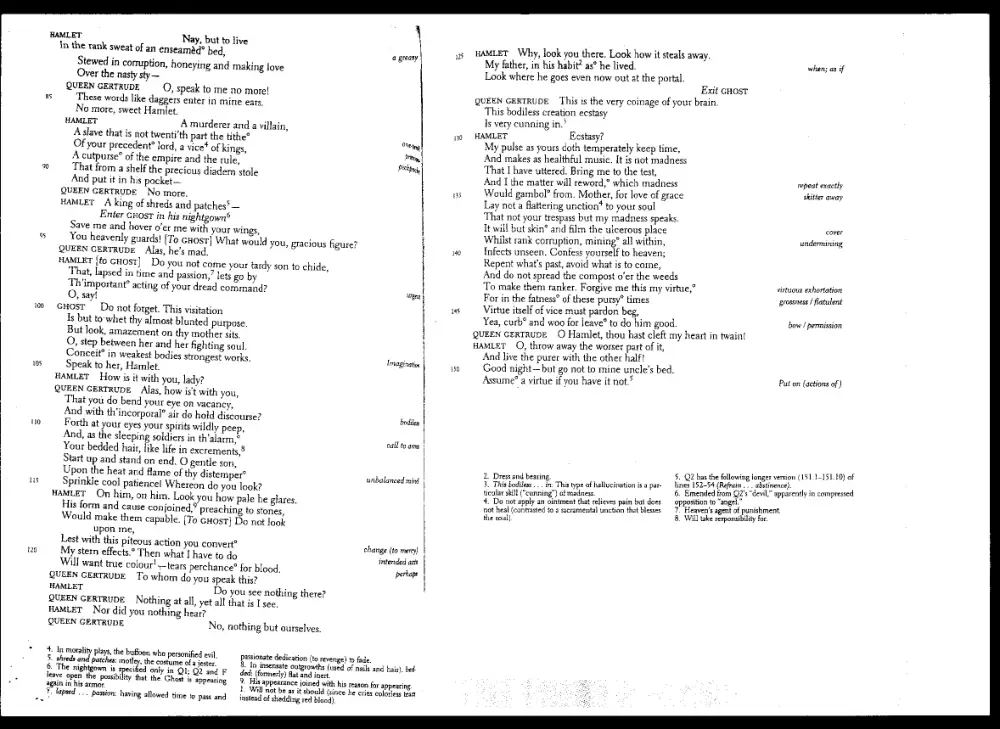
98 ‘You heavenly guards! [To GHOST]
10
ho
HAMLET Nay, but to live
in the rank sweat of an enseamed’ bed,
Stewed in comuption, honeying and making love
Over the nasty sty—
QUEEN GERTRUDE O, speak to me no more!
® These words like daggers enter in mine ears,
No more, sweet Hamiet.
HAMLET A murderer anda villain,
A slave that is not twenti’th part the tithe?
Of your precedent? lord, a vice* of kings,
A cutpurse® of the empire and the rule,
% That from a shelf the precious diadem stole
And put it in his pocket—
QUEEN GERTRUDE No more.
HAMLET A king of shreds and patches’ —
Enter Gxost in his nightgown®
Save me and hover o'er me with your wings,
What would you, gracious figure?
QUEEN GERTRUDE Alas, he’s mad.
HAMLET [fo Host] Do you not come your tardy son to chide,
‘That, lapsed in time and passion,’ lets go by
‘Th'important? acting of your dread command?
O, say!
Gost Do not forget. This visitation
Js but towhet thy almost blunted Purpose.
But look, amazement on thy mother sits.
O, step between her and her fighting soul.
Conceit? in weakest bodies strongest works.
Is Speak to her, Hamlet.
HAMLET How is it with you, lady?
QUEEN GERTRUDE Alas, how is’t with you,
That you do bend your eye on vacancy,
And with th’incorporal” air do hold discourse?
Forth at your eyes your spirits wildly peep,
And, as the sleeping soldiers in th’alarm,®
Your bedded hair, like life in excrements,®
Start up and stand on end. O gentle son,
Upon the heat and flame of thy distemper?
us Sprinkle cool patience! Whereon do you look?
no
HAMLET On him, on him. Look you how pale he glares,
His form and cause conjoined,” Preaching to stones,
Would make them capable, [To GHost] Do not look
upon me,
Lest with this piteous action you convert?
My stern effects,° Then what I have to do
Will want true colour!..-tears perchance? for blood,
QUEEN GERTRUDE To whom do you speak this?
HAMLET Do you see nothing there?
QUEEN GERTRUDE Nothing at all, yet all that is I see,
HAMLET Nor did you nothing hear?
QUEEN GERTRUDE No, nothing but ourselves.
4 In morality plays, the buffoon who personified evi,
5. shreds ond pc ney the costume of a jester.
6. The nightgown is specited only in Ql; Q2 and F
leave open the possibilty that the Ghost is appearing
again in his armor
¥ lapeed ... passion: having allowed time to pass and
ded: (formerly) fat and inert.
instead of shedding red blood},
\
a greary
eet
bre
ca
Imagination
edits
call to arm
unbalanced mind
H
|
{
|
|
|
|
i
change (to mercy}
intended aett
perhape
passionate dedication (to revenge) to fade.
8. In insensate outgrowths (used of nails and hair). bed
His appearance joined with his reason for appearing
1. Will not be as it should (since he cries coloriess teas
5 HAMLET Why, look you there. Look how it steals away.
"My father, in his habit? as® he lived.
Look where he goes even now out at the portal.
Exit Gost
QUEEN GERTRUDE This is the very coinage of your brain.
This bodiless creation ecstasy
Is very cunning in?
0 HAMLET Ecstasy? ;
My pulse as yours doth temperately keep time,
And makes as healthful music. It is not madness
‘That I have uttered. Bring me to the test,
And I the matter will reword,? which madness
Bs Would gambol? from. Mother, for love of grace
Lay not a flattering unction* to your soul
‘That not your trespass but my madness speaks.
Tt will but skin® and film the ulcerous place
Whilst rank corruption, mining? all within,
40 Infects unseen. Confess yourself to heaven;
Repent what's past, avoid what is to come, |
And do not spread the compost o'er the weeds
To make them ranker. Forgive me this my virtue,”
For in the fatness° of these pursy® times
us Virtue itself of vice must pardon beg,
Yea, curb® and woo for jeave® to do him good. |
QUEEN GERTRUDE O Hamlet, thou hast cleft my heart in twain!
HAMLET O, throw away the worser part of it,
And live the purer with the other half! ,
150 Good night—but go not to mine uncle’s bed.
Assume” a virtue if you have it not.®
2. Dress and bearin
Phi Eodies This typeof hallucination ia pr
ticular skill ("cunning") of madness
4. Do not apply an ointment that relieves pain but does
hot heal fcontated fo 2 saramental unction tht bleses
the soul)
lines 152-54 (Refrain
6. Emended from Q2
opposition to “angel.
8. Will tke responsibilty for.
“devil,”
when; as if
repeat exactly
skitter away
cover
undermining
virtuous exhortation
grossness /flatulent
bow | permission
Put on (actions of)
5. Q2 has the following longer version (151.1-151.10) of
“bstinence)
"apparently in compressed
7. Heaven's agent of punishment
390
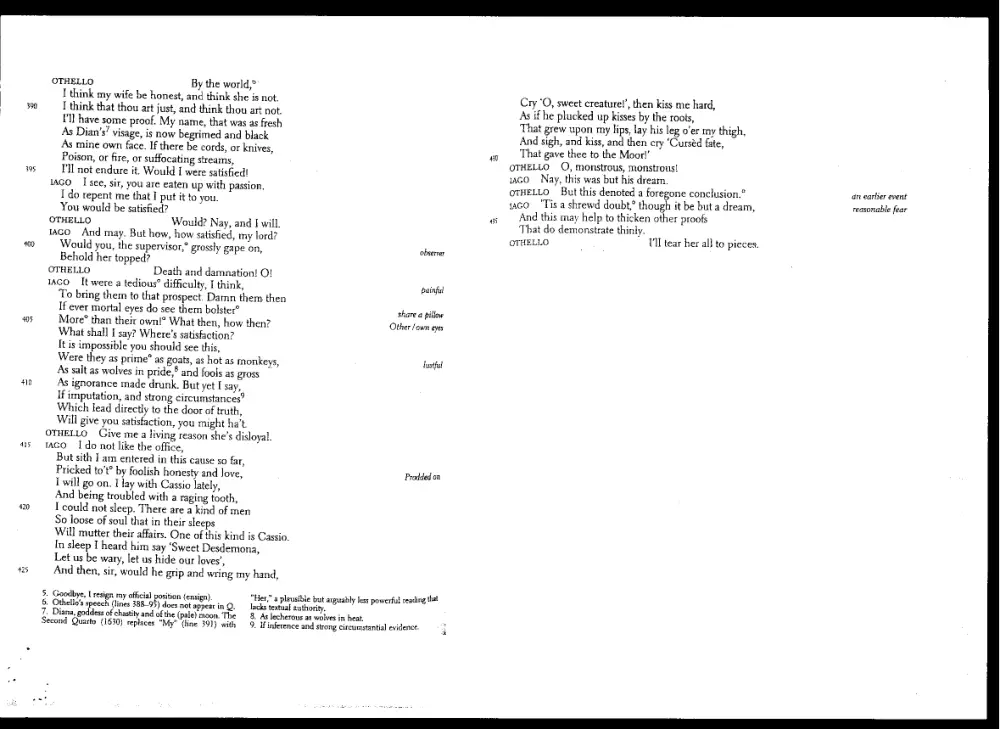
OTHELLO By the world,°
I think my wife be honest, and think she is not,
1 think that thou art just, and think thou art not.
Pll have some proof. My name, that was as fresh
Cry ‘O, sweet creature!’, then kiss me hard,
As if he plucked up kisses by the roots,
That grew upon my lips, lay his leg o'er my thigh,
And sigh, and kiss, and then cry ‘Curséd fate,
That gave thee to the Moor!’
OTHELLO O, monstrous, monstrous!
aco Nay, this was but his dream.
OTHELLO But this denoted a foregone conclusion.”
co "Tis a shrewd doubt,’ though it be but a dream,
You would be satisfied? And this may help to thicken other proofs
OTHELLO Would? Nay, and I will. That do demonstrate thinly.
taco And may. But how, how satisfied, my lord? OTHELLO
#0 Would you, the supervisor,’ grossly gape on, observer
Behold her topped?
OTRELLO Death and damnation! O!
1aco It were a tedious? difficulty, I think, painful
To bring them to that prospect. Damn them then
If ever mortal eyes do see them bolster? share a pillow
495 More” than their ownl? What then, how then? Other /own eyes
What shail I say? Where’s satisfaction?
It is impossible you should see this,
Were they as prime” as goats, as hot as monkeys, stfu
As salt as wolves in pride,® and fools as gross
#70 As ignorance made drunk. But yet [ say,
If imputation, and strong circumstances?
Which lead directly to the door of truth,
Will give you satisfaction, you might ha’t
OTHELLO Give me a living reason she’s disloyal.
45 1aGO_ I do not like the office,
But sith I am entered in this cause so far,
Pricked to’t® by foolish honesty and love, Prodded on
1 will go on. 1 lay with Cassio lately,
And being troubled with a raging tooth,
420 could not sleep. There are a kind of men
So loose of soul that in their sleeps
Will mutter their affairs. One of this kind is Cassio.
In sleep I heard him say ‘Sweet Desdemona,
Let us be wary, let us hide our loves’,
#5 And then, sir, would he grip and wring my hand,
As Dian’s’ visage, is now begrimed and black
As mine own face. If there be cords, or knives,
Poison, ot fire, or suffocating streams,
395 Til not endure it. Would I were satisfied!
1aco I see, sir, you are eaten up with passion.
Ido repent me that I put it to you
ro)
an earlier event
reasonable fear
#8
UIl tear her all to pieces
5. Goodbye, | resign my official position (ensign) “Her,” a plausible but arguably less powerful reading that
8. Othello's speech (lines 388-95) docs not appear in, lacks textual authority. m
7. Diana, goddess of chastity and ofthe (pale) moon. The 8, As lecherous as wolves in heat
Second Quarto (1630) replaces "My" (line 391} with 9. If inference and strong circumstantial evidence
”
%
8
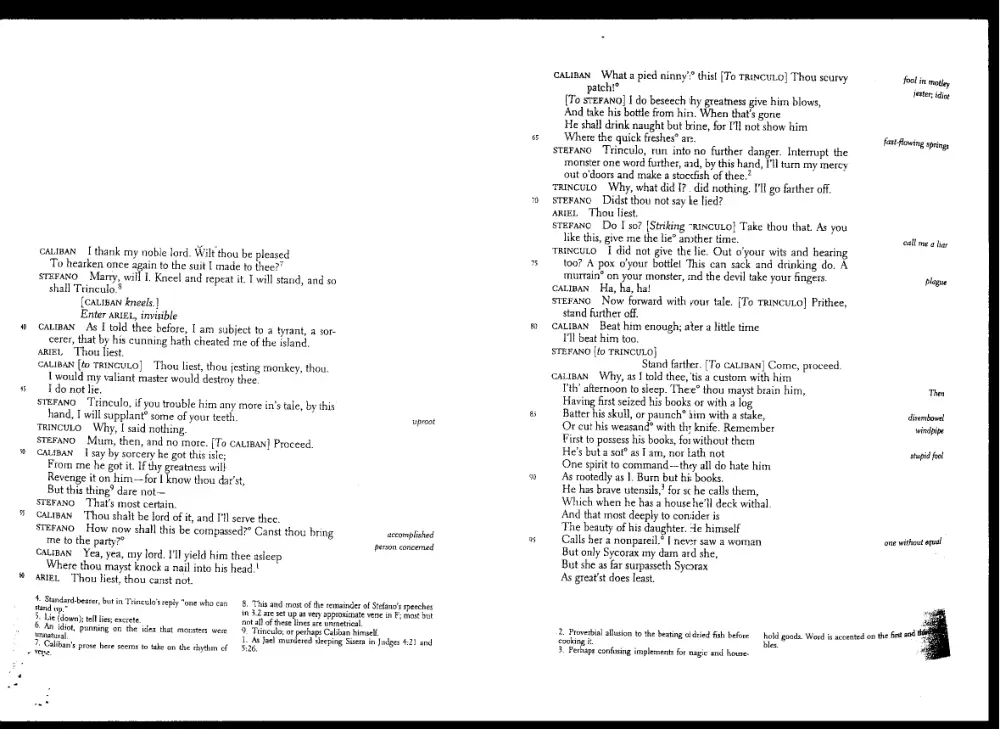
CALIBAN I thank my noble lord. Wilt thou be pleased
To hearken once again to the suit | made to thee?”
steFANO Many, will I. Kneel and repeat it. I will stand, and so
shall Trinculo.§
[CALIBAN kneels
Enter aRiEL, invisible
CALIBAN As I told thee before, I am subject to a tyrant, a sor-
cerer, that by his cunning hath cheated me of the island.
ARIEL Thou liest.
CALIBAN [to TRINCULO] Thou liest, thou jesting monkey, thou.
{would my valiant master would destroy thee
I do not lie.
sterano Trinculo, if you trouble him any more in’s tale, by this
hand, I will supplant? some of your teeth uproot
TRINCULO Why, I said nothing.
STEFANO Mum, then, and no mote. [To CALIBAN] Proceed.
CALIBAN _ I say by sorcery he got this isle;
From me he got it. If thy greatness will
Revenge it on him—for | know thou dar’st,
But this thing? dare not—
STEFANO That's most certain,
CaLBAN Thou shalt be lord of it, and I'll serve thee.
STEFANO How now shall this be compassed?® Canst thou bring
me to the party?°
CALIBAN Yea, yea, my lord. I'll yield him thee asleep
Where thou mayst knock a nail into his head.!
ARIEL Thou liest, thou canst not.
accomplished
person concemed
4, Standard bearer, but in Trinculo’sreply “one who can 8 This and most of the remainder of Stefano’s speeches
gand up." in 3.2 ate set up as very approximate verse in F; most but
Lie (down); tell lies; excrete not all of these lines are unmetrical.
An idiot, punning on the idea that monsters were 9. Trinculo: or r peshaps Caliban himsel,
unnatural 1. As Jael murdered sleeping Sisera in Judges 4:21 and
7. Caliban’s prose here seems to take on the chythm cf 5.26.
- vena
6
no
%
80
8
oy
9s
CALIBAN What a pied ninny'® this! [To TRIvcULO] Thou scurvy
patch!?
[To srEFANO] I do beseech thy greatness give him blows,
And take his bottle from hin. When that’s gone
He shall drink naught but brine, for I'll not show him
Where the quick freshes? ar.
STEFANO Trinculo, run into no further danger. Interrupt the
monster one word further, aad, by this hand, I'll turn my mercy
out o'doors and make a stoccfish of thee.”
TRINCULO Why, what did I? . did nothing. I'll go farther off.
STEFANO Didst thou not say he lied?
ARIEL Thou liest.
sreFano Do I so? [Striking "RINCULO] Take thou that. As you
like this, give me the lie® another time.
TRINCULO I did not give the lie. Out o'your wits and hearing
too? A pox o’your bottle! This can sack and drinking do. A
murrain® on your monster, and the devil take your fingers.
CALIBAN Ha, ha, ha!
steFANO_ Now forward with your tale. [To TRINCULO] Prithee,
stand further off.
CALIBAN Beat him enough; ater a little time
Tl beat him too.
STEFANO {fo TRINCULO}
Stand farther. [To catisan] Come, proceed.
CALIBAN Why, as J told thee, ‘tis a custom with him
lth’ afternoon to sleep. Thee® thou mayst brain him,
Having first seized his books or with a log
Batter his skull, or paunch” him with a stake,
Or cut his weasand? with thy knife. Remember
First to possess his books, for without them
He's but a sot® as I am, nor Lath not
One spirit to command—they all do hate him
As rootedly as I. Burn but hi: books.
He has brave utensils,? for sc he calls them,
Which when he has a househe’ll deck withal
And that most deeply to coniider is
‘The beauty of his daughter. Ae himself
Calls her a nonpareil.? I never saw a woman
But only Sycorax my dam ard she,
But she as far surpasseth Sycorax
As great’st does least.
2, Proverbial allusion to the beating ol died fish before hold goods. Word is accented on the fist and’
cooking it bles.
3. Pethaps confusing implements for nagic and howse-
fool in motley
Jester; idiot
fast-flowing Springs
call me a liar
plogue
Then
disembowel
wwindpipe
stupid fool
one without equal