
ENG 212 Final, Spring 2004
American University of Beirut · The Age of Shakespeare · 1 page
Stuck on a question? A tutor can walk you through it.
More ENG 212 files
Show the text of this final exam
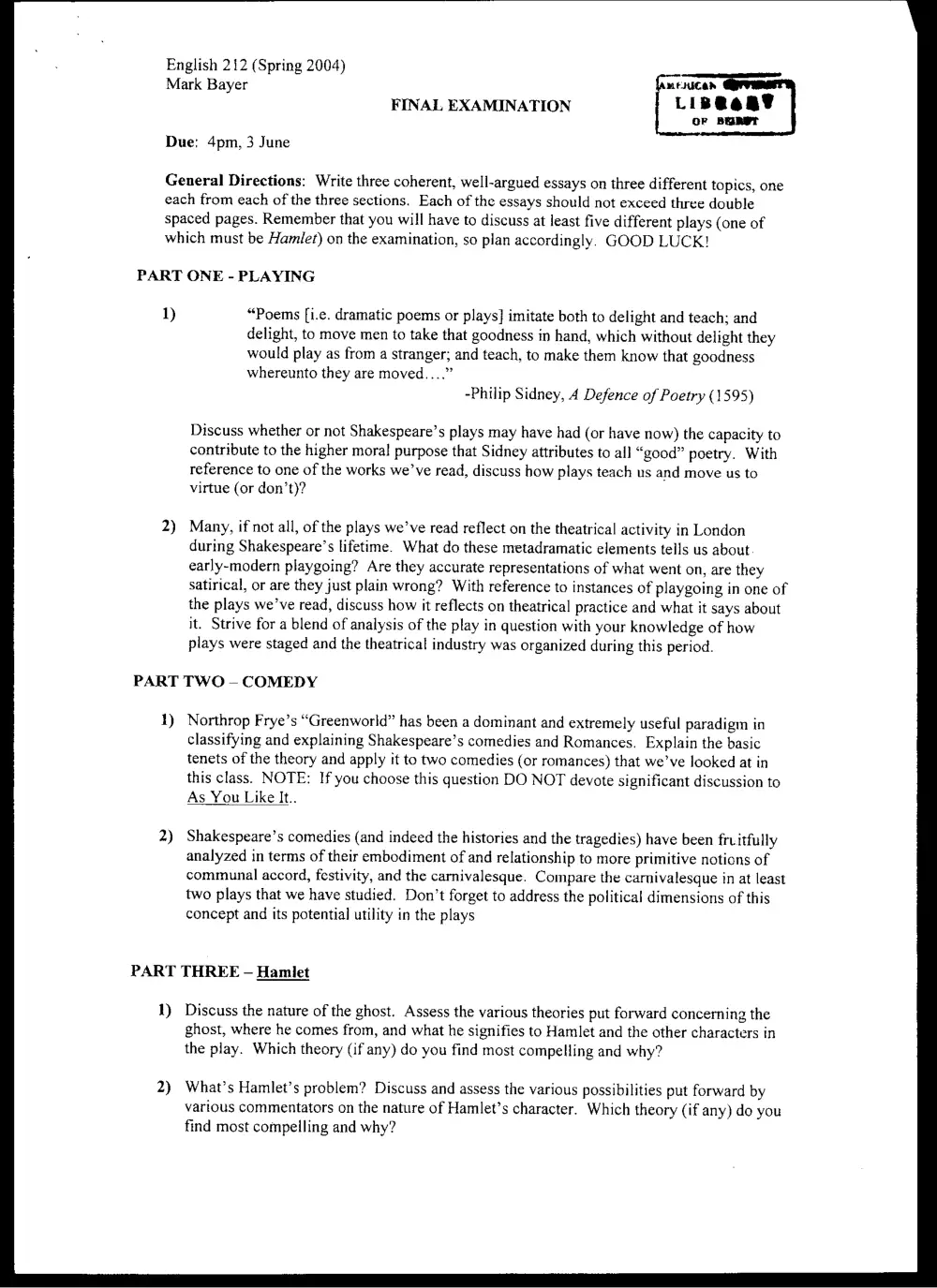
English 212 (Spring 2004)
Mark Bayer
FINAL EXAMINATION
Due: 4pm, 3 June
General Directions: Write three coherent, well-argued essays on three different topics, one
each from each of the three sections. Each of the essays should not exceed three double
spaced pages. Remember that you will have to discuss at least five different plays (one of
which must be Hamlet) on the examination, so plan accordingly. GOOD LUCK!
PART ONE - PLAYING
1) “Poems [i.e. dramatic poems or plays] imitate both to delight and teach; and
delight, to move men to take that goodness in hand, which without delight they
would play as from a stranger; and teach, to make them know that goodness
whereunto they are moved....”
-Philip Sidney, 4 Defence of Poetry (1595)
Discuss whether or not Shakespeare’s plays may have had (or have now) the capacity to
contribute to the higher moral purpose that Sidney attributes to all “good” poetry. With
reference to one of the works we’ve read, discuss how plays teach us and move us to
virtue (or don’t)?
2) Many, ifnot all, of the plays we’ve read reflect on the theatrical activity in London
during Shakespeare’s lifetime. What do these metadramatic elements tells us about
early-modern playgoing? Are they accurate representations of what went on, are they
Satirical, or are they just plain wrong? With reference to instances of playgoing in one of
the plays we’ve read, discuss how it reflects on theatrical practice and what it says about
it. Strive for a blend of analysis of the play in question with your knowledge of how
plays were staged and the theatrical industry was organized during this period.
PART TWO - COMEDY
1) Northrop Frye’s “Greenworld” has been a dominant and extremely useful paradigm in
classifying and explaining Shakespeare’s comedies and Romances. Explain the basic
tenets of the theory and apply it to two comedies (or romances) that we’ve looked at in
this class. NOTE: If you choose this question DO NOT devote significant discussion to
As You Like It..
2) Shakespeare’s comedies (and indeed the histories and the tragedies) have been fru itfully
analyzed in terms of their embodiment of and relationship to more primitive notions of
communal accord, festivity, and the carnivalesque. Compare the carnivalesque in at least
two plays that we have studied. Don’t forget to address the political dimensions of this
concept and its potential utility in the plays
PART THREE - Hamlet
1) Discuss the nature of the ghost. Assess the various theories put forward concerning the
ghost, where he comes from, and what he signifies to Hamlet and the other characters in
the play. Which theory (if any) do you find most compelling and why?
2) What’s Hamlet’s problem? Discuss and assess the various possibilities put forward by
various commentators on the nature of Hamlet’s character. Which theory (if any) do you
find most compelling and why?