
ENG 212 Final, Fall 2007
American University of Beirut · The Age of Shakespeare · 1 page
Stuck on a question? A tutor can walk you through it.
More ENG 212 files
Show the text of this final exam
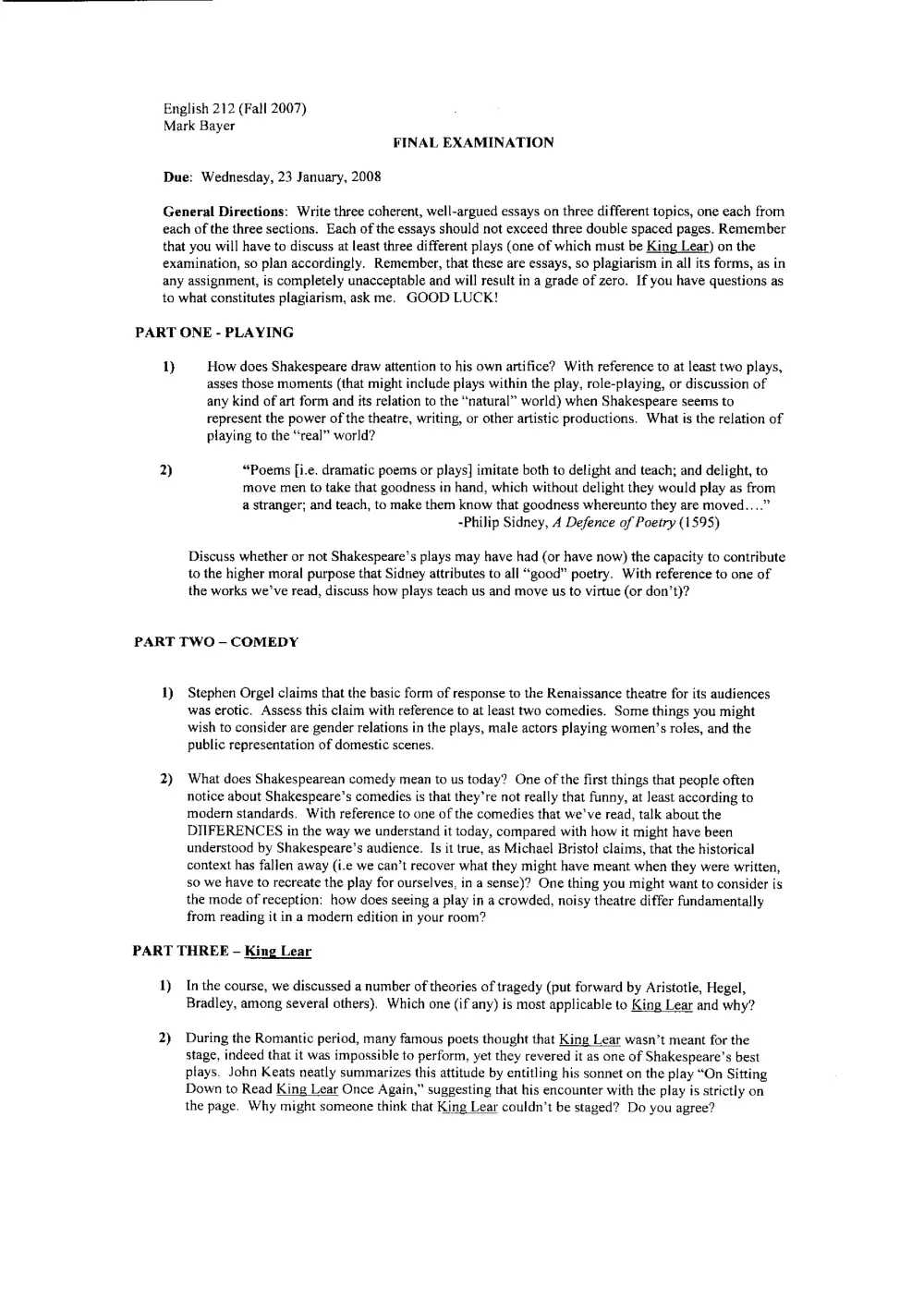
English 212 (Fall 2007)
Mark Bayer
FINAL EXAMINATION
Due: Wednesday, 23 January, 2008
General Directions: Write three coherent, well-argued essays on three different topics, one each from
each of the three sections. Each of the essays should not exceed three double spaced pages. Remember
that you will have to discuss at least three different plays (one of which must be King Lear) on the
examination, so plan accordingly. Remember, that these are essays, so plagiarism in all its forms, as in
any assignment, is completely unacceptable and will result in a grade of zero. If you have questions as
to what constitutes plagiarism, ask me. GOOD LUCK!
PART ONE - PLAYING
1)
xy
How does Shakespeare draw attention to his own artifice? With reference to at least two plays,
asses those moments (that might include plays within the play, role-playing, or discussion of
any kind of art form and its relation to the “natural” world) when Shakespeare seems to
represent the power of the theatre, writing, or other artistic productions. What is the relation of
playing to the “real” world?
“Poems [i.e. dramatic poems or plays] imitate both to delight and teach; and delight, to
move men to take that goodness in hand, which without delight they would play as from
a stranger; and teach, to make them know that goodness whereunto they are moved....”
-Philip Sidney, 4 Defence of Poetry (1595)
Discuss whether or not Shakespeare’s plays may have had (or have now) the capacity to contribute
to the higher moral purpose that Sidney attributes to all “good” poetry. With reference to one of
the works we’ve read, discuss how plays teach us and move us to virtue (or don’t)?
PART TWO —- COMEDY
0)
2)
Stephen Orgel claims that the basic form of response to the Renaissance theatre for its audiences
was erotic. Assess this claim with reference to at least two comedies. Some things you might
wish to consider are gender relations in the plays, male actors playing women’s roles, and the
public representation of domestic scenes.
What does Shakespearean comedy mean to us today? One of the first things that people often
notice about Shakespeare’s comedies is that they’re not really that funny, at least according to
modern standards. With reference to one of the comedies that we've read, talk about the
DIIFERENCES in the way we understand it today, compared with how it might have been
understood by Shakespeare's audience. Is it true, as Michael Bristol claims, that the historical
context has fallen away (i.e we can’t recover what they might have meant when they were written,
so we have to recreate the play for ourselves, in a sense)? One thing you might want to consider is
the mode of reception: how does seeing a play in a crowded, noisy theatre differ fundamentally
from reading it in a modern edition in your room?
PART THREE - King Lear
1)
2)
In the course, we discussed a number of theories of tragedy (put forward by Aristotle, Hegel,
Bradley, among several others). Which one (if any) is most applicable to King Lear and why?
During the Romantic period, many famous poets thought that King Lear wasn’t meant for the
stage, indeed that it was impossible to perform, yet they revered it as one of Shakespeare's best
plays. John Keats neatly summarizes this attitude by entitling his sonnet on the play “On Sitting
Down to Read King Lear Once Again,” suggesting that his encounter with the play is strictly on
the page. Why might someone think that King Lear couldn’t be staged? Do you agree?