
ENG 212 Final, Spring 2008
American University of Beirut · The Age of Shakespeare · 4 pages


More ENG 212 files
Show the text of this final exam
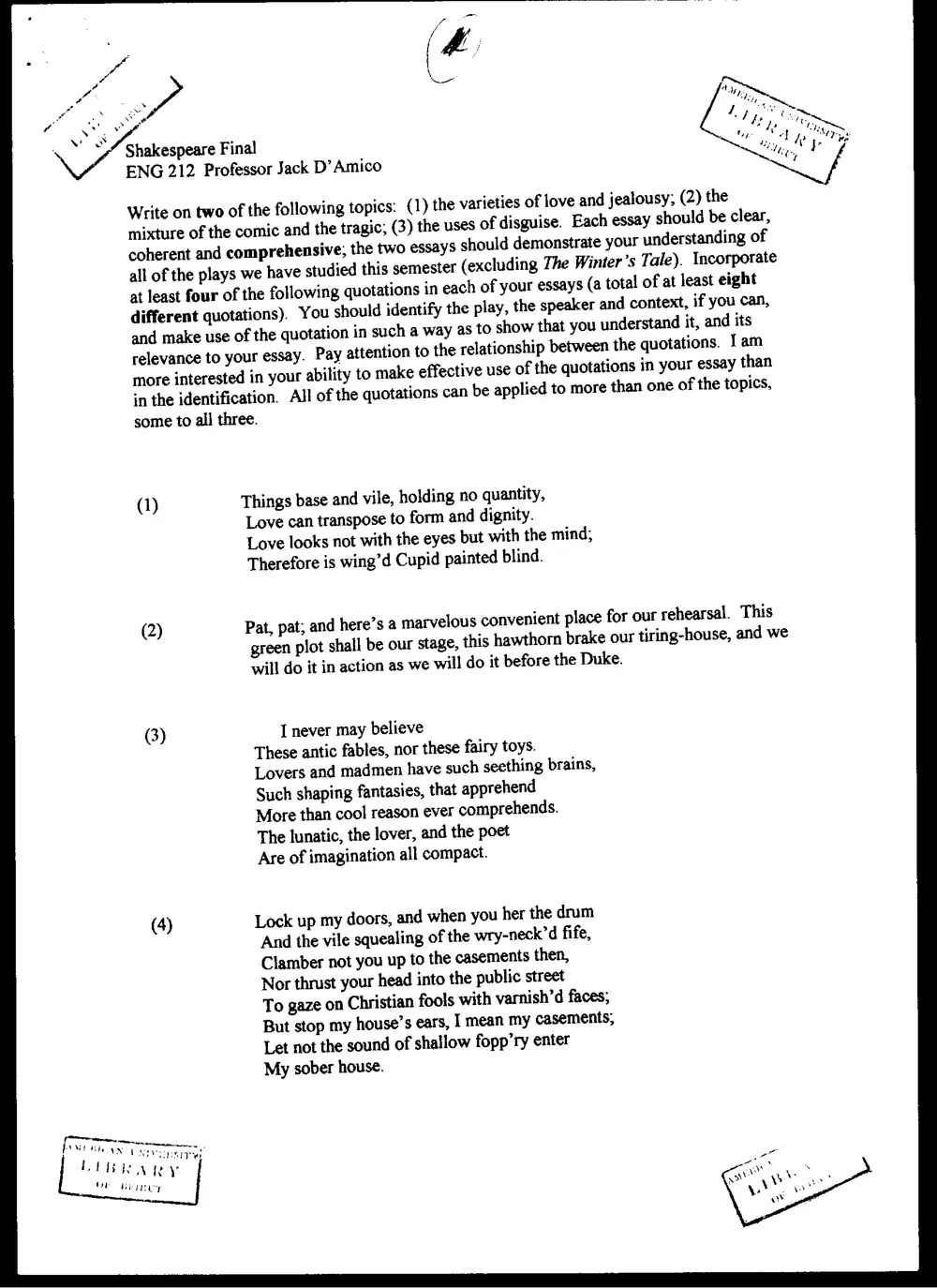
Shakespeare Final
ENG 212 Professor Jack D’ Amico
Write on two of the following topics: (1) the varieties of love and jealousy; (2) the
mixture of the comic and the tragic; (3) the uses of disguise. Each essay should be clear,
coherent and comprehensive, the two essays should demonstrate your understanding of
all of the plays we have studied this semester (excluding The Winter ’s Tale). Incorporate
at least four of the following quotations in each of your essays (a total of at least eight
different quotations). You should identify the play, the speaker and context, if you can,
and make use of the quotation in such a way as to show that you understand it, and its
relevance to your essay. Pay attention to the relationship between the quotations. Tam
more interested in your ability to make effective use of the quotations in your essay than
in the identification. All of the quotations can be applied to more than one of the topics,
some to all three.
Things base and vile, holding no quantity,
Love can transpose to form and dignity.
Love looks not with the eyes but with the mind;
Therefore is wing’d Cupid painted blind.
Pat, pat; and here’s a marvelous convenient place for our rehearsal. This
green plot shall be our stage, this hawthorn brake our tiring-house, and we
will do it in action as we will do it before the Duke.
I never may believe
These antic fables, nor these fairy toys.
Lovers and madmen have such seething brains,
Such shaping fantasies, that apprehend
More than cool reason ever comprehends.
The lunatic, the lover, and the poet
Are of imagination all compact.
Lock up my doors, and when you her the drum
And the vile squealing of the wry-neck’d fife,
Clamber not you up to the casements then,
Nor thrust your head into the public street
To gaze on Christian fools with varnish’d faces,
But stop my house’s ears, I mean my casements,
Let not the sound of shallow fopp’ry enter
My sober house.
YON SIT er
OE Beiney
(5)
(6)
(7)
(8)
(9)
But now I was the lord
Of this fair mansion, master of my servants,
Queen o’er myself, and even now, but now,
This house, these servants, and this same myself
Are yours—my lord’s!—I give them with this ring,
Which when you part from, lose, or give away,
Let it presage the ruin of your love,
And be my vantage to exclaim on you.
T'll hold thee any wager,
When we are both accoutered like young men,
I’ll prove the prettier fellow of the two,
And wear my dagger with the braver grace,
And speak between the change of man and boy
With a reed voice, and turn two mincing steps
Into a manly stride; .. .
Well, do not swear. Although I joy in thee,
I have no joy of this contract to-night,
It is too rash, too unadvis’d, too sudden,
Too like the lightning, which doth cease to be
Ere one can say it lightens. Sweet, good night!
This bud of love, by summer’s ripening breath,
May prove a beauteous flow’r when next we meet.
Hah, let me see her. Out alas, she’s cold,
Her blood is settled, and her joints are stiff;
Life and these lips have long been separated.
Death lies on her like an untimely frost
Upon the sweetest flower of all the field.
How oft when men are at the point of death
Have they been merry, which their keepers call
A lightning before death! O my love, my wife,
Death, that hath suck’d the honey of thy breath,
Hath had no power yet upon thy beauty:
Thou art not conquer’d, beauty’s ensign yet
Is crimson in thy lips and in thy cheeks
And death’s pale flag is not advanced there.
(10)
(11)
(12)
(13)
(14)
A blank, my lord; she never told her love,
But let concealment like a worm i’th’bud
Feed on her damask cheek she pin’d in thought,
And with a green and yellow melancholy
She sate like Patience on a monument,
Smiling at grief. Was not this love indeed?
We men may say more, swear more, but indeed
Our shows are more than will; for still we prove
Much in our vows, but little in our love.
“If this fall into thy hand, revolve. In my stars T am above thee, but be not
afraid of greatness. Some are born great, some achieve greatness, and
some have greatness thrust upon ‘em. Thy Fates open their hands, let thy
blood and spirit embrace them, and to inure thyself to what thou art like to
be, cast thy humble slough and appear fresh. Be opposite with a kinsman,
surly with servant; le thy tongue tang arguments of state; put thyself into
the trick of singularity. She thus advises thee that sighs for thee.”
Why should I not (had I the heart to do it),
Like to th’ Egyptian thief at point of death,
Kill what I love? (a savage jealousy
That sometime savors nobly), but hear me this
Since you to non-regardance cast my faith,
And that I partly know the instrument
That screws me from my true place in your favor,
Live you the marble-breasted tyrant still.
But this your minion, whom I know you love,
And whom, by heaven I swear, I tender dearly,
Him will I tear out of that cruel eye,
Where he sits crowned in his master’s spite.
‘Tis not to make me jealous
To say my wife is fair, feeds well, loves company,
Is free of speech, sings, plays, dances well,
Where virtue is, these are more virtuous.
Nor from mine own weak merits will I draw
The smallest fear or doubt of her revolt,
For she had eyes, and chose me.
Stand you a while apart,
Confine yourself but in a patient list. . . .
Do but enclave yourself
And mark the fleers, the gibes, and notable scorns
That dweil in every region of his face,
For I will make him tell the tale anew:
Where, how, how oft, how long ago, and when
He hath, and is again to cope your wife.
Put out the light, and then put out the light:
If I quench thee, thou flaming minister,
I can again thy former light restore,
Should I repent me; but once put out thy light,
Thou cunng’st pattern of excelling nature,
I know not where is tht Promethean heat
That can thy light relume. When I have pluck’d thy rose,
T cannot tive it vital growth again,
It needs must wither. I'll smell! thee on the tree.