
ENG 227 Midterm, Fall 2011
American University of Beirut · Introduction to Language · 3 pages · Dr. May Mikati


More ENG 227 files
- Midterm · Fall 2013ExamView
- Exam 1 · Fall 2011ExamView
- Syllabus · Summer 2017LabView
- Chapter 6 Main Points · Spring 2012ChapterView
- Chapter Grammatical Aspects of Language · Spring 2012ChapterView
- Chapter Main Points Chapter 1 · Spring 2012ChapterView
- Final · Fall 2011Final examView
- Syllabus · Fall 2011LabView
Show the text of this exam
English 227, Section 3 (May Mikati)
Midterm
November 2011
PART I
Comprehension Questions – Choose three out of four. (15 points each)
1. Early this semester two Human Language Series videos were displayed in English 227: Part I:
“Colorless Green Ideas” and Part II: “Acquiring the Human Language”. Discuss two main points you
recall, one from each, providing concrete support.
2. a. What topic are you considering for your English 227 documented essay, and why?
b. The course Moodle web site includes links to online resources that supplement the chapters in your
textbook. Refer to one or more resources (links) that you have found useful in understanding explained
concepts; if possible, relate the concepts to the topic you may be writing about. Do not worry if you cannot
recall exact titles.
3. SLI and developmental dyslexia were discussed in the same chapter in your textbook; why do you
believe this is so? What do the two phenomena illustrate/have in common exactly? Explain with reference
to the chapter in general.
4. What did the article “How I Met My Wife” illustrate? Link your explanation to a relevant
chapter/concept, providing at least two specific examples that you recall from the article.
PART II
Application Questions – Choose five out of six. (11 points each)
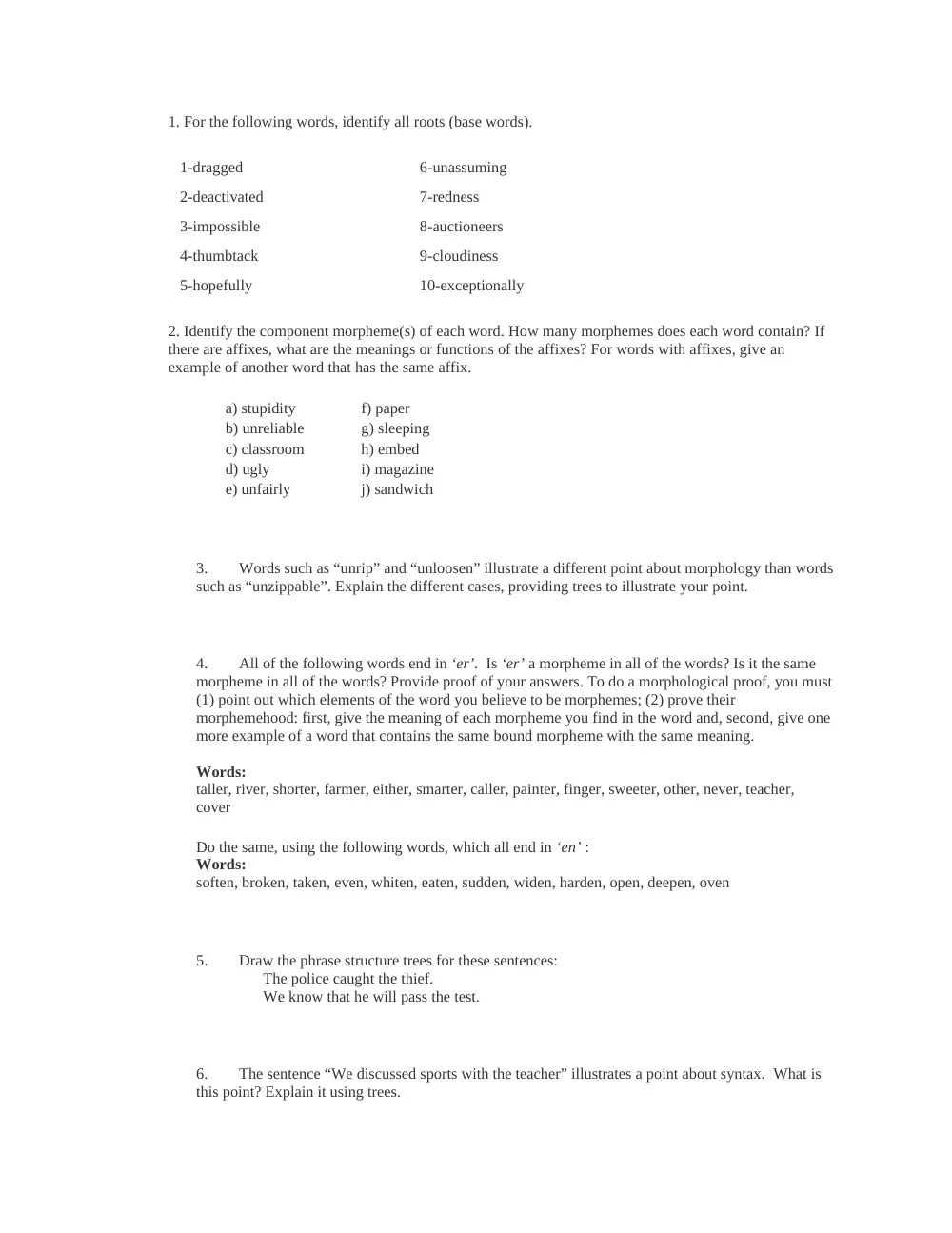
1. For the following words, identify all roots (base words).
1-dragged
6-unassuming
2-deactivated
7-redness
3-impossible
8-auctioneers
4-thumbtack
9-cloudiness
5-hopefully
10-exceptionally
2. Identify the component morpheme(s) of each word. How many morphemes does each word contain? If
there are affixes, what are the meanings or functions of the affixes? For words with affixes, give an
example of another word that has the same affix.
a) stupidity
f) paper
b) unreliable
g) sleeping
c) classroom
h) embed
d) ugly
i) magazine
e) unfairly
j) sandwich
3. Words such as “unrip” and “unloosen” illustrate a different point about morphology than words
such as “unzippable”. Explain the different cases, providing trees to illustrate your point.
4. All of the following words end in ‘er’. Is ‘er’ a morpheme in all of the words? Is it the same
morpheme in all of the words? Provide proof of your answers. To do a morphological proof, you must
(1) point out which elements of the word you believe to be morphemes; (2) prove their
morphemehood: first, give the meaning of each morpheme you find in the word and, second, give one
more example of a word that contains the same bound morpheme with the same meaning.
Words:
taller, river, shorter, farmer, either, smarter, caller, painter, finger, sweeter, other, never, teacher,
cover
Do the same, using the following words, which all end in ‘en’ :
Words:
soften, broken, taken, even, whiten, eaten, sudden, widen, harden, open, deepen, oven
5. Draw the phrase structure trees for these sentences:
The police caught the thief.
We know that he will pass the test.
6. The sentence “We discussed sports with the teacher” illustrates a point about syntax. What is
this point? Explain it using trees.
Good luck!