
ENG 227 Midterm, Fall 2013
American University of Beirut · Introduction to Language · 1 page
Stuck on a question? A tutor can walk you through it.
More ENG 227 files
- Exam 1 · Fall 2011ExamView
- Midterm · Fall 2011ExamView
- Syllabus · Summer 2017LabView
- Chapter 6 Main Points · Spring 2012ChapterView
- Chapter Grammatical Aspects of Language · Spring 2012ChapterView
- Chapter Main Points Chapter 1 · Spring 2012ChapterView
- Final · Fall 2011Final examView
- Syllabus · Fall 2011LabView
Show the text of this exam
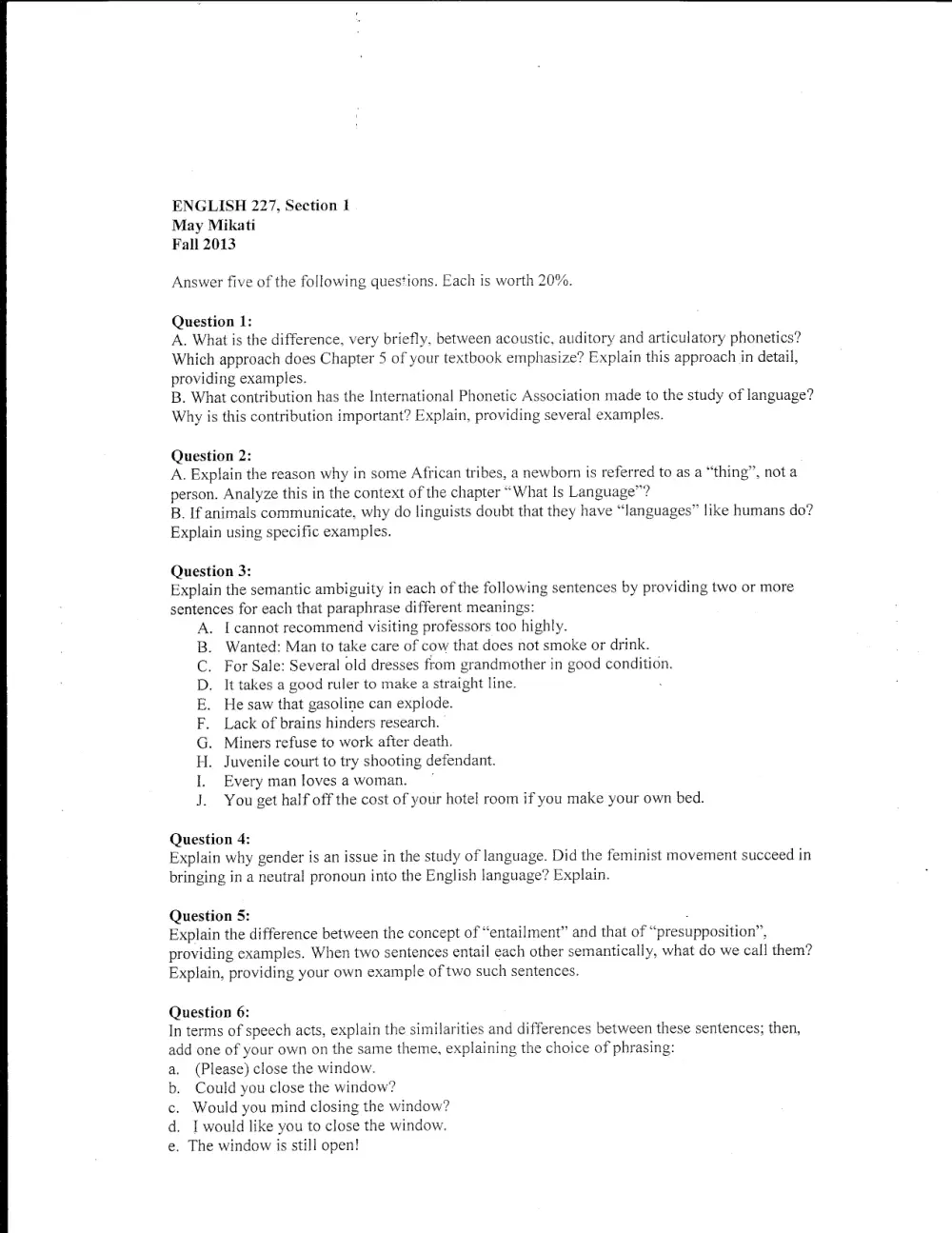
ENGLISH 227, Section 1
May Mikati
Fall 2013
Answer five of the following questions. Each is worth 20%.
Question 1:
A. What is the difference, very briefly, between acoustic, auditory and articulatory phonetics?
Which approach does Chapter 5 of your textbook emphasize? Explain this approach in detail,
providing examples.
B. What contribution has the International Phonetic Association made to the study of language?
Why is this contribution important? Explain, providing several examples.
Question 2:
A. Explain the reason why in some African tribes, a newborn is referred to as a “thing”, not a
person. Analyze this in the context of the chapter “What Is Language”?
B. If animals communicate, why do linguists doubt that they have “languages” like humans do?
Explain using specific examples.
Question 3:
Explain the semantic ambiguity in each of the following sentences by providing two or more
sentences for each that paraphrase different meanings:
A. [cannot recommend visiting professors too highly.
Wanted: Man to take care of cow that does not smoke or drink.
For Sale: Several old dresses from grandmother in good condition.
It takes a good ruler to make a straight line.
He saw that gasoline can explode.
Lack of brains hinders research.
Miners refuse to work after death.
Juvenile court to try shooting defendant.
Every man loves a woman. ~
You get half off the cost of your hotel room if you make your own bed.
OmmoOw
Ce
oo oe
Question 4:
Explain why gender is an issue in the study of language. Did the feminist movement succeed in
bringing in a neutral pronoun into the English language? Explain.
Question 5: :
Explain the difference between the concept of “entailment” and that of “presupposition”,
providing examples. When two sentences entail each other semantically, what do we cal] them?
Explain, providing your own example of two such sentences.
Question 6:
In terms of speech acts, explain the similarities and differences between these sentences; then,
add one of your own on the same theme, explaining the choice of phrasing:
a. (Please) close the window.
b. Could you close the window?
c. Would you mind closing the window?
d. T would like you to close the window,
e. The window is stiJl open!