
ENG 227 Syllabus, Fall 2011
American University of Beirut · Introduction to Language · 6 pages · Dr. Ulrike Pölzl

More ENG 227 files
- Syllabus · Summer 2017LabView
- Midterm · Fall 2013ExamView
- Chapter 6 Main Points · Spring 2012ChapterView
- Chapter Grammatical Aspects of Language · Spring 2012ChapterView
- Chapter Main Points Chapter 1 · Spring 2012ChapterView
- Exam 1 · Fall 2011ExamView
- Final · Fall 2011Final examView
- Midterm · Fall 2011ExamView
Show the text of this lab
ENGLISH
DEPARTMENT
http://www.flickr.com/photos/the_worm_turns/97814457/
INTRODUCTION TO LANGUAGE
Course number:
ENGL 227
Credits:
3
Faculty:
Dr. Ulrike Pölzl, Fisk 207
Email:
up00@aub.edu.lb
Class times +rooms:
SI 11:00-12:15 Tues/Thurs, Nicely 416
SII 09:30-10:45 Tues/Thurs, Nicely 416
Office hours:
14:15-15:15 Tues/Thurs
@online 11:15-12:15 Wed
Course description:
This course is offered in a blended format in which 2/3 of course time is in-class
face-to-face meetings and 1/3 of course time is online. The F2F meetings consist
of interactive lectures (theory and practice), whilst the online activities are project
work for a thematically related end of term presentation. ENGL 227 is a general
introduction to language studies covering the most important topics that
constitute the field of linguistics. During this course students will investigate
specific ways how to describe and analyze language. These topics include
phonetics and phonology, morphology, syntax, semantics, writing systems,
language acquisition, sociolinguistics, and neurolinguistics.
Why blended?
Your professor decided to offer this course in a blended format in order to enable
you to
participate actively in the learning process
practice and apply 21st century technology
explore linguistic themes in a student centered way
work in teams on exotic projects
manage your own time and be more flexible
Required Reading:
Fromkin, Victoria; Rodman, Robert & Nina Hyams (2010) An Introduction to
Language. 9th edition. Thomson/Wadsworth.
Teaching/Learning strategies:
This course attempts to reconcile teacher centered and student centered
approaches. Linguistic theory is introduced in lectures, whilst student practice their
understanding of each topic mainly online. The interactive lectures will prepare
students to work independently and in teams on an extraterrestrial linguistic
project. Active class participation is a MUST. Online sessions will structure student
projects in manageable steps. Lab sessions will serve as a platform for discussion
and practice. Research results are presented in a mini conference at the end of the
semester. The professor serves as an advisor and a resource, whilst the students are
empowered to explore scientific facts creatively online.
Assignments:
Offline reading assignments: book chapters have to be read before class
Online assignments: exercises, forum discussions, projects are on Moodle and have
clearly indicated deadlines which have to be observed since no late work will be
accepted! Please do follow the instructions given for each assignment PRECISELY as
this will make part of your grade. Always check the rubric.
In case of any doubt check the DATES and DEADLINE on Moodle!
Projects:
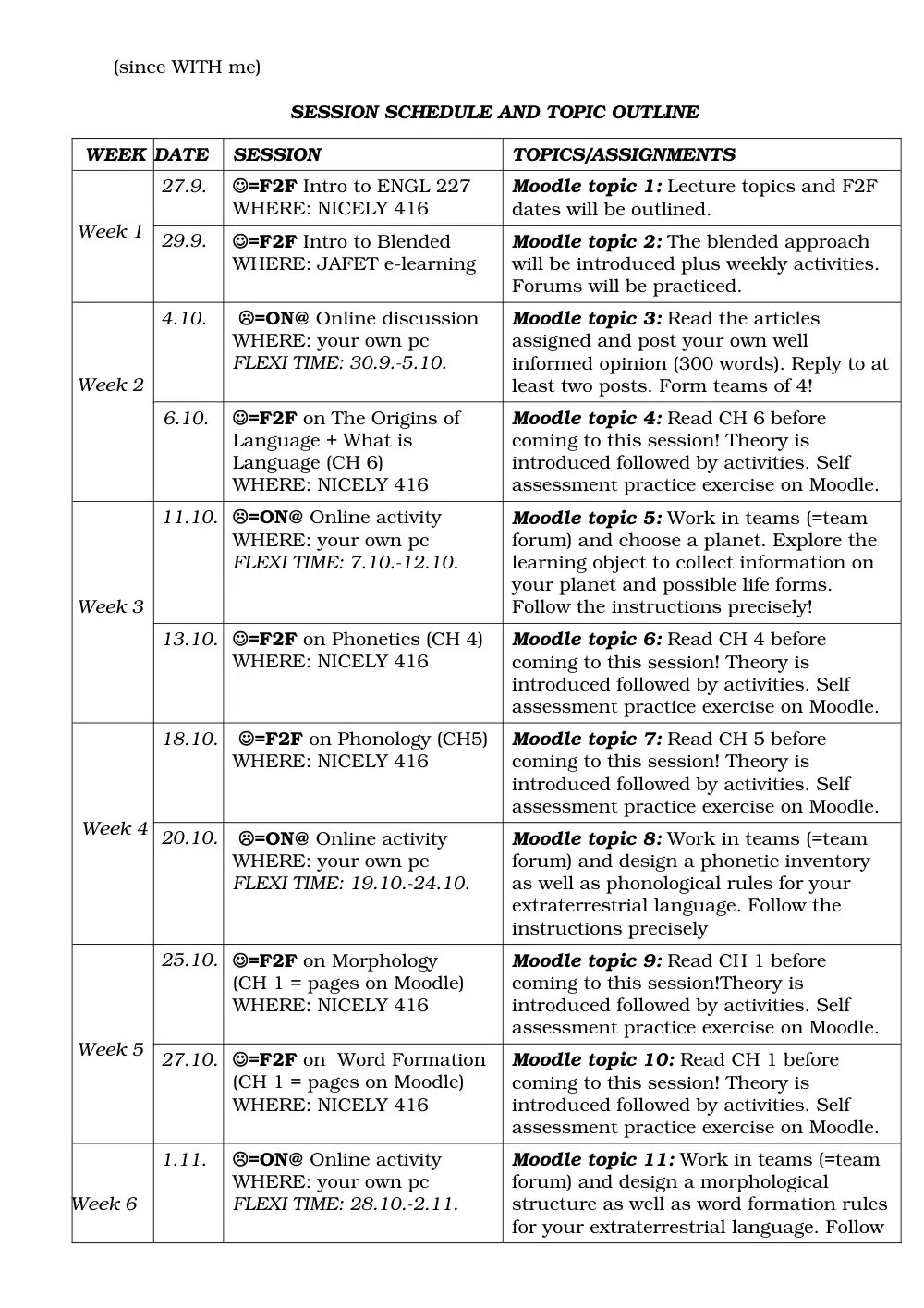
Students are expected to form teams (4 members) and engage in two different but
related projects on
Extraterrestrial Languages:
RESEARCH ONLINE ACTIVITIES
PRESENTATION FOR MINI
CONFERENCE
The team explores a planet, its life
forms and their language scientifically
and creatively. The topics to be
analyzed relate to the course topics.
The team adapts their online
research activities to a power point
presentation of 15-20 slides for a
mini conference on campus.
Instructions are presented in detail on Moodle!
MOODLE PRESENCE:
Moodle is an essential part of this course. Please check your Moodle once a day.
Online activities are put on Moodle. Always read the instructions carefully and
follow them precisely. Check the attached rubrics to know how you are being
graded.
SESSIONS OUTLINE:
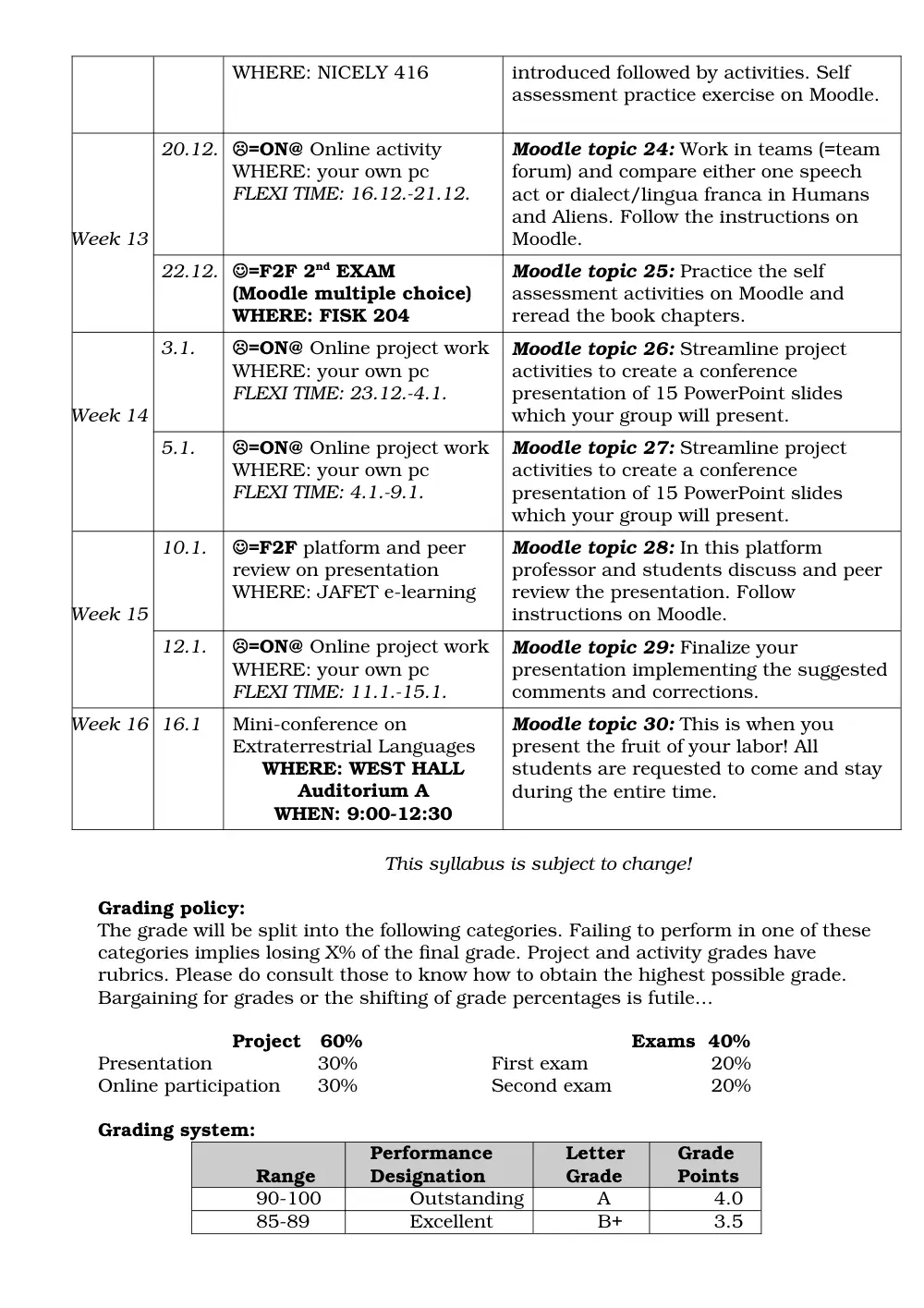
ENGL 227
is structured as
2/3 face to face 1/3 online
Face-to-face sessions take place in
Nicely, JAFET E-learning classroom
and FISK lab 204. Place and day are
indicated in the table below. Face-to-
face sessions are marked as =F2F
(since WITH me)
SESSION SCHEDULE AND TOPIC OUTLINE
WEEK DATE
SESSION
TOPICS/ASSIGNMENTS
Week 1
27.9.
=F2F Intro to ENGL 227
WHERE: NICELY 416
Moodle topic 1: Lecture topics and F2F
dates will be outlined.
29.9.
=F2F Intro to Blended
WHERE: JAFET e-learning
Moodle topic 2: The blended approach
will be introduced plus weekly activities.
Forums will be practiced.
Week 2
4.10.
=ON@ Online discussion
WHERE: your own pc
FLEXI TIME: 30.9.-5.10.
Moodle topic 3: Read the articles
assigned and post your own well
informed opinion (300 words). Reply to at
least two posts. Form teams of 4!
6.10.
=F2F on The Origins of
Language + What is
Language (CH 6)
WHERE: NICELY 416
Moodle topic 4: Read CH 6 before
coming to this session! Theory is
introduced followed by activities. Self
assessment practice exercise on Moodle.
Week 3
11.10. =ON@ Online activity
WHERE: your own pc
FLEXI TIME: 7.10.-12.10.
Moodle topic 5: Work in teams (=team
forum) and choose a planet. Explore the
learning object to collect information on
your planet and possible life forms.
Follow the instructions precisely!
13.10. =F2F on Phonetics (CH 4)
WHERE: NICELY 416
Moodle topic 6: Read CH 4 before
coming to this session! Theory is
introduced followed by activities. Self
assessment practice exercise on Moodle.
Week 4
18.10. =F2F on Phonology (CH5)
WHERE: NICELY 416
Moodle topic 7: Read CH 5 before
coming to this session! Theory is
introduced followed by activities. Self
assessment practice exercise on Moodle.
20.10. =ON@ Online activity
WHERE: your own pc
FLEXI TIME: 19.10.-24.10.
Moodle topic 8: Work in teams (=team
forum) and design a phonetic inventory
as well as phonological rules for your
extraterrestrial language. Follow the
instructions precisely
Week 5
25.10. =F2F on Morphology
(CH 1 = pages on Moodle)
WHERE: NICELY 416
Moodle topic 9: Read CH 1 before
coming to this session!Theory is
introduced followed by activities. Self
assessment practice exercise on Moodle.
27.10. =F2F on Word Formation
(CH 1 = pages on Moodle)
WHERE: NICELY 416
Moodle topic 10: Read CH 1 before
coming to this session! Theory is
introduced followed by activities. Self
assessment practice exercise on Moodle.
Week 6
1.11.
=ON@ Online activity
WHERE: your own pc
FLEXI TIME: 28.10.-2.11.
Moodle topic 11: Work in teams (=team
forum) and design a morphological
structure as well as word formation rules
for your extraterrestrial language. Follow
Week 6
the instructions precisely!
3.11.
=F2F on Syntax (CH 2)
WHERE: NICELY 416
Moodle topic 12: Read CH 2 before
coming to this session! Theory is
introduced followed by activities. Self
assessment practice exercise on Moodle.
Week 7
8.11.
Holiday no classes
My advice: Study!
10.11. =ON@ Online project work
WHERE: your own pc
FLEXI TIME: 4.11.-14.11.
Moodle topic 13: Work in teams (=team
forum) and design a relevant syntax for
your extraterrestrial language. Follow the
instructions precisely
Week 8
15.11. .=F2F 1st EXAM
(Moodle multiple choice)
WHERE: FISK 204
Moodle topic 14: Practice the self
assessment activities on Moodle and
reread the book chapters
17.11. =F2F on Writing Systems
(CH 11)
WHERE: NICELY 416
Moodle topic 15: Read CH 11 before
coming to this session! Theory is
introduced followed by activities. Self
assessment practice exercise on Moodle.
Week 9
22.11. Holiday no classes
=ON@ Online activity
WHERE: your own pc
FLEXI TIME: 16.11.-23.11.
Moodle topic 16: Work in teams (=team
forum) and design a writing for your
extraterrestrial language. Follow the
instructions precisely!
24.11. =F2F on The Human
Brain (Intro)
WHERE: NICELY 416
Moodle topic 17: Read intro before
coming to this session! Theory is
introduced followed by activities. Self
assessment practice exercise on Moodle
Week 10
29.11. =ON@ Online activity
WHERE: your own pc
FLEXI TIME: 25.11.-31.11.
Moodle topic 18: Work in teams (=team
forum) and compare the human brain to
the Alien brain. Follow the instructions!
1.12.
=F2F on First Language
Acquisition (CH 7)
WHERE: NICELY 416
Moodle topic 19: Read the CH 7 before
coming to this session! Theory is
introduced followed by activities. Self
assessment practice exercise on Moodle.
Week 11
6.12.
=F2F on Second Language
Acquisition (CH 7)
WHERE: NICELY 416
Moodle topic 20: Read the CH 7 before
coming to this session! Theory is
introduced followed by activities. Self
assessment practice exercise on Moodle.
8.12.
=ON@ Online activity
WHERE: your own pc
FLEXI TIME: 7.12.-12.12.
Moodle topic 21: Work in teams (=team
forum) and compare either FLA or SLA in
Humans and Aliens Follow the
instructions precisely!
Week 12
13.12. =F2F on Pragmatics (CH3)
WHERE: NICELY 416
Moodle topic 22: Read CH 3 before
coming to this session! Theory is
introduced followed by activities. Self
assessment practice exercise on Moodle.
15.12. =F2F on Language in
Society (CH 9)
Moodle topic 23: Read CH 9 before
coming to this session! Theory is
WHERE: NICELY 416
introduced followed by activities. Self
assessment practice exercise on Moodle.
Week 13
20.12. =ON@ Online activity
WHERE: your own pc
FLEXI TIME: 16.12.-21.12.
Moodle topic 24: Work in teams (=team
forum) and compare either one speech
act or dialect/lingua franca in Humans
and Aliens. Follow the instructions on
Moodle.
22.12. =F2F 2nd EXAM
(Moodle multiple choice)
WHERE: FISK 204
Moodle topic 25: Practice the self
assessment activities on Moodle and
reread the book chapters.
Week 14
3.1.
=ON@ Online project work
WHERE: your own pc
FLEXI TIME: 23.12.-4.1.
Moodle topic 26: Streamline project
activities to create a conference
presentation of 15 PowerPoint slides
which your group will present.
5.1.
=ON@ Online project work
WHERE: your own pc
FLEXI TIME: 4.1.-9.1.
Moodle topic 27: Streamline project
activities to create a conference
presentation of 15 PowerPoint slides
which your group will present.
Week 15
10.1.
=F2F platform and peer
review on presentation
WHERE: JAFET e-learning
Moodle topic 28: In this platform
professor and students discuss and peer
review the presentation. Follow
instructions on Moodle.
12.1.
=ON@ Online project work
WHERE: your own pc
FLEXI TIME: 11.1.-15.1.
Moodle topic 29: Finalize your
presentation implementing the suggested
comments and corrections.
Week 16 16.1
Mini-conference on
Extraterrestrial Languages
WHERE: WEST HALL
Auditorium A
WHEN: 9:00-12:30
Moodle topic 30: This is when you
present the fruit of your labor! All
students are requested to come and stay
during the entire time.
This syllabus is subject to change!
Grading policy:
The grade will be split into the following categories. Failing to perform in one of these
categories implies losing X% of the final grade. Project and activity grades have
rubrics. Please do consult those to know how to obtain the highest possible grade.
Bargaining for grades or the shifting of grade percentages is futile…
Project 60%
Exams 40%
Presentation
30%
Online participation
30%
First exam
20%
Second exam
20%
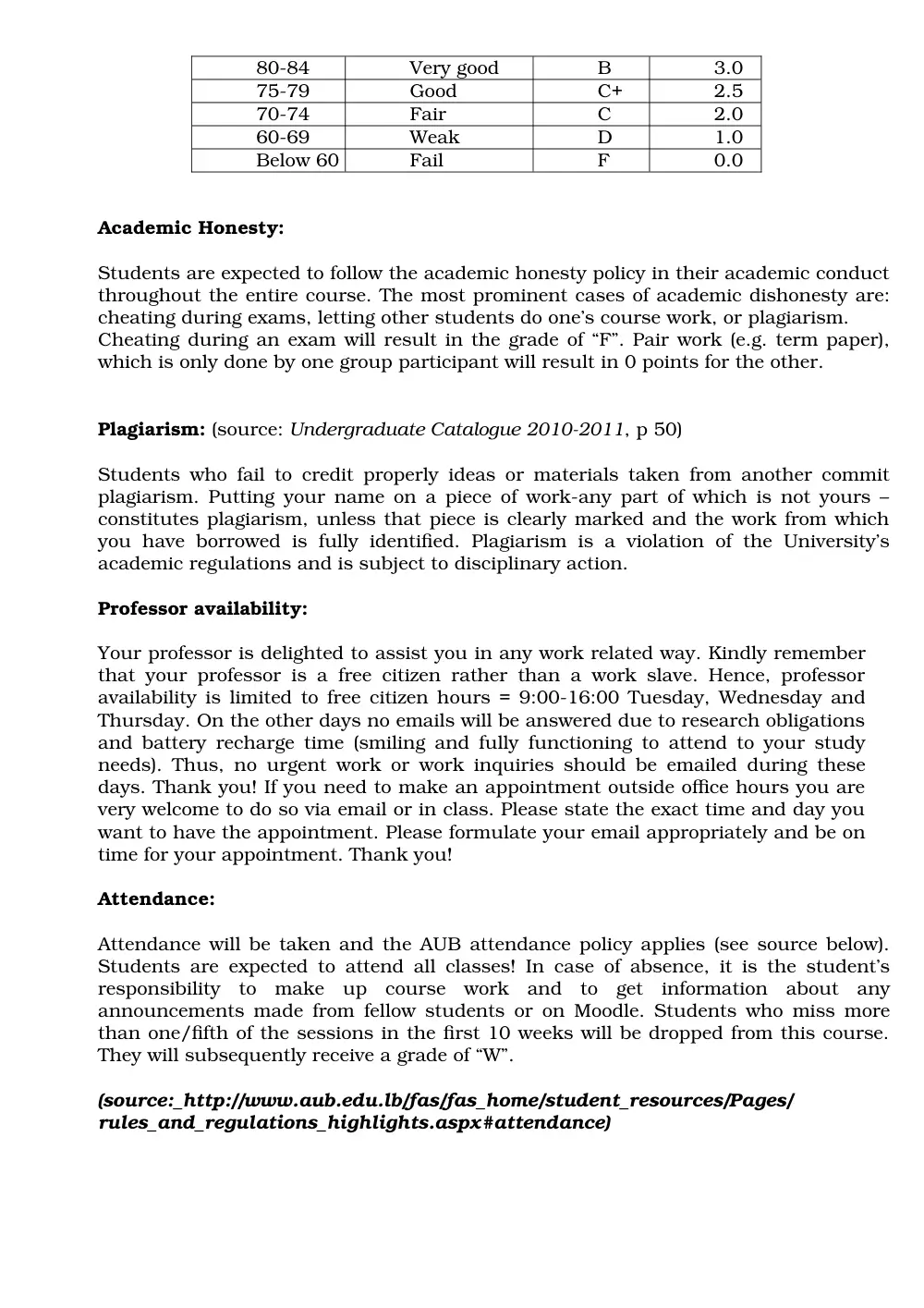
Grading system:
Range
Performance
Designation
Letter
Grade
Grade
Points
90-100
Outstanding
A
4.0
85-89
Excellent
B+
3.5
80-84
Very good
B
3.0
75-79
Good
C+
2.5
70-74
Fair
C
2.0
60-69
Weak
D
1.0
Below 60
Fail
F
0.0
Academic Honesty:
Students are expected to follow the academic honesty policy in their academic conduct
throughout the entire course. The most prominent cases of academic dishonesty are:
cheating during exams, letting other students do one’s course work, or plagiarism.
Cheating during an exam will result in the grade of “F”. Pair work (e.g. term paper),
which is only done by one group participant will result in 0 points for the other.
Plagiarism: (source: Undergraduate Catalogue 2010-2011, p 50)
Students who fail to credit properly ideas or materials taken from another commit
plagiarism. Putting your name on a piece of work-any part of which is not yours –
constitutes plagiarism, unless that piece is clearly marked and the work from which
you have borrowed is fully identified. Plagiarism is a violation of the University’s
academic regulations and is subject to disciplinary action.
Professor availability:
Your professor is delighted to assist you in any work related way. Kindly remember
that your professor is a free citizen rather than a work slave. Hence, professor
availability is limited to free citizen hours = 9:00-16:00 Tuesday, Wednesday and
Thursday. On the other days no emails will be answered due to research obligations
and battery recharge time (smiling and fully functioning to attend to your study
needs). Thus, no urgent work or work inquiries should be emailed during these
days. Thank you! If you need to make an appointment outside office hours you are
very welcome to do so via email or in class. Please state the exact time and day you
want to have the appointment. Please formulate your email appropriately and be on
time for your appointment. Thank you!
Attendance:
Attendance will be taken and the AUB attendance policy applies (see source below).
Students are expected to attend all classes! In case of absence, it is the student’s
responsibility to make up course work and to get information about any
announcements made from fellow students or on Moodle. Students who miss more
than one/fifth of the sessions in the first 10 weeks will be dropped from this course.
They will subsequently receive a grade of “W”.
(source:_http://www.aub.edu.lb/fas/fas_home/student_resources/Pages/
rules_and_regulations_highlights.aspx#attendance)