
HIST 101 Final, Fall 2007
American University of Beirut · Survey of Modern Europe · 2 pages
More HIST 101 files
Show the text of this final exam
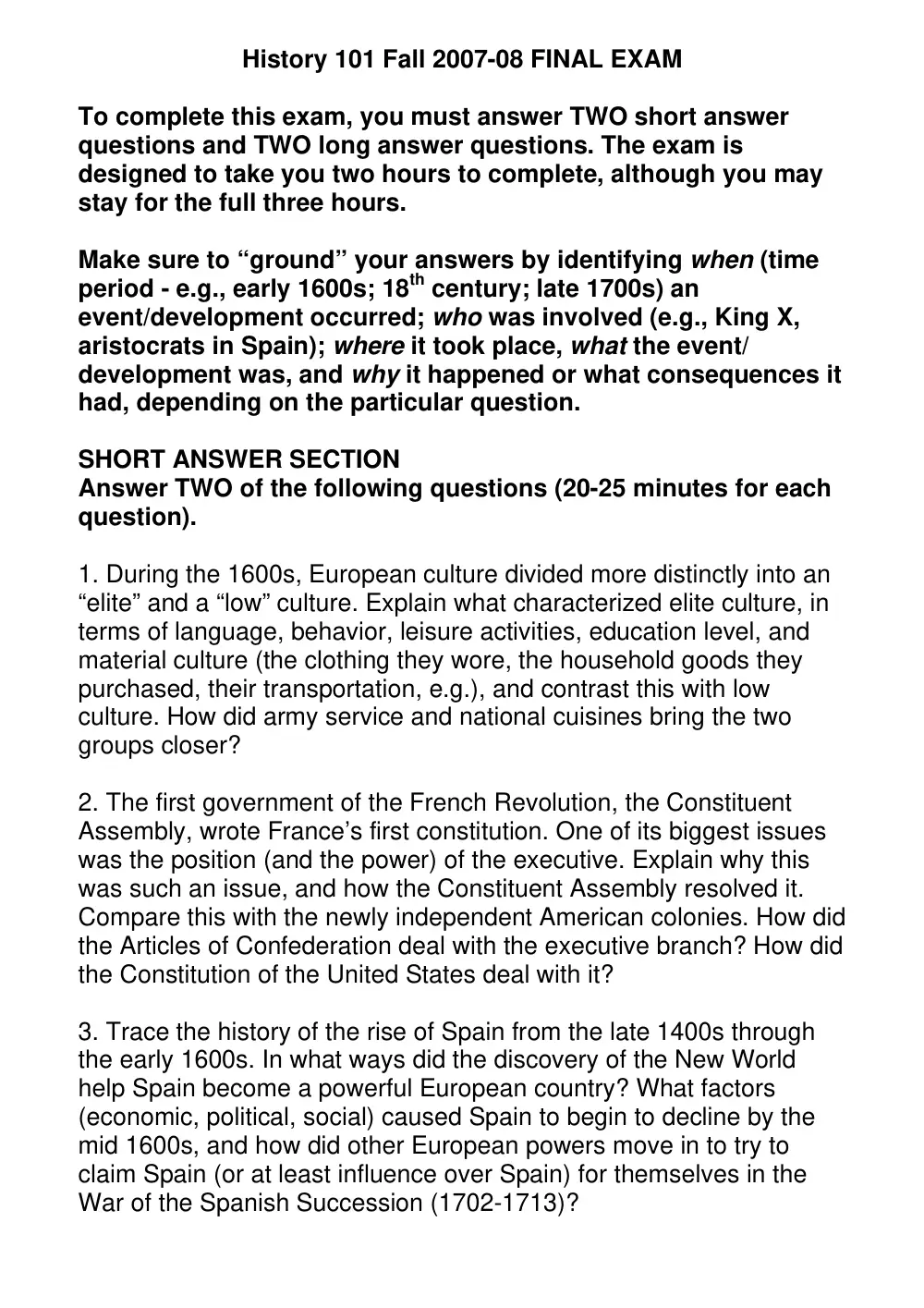
History 101 Fall 2007-08 FINAL EXAM
To complete this exam, you must answer TWO short answer
questions and TWO long answer questions. The exam is
designed to take you two hours to complete, although you may
stay for the full three hours.
Make sure to “ground” your answers by identifying when (time
period - e.g., early 1600s; 18th century; late 1700s) an
event/development occurred; who was involved (e.g., King X,
aristocrats in Spain); where it took place, what the event/
development was, and why it happened or what consequences it
had, depending on the particular question.
SHORT ANSWER SECTION
Answer TWO of the following questions (20-25 minutes for each
question).
1. During the 1600s, European culture divided more distinctly into an
“elite” and a “low” culture. Explain what characterized elite culture, in
terms of language, behavior, leisure activities, education level, and
material culture (the clothing they wore, the household goods they
purchased, their transportation, e.g.), and contrast this with low
culture. How did army service and national cuisines bring the two
groups closer?
2. The first government of the French Revolution, the Constituent
Assembly, wrote France’s first constitution. One of its biggest issues
was the position (and the power) of the executive. Explain why this
was such an issue, and how the Constituent Assembly resolved it.
Compare this with the newly independent American colonies. How did
the Articles of Confederation deal with the executive branch? How did
the Constitution of the United States deal with it?
3. Trace the history of the rise of Spain from the late 1400s through
the early 1600s. In what ways did the discovery of the New World
help Spain become a powerful European country? What factors
(economic, political, social) caused Spain to begin to decline by the
mid 1600s, and how did other European powers move in to try to
claim Spain (or at least influence over Spain) for themselves in the
War of the Spanish Succession (1702-1713)?
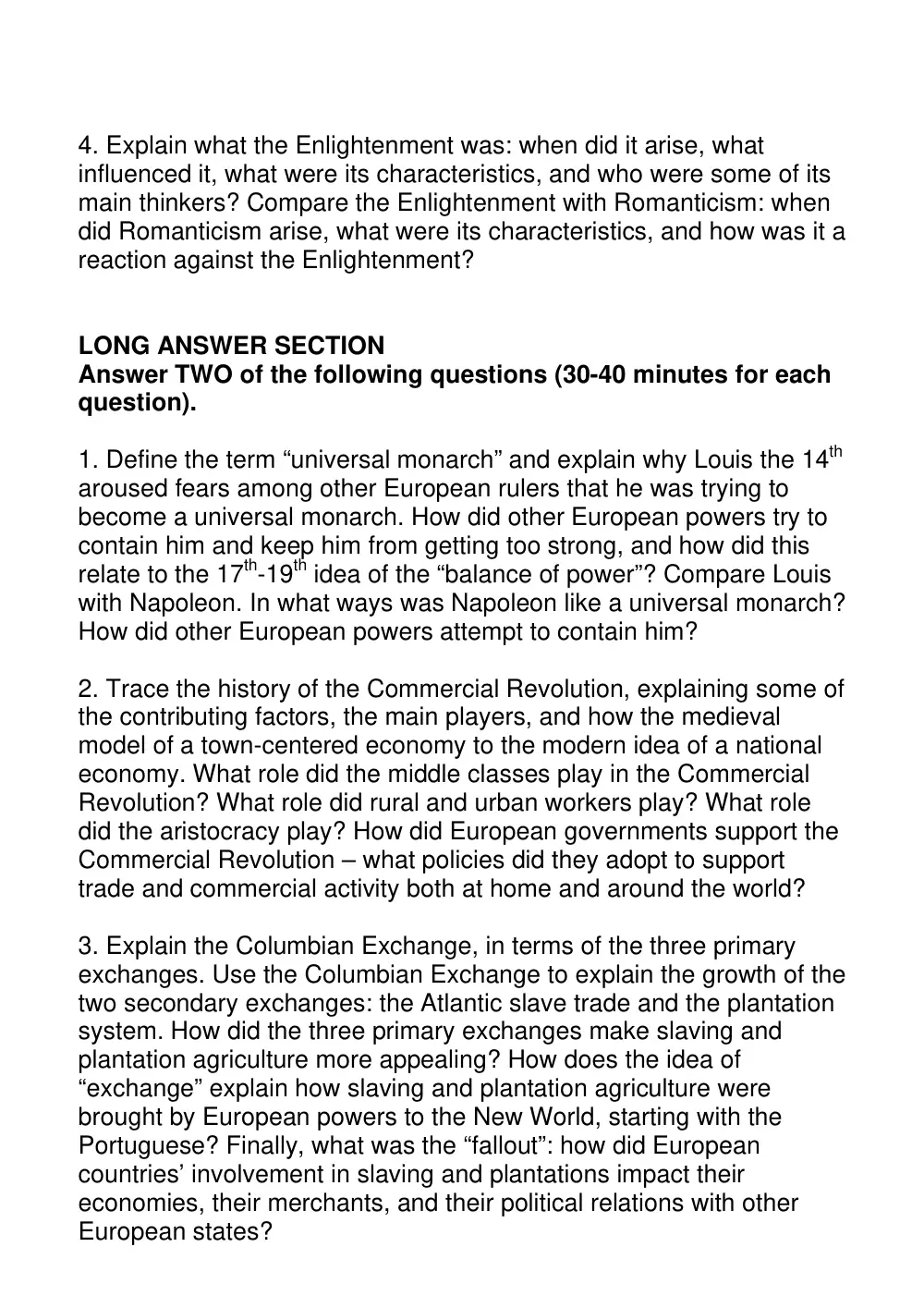
4. Explain what the Enlightenment was: when did it arise, what
influenced it, what were its characteristics, and who were some of its
main thinkers? Compare the Enlightenment with Romanticism: when
did Romanticism arise, what were its characteristics, and how was it a
reaction against the Enlightenment?
LONG ANSWER SECTION
Answer TWO of the following questions (30-40 minutes for each
question).
1. Define the term “universal monarch” and explain why Louis the 14th
aroused fears among other European rulers that he was trying to
become a universal monarch. How did other European powers try to
contain him and keep him from getting too strong, and how did this
relate to the 17th-19th idea of the “balance of power”? Compare Louis
with Napoleon. In what ways was Napoleon like a universal monarch?
How did other European powers attempt to contain him?
2. Trace the history of the Commercial Revolution, explaining some of
the contributing factors, the main players, and how the medieval
model of a town-centered economy to the modern idea of a national
economy. What role did the middle classes play in the Commercial
Revolution? What role did rural and urban workers play? What role
did the aristocracy play? How did European governments support the
Commercial Revolution – what policies did they adopt to support
trade and commercial activity both at home and around the world?
3. Explain the Columbian Exchange, in terms of the three primary
exchanges. Use the Columbian Exchange to explain the growth of the
two secondary exchanges: the Atlantic slave trade and the plantation
system. How did the three primary exchanges make slaving and
plantation agriculture more appealing? How does the idea of
“exchange” explain how slaving and plantation agriculture were
brought by European powers to the New World, starting with the
Portuguese? Finally, what was the “fallout”: how did European
countries’ involvement in slaving and plantations impact their
economies, their merchants, and their political relations with other
European states?