
HIST 101 Final, Fall 2007
American University of Beirut · Survey of Modern Europe · 1 page
Stuck on a question? A tutor can walk you through it.
More HIST 101 files
Show the text of this final exam
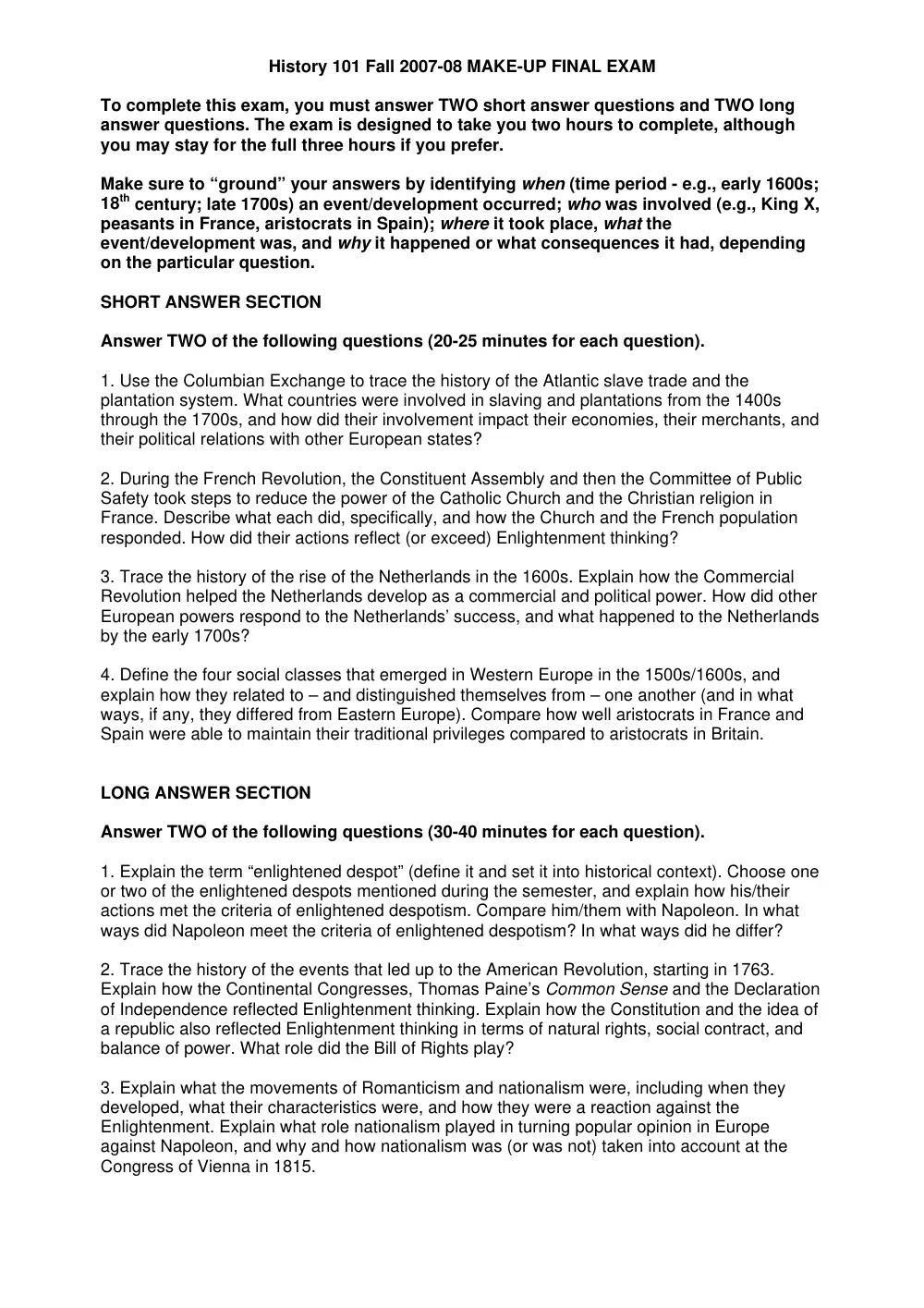
History 101 Fall 2007-08 MAKE-UP FINAL EXAM
To complete this exam, you must answer TWO short answer questions and TWO long
answer questions. The exam is designed to take you two hours to complete, although
you may stay for the full three hours if you prefer.
Make sure to “ground” your answers by identifying when (time period - e.g., early 1600s;
18th century; late 1700s) an event/development occurred; who was involved (e.g., King X,
peasants in France, aristocrats in Spain); where it took place, what the
event/development was, and why it happened or what consequences it had, depending
on the particular question.
SHORT ANSWER SECTION
Answer TWO of the following questions (20-25 minutes for each question).
1. Use the Columbian Exchange to trace the history of the Atlantic slave trade and the
plantation system. What countries were involved in slaving and plantations from the 1400s
through the 1700s, and how did their involvement impact their economies, their merchants, and
their political relations with other European states?
2. During the French Revolution, the Constituent Assembly and then the Committee of Public
Safety took steps to reduce the power of the Catholic Church and the Christian religion in
France. Describe what each did, specifically, and how the Church and the French population
responded. How did their actions reflect (or exceed) Enlightenment thinking?
3. Trace the history of the rise of the Netherlands in the 1600s. Explain how the Commercial
Revolution helped the Netherlands develop as a commercial and political power. How did other
European powers respond to the Netherlands’ success, and what happened to the Netherlands
by the early 1700s?
4. Define the four social classes that emerged in Western Europe in the 1500s/1600s, and
explain how they related to – and distinguished themselves from – one another (and in what
ways, if any, they differed from Eastern Europe). Compare how well aristocrats in France and
Spain were able to maintain their traditional privileges compared to aristocrats in Britain.
LONG ANSWER SECTION
Answer TWO of the following questions (30-40 minutes for each question).
1. Explain the term “enlightened despot” (define it and set it into historical context). Choose one
or two of the enlightened despots mentioned during the semester, and explain how his/their
actions met the criteria of enlightened despotism. Compare him/them with Napoleon. In what
ways did Napoleon meet the criteria of enlightened despotism? In what ways did he differ?
2. Trace the history of the events that led up to the American Revolution, starting in 1763.
Explain how the Continental Congresses, Thomas Paine’s Common Sense and the Declaration
of Independence reflected Enlightenment thinking. Explain how the Constitution and the idea of
a republic also reflected Enlightenment thinking in terms of natural rights, social contract, and
balance of power. What role did the Bill of Rights play?
3. Explain what the movements of Romanticism and nationalism were, including when they
developed, what their characteristics were, and how they were a reaction against the
Enlightenment. Explain what role nationalism played in turning popular opinion in Europe
against Napoleon, and why and how nationalism was (or was not) taken into account at the
Congress of Vienna in 1815.