
MATH 212 Final, Spring 2009
American University of Beirut · Introductory Partial Differential Equations · 16 pages





Showing the first 10 of 16 pages. Download the PDF to see all of it.
More MATH 212 files
- Final · Spring 2016Final examView
- Final · Fall 2015Final examView
- Final · Fall 2007Final examView
- Useful File Selected Solutions for Introduction to Partial Differential Equation · Fall 2016File · with solutionView
- Exam 1 · Fall 2016ExamView
- Exam 1 · Fall 2016ExamView
- Homework Assignment 3 Solutions · Fall 2016Homework · with solutionView
- Exam 1 · Spring 2016ExamView
Show the text of this final exam
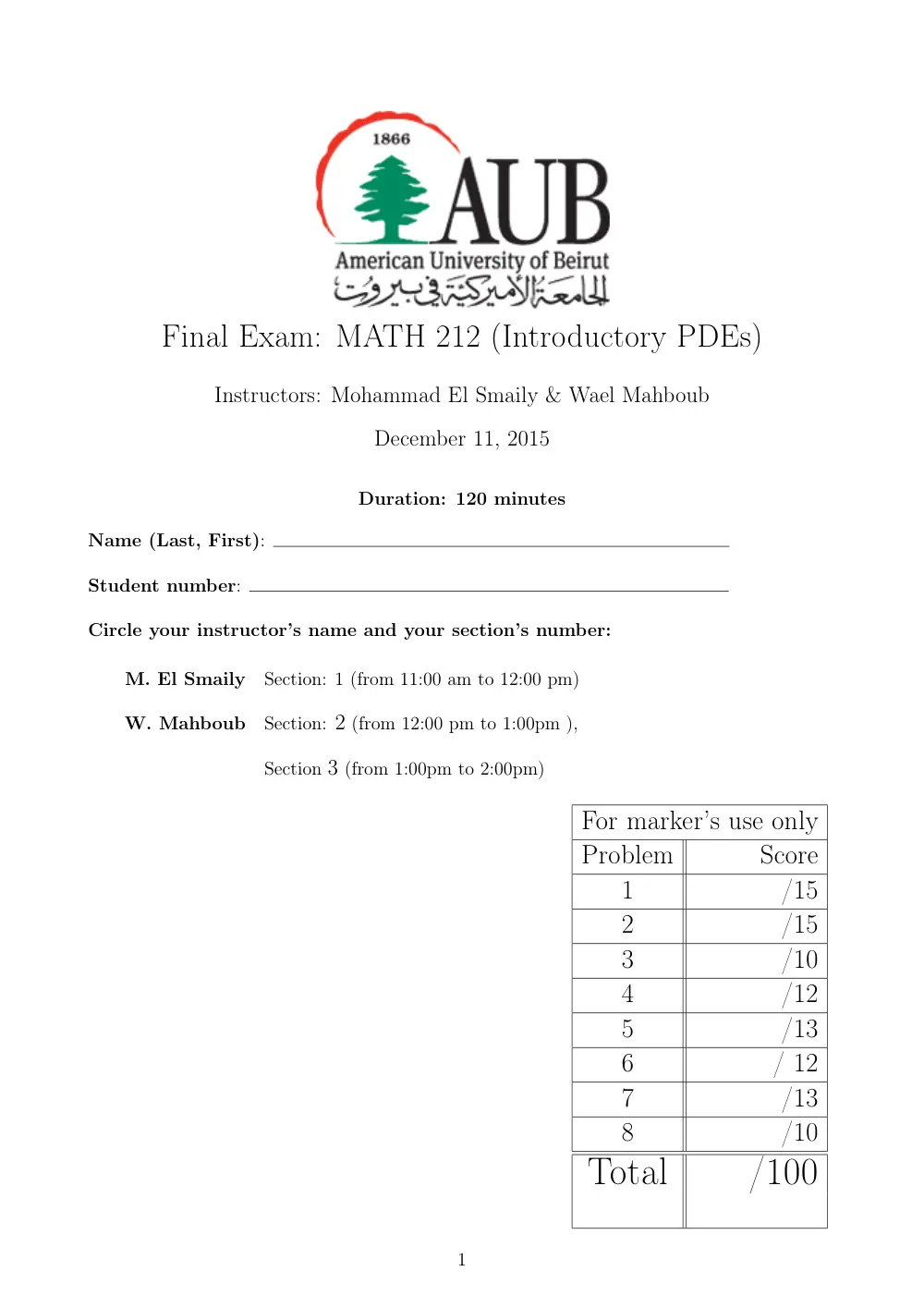
Final Exam: MATH 212 (Introductory PDEs)
Instructors: Mohammad El Smaily & Wael Mahboub
December 11, 2015
Duration: 120 minutes
Name (Last, First):
Student number:
Circle your instructor’s name and your section’s number:
M. El Smaily
Section: 1 (from 11:00 am to 12:00 pm)
W. Mahboub
Section: 2 (from 12:00 pm to 1:00pm ),
Section 3 (from 1:00pm to 2:00pm)
For marker’s use only
Problem
Score
1
/15
2
/15
3
/10
4
/12
5
/13
6
/ 12
7
/13
8
/10
Total
/100
1
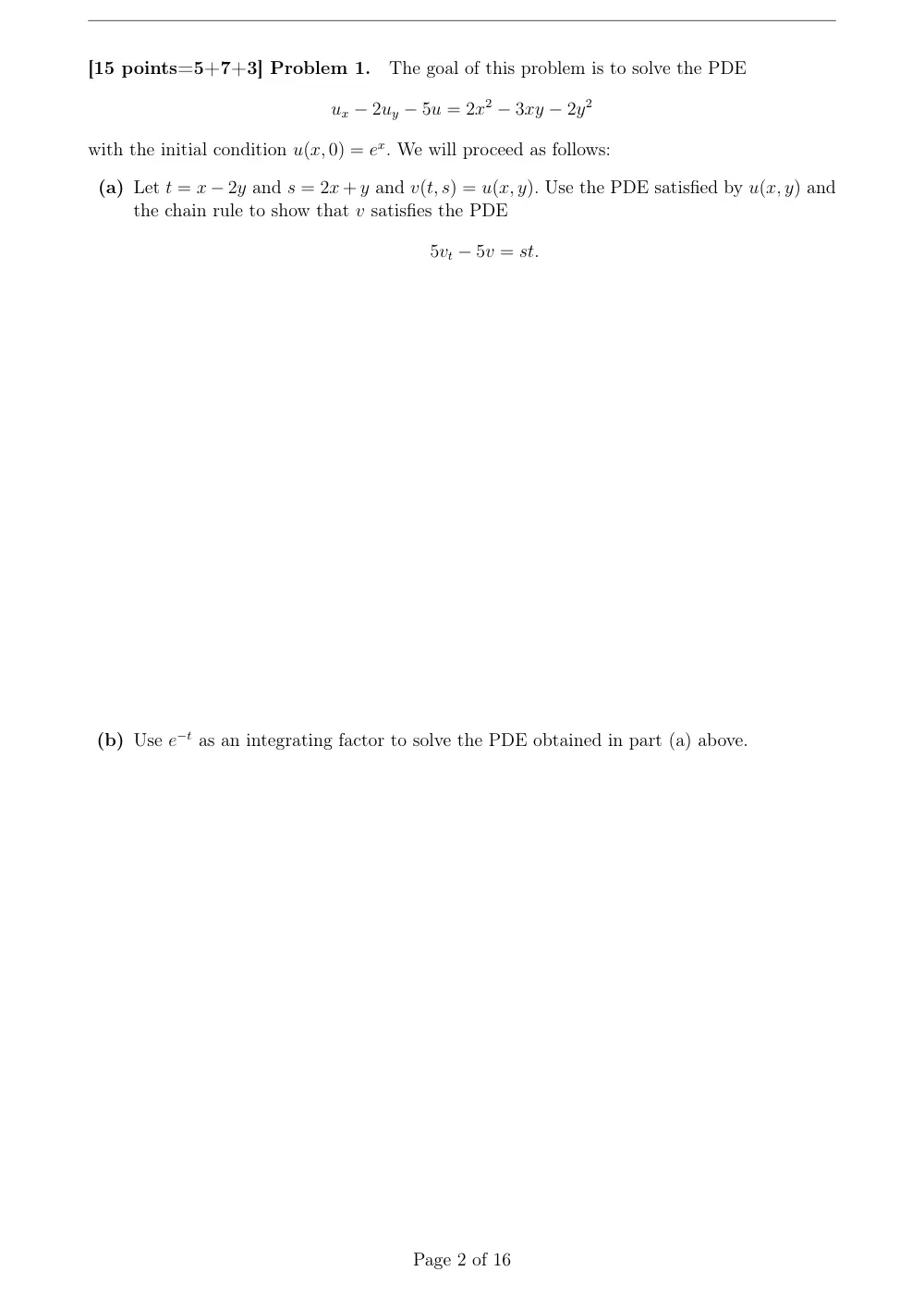
[15 points=5+7+3] Problem 1.
The goal of this problem is to solve the PDE
ux − 2uy − 5u = 2x2 − 3xy − 2y2
with the initial condition u(x, 0) = ex. We will proceed as follows:
(a) Let t = x − 2y and s = 2x + y and v(t, s) = u(x, y). Use the PDE satisfied by u(x, y) and
the chain rule to show that v satisfies the PDE
5vt − 5v = st.
(b) Use e−t as an integrating factor to solve the PDE obtained in part (a) above.
Page 2 of 16
(c) Deduce u(x, y) interms of x and y (use the initial conditions in the process).
Page 3 of 16
[15 points=6+6+3] Problem 2.
Let
f(x) =
� 1
for
− 1 ≤ x ≤ 1
0
otherwise
and
g(x) =
� 1
for
− 2 ≤ x ≤ 2
0
otherwise.
(a) Find f ∗ g(x).
Page 4 of 16
(b) Find the Fourier transform �f(k) and �g(k).
Page 5 of 16
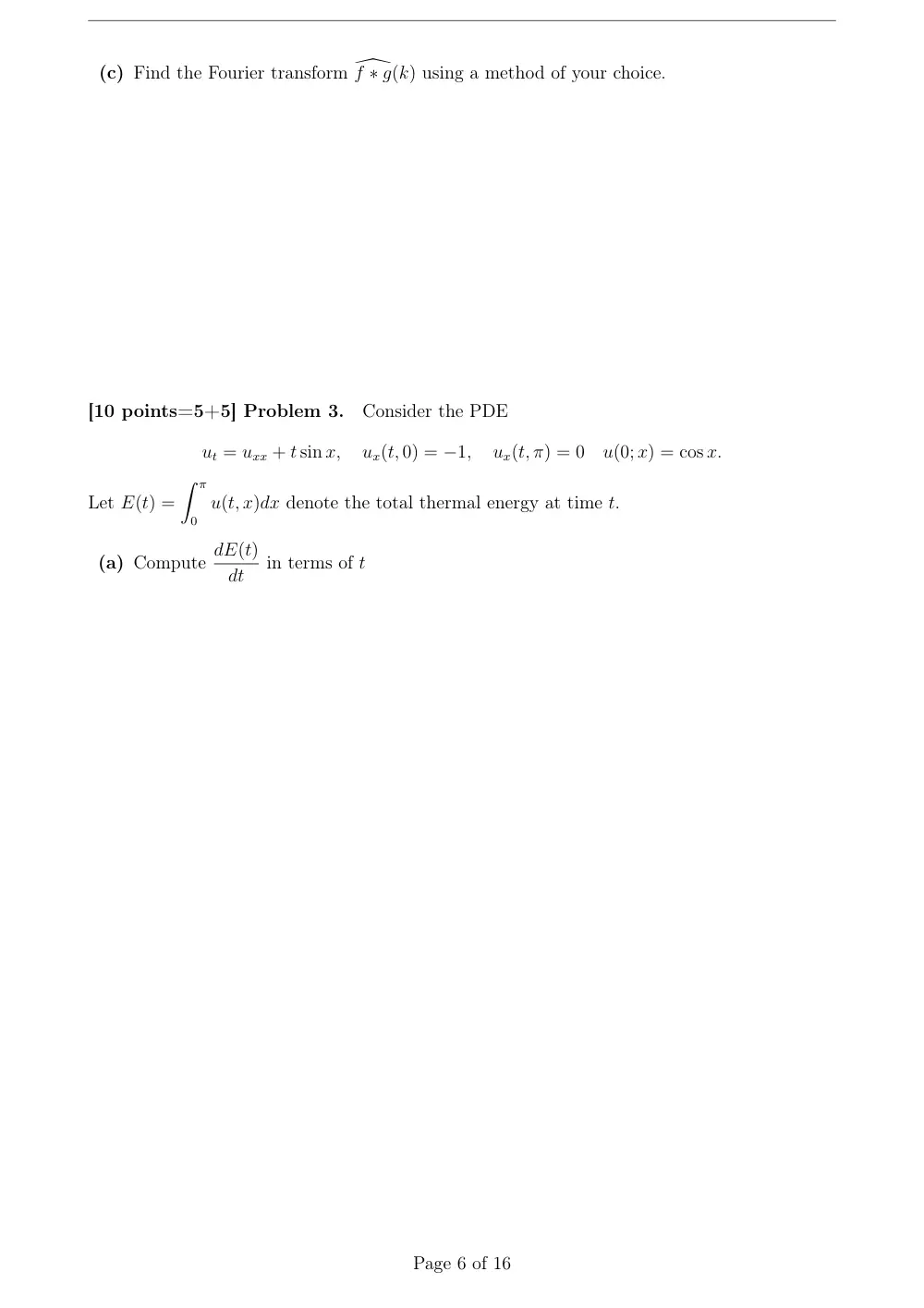
(c) Find the Fourier transform �
f ∗ g(k) using a method of your choice.
[10 points=5+5] Problem 3.
Consider the PDE
ut = uxx + t sin x,
ux(t, 0) = −1,
ux(t, π) = 0
u(0; x) = cos x.
Let E(t) =
� π
0
u(t, x)dx denote the total thermal energy at time t.
(a) Compute dE(t)
dt
in terms of t
Page 6 of 16
(b) Conclude E(t) in terms of t.
Page 7 of 16
[12 points] Problem 4.
Solve using a method of your choice the initial value problem
ut + ux − 3u = t for t > 0,
u(0, x) = x2.
Page 8 of 16
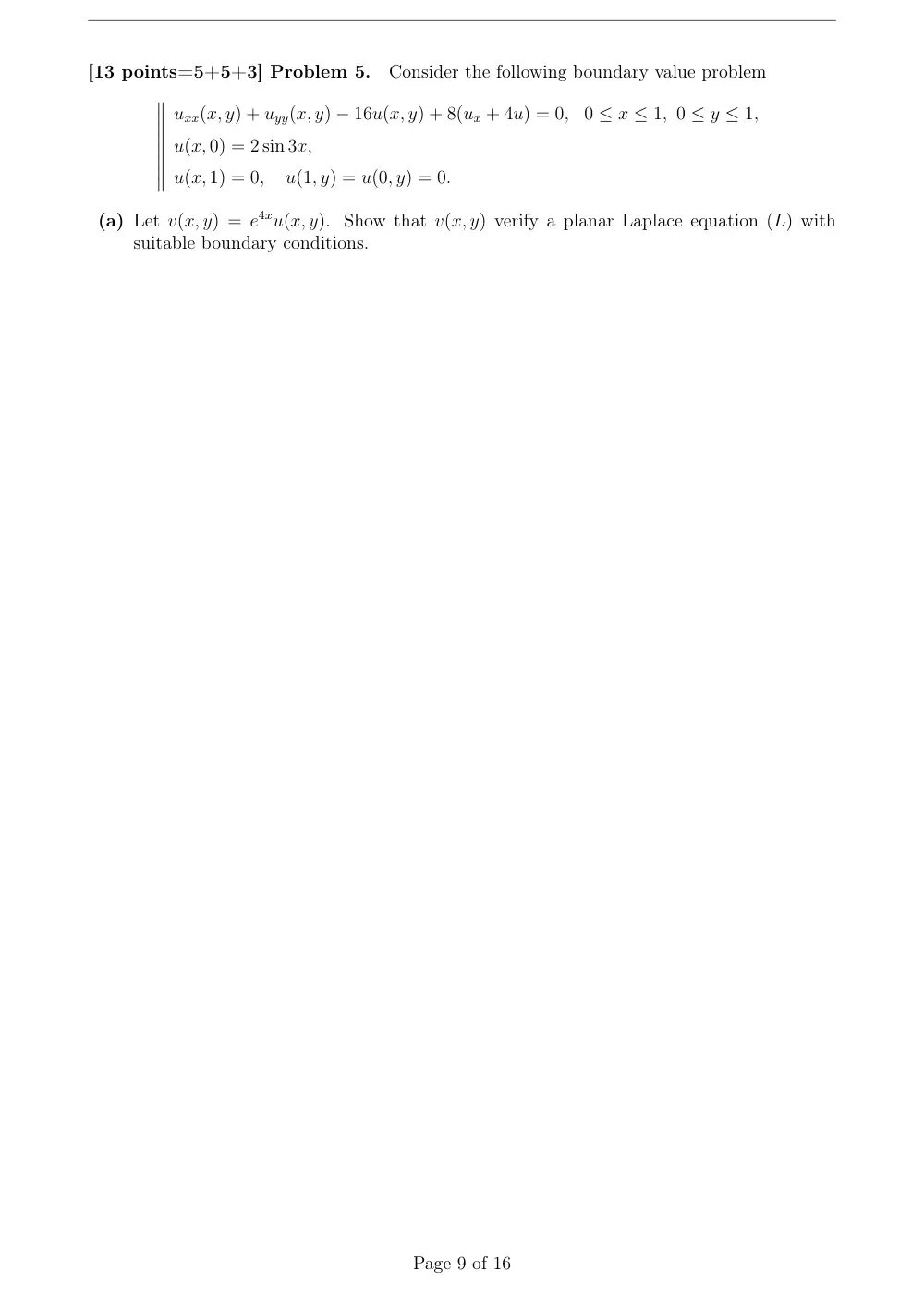
[13 points=5+5+3] Problem 5.
Consider the following boundary value problem
��������
uxx(x, y) + uyy(x, y) − 16u(x, y) + 8(ux + 4u) = 0,
0 ≤ x ≤ 1, 0 ≤ y ≤ 1,
u(x, 0) = 2 sin 3x,
u(x, 1) = 0,
u(1, y) = u(0, y) = 0.
(a) Let v(x, y) = e4xu(x, y). Show that v(x, y) verify a planar Laplace equation (L) with
suitable boundary conditions.
Page 9 of 16
(b) Write v(x, y) in a series format–compute the coefficients of the trigonometric terms.
(c) Deduce a series format for u(x, y).
Page 10 of 16
[12 points=5+7] Problem 6.
Consider the heat problem with inhomogeneous Dirichlet
boundary conditions
�����
ut(t, x) = uxx(t, x) for 0 ≤ x ≤ 2, t ≥ 0,
u(t, 0) = 0,
u(t, 2) = 2,
and the initial datum
u(0, x) =
�
x if 0 ≤ x ≤ 1
2 − x if 1 < x ≤ 2
(a) Find the equilibrium state u∗(x).
Page 11 of 16
(b) Using the function v(t, x) = u(t, x) − u∗(x), find u(x, y).
Page 12 of 16
[13 points=4+6+3] Problem 7.
Consider the sequences of functions {fn(x)} and {gn(x)}
defined by
fn(x) =
n
nx + 1,
x ∈ (0, 1)
and
gn(x) =
�
1 + x
n
�n
,
x ∈ R.
(a) Find the pointwise limits f and g of {fn(x)} and {gn(x)} respectively.
Page 13 of 16
(b) Show that {fn(x)} converges to f uniformly on [a, 1) for every 0 < a < 1 but not over
(0, 1).
Page 14 of 16
(c) Does {gn(x)} converge uniformly to g over R? Justify your answer.
Page 15 of 16
[10 points] Problem 8.
Show that, if v(t, x) > 0 is any positive solution to the linear heat
equation vt = γvxx, then u(t, x) = ∂
∂x (−2γ log v(t, x)) solves Burgers’ equation ut + uux = uxx.
Page 16 of 16