
MATH 212 Final, Spring 2016
American University of Beirut · Introductory Partial Differential Equations · 12 pages



Showing the first 10 of 12 pages. Download the PDF to see all of it.
More MATH 212 files
- Final · Fall 2015Final examView
- Final · Spring 2009Final examView
- Final · Fall 2007Final examView
- Useful File Selected Solutions for Introduction to Partial Differential Equation · Fall 2016File · with solutionView
- Exam 1 · Fall 2016ExamView
- Exam 1 · Fall 2016ExamView
- Homework Assignment 3 Solutions · Fall 2016Homework · with solutionView
- Exam 1 · Spring 2016ExamView
Show the text of this final exam
Final Exam : MATH 212 (Introductory PDEs)
Instructor: Wael Mahboub
May 13, 2016
Duration: 120 minutes
Name (Last, First):
Student number:
For marker’s use only
Problem
Score
1
/10
2
/20
3
/10
4
/15
5
/15
6
/ 20
7
/ 10
Total
/100
1
[10 points=5+5] Problem 1.
Consider the following PDE
ut = uxx + 2ux − 3u.
(a) Let v(t, x) = e3tu(t, x). Use the PDE satisfied by u(x, y) to show that v satisfies the PDE.
vt + 2vx = vxx.
(1)
(b) Let ξ = x − 2t, and W(t, ξ) = v(t, x). Use the PDE satisfied by v(t, x) and chain rule to
show that W satisfies a heat equation.
Page 2 of 12
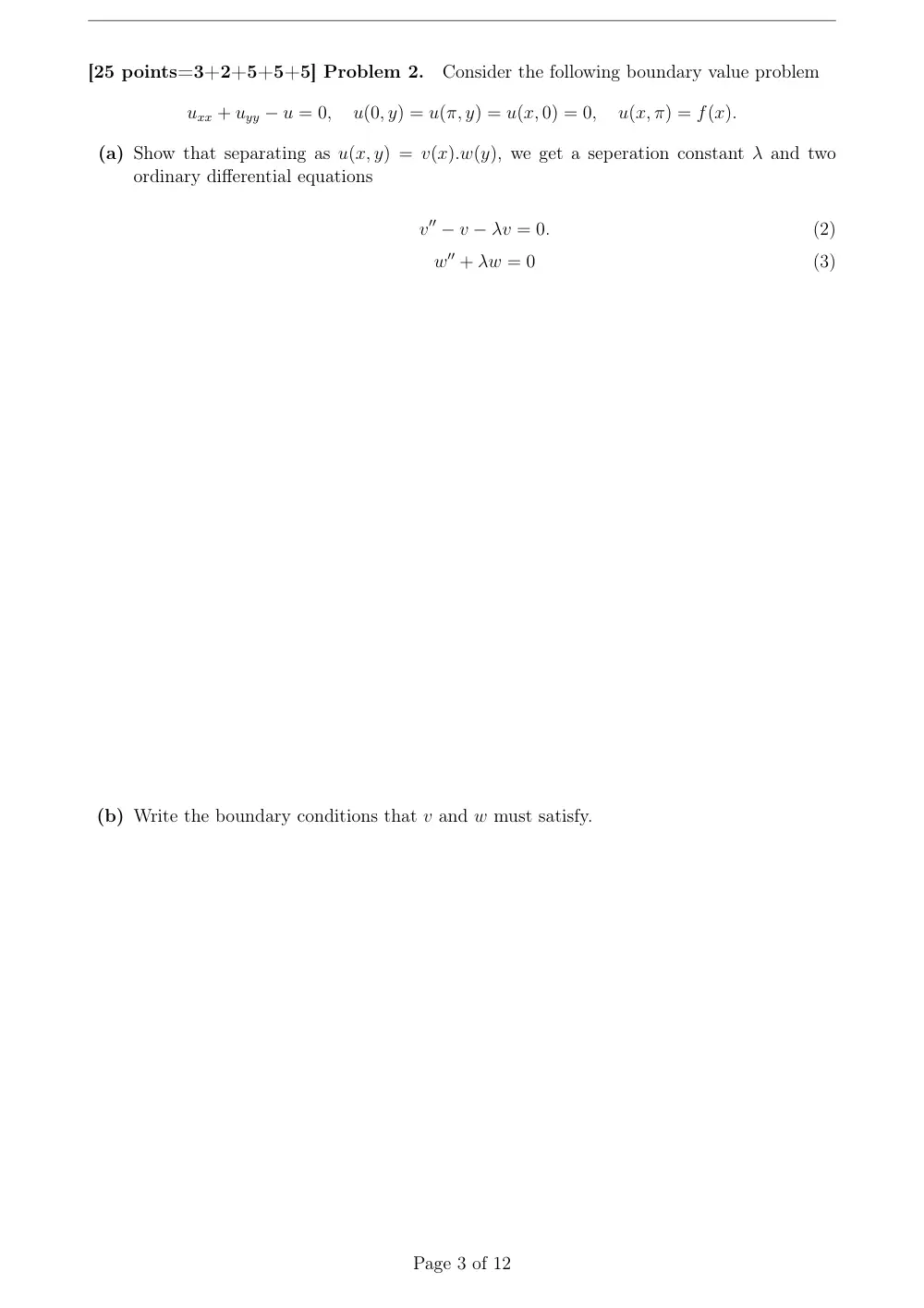
[25 points=3+2+5+5+5] Problem 2.
Consider the following boundary value problem
uxx + uyy − u = 0,
u(0, y) = u(π, y) = u(x, 0) = 0,
u(x, π) = f(x).
(a) Show that separating as u(x, y) = v(x).w(y), we get a seperation constant λ and two
ordinary differential equations
v′′ − v − λv = 0.
(2)
w′′ + λw = 0
(3)
(b) Write the boundary conditions that v and w must satisfy.
Page 3 of 12
(c) Show that the ODE (2) admits a non trivial solution, if and only if λ = −1 − n2 where n
is a integer.
Page 4 of 12
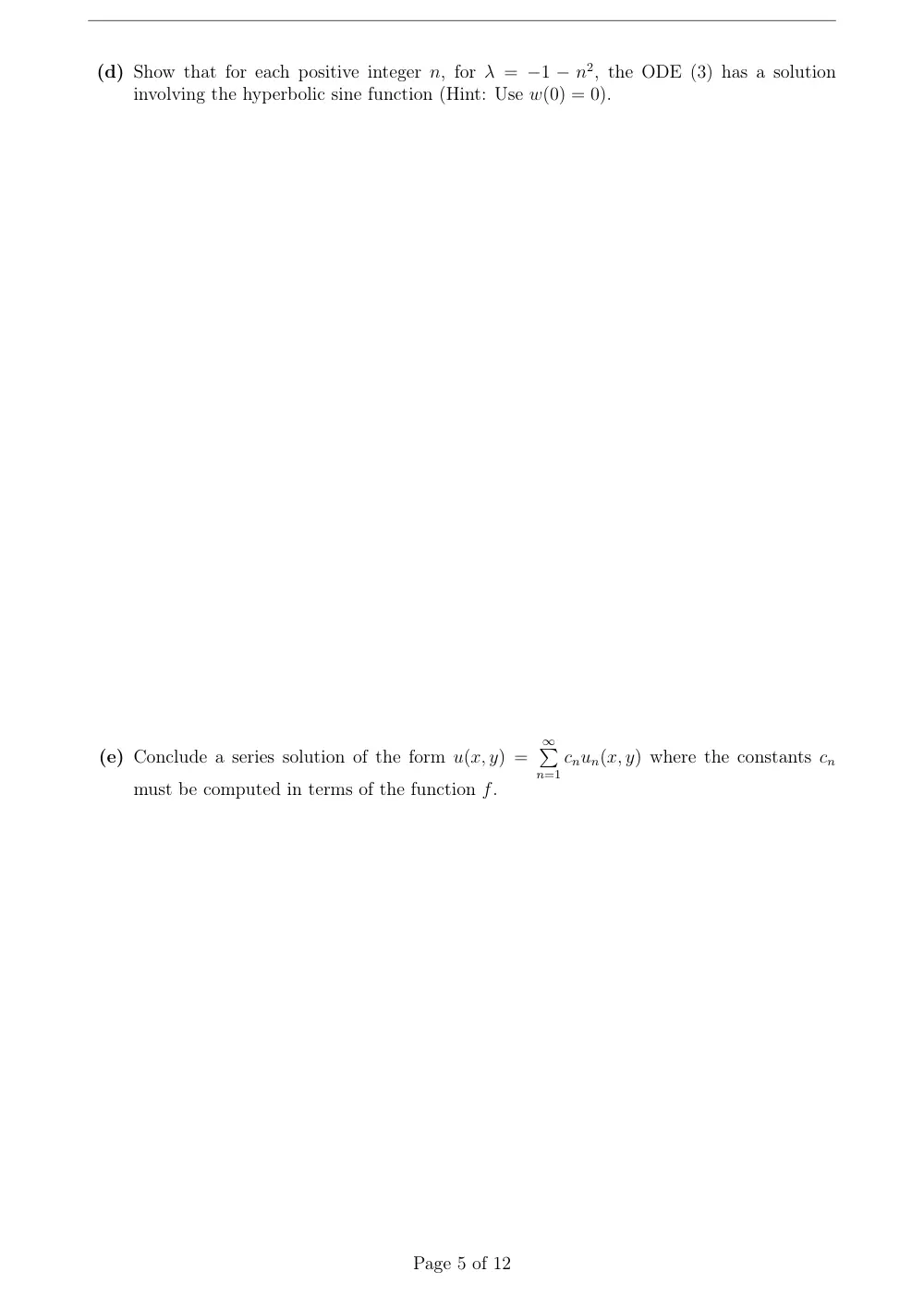
(d) Show that for each positive integer n, for λ = −1 − n2, the ODE (3) has a solution
involving the hyperbolic sine function (Hint: Use w(0) = 0).
(e) Conclude a series solution of the form u(x, y) =
∞
�
n=1
cnun(x, y) where the constants cn
must be computed in terms of the function f.
Page 5 of 12
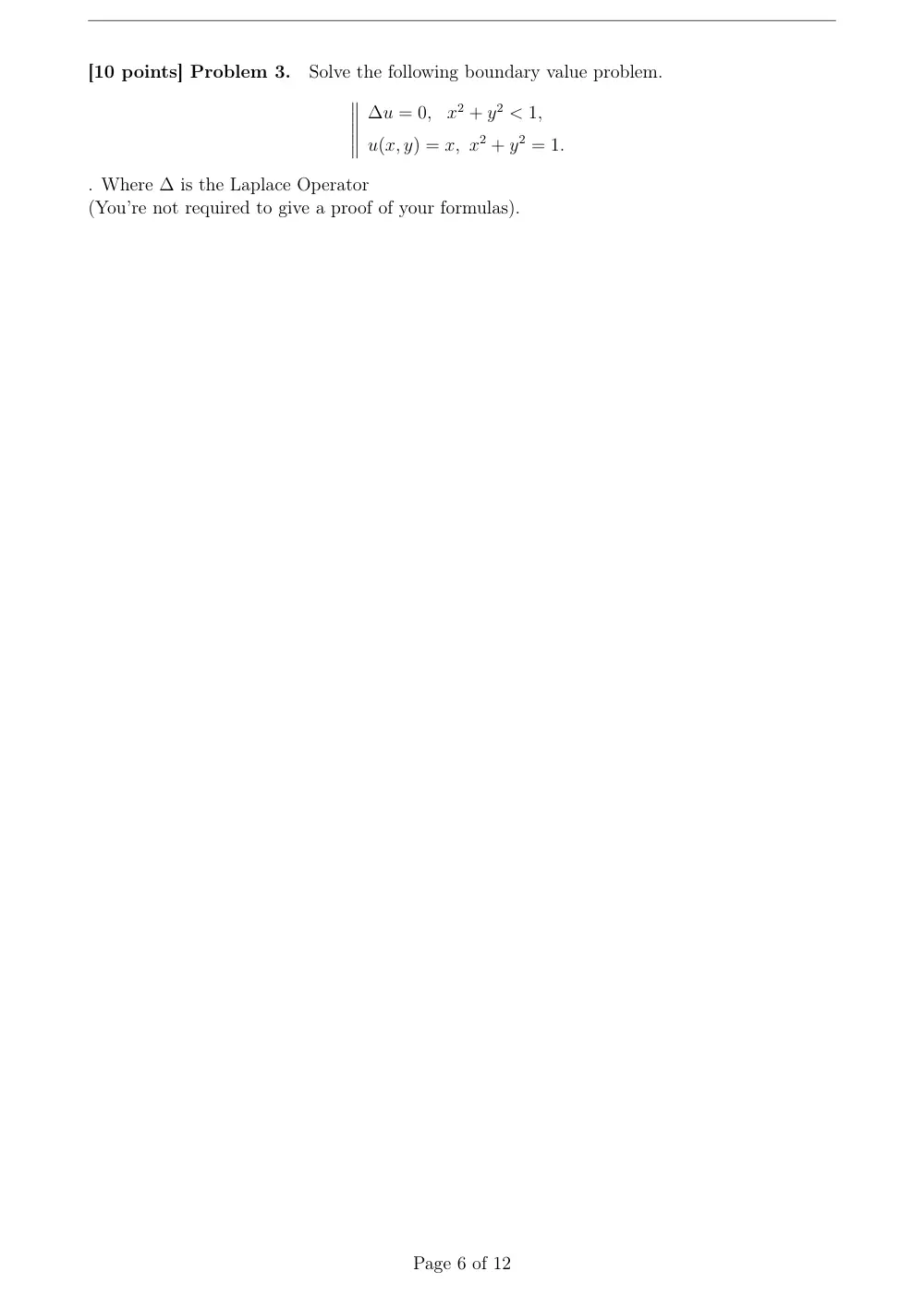
[10 points] Problem 3.
Solve the following boundary value problem.
�����
∆u = 0,
x2 + y2 < 1,
u(x, y) = x, x2 + y2 = 1.
. Where ∆ is the Laplace Operator
(You’re not required to give a proof of your formulas).
Page 6 of 12
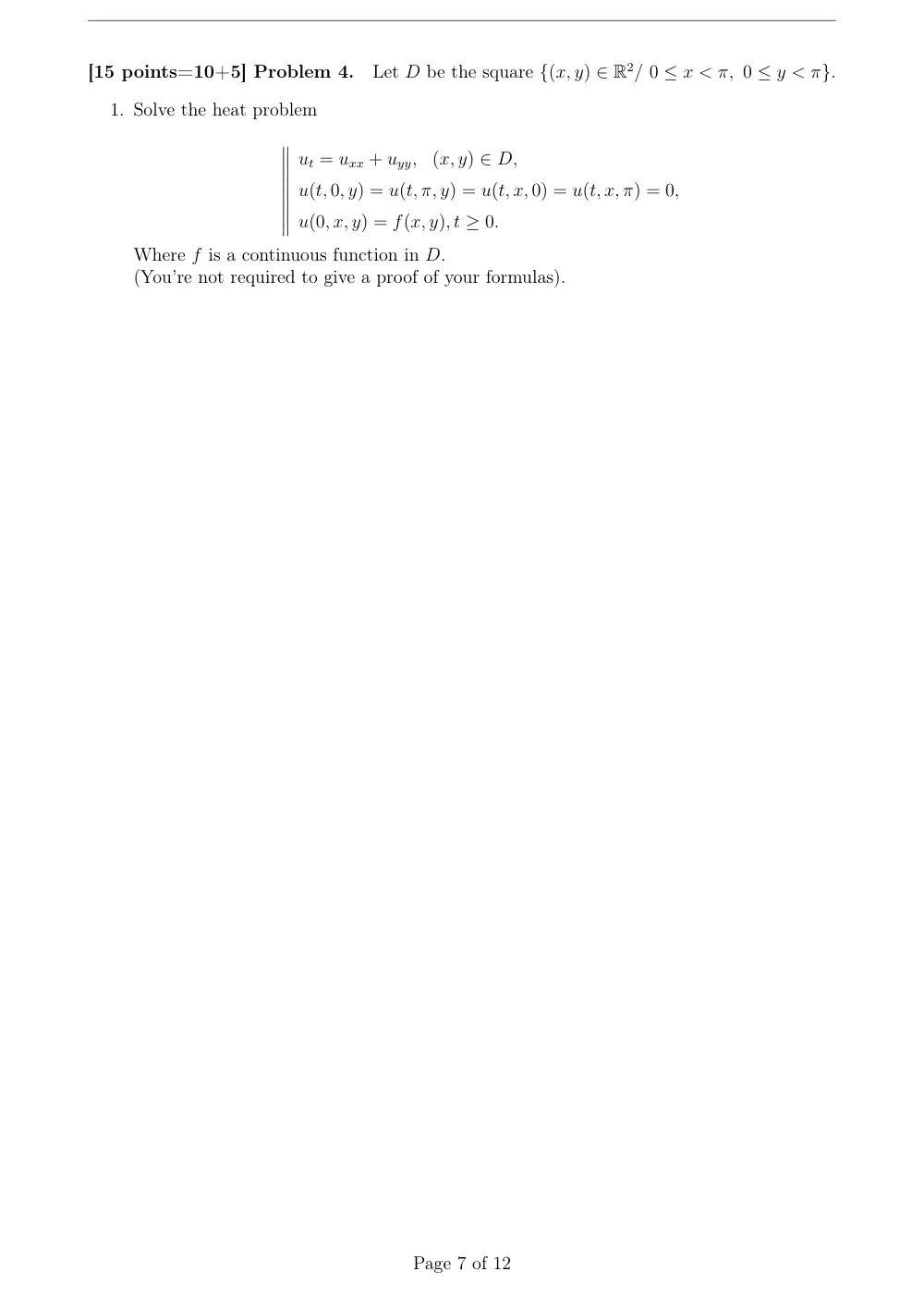
[15 points=10+5] Problem 4.
Let D be the square {(x, y) ∈ R2/ 0 ≤ x < π, 0 ≤ y < π}.
1. Solve the heat problem
��������
ut = uxx + uyy,
(x, y) ∈ D,
u(t, 0, y) = u(t, π, y) = u(t, x, 0) = u(t, x, π) = 0,
u(0, x, y) = f(x, y), t ≥ 0.
Where f is a continuous function in D.
(You’re not required to give a proof of your formulas).
Page 7 of 12
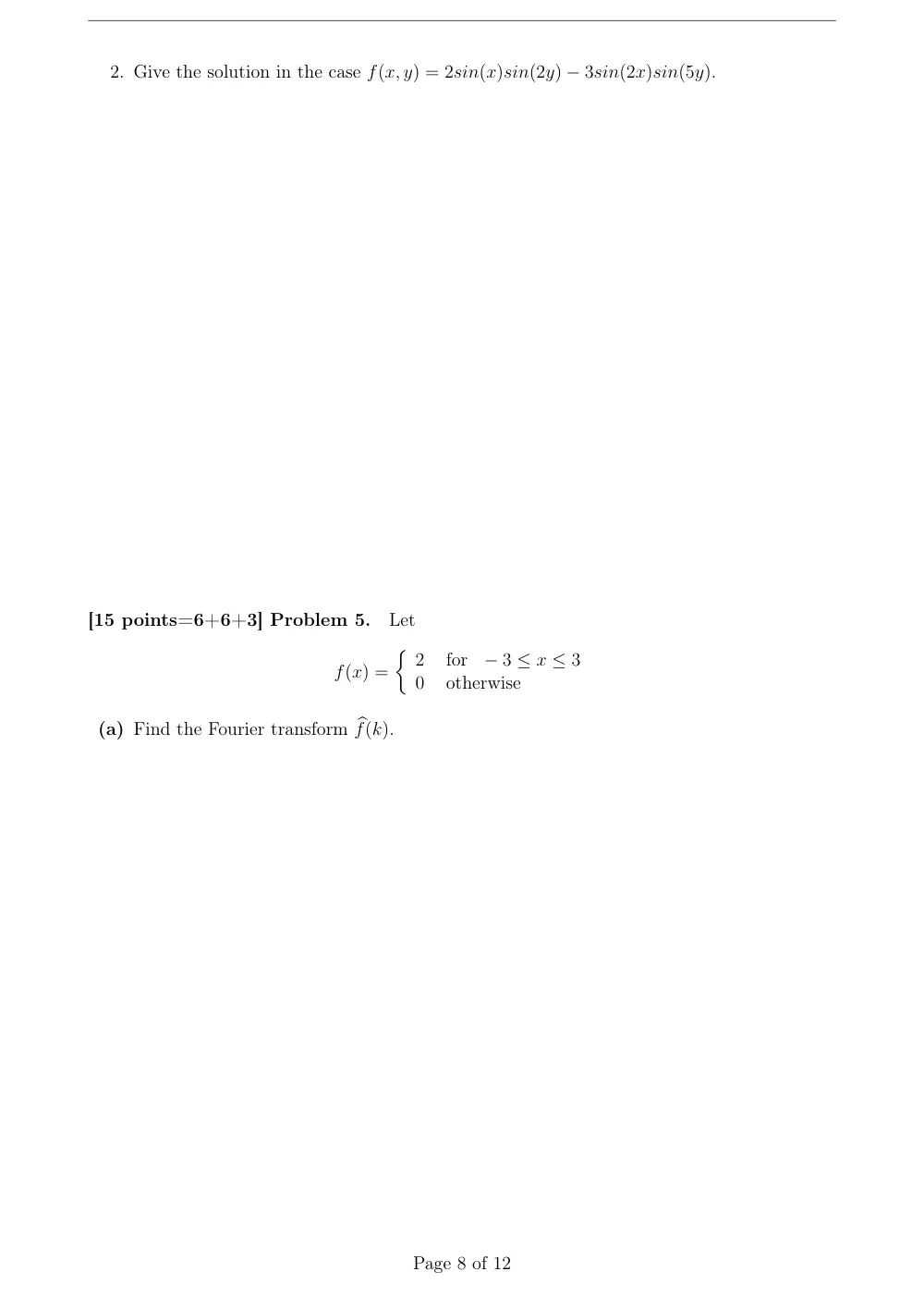
2. Give the solution in the case f(x, y) = 2sin(x)sin(2y) − 3sin(2x)sin(5y).
[15 points=6+6+3] Problem 5.
Let
f(x) =
� 2
for
− 3 ≤ x ≤ 3
0
otherwise
(a) Find the Fourier transform �f(k).
Page 8 of 12
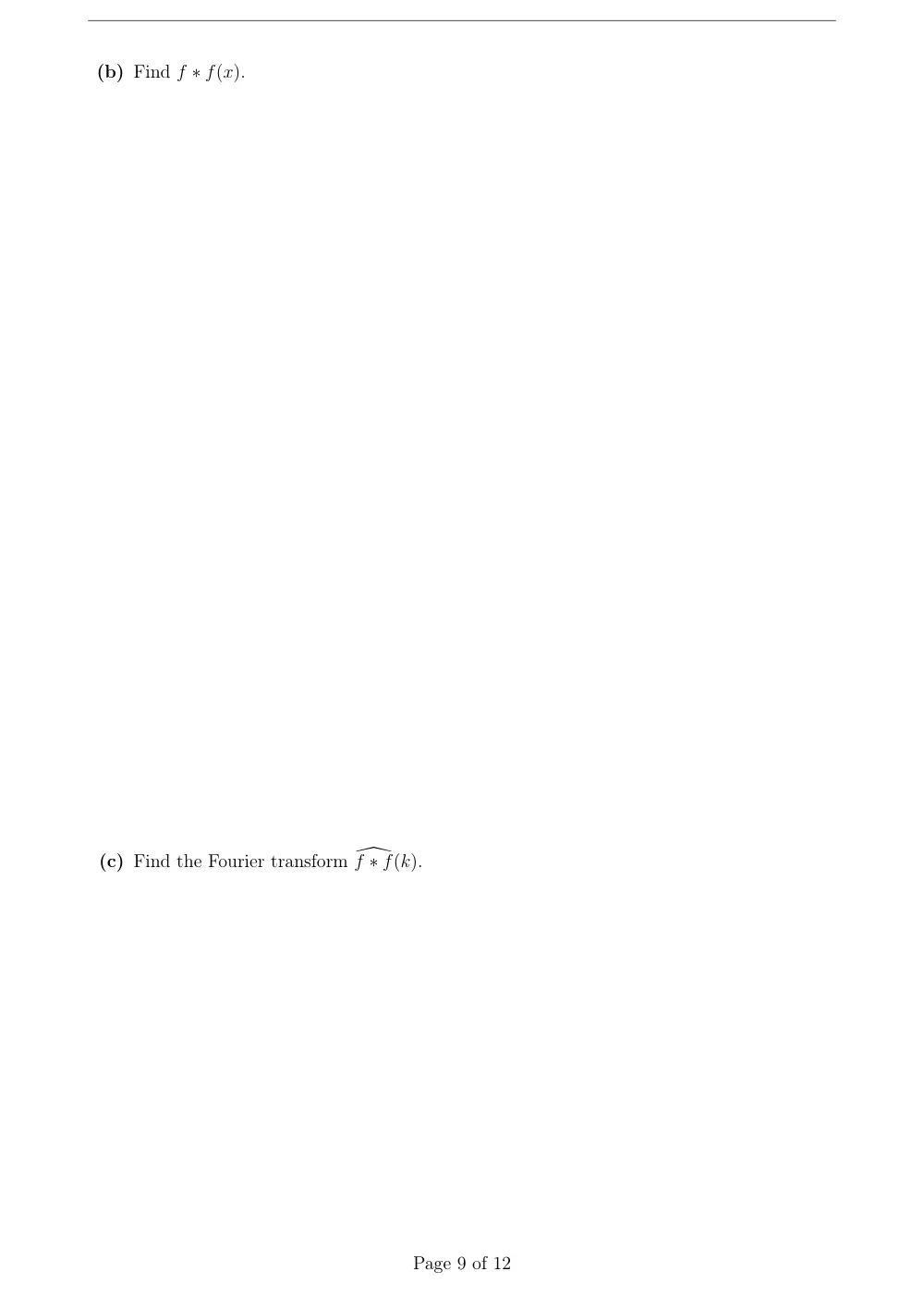
(b) Find f ∗ f(x).
(c) Find the Fourier transform �
f ∗ f(k).
Page 9 of 12
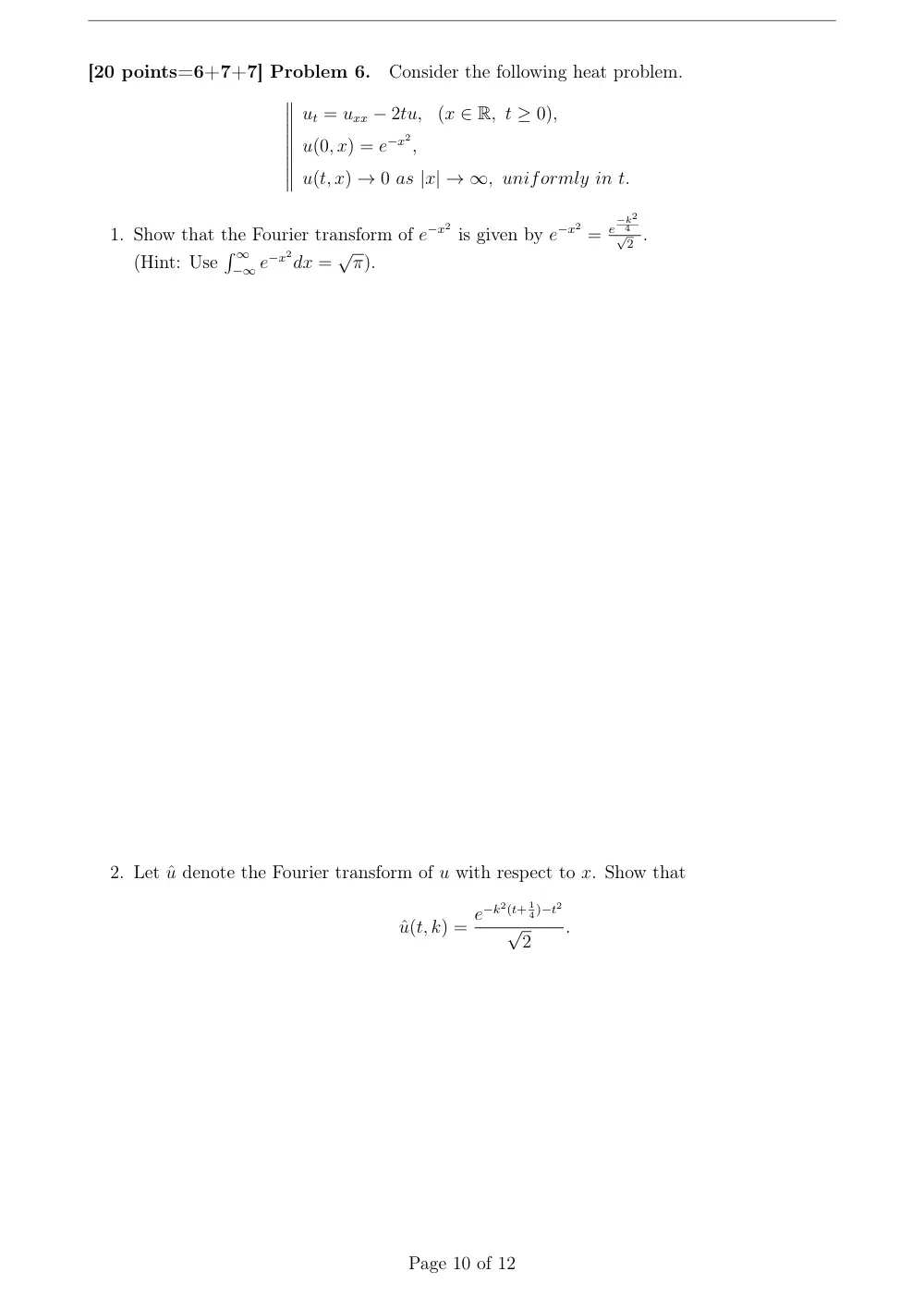
[20 points=6+7+7] Problem 6.
Consider the following heat problem.
��������
ut = uxx − 2tu,
(x ∈ R, t ≥ 0),
u(0, x) = e−x2,
u(t, x) → 0 as |x| → ∞, uniformly in t.
1. Show that the Fourier transform of e−x2 is given by e−x2 = e
−k2
4
√
2 .
(Hint: Use
� ∞
−∞ e−x2dx = √π).
2. Let ˆu denote the Fourier transform of u with respect to x. Show that
ˆu(t, k) = e−k2(t+ 1
4 )−t2
√
2
.
Page 10 of 12
3. Show that the solution is given by
u(t, x) = e−t2
√π
� ∞
0
e−k2(t+ 1
4 )cos(kx)dx.
[10 points=6+4] Problem 7.
Let f(x) = sin x for 0 ≤ x < π.
(a) Expand the function f(x) = sin x in a Fourier cosine series in the range 0 ≤ x < π.
Page 11 of 12
(b) Use the series to evaluate the sum
∞
�
k=1
1
4k2 − 1.
Page 12 of 12