
MATH 212 Homework 1 Chapter 1, Fall 2014
American University of Beirut · Introductory Partial Differential Equations · 2 pages
More MATH 212 files
- Final · Spring 2016Final examView
- Homework Assignment 1 Solutions · Fall 2016Homework · with solutionView
- Useful File Selected Solutions for Introduction to Partial Differential Equation · Fall 2016File · with solutionView
- Exam 1 · Fall 2016ExamView
- Exam 1 · Fall 2016ExamView
- Homework Assignment 7 Questions · Fall 2016HomeworkView
- Exam 1 · Spring 2016ExamView
- Homework Solution of Assignment 1 · Fall 2016Homework · with solutionView
Show the text of this chapter
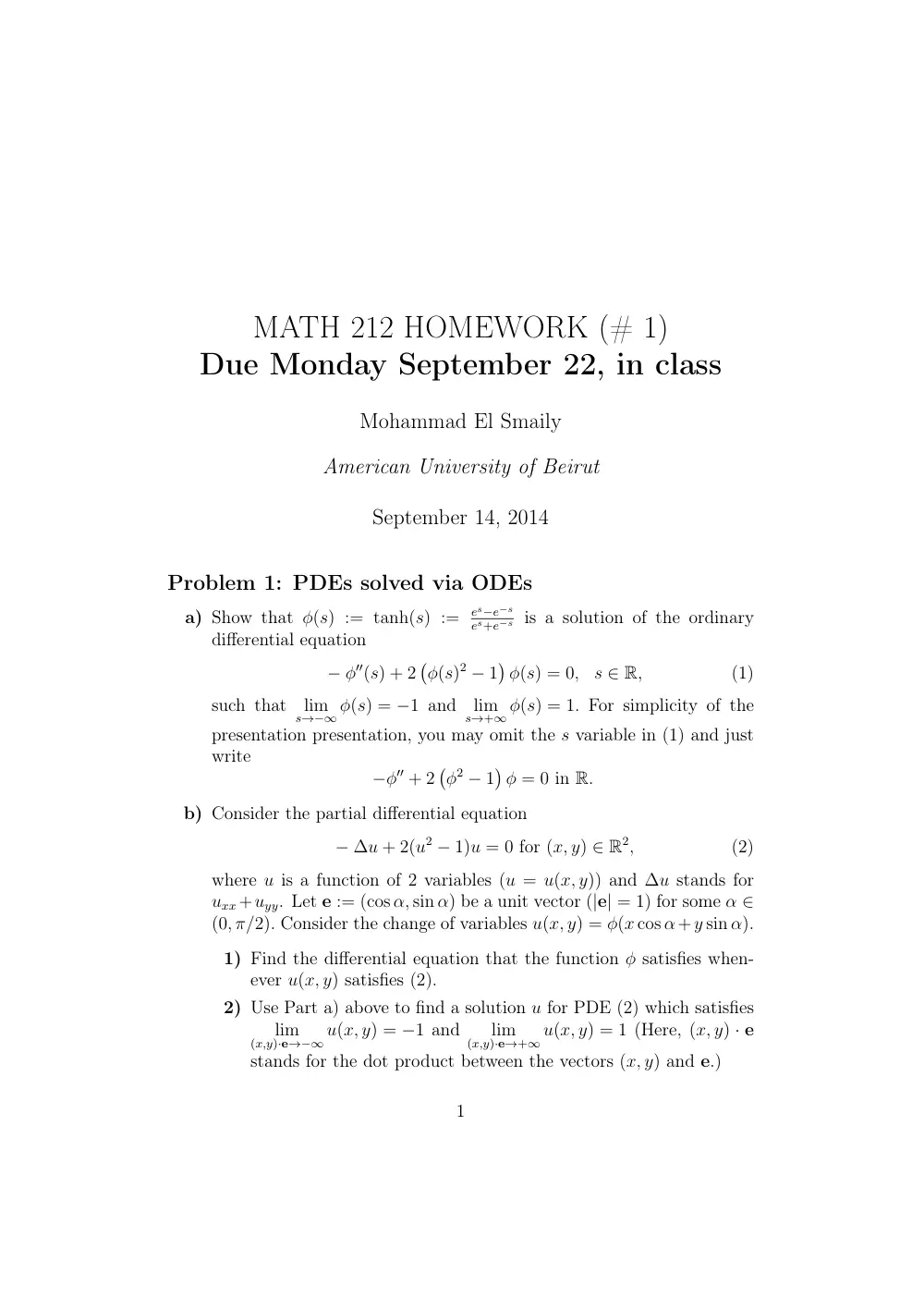
MATH 212 HOMEWORK (# 1)
Due Monday September 22, in class
Mohammad El Smaily
American University of Beirut
September 14, 2014
Problem 1: PDEs solved via ODEs
a) Show that φ(s) := tanh(s) :=
es−e−s
es+e−s is a solution of the ordinary
differential equation
− φ00(s) + 2
�
φ(s)2 − 1
�
φ(s) = 0,
s 2 R,
(1)
such that
lim
s!−1 φ(s) = −1 and
lim
s!+1 φ(s) = 1. For simplicity of the
presentation presentation, you may omit the s variable in (1) and just
write
−φ00 + 2
�
φ2 − 1
�
φ = 0 in R.
b) Consider the partial differential equation
− ∆u + 2(u2 − 1)u = 0 for (x, y) 2 R2,
(2)
where u is a function of 2 variables (u = u(x, y)) and ∆u stands for
uxx +uyy. Let e := (cos ↵, sin ↵) be a unit vector (|e| = 1) for some ↵ 2
(0, ⇡/2). Consider the change of variables u(x, y) = φ(x cos ↵+y sin ↵).
1) Find the differential equation that the function φ satisfies when-
ever u(x, y) satisfies (2).
2) Use Part a) above to find a solution u for PDE (2) which satisfies
lim
(x,y)·e!−1 u(x, y) = −1 and
lim
(x,y)·e!+1 u(x, y) = 1 (Here, (x, y) · e
stands for the dot product between the vectors (x, y) and e.)
1
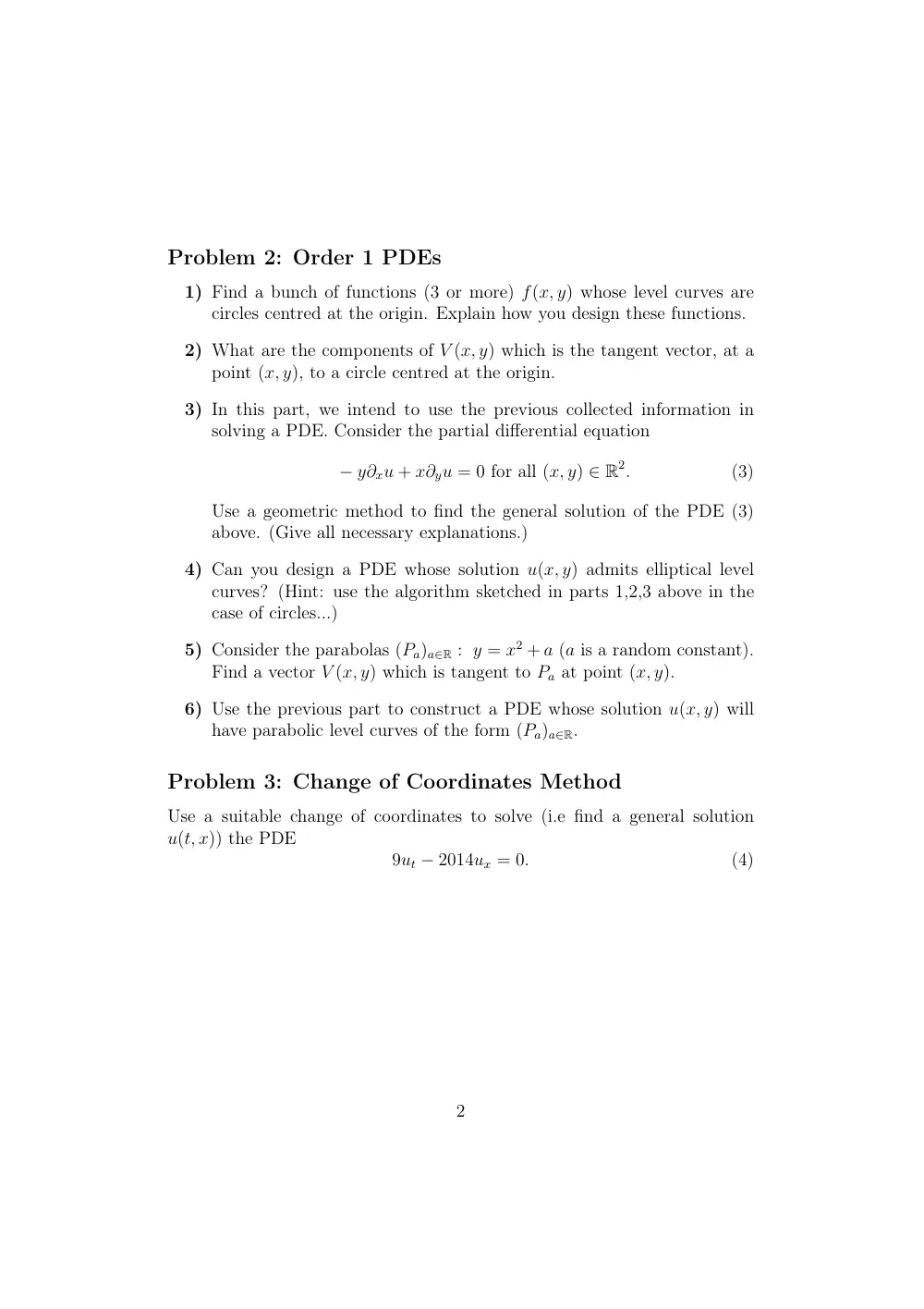
Problem 2: Order 1 PDEs
1) Find a bunch of functions (3 or more) f(x, y) whose level curves are
circles centred at the origin. Explain how you design these functions.
2) What are the components of V (x, y) which is the tangent vector, at a
point (x, y), to a circle centred at the origin.
3) In this part, we intend to use the previous collected information in
solving a PDE. Consider the partial differential equation
− y@xu + x@yu = 0 for all (x, y) 2 R2.
(3)
Use a geometric method to find the general solution of the PDE (3)
above. (Give all necessary explanations.)
4) Can you design a PDE whose solution u(x, y) admits elliptical level
curves? (Hint: use the algorithm sketched in parts 1,2,3 above in the
case of circles...)
5) Consider the parabolas (Pa)a2R : y = x2 + a (a is a random constant).
Find a vector V (x, y) which is tangent to Pa at point (x, y).
6) Use the previous part to construct a PDE whose solution u(x, y) will
have parabolic level curves of the form (Pa)a2R.
Problem 3: Change of Coordinates Method
Use a suitable change of coordinates to solve (i.e find a general solution
u(t, x)) the PDE
9ut − 2014ux = 0.
(4)
2