
MATH 214 Exam 2, Fall 2018
American University of Beirut · Topology I · 2 pages · Dr. Richard Aoun
More MATH 214 files
Show the text of this exam
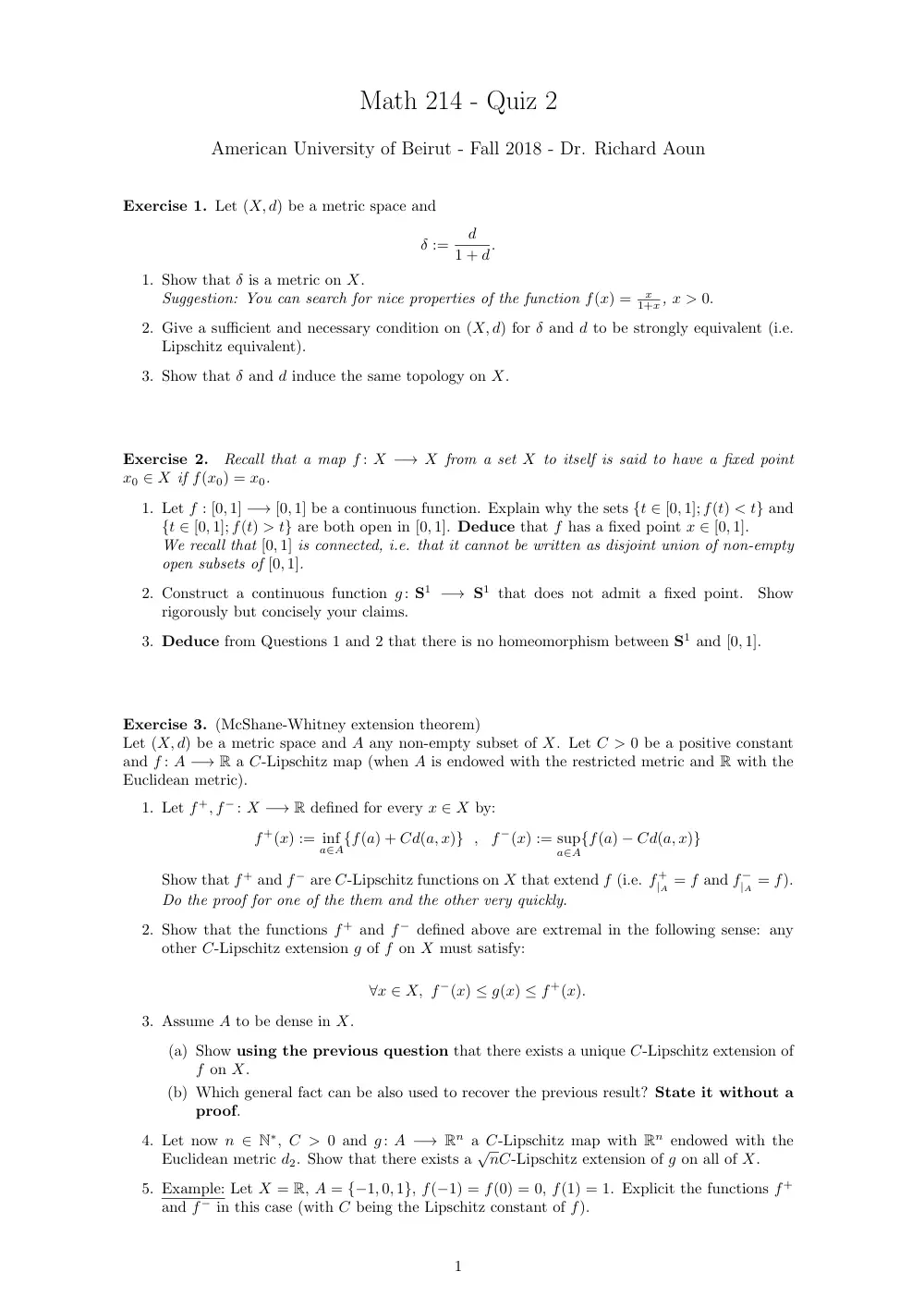
Math 214 - Quiz 2
American University of Beirut - Fall 2018 - Dr. Richard Aoun
Exercise 1. Let (X, d) be a metric space and
δ :=
d
1 + d.
1. Show that δ is a metric on X.
Suggestion: You can search for nice properties of the function f(x) =
x
1+x, x > 0.
2. Give a sufficient and necessary condition on (X, d) for δ and d to be strongly equivalent (i.e.
Lipschitz equivalent).
3. Show that δ and d induce the same topology on X.
Exercise 2.
Recall that a map f : X −→ X from a set X to itself is said to have a fixed point
x0 ∈ X if f(x0) = x0.
1. Let f : [0, 1] −→ [0, 1] be a continuous function. Explain why the sets {t ∈ [0, 1]; f(t) < t} and
{t ∈ [0, 1]; f(t) > t} are both open in [0, 1]. Deduce that f has a fixed point x ∈ [0, 1].
We recall that [0, 1] is connected, i.e. that it cannot be written as disjoint union of non-empty
open subsets of [0, 1].
2. Construct a continuous function g: S1 −→ S1 that does not admit a fixed point.
Show
rigorously but concisely your claims.
3. Deduce from Questions 1 and 2 that there is no homeomorphism between S1 and [0, 1].
Exercise 3. (McShane-Whitney extension theorem)
Let (X, d) be a metric space and A any non-empty subset of X. Let C > 0 be a positive constant
and f : A −→ R a C-Lipschitz map (when A is endowed with the restricted metric and R with the
Euclidean metric).
1. Let f +, f − : X −→ R defined for every x ∈ X by:
f +(x) := inf
a∈A{f(a) + Cd(a, x)} ,
f −(x) := sup
a∈A
{f(a) − Cd(a, x)}
Show that f + and f − are C-Lipschitz functions on X that extend f (i.e. f +
|A = f and f −
|A = f).
Do the proof for one of the them and the other very quickly.
2. Show that the functions f + and f − defined above are extremal in the following sense: any
other C-Lipschitz extension g of f on X must satisfy:
∀x ∈ X, f −(x) ≤ g(x) ≤ f +(x).
3. Assume A to be dense in X.
(a) Show using the previous question that there exists a unique C-Lipschitz extension of
f on X.
(b) Which general fact can be also used to recover the previous result? State it without a
proof.
4. Let now n ∈ N∗, C > 0 and g: A −→ Rn a C-Lipschitz map with Rn endowed with the
Euclidean metric d2. Show that there exists a √nC-Lipschitz extension of g on all of X.
5. Example: Let X = R, A = {−1, 0, 1}, f(−1) = f(0) = 0, f(1) = 1. Explicit the functions f +
and f − in this case (with C being the Lipschitz constant of f).
1
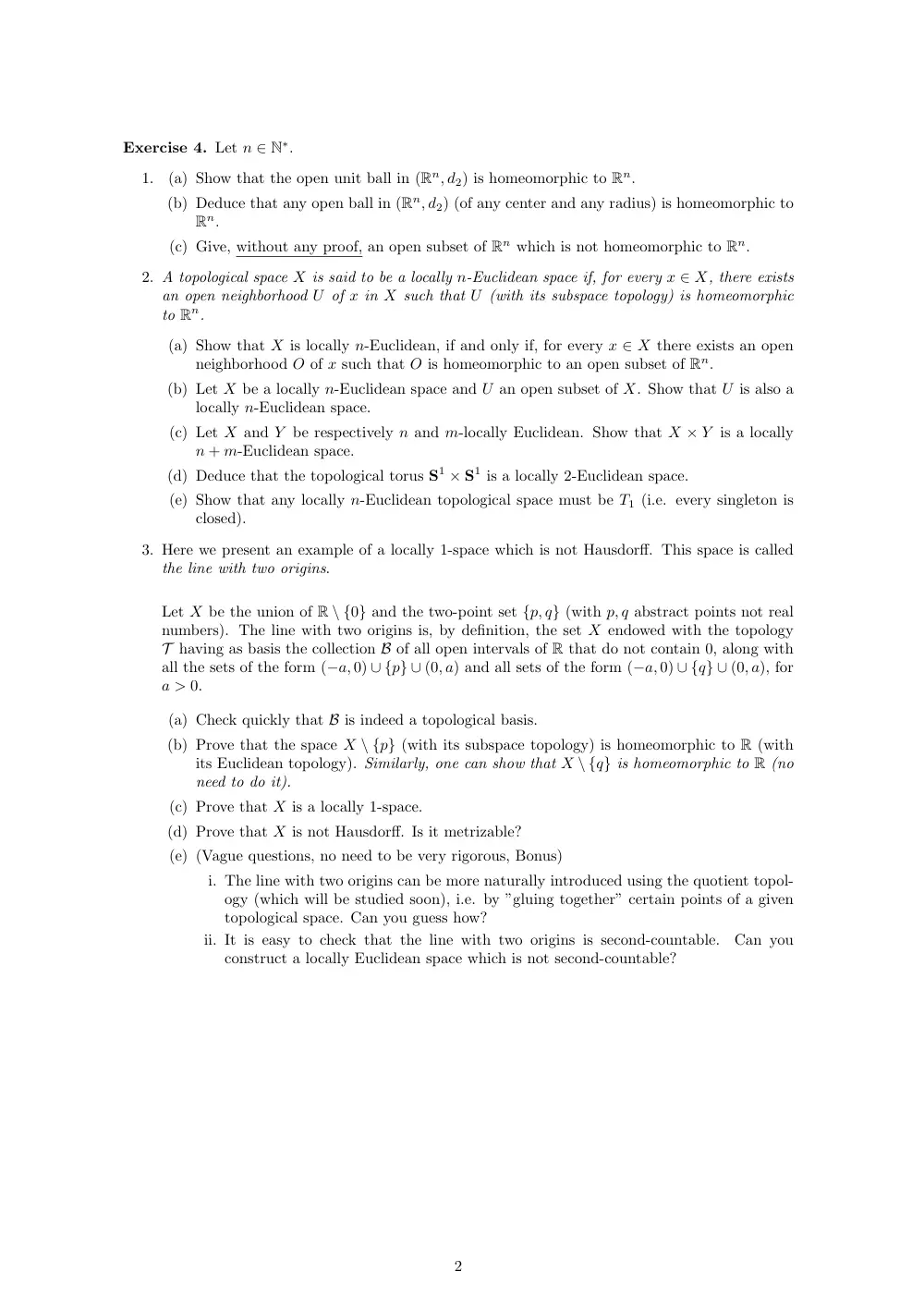
Exercise 4. Let n ∈ N∗.
1.
(a) Show that the open unit ball in (Rn, d2) is homeomorphic to Rn.
(b) Deduce that any open ball in (Rn, d2) (of any center and any radius) is homeomorphic to
Rn.
(c) Give, without any proof, an open subset of Rn which is not homeomorphic to Rn.
2. A topological space X is said to be a locally n-Euclidean space if, for every x ∈ X, there exists
an open neighborhood U of x in X such that U (with its subspace topology) is homeomorphic
to Rn.
(a) Show that X is locally n-Euclidean, if and only if, for every x ∈ X there exists an open
neighborhood O of x such that O is homeomorphic to an open subset of Rn.
(b) Let X be a locally n-Euclidean space and U an open subset of X. Show that U is also a
locally n-Euclidean space.
(c) Let X and Y be respectively n and m-locally Euclidean. Show that X × Y is a locally
n + m-Euclidean space.
(d) Deduce that the topological torus S1 × S1 is a locally 2-Euclidean space.
(e) Show that any locally n-Euclidean topological space must be T1 (i.e. every singleton is
closed).
3. Here we present an example of a locally 1-space which is not Hausdorff. This space is called
the line with two origins.
Let X be the union of R \ {0} and the two-point set {p, q} (with p, q abstract points not real
numbers). The line with two origins is, by definition, the set X endowed with the topology
T having as basis the collection B of all open intervals of R that do not contain 0, along with
all the sets of the form (−a, 0) ∪ {p} ∪ (0, a) and all sets of the form (−a, 0) ∪ {q} ∪ (0, a), for
a > 0.
(a) Check quickly that B is indeed a topological basis.
(b) Prove that the space X \ {p} (with its subspace topology) is homeomorphic to R (with
its Euclidean topology). Similarly, one can show that X \ {q} is homeomorphic to R (no
need to do it).
(c) Prove that X is a locally 1-space.
(d) Prove that X is not Hausdorff. Is it metrizable?
(e) (Vague questions, no need to be very rigorous, Bonus)
i. The line with two origins can be more naturally introduced using the quotient topol-
ogy (which will be studied soon), i.e. by ”gluing together” certain points of a given
topological space. Can you guess how?
ii. It is easy to check that the line with two origins is second-countable.
Can you
construct a locally Euclidean space which is not second-countable?
2