
MATH 223 Final, Fall 1996
American University of Beirut · Advanced Calculus · 1 page
Stuck on a question? A tutor can walk you through it.
More MATH 223 files
Show the text of this final exam
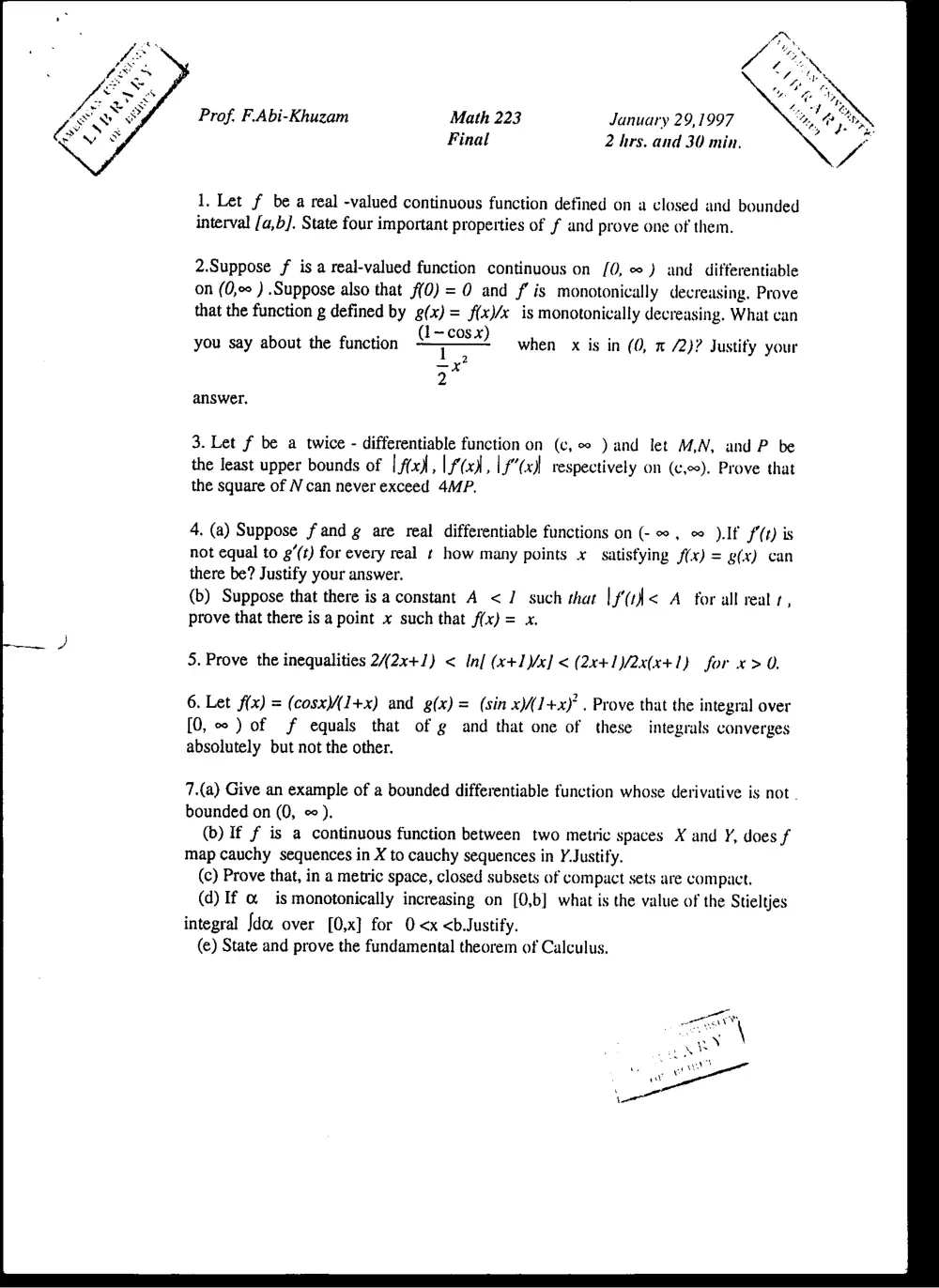
Prof. F.Abi-Khuzam Math 223 January 29,1997
Final 2 hrs. and 30 min.
1. Let f be a real -valued continuous function defined on a closed and bounded
interval [a,b]. State four important properties of f and prove one of them.
2.Suppose f is a real-valued function continuous on 0, «© ) and differentiable
on (0,c¢ ) .Suppose also that (0) = 0 and f is monotonically decreasing. Prove
that the function g defined by g(x) = f(x)/x is monotonically decreasing. What can
you say about the function Gr cos)
2
—x
2
when x is in (0, m /2)? Justify your
answer.
3. Let f be a twice - differentiable function on (c, ee ) and let M,N, and P be
the least upper bounds of | f(xJ, | fA, AS Od respectively on (c,c). Prove that
the square of N can never exceed 4MP.
4. (a) Suppose f and g are real differentiable functions on (- 0 , © ).If f(t) is
not equal to g(t) for every real ¢ how many points x satisfying f(x) = e(x) can
there be? Justify your answer.
(b) Suppose that there is a constant A </ such that |f(t]< A for all reals,
prove that there is a point x such that f(x) = x.
5. Prove the inequalities 242x+1) < Inf (x+1 xu] < (2x+1)/2x(x+1) for x>0.
6. Let f(x) = (cosx)M1+x) and g(x) = (sin x1 +x) . Prove that the integral over
[0, e ) of f equals that of g and that one of these integrals converges
absolutely but not the other.
7.(a) Give an example of a bounded differentiable function whose derivative is not .
bounded on (0, °).
(b) If f is a continuous function between two metric spaces X and Y, does f
map cauchy sequences in X to cauchy sequences in Y.Justify.
(c) Prove that, in a metric space, closed subsets of compact sets are compact.
(d) If & is monotonically increasing on [0,b] what is the value of the Stieltjes
integral Jdcr over [0,x] for 0 <x <b.Justify.
(e) State and prove the fundamental theorem of Calculus.