
MATH 223 Final, Fall 2005
American University of Beirut · Advanced Calculus · 2 pages

More MATH 223 files
Show the text of this final exam
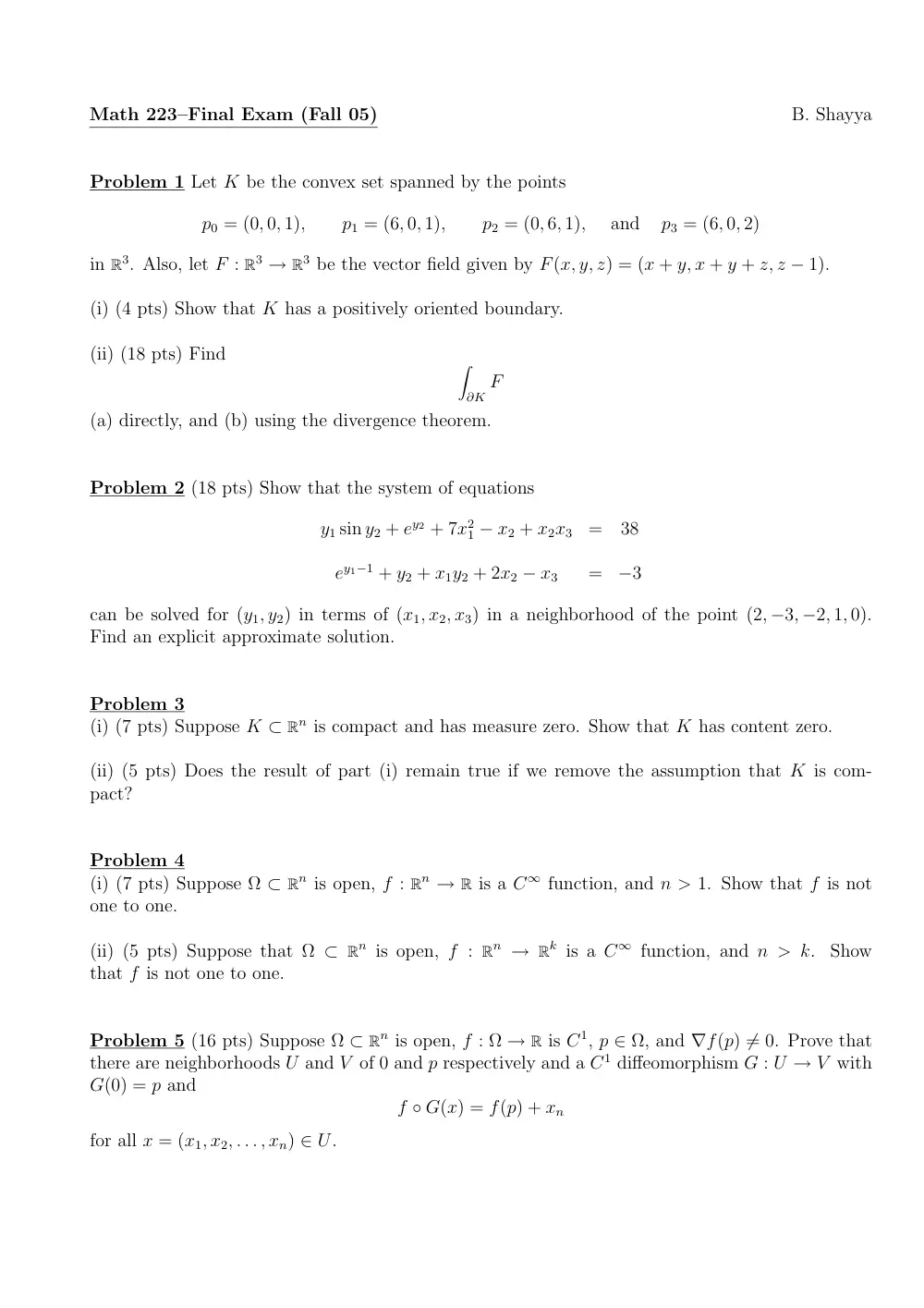
Math 223–Final Exam (Fall 05)
B. Shayya
Problem 1 Let K be the convex set spanned by the points
p0 = (0, 0, 1),
p1 = (6, 0, 1),
p2 = (0, 6, 1),
and
p3 = (6, 0, 2)
in R3. Also, let F : R3 → R3 be the vector field given by F(x, y, z) = (x + y, x + y + z, z − 1).
(i) (4 pts) Show that K has a positively oriented boundary.
(ii) (18 pts) Find
�
∂K F
(a) directly, and (b) using the divergence theorem.
Problem 2 (18 pts) Show that the system of equations
y1 sin y2 + ey2 + 7x2
1 − x2 + x2x3
=
38
ey1−1 + y2 + x1y2 + 2x2 − x3
=
−3
can be solved for (y1, y2) in terms of (x1, x2, x3) in a neighborhood of the point (2, −3, −2, 1, 0).
Find an explicit approximate solution.
Problem 3
(i) (7 pts) Suppose K ⊂ Rn is compact and has measure zero. Show that K has content zero.
(ii) (5 pts) Does the result of part (i) remain true if we remove the assumption that K is com-
pact?
Problem 4
(i) (7 pts) Suppose Ω ⊂ Rn is open, f : Rn → R is a C∞ function, and n > 1. Show that f is not
one to one.
(ii) (5 pts) Suppose that Ω ⊂ Rn is open, f : Rn → Rk is a C∞ function, and n > k.
Show
that f is not one to one.
Problem 5 (16 pts) Suppose Ω ⊂ Rn is open, f : Ω → R is C1, p ∈ Ω, and ∇f(p) ̸= 0. Prove that
there are neighborhoods U and V of 0 and p respectively and a C1 diffeomorphism G : U → V with
G(0) = p and
f ◦ G(x) = f(p) + xn
for all x = (x1, x2, . . . , xn) ∈ U.
Problem 6 Let
U = {(u, v, r, s) ∈ R4 : 0 < v < u < π
2 and 0 < s < r}.
For (u, v, r, s) ∈ U, define
G(u, v, r, s) =
�
r cos u + s cos v, r sin u + s sin v, r2 + s2, arctan r
s
�
.
(i) (4 pts) Prove that G is 1-1.
(ii) (4 pts) Find JG.
(iii) (4 pts) Let X = G(U). Show that X is an open subset of R4 and that G : U → X is a
C1 diffeomorphism.
(v) (8 pts) Suppose ∆ ⊂ U is compact, the topological boundaries of ∆ and G(∆) have content
zero, f, F : R4 → R are continuous functions, and
�
G(∆) F(x, y, z, w) dxdydzdw =
�
∆ f ◦ G(u, v, r, s) dudvdrds.
Find F(x, y, z, w) in terms of f(x, y, z, w).
Hint. If (x, y, z, w) = G(u, v, r, s), then
x2 + y2 = r2 + s2 + 2rs cos(u − v),
r = √z sin w,
and
s = √z cos w.
Also, if 0 ≤ θ ≤ π/2, then
sin θ =
�
(1 − cos θ)(1 + cos θ).