
MATH 223 Final, Fall 2000
American University of Beirut · Advanced Calculus · 3 pages
More MATH 223 files
Show the text of this final exam
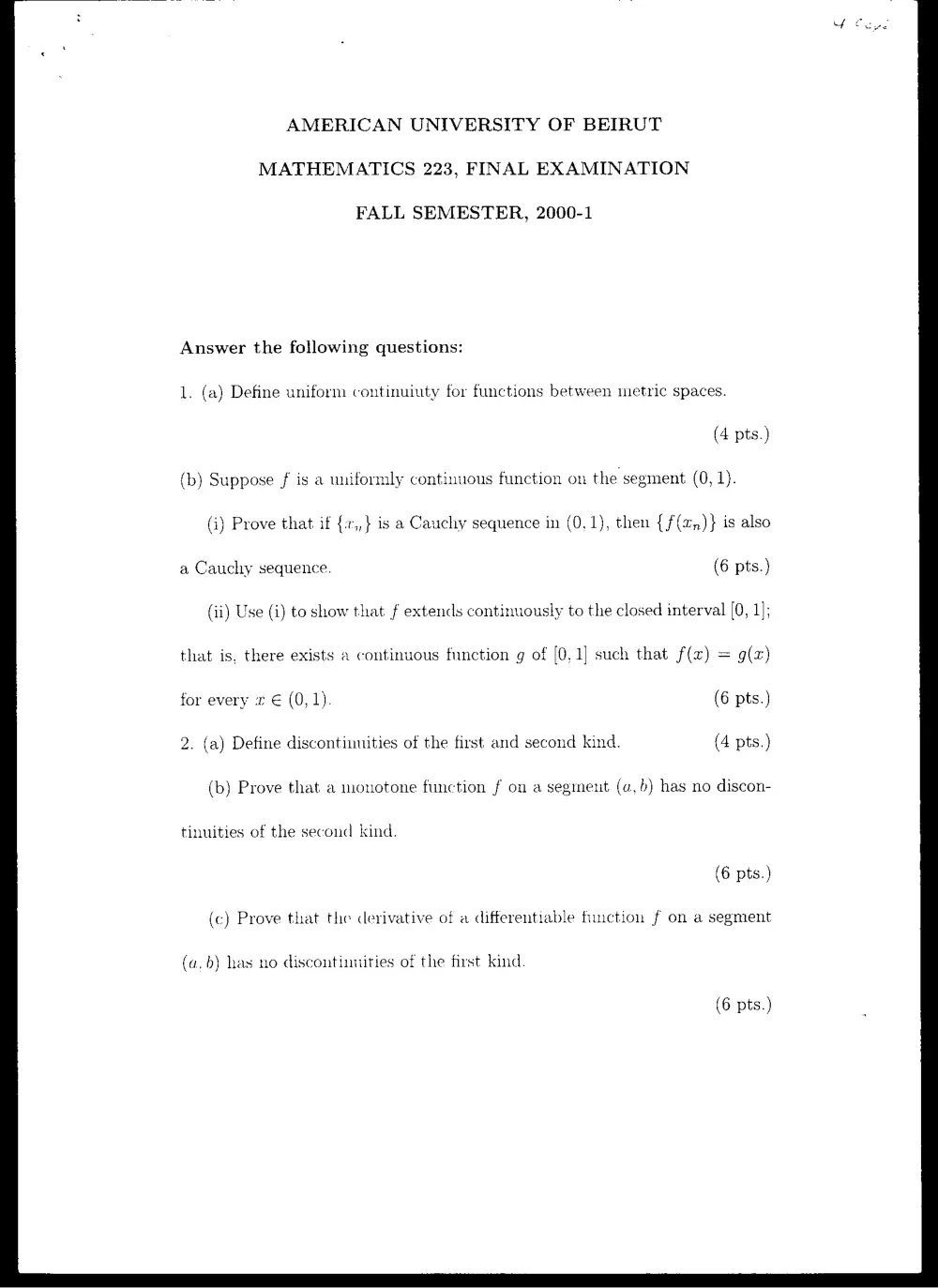
AMERICAN UNIVERSITY OF BEIRUT
MATHEMATICS 223, FINAL EXAMINATION
FALL SEMESTER, 2000-1
Answer the following questions:
1. (a) Define uniform continuiuty for functions between metric spaces.
(4 pts.)
(b) Suppose f is a uniformly continuous function on the segment (0, 1).
(i) Prove that if {:,,} is a Cauchy sequence in (0,1), then {f(an)} is also
a Cauchy sequence. (6 pts.)
(ii) Use (i) to show that f extends continuously to the closed interval (0, 1];
that is, there exists a continuous function g of [0,1] such that f(z) = g(x)
for every x € (0,1). (6 pts.)
2. (a) Define discontinuities of the first and second kind. (4 pts.)
(b) Prove that a monotone function f on a segment (a,b) has no discon-
tinuities of the secoud kind.
(6 pts.)
(c) Prove that the derivative of a differentiable function f on a segment
(a,b) has no discontinuities of the first kind.
(6 pts.)
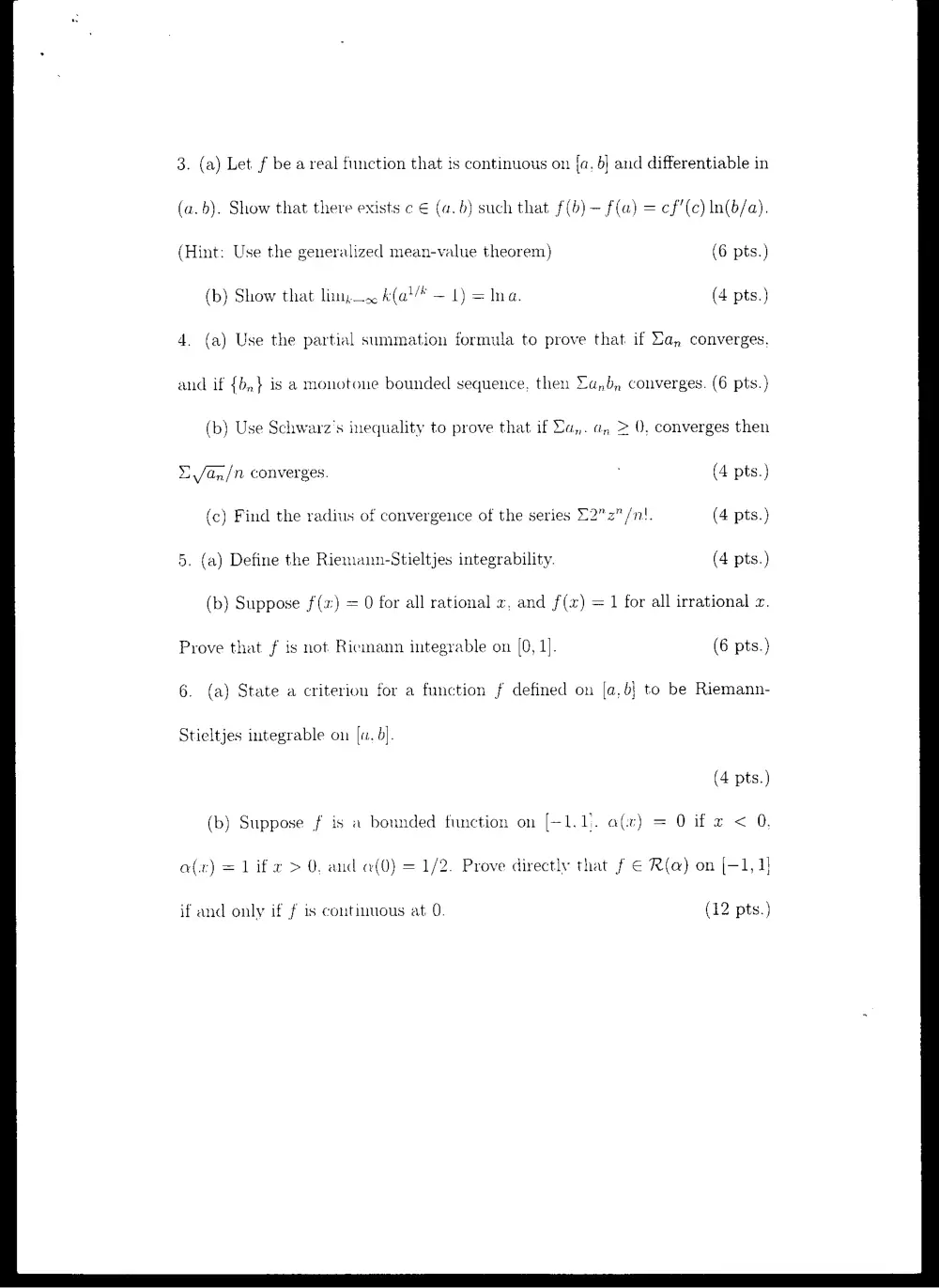
3. (a) Let. f be a real fiction that is continuous on {a. 5] and differentiable in
(a.b). Show that there exists c € (a.b) such that f(6)— f(a) = cf'(c) In(b/a).
(Hint: Use the generalized mean-value theorem) (6 pts.)
(b) Show that lim,—. A(al/* - 1) = Ina. (4 pts.)
4. (a) Use the partial summation formula to prove that if Xa, converges.
and if {b,} is a monotoue bounded sequence, then La,,b, converges. (6 pts.)
(b) Use Schwarz’s inequality to prove that if La,,. a, > 0, converges then
UVa, /n converges. : (4 pts.)
(c) Find the radius of convergence of the series 2"2"/n!. (4 pts.)
5. (a) Define the Riemann-Stieltjes integrability. (4 pts.)
(b) Suppose f(x) = 0 for all rational x, and f(x) = 1 for all irrational z.
Prove that f is not Ricmann integrable on [0, 1]. (6 pts.)
6. (a) State a criterion for a function f defined on [a,b] to be Riemann-
Stieltjes integrable on [c. b].
(4 pts.)
(b) Suppose f is a bounded function on [—1.1. ar) = 0 if < 0,
a(x) =1ifa > 0, and a(0) = 1/2. Prove directly that f € R(a) on [-1, 1]
1
if and only if f is continuous at 0. (12 pts.)
=
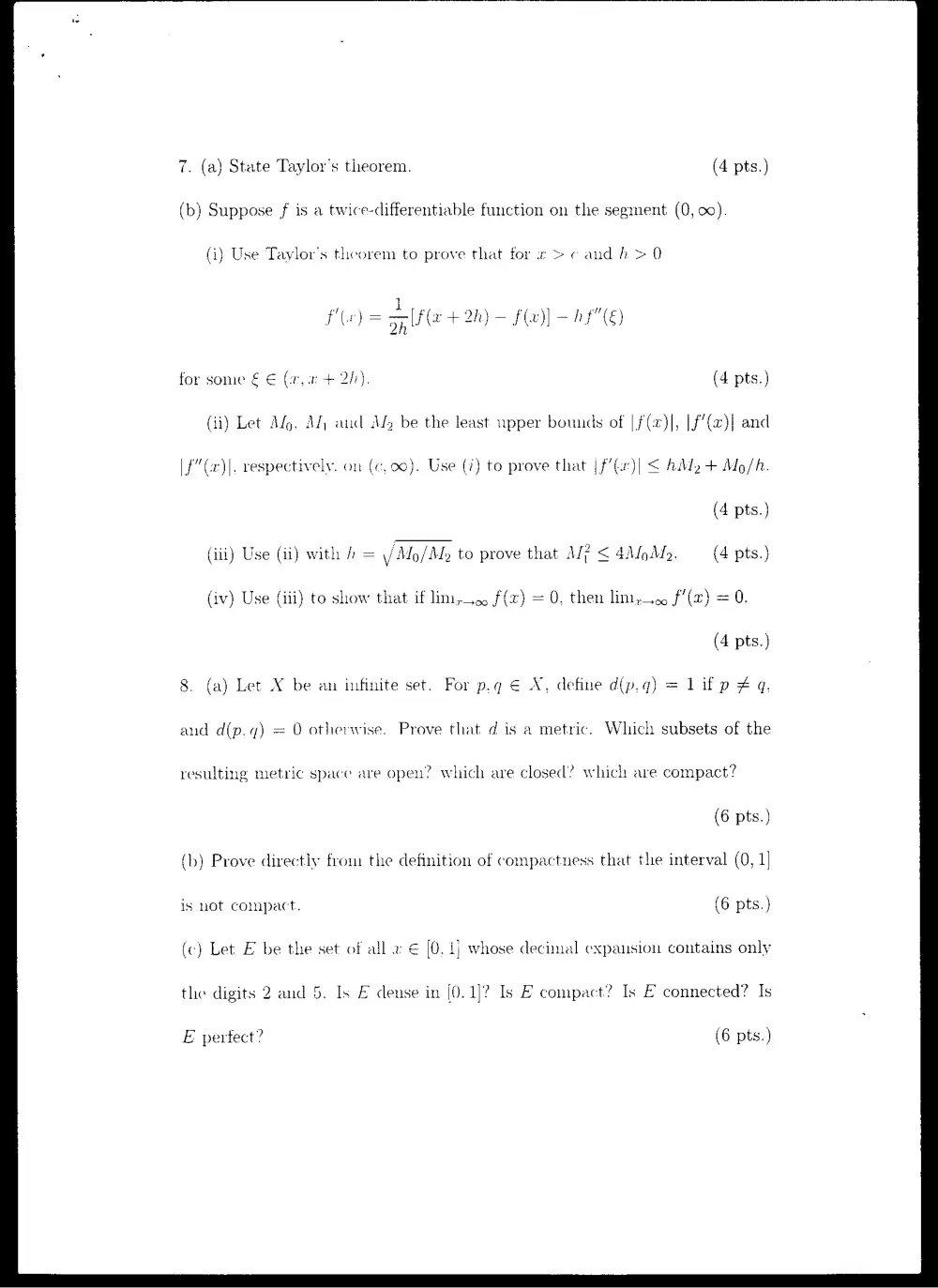
7. (a) State Taylor's theorem. (4 pts.)
(b) Suppose f is a twice-differentiable function on the segment (0, 00).
(i) Use Taylor's theorem to prove that for x > ¢ aud h > 0
fr) = srlfla + 2h) — fay) = a P"()
for some € € (ra + 2h). (4 pts.)
(ii) Let Afo. AL) and Af, be the least upper bounds of | f(x), [f(a] and
| f(z) |. respectively. on (c,00). Use (/) to prove that |f’(r)| < AM + Mo/h.
(4 pts.)
(iil) Use (ii) with = yf Mo/Me to prove that AJ? < 4\fgMo. (4 pts.)
(iv) Use (iii) to show that if lim, f(z) = 0, then lim, f’(2) = 0.
(4 pts.)
8. (a) Let X be an infinite set. For p.q € NX, define d(p,q) = Lif p 4 q,
aud d(p.q) = 0 otherwise. Prove that dis a metric. Which subsets of the
resulting metric space are open? which are closed? which are compact?
(6 pts.)
(b) Prove directly from the definition of compactness that the interval (0, 1]
is not compact. (6 pts.)
(c) Let E be the set of all 2 € (0.1) whose decimal expansion contains only
the digits 2 and 5. Is £ dense in [0.1]? Is E compact? Is E connected? Is
E perfect? (6 pts.)