
MATH 223 Final, Fall 2000
American University of Beirut · Advanced Calculus · 2 pages
More MATH 223 files
Show the text of this final exam
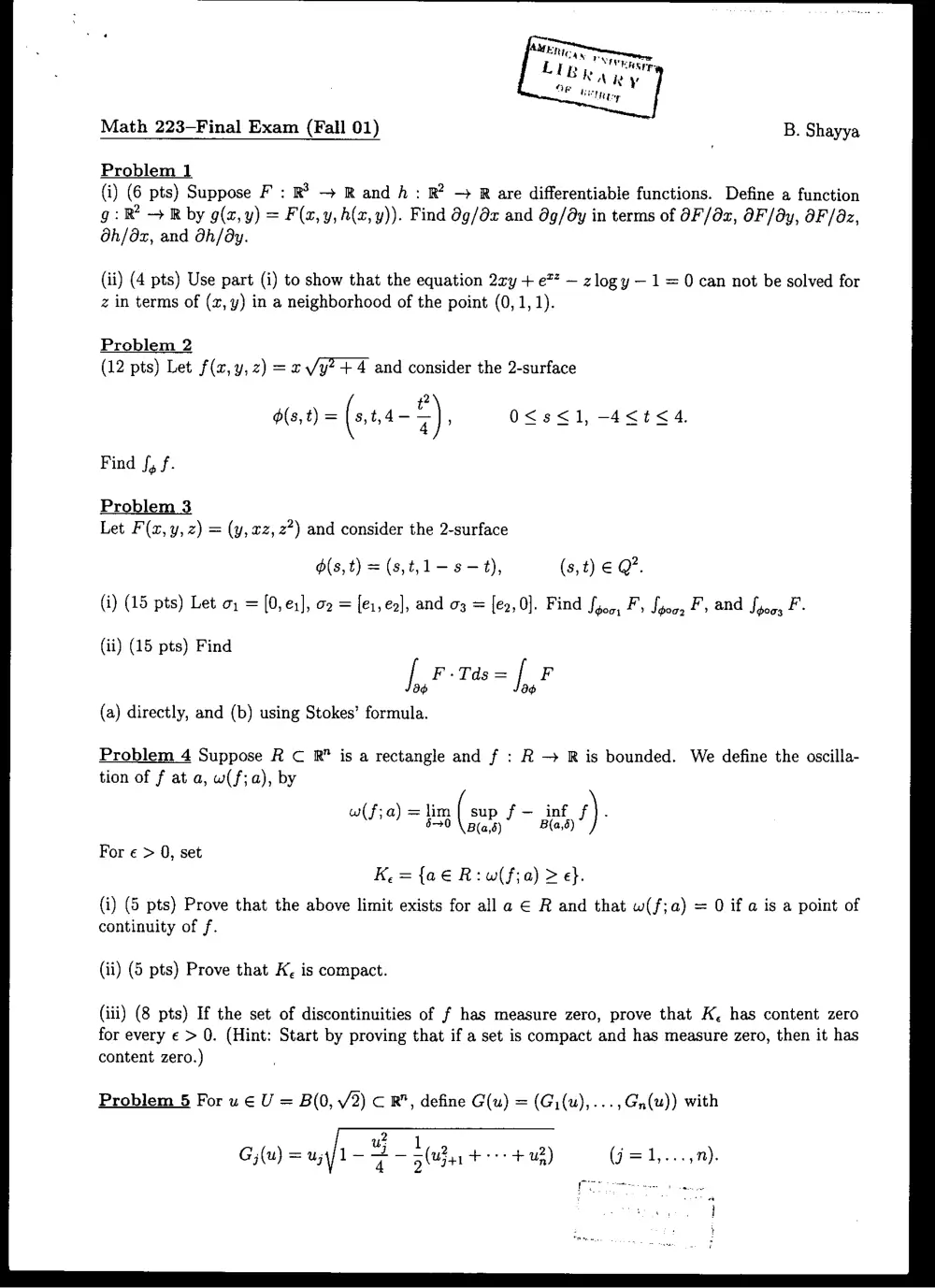
Math 223—Final Exam (Fall 01) B. Shayya
Problem 1
(i) (6 pts) Suppose F : R® + R and h: R — R are differentiable functions. Define a function
g: ® + R by o(z,y) = F(z,y,h(z,y)). Find O9/Ox and Og/Oy in terms of OF /Oz, OF /dy, OF /dz,
Oh/Ax, and Oh/dy.
(ii) (4 pts) Use part (i) to show that the equation 2ry + e** — zlogy — 1 = 0 can not be solved for
z in terms of (2, y) in a neighborhood of the point (0,1, 1).
Problem 2
(12 pts) Let f(z, y,z) = z/y?+4 and consider the 2-surface
2
a) =(s04-2), 0<s<1,-4<t<4.
Find f, f.
Problem 3
Let F(z, y,z) = (y, 22,2") and consider the 2-surface
6(s,t) = (s,t,1—s—t), (s,t) € Q?.
(i) (15 pts) Let o, = [0,e1], 72 = [e1, €2], and o3 = [e2,0]. Find fxg, Fs Ssooy Fs and Syog, F-
(ii) (15 pts) Find
F-Tds= PF
ag ag
(a) directly, and (b) using Stokes’ formula.
Problem 4 Suppose R C R” is a rectangle and f : R —> R is bounded. We define the oscilla-
tion of f at a, w(f;a), by
(Fie) = tim ( sop f— inf f).
60 \ B(a,6) B(a,6)
For € > 0, set
K, = {a€ R: w(f;a) > ¢}.
(i) (5 pts) Prove that the above limit exists for all a € R and that w(f;a) = 0 if a is a point of
continuity of f.
(ii) (5 pts) Prove that K, is compact.
(iii) (8 pts) If the set of discontinuities of f has measure zero, prove that K, has content zero
for every € > 0. (Hint: Start by proving that if a set is compact and has measure zero, then it has
content zero.)
Problem 5 For u € U = B(0, V2) CR", define G(u) = (Gi (u),...,Gn(u)) with
uel, 2
Gy(u) = ul — — sup + + Us)
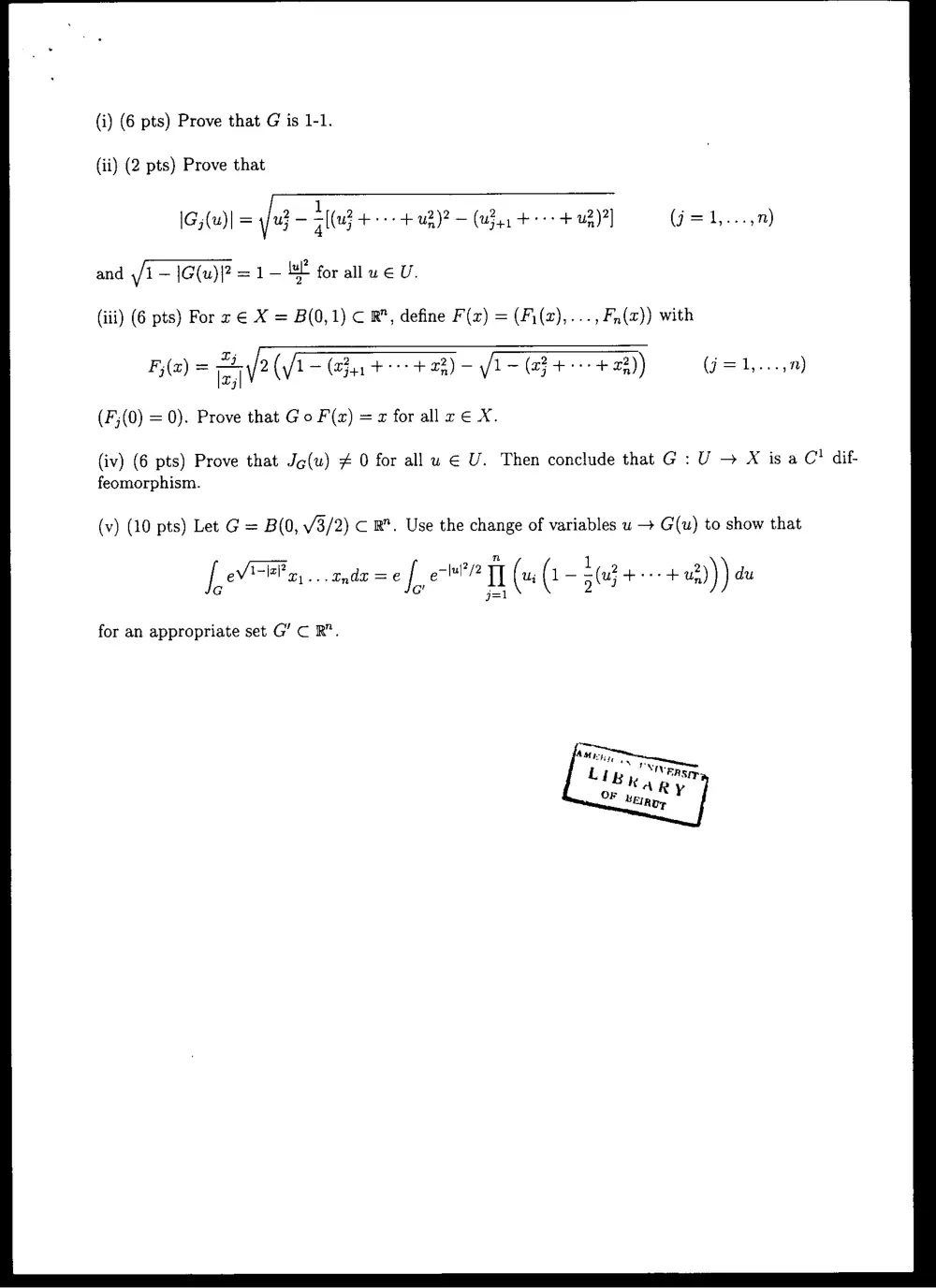
(i) (6 pts) Prove that G is 1-1.
(ii) (2 pts) Prove that
|G; (u)| = 3 - Fleg +e tua)? _ (u2
and ,/1 — |G(u)|? =1—- wl? for allue U.
(iii) (6 pts) For z € X = B(0,1) C R", define F(x) = (F((2),..., F,(z)) with
Baybee + a2) — /1~ (o2 +++ +22)
(F;(0) = 0). Prove that Go F(x) =a for allz eX.
(iv) (6 pts) Prove that Jg(u) # 0 for all wu € U. Then conclude that G: U > X is aC’ dif
feomorphism.
(v) (10 pts) Let G = B(0, V3/2) C R*. Use the change of variables u + G(u) to show that
n
fpaiie 1
Le is? o. _dt = ef e luP/2 I (u (1 = 5 (45
jel
for an appropriate set G’ C R”.