
MATH 241 Homework 1, Fall 2011
American University of Beirut · Introduction to Abstract Algebra · 6 pages · Prof. Kamal Makdisi
More MATH 241 files
Show the text of this homework
Math 241
Problem Set 1 solution manual
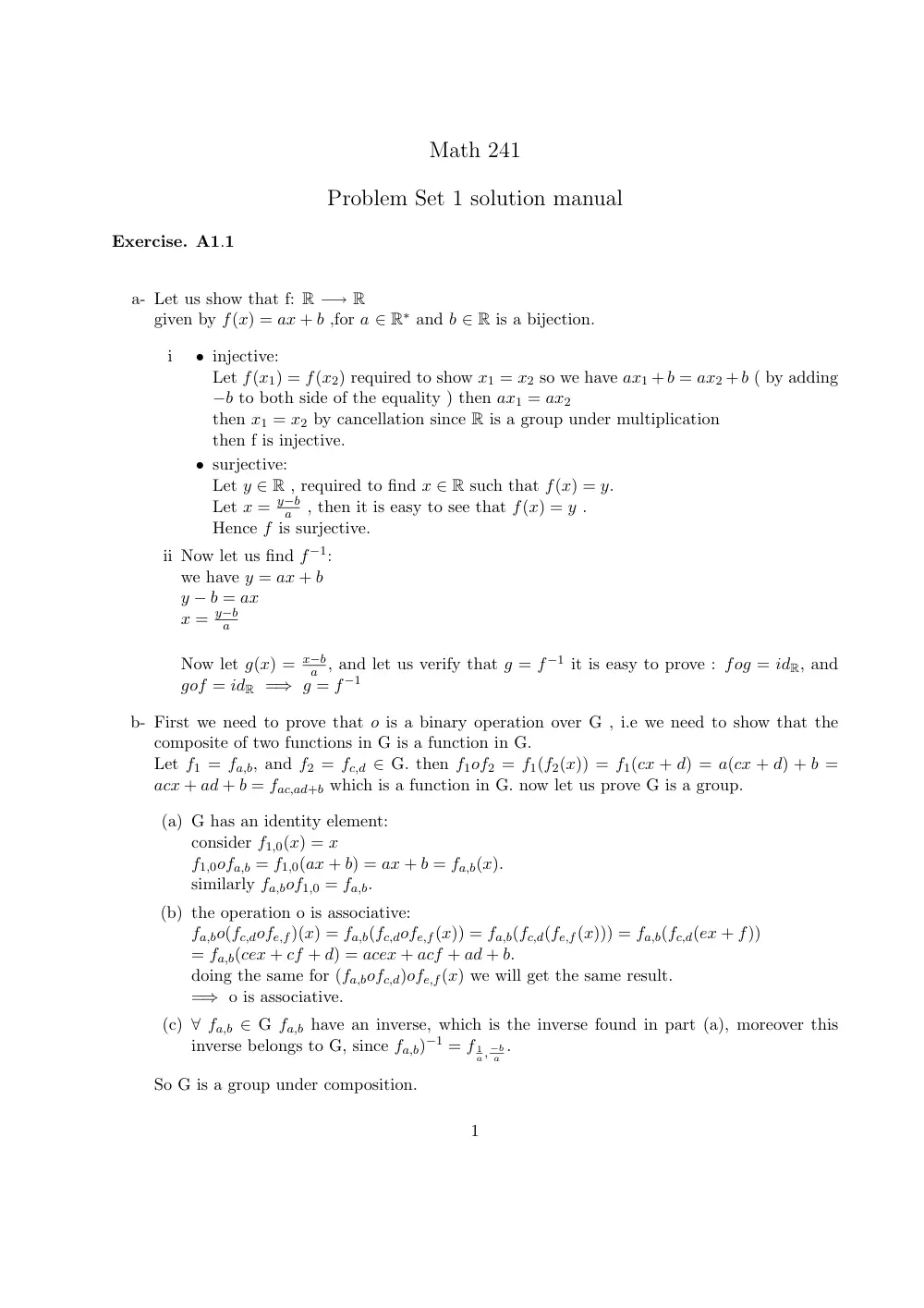
Exercise. A1.1
a- Let us show that f: R −→ R
given by f(x) = ax + b ,for a ∈ R∗ and b ∈ R is a bijection.
i
• injective:
Let f(x1) = f(x2) required to show x1 = x2 so we have ax1 + b = ax2 + b ( by adding
−b to both side of the equality ) then ax1 = ax2
then x1 = x2 by cancellation since R is a group under multiplication
then f is injective.
• surjective:
Let y ∈ R , required to find x ∈ R such that f(x) = y.
Let x = y−b
a
, then it is easy to see that f(x) = y .
Hence f is surjective.
ii Now let us find f−1:
we have y = ax + b
y − b = ax
x = y−b
a
Now let g(x) = x−b
a , and let us verify that g = f−1 it is easy to prove : fog = idR, and
gof = idR =⇒ g = f−1
b- First we need to prove that o is a binary operation over G , i.e we need to show that the
composite of two functions in G is a function in G.
Let f1 = fa,b, and f2 = fc,d ∈ G. then f1of2 = f1(f2(x)) = f1(cx + d) = a(cx + d) + b =
acx + ad + b = fac,ad+b which is a function in G. now let us prove G is a group.
(a) G has an identity element:
consider f1,0(x) = x
f1,0ofa,b = f1,0(ax + b) = ax + b = fa,b(x).
similarly fa,bof1,0 = fa,b.
(b) the operation o is associative:
fa,bo(fc,dofe,f)(x) = fa,b(fc,dofe,f(x)) = fa,b(fc,d(fe,f(x))) = fa,b(fc,d(ex + f))
= fa,b(cex + cf + d) = acex + acf + ad + b.
doing the same for (fa,bofc,d)ofe,f(x) we will get the same result.
=⇒ o is associative.
(c) ∀ fa,b ∈ G fa,b have an inverse, which is the inverse found in part (a), moreover this
inverse belongs to G, since fa,b)−1 = f 1
a, −b
a .
So G is a group under composition.
1
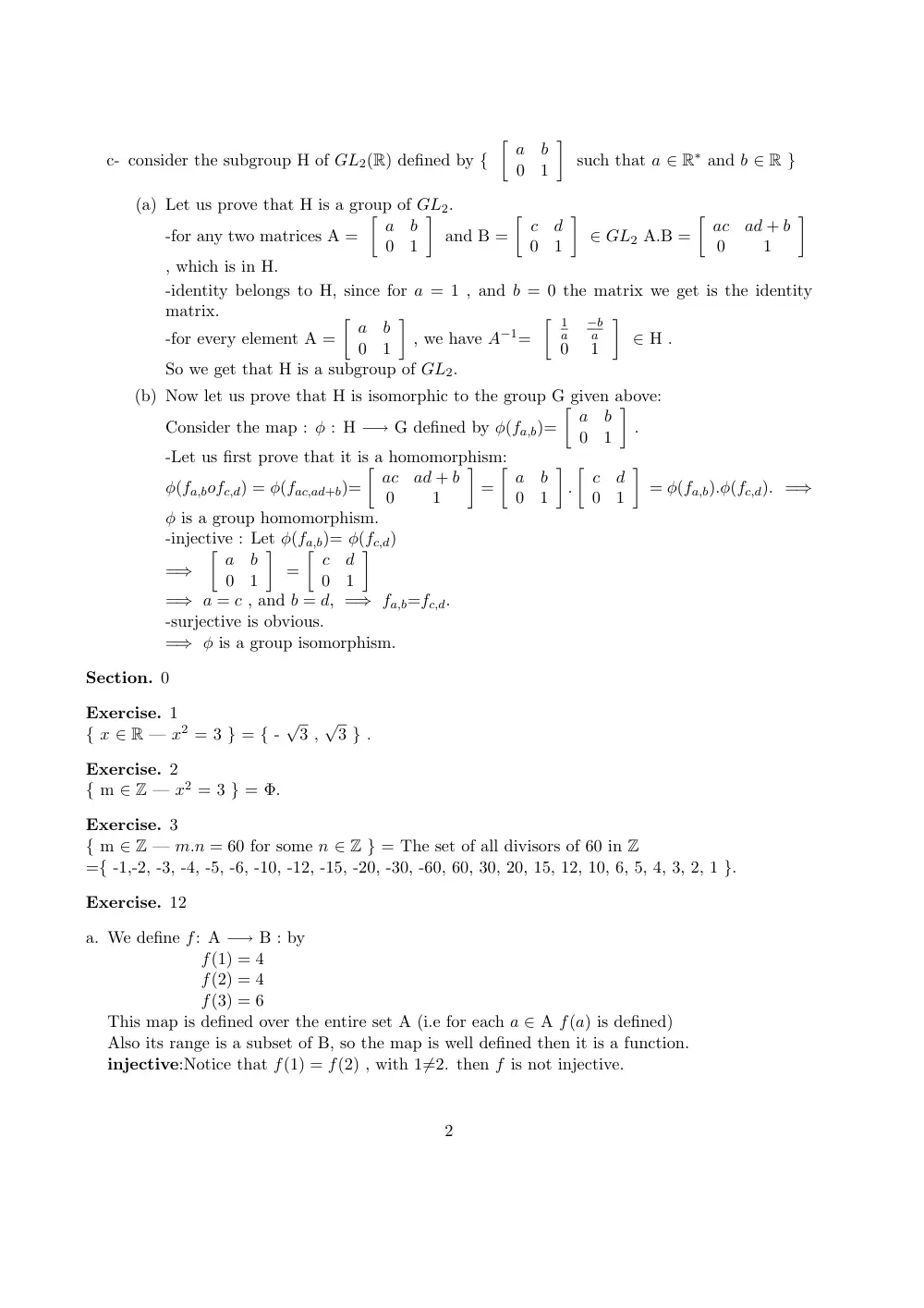
c- consider the subgroup H of GL2(R) defined by {
� a
b
0
1
�
such that a ∈ R∗ and b ∈ R }
(a) Let us prove that H is a group of GL2.
-for any two matrices A =
� a
b
0
1
�
and B =
� c
d
0
1
�
∈ GL2 A.B =
� ac
ad + b
0
1
�
, which is in H.
-identity belongs to H, since for a = 1 , and b = 0 the matrix we get is the identity
matrix.
-for every element A =
� a
b
0
1
�
, we have A−1=
� 1
a
−b
a
0
1
�
∈ H .
So we get that H is a subgroup of GL2.
(b) Now let us prove that H is isomorphic to the group G given above:
Consider the map : φ : H −→ G defined by φ(fa,b)=
� a
b
0
1
�
.
-Let us first prove that it is a homomorphism:
φ(fa,bofc,d) = φ(fac,ad+b)=
� ac
ad + b
0
1
�
=
� a
b
0
1
�
.
� c
d
0
1
�
= φ(fa,b).φ(fc,d). =⇒
φ is a group homomorphism.
-injective : Let φ(fa,b)= φ(fc,d)
=⇒
� a
b
0
1
�
=
� c
d
0
1
�
=⇒ a = c , and b = d, =⇒ fa,b=fc,d.
-surjective is obvious.
=⇒ φ is a group isomorphism.
Section. 0
Exercise. 1
{ x ∈ R — x2 = 3 } = { -
√
3 ,
√
3 } .
Exercise. 2
{ m ∈ Z — x2 = 3 } = Φ.
Exercise. 3
{ m ∈ Z — m.n = 60 for some n ∈ Z } = The set of all divisors of 60 in Z
={ -1,-2, -3, -4, -5, -6, -10, -12, -15, -20, -30, -60, 60, 30, 20, 15, 12, 10, 6, 5, 4, 3, 2, 1 }.
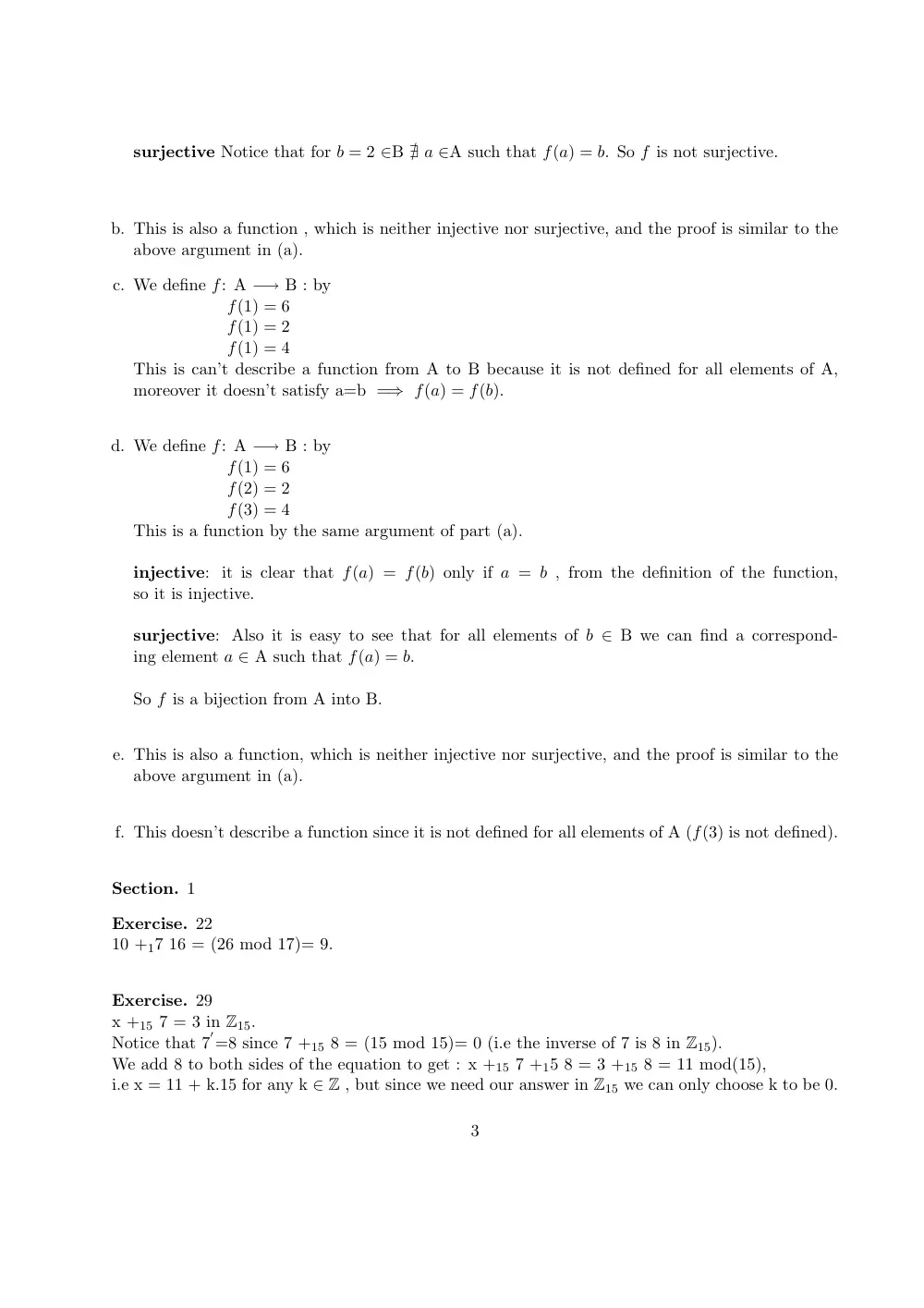
Exercise. 12
a. We define f: A −→ B : by
f(1) = 4
f(2) = 4
f(3) = 6
This map is defined over the entire set A (i.e for each a ∈ A f(a) is defined)
Also its range is a subset of B, so the map is well defined then it is a function.
injective:Notice that f(1) = f(2) , with 1̸=2. then f is not injective.
2
surjective Notice that for b = 2 ∈B ∄ a ∈A such that f(a) = b. So f is not surjective.
b. This is also a function , which is neither injective nor surjective, and the proof is similar to the
above argument in (a).
c. We define f: A −→ B : by
f(1) = 6
f(1) = 2
f(1) = 4
This is can’t describe a function from A to B because it is not defined for all elements of A,
moreover it doesn’t satisfy a=b =⇒ f(a) = f(b).
d. We define f: A −→ B : by
f(1) = 6
f(2) = 2
f(3) = 4
This is a function by the same argument of part (a).
injective: it is clear that f(a) = f(b) only if a = b , from the definition of the function,
so it is injective.
surjective: Also it is easy to see that for all elements of b ∈ B we can find a correspond-
ing element a ∈ A such that f(a) = b.
So f is a bijection from A into B.
e. This is also a function, which is neither injective nor surjective, and the proof is similar to the
above argument in (a).
f. This doesn’t describe a function since it is not defined for all elements of A (f(3) is not defined).
Section. 1
Exercise. 22
10 +17 16 = (26 mod 17)= 9.
Exercise. 29
x +15 7 = 3 in Z15.
Notice that 7
′=8 since 7 +15 8 = (15 mod 15)= 0 (i.e the inverse of 7 is 8 in Z15).
We add 8 to both sides of the equation to get : x +15 7 +15 8 = 3 +15 8 = 11 mod(15),
i.e x = 11 + k.15 for any k ∈ Z , but since we need our answer in Z15 we can only choose k to be 0.
3
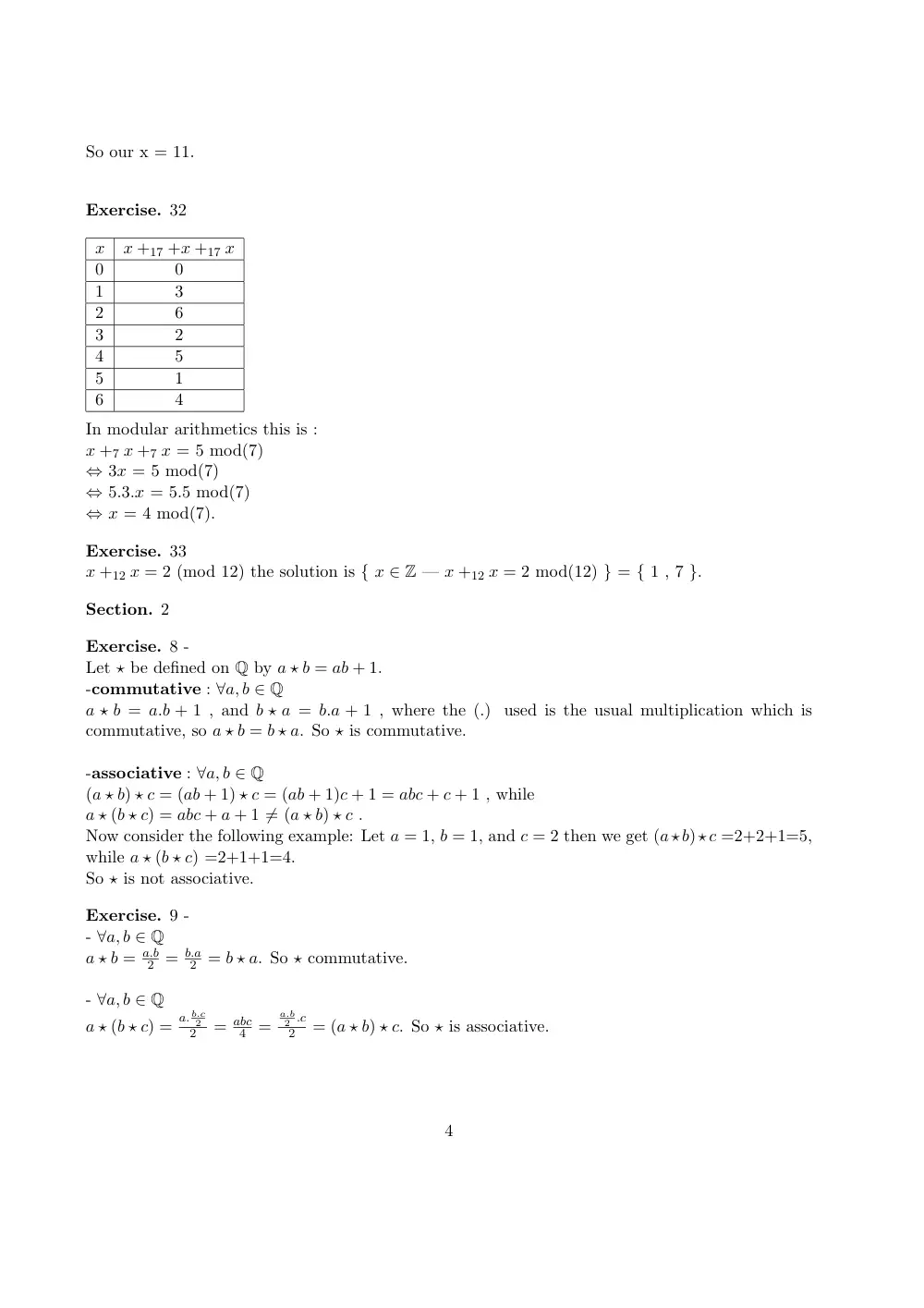
So our x = 11.
Exercise. 32
x
x +17 +x +17 x
0
0
1
3
2
6
3
2
4
5
5
1
6
4
In modular arithmetics this is :
x +7 x +7 x = 5 mod(7)
⇔ 3x = 5 mod(7)
⇔ 5.3.x = 5.5 mod(7)
⇔ x = 4 mod(7).
Exercise. 33
x +12 x = 2 (mod 12) the solution is { x ∈ Z — x +12 x = 2 mod(12) } = { 1 , 7 }.
Section. 2
Exercise. 8 -
Let ⋆ be defined on Q by a ⋆ b = ab + 1.
-commutative : ∀a, b ∈ Q
a ⋆ b = a.b + 1 , and b ⋆ a = b.a + 1 , where the (.) used is the usual multiplication which is
commutative, so a ⋆ b = b ⋆ a. So ⋆ is commutative.
-associative : ∀a, b ∈ Q
(a ⋆ b) ⋆ c = (ab + 1) ⋆ c = (ab + 1)c + 1 = abc + c + 1 , while
a ⋆ (b ⋆ c) = abc + a + 1 ̸= (a ⋆ b) ⋆ c .
Now consider the following example: Let a = 1, b = 1, and c = 2 then we get (a⋆b)⋆c =2+2+1=5,
while a ⋆ (b ⋆ c) =2+1+1=4.
So ⋆ is not associative.
Exercise. 9 -
- ∀a, b ∈ Q
a ⋆ b = a.b
2 = b.a
2 = b ⋆ a. So ⋆ commutative.
- ∀a, b ∈ Q
a ⋆ (b ⋆ c) =
a. b.c
22
= abc
4 =
a.b
2 .c
2
= (a ⋆ b) ⋆ c. So ⋆ is associative.
4
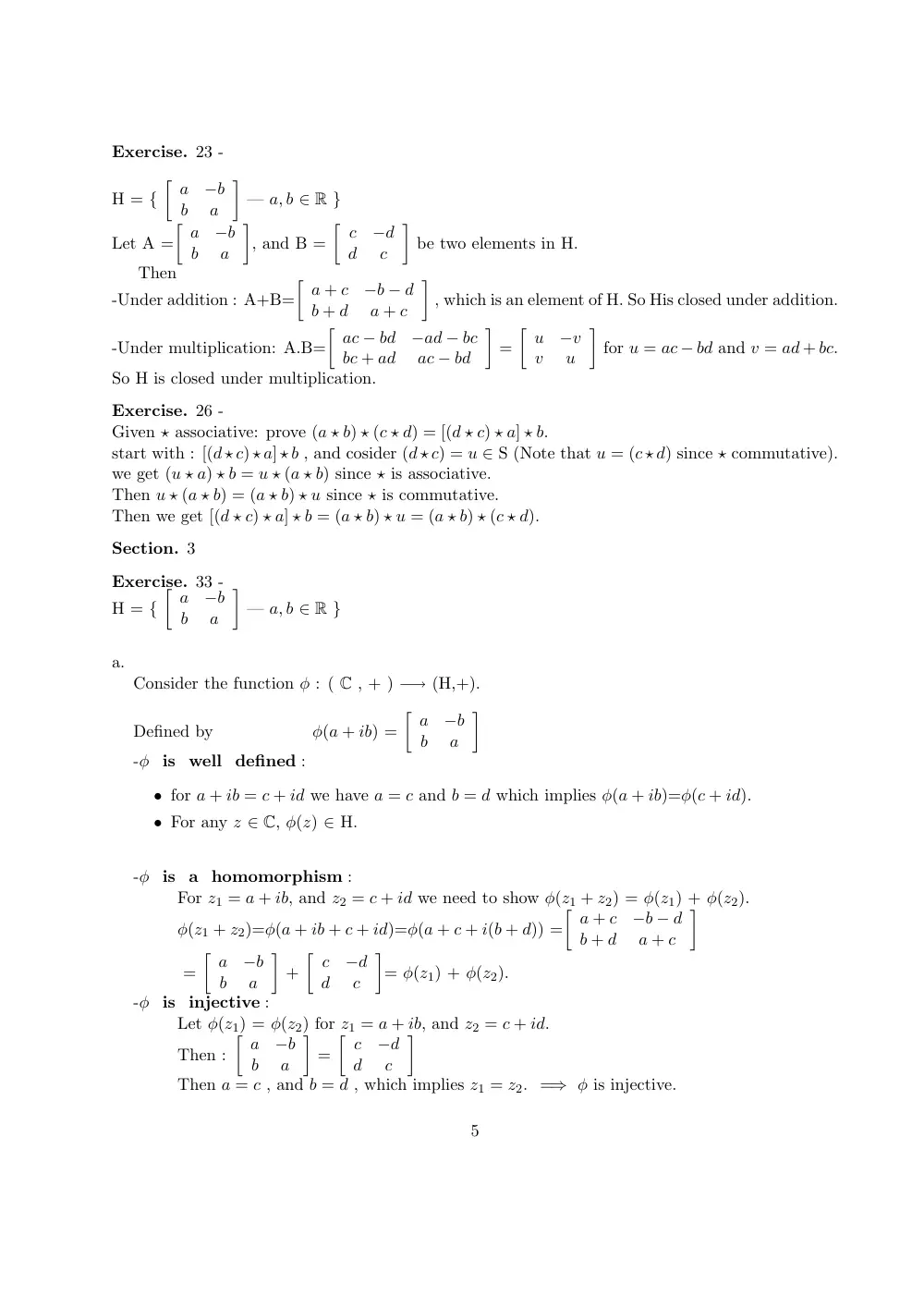
Exercise. 23 -
H = {
� a
−b
b
a
�
— a, b ∈ R }
Let A =
� a
−b
b
a
�
, and B =
� c
−d
d
c
�
be two elements in H.
Then
-Under addition : A+B=
� a + c
−b − d
b + d
a + c
�
, which is an element of H. So His closed under addition.
-Under multiplication: A.B=
� ac − bd
−ad − bc
bc + ad
ac − bd
�
=
� u
−v
v
u
�
for u = ac − bd and v = ad + bc.
So H is closed under multiplication.
Exercise. 26 -
Given ⋆ associative: prove (a ⋆ b) ⋆ (c ⋆ d) = [(d ⋆ c) ⋆ a] ⋆ b.
start with : [(d ⋆ c) ⋆ a] ⋆ b , and cosider (d ⋆ c) = u ∈ S (Note that u = (c ⋆ d) since ⋆ commutative).
we get (u ⋆ a) ⋆ b = u ⋆ (a ⋆ b) since ⋆ is associative.
Then u ⋆ (a ⋆ b) = (a ⋆ b) ⋆ u since ⋆ is commutative.
Then we get [(d ⋆ c) ⋆ a] ⋆ b = (a ⋆ b) ⋆ u = (a ⋆ b) ⋆ (c ⋆ d).
Section. 3
Exercise. 33 -
H = {
� a
−b
b
a
�
— a, b ∈ R }
a.
Consider the function φ : ( C , + ) −→ (H,+).
Defined by
φ(a + ib) =
� a
−b
b
a
�
-φ is well defined :
• for a + ib = c + id we have a = c and b = d which implies φ(a + ib)=φ(c + id).
• For any z ∈ C, φ(z) ∈ H.
-φ is a homomorphism :
For z1 = a + ib, and z2 = c + id we need to show φ(z1 + z2) = φ(z1) + φ(z2).
φ(z1 + z2)=φ(a + ib + c + id)=φ(a + c + i(b + d)) =
� a + c
−b − d
b + d
a + c
�
=
� a
−b
b
a
�
+
� c
−d
d
c
�
= φ(z1) + φ(z2).
-φ is injective :
Let φ(z1) = φ(z2) for z1 = a + ib, and z2 = c + id.
Then :
� a
−b
b
a
�
=
� c
−d
d
c
�
Then a = c , and b = d , which implies z1 = z2. =⇒ φ is injective.
5
-φ is surjective :
Let A=
� a
−b
b
a
�
∈ H, then consider z = a + ib ∈ C, it is clear that φ(z)=A.
=⇒ φ is surjective.
Note that instead of proving Φ inective and surjective we can just prove that φ has a well
defined inverse function which is :
φ−1(
� a
−b
b
a
�
) = a + ib. So (C,+) ∼= (H,+)
b.
Consider the same function φ introduced above, it is still a well defined bijection from (C, ·) to
(H,·). So we only need to show that it is a homomorphism.
For z1 = a + ib, and z2 = c + id we need to show φ(z1 + z2) = φ(z1) + φ(z2).
φ(z1.z2)=φ((a + ib).(c + id))=φ(ac − bd + i(ad + bc)) =
� ac − bd
−(ad + bc)
ad + bc
ac − bd
�
=
� a
−b
b
a
�
.
� c
−d
d
c
�
= φ(z1) . φ(z2).
So φ ia an isomorphism. =⇒ (C,.) ∼= (H,.)
Section. 4
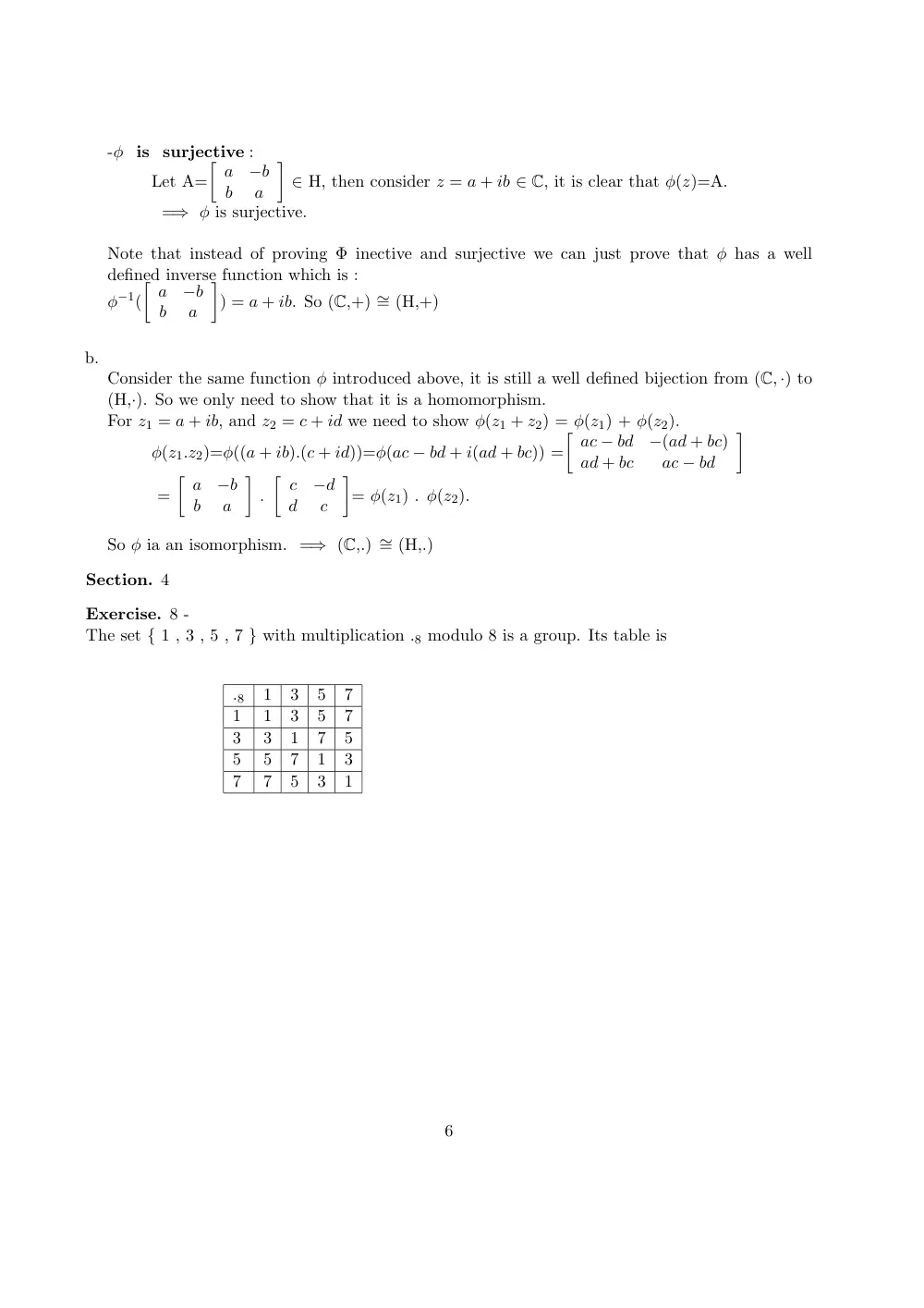
Exercise. 8 -
The set { 1 , 3 , 5 , 7 } with multiplication .8 modulo 8 is a group. Its table is
.8
1
3
5
7
1
1
3
5
7
3
3
1
7
5
5
5
7
1
3
7
7
5
3
1
6