
MATH 241 Homework 11, Fall 2011
American University of Beirut · Introduction to Abstract Algebra · 4 pages · Prof. Kamal Makdisi
More MATH 241 files
Show the text of this homework
Math 241
Problem Set 11 solution manual
Exercise. A11.1
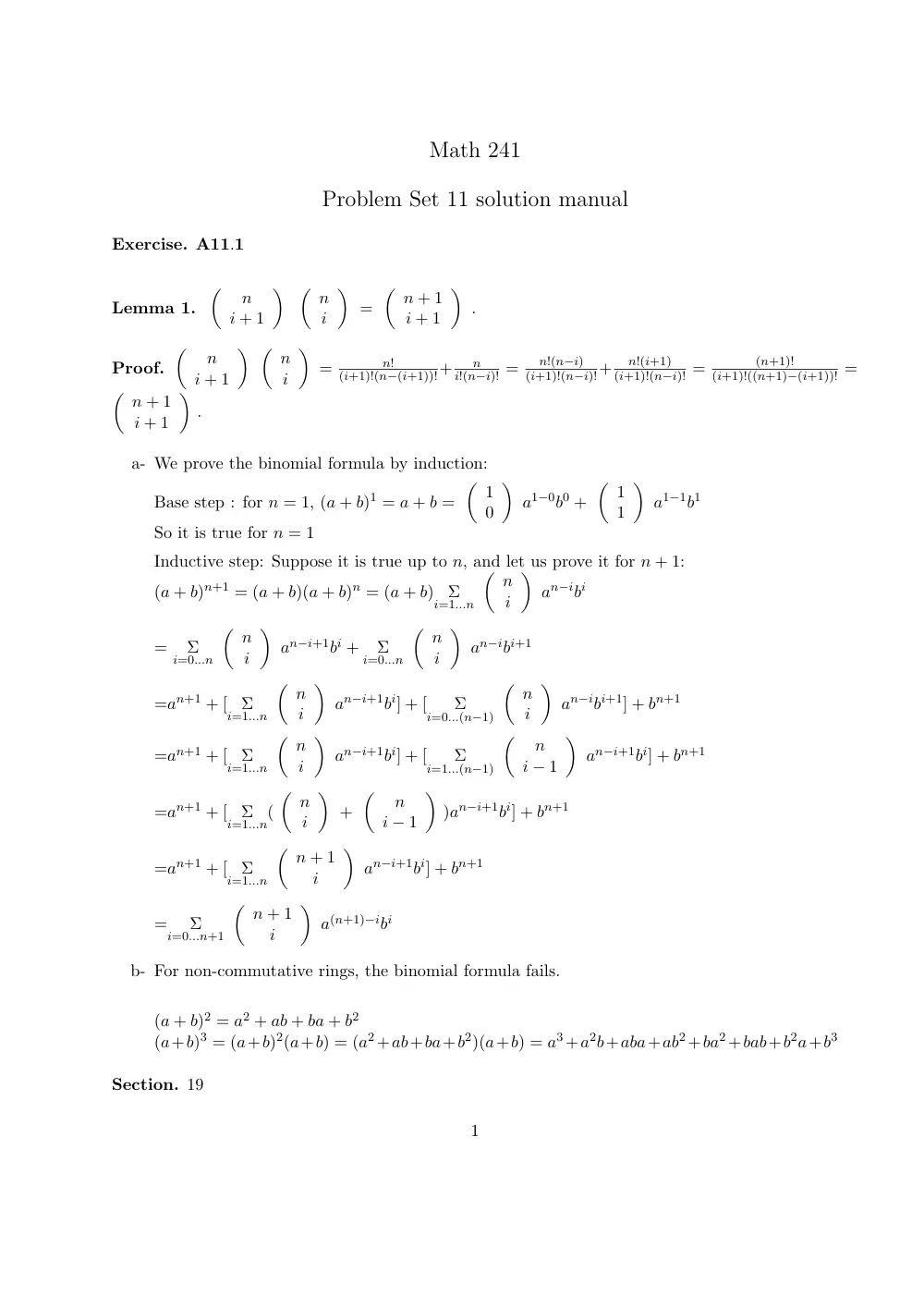
Lemma 1.
�
n
i + 1
�
� n
i
�
=
� n + 1
i + 1
�
.
Proof.
�
n
i + 1
� � n
i
�
=
n!
(i+1)!(n−(i+1))!+
n
i!(n−i)! =
n!(n−i)
(i+1)!(n−i)!+
n!(i+1)
(i+1)!(n−i)! =
(n+1)!
(i+1)!((n+1)−(i+1))! =
� n + 1
i + 1
�
.
a- We prove the binomial formula by induction:
Base step : for n = 1, (a + b)1 = a + b =
� 1
0
�
a1−0b0 +
� 1
1
�
a1−1b1
So it is true for n = 1
Inductive step: Suppose it is true up to n, and let us prove it for n + 1:
(a + b)n+1 = (a + b)(a + b)n = (a + b)
Σ
i=1...n
� n
i
�
an−ibi
=
Σ
i=0...n
� n
i
�
an−i+1bi +
Σ
i=0...n
� n
i
�
an−ibi+1
=an+1 + [
Σ
i=1...n
� n
i
�
an−i+1bi] + [
Σ
i=0...(n−1)
� n
i
�
an−ibi+1] + bn+1
=an+1 + [
Σ
i=1...n
� n
i
�
an−i+1bi] + [
Σ
i=1...(n−1)
�
n
i − 1
�
an−i+1bi] + bn+1
=an+1 + [
Σ
i=1...n(
� n
i
�
+
�
n
i − 1
�
)an−i+1bi] + bn+1
=an+1 + [
Σ
i=1...n
� n + 1
i
�
an−i+1bi] + bn+1
=
Σ
i=0...n+1
� n + 1
i
�
a(n+1)−ibi
b- For non-commutative rings, the binomial formula fails.
(a + b)2 = a2 + ab + ba + b2
(a+b)3 = (a+b)2(a+b) = (a2 +ab+ba+b2)(a+b) = a3 +a2b+aba+ab2 +ba2 +bab+b2a+b3
Section. 19
1
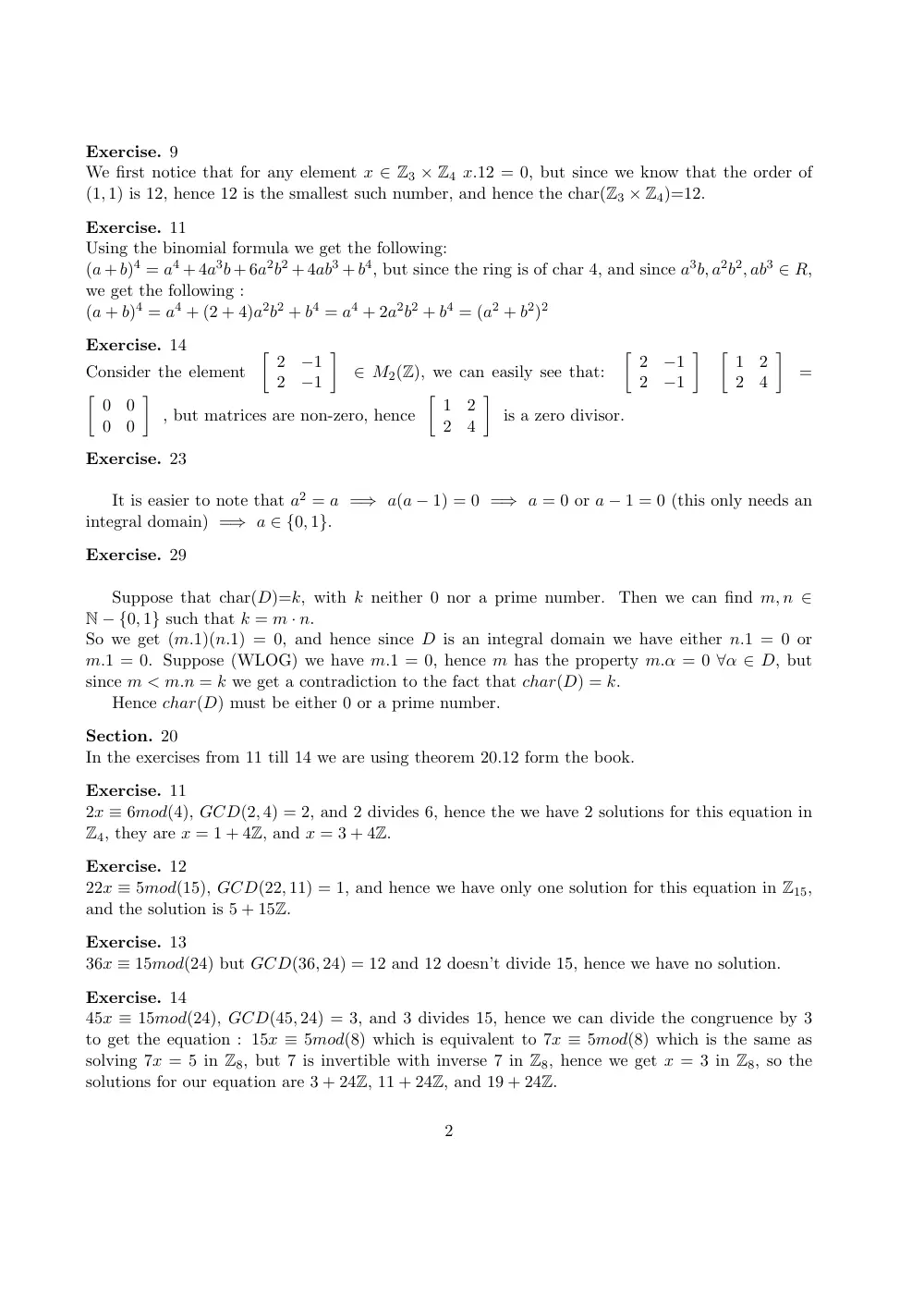
Exercise. 9
We first notice that for any element x ∈ Z3 × Z4 x.12 = 0, but since we know that the order of
(1, 1) is 12, hence 12 is the smallest such number, and hence the char(Z3 × Z4)=12.
Exercise. 11
Using the binomial formula we get the following:
(a + b)4 = a4 + 4a3b + 6a2b2 + 4ab3 + b4, but since the ring is of char 4, and since a3b, a2b2, ab3 ∈ R,
we get the following :
(a + b)4 = a4 + (2 + 4)a2b2 + b4 = a4 + 2a2b2 + b4 = (a2 + b2)2
Exercise. 14
Consider the element
� 2
−1
2
−1
�
∈ M2(Z), we can easily see that:
� 2
−1
2
−1
�
� 1
2
2
4
�
=
� 0
0
0
0
�
, but matrices are non-zero, hence
� 1
2
2
4
�
is a zero divisor.
Exercise. 23
It is easier to note that a2 = a =⇒ a(a − 1) = 0 =⇒ a = 0 or a − 1 = 0 (this only needs an
integral domain) =⇒ a ∈ {0, 1}.
Exercise. 29
Suppose that char(D)=k, with k neither 0 nor a prime number. Then we can find m, n ∈
N − {0, 1} such that k = m · n.
So we get (m.1)(n.1) = 0, and hence since D is an integral domain we have either n.1 = 0 or
m.1 = 0. Suppose (WLOG) we have m.1 = 0, hence m has the property m.α = 0 ∀α ∈ D, but
since m < m.n = k we get a contradiction to the fact that char(D) = k.
Hence char(D) must be either 0 or a prime number.
Section. 20
In the exercises from 11 till 14 we are using theorem 20.12 form the book.
Exercise. 11
2x ≡ 6mod(4), GCD(2, 4) = 2, and 2 divides 6, hence the we have 2 solutions for this equation in
Z4, they are x = 1 + 4Z, and x = 3 + 4Z.
Exercise. 12
22x ≡ 5mod(15), GCD(22, 11) = 1, and hence we have only one solution for this equation in Z15,
and the solution is 5 + 15Z.
Exercise. 13
36x ≡ 15mod(24) but GCD(36, 24) = 12 and 12 doesn’t divide 15, hence we have no solution.
Exercise. 14
45x ≡ 15mod(24), GCD(45, 24) = 3, and 3 divides 15, hence we can divide the congruence by 3
to get the equation : 15x ≡ 5mod(8) which is equivalent to 7x ≡ 5mod(8) which is the same as
solving 7x = 5 in Z8, but 7 is invertible with inverse 7 in Z8, hence we get x = 3 in Z8, so the
solutions for our equation are 3 + 24Z, 11 + 24Z, and 19 + 24Z.
2
Exercise. 27
For an element a to be its own inverse it must satisfy a2 = 1. SO in Zp the only elements
that are their own ,multiplicative inverse are the solutions for the equation x2 − 1 = 0
=⇒
(x − 1)(x + 1) = 0, but since Zp is a field whenever p is prime, this can only happen if x − 1 = 0
or x + 1 = 0, i.e x = 1 or x = −1 ≡ p − 1 mod(p). So we deduce that the only elements that are
their own multiplicative inverse in Zp are 1, p − 1.
Section. 21
Exercise. 1
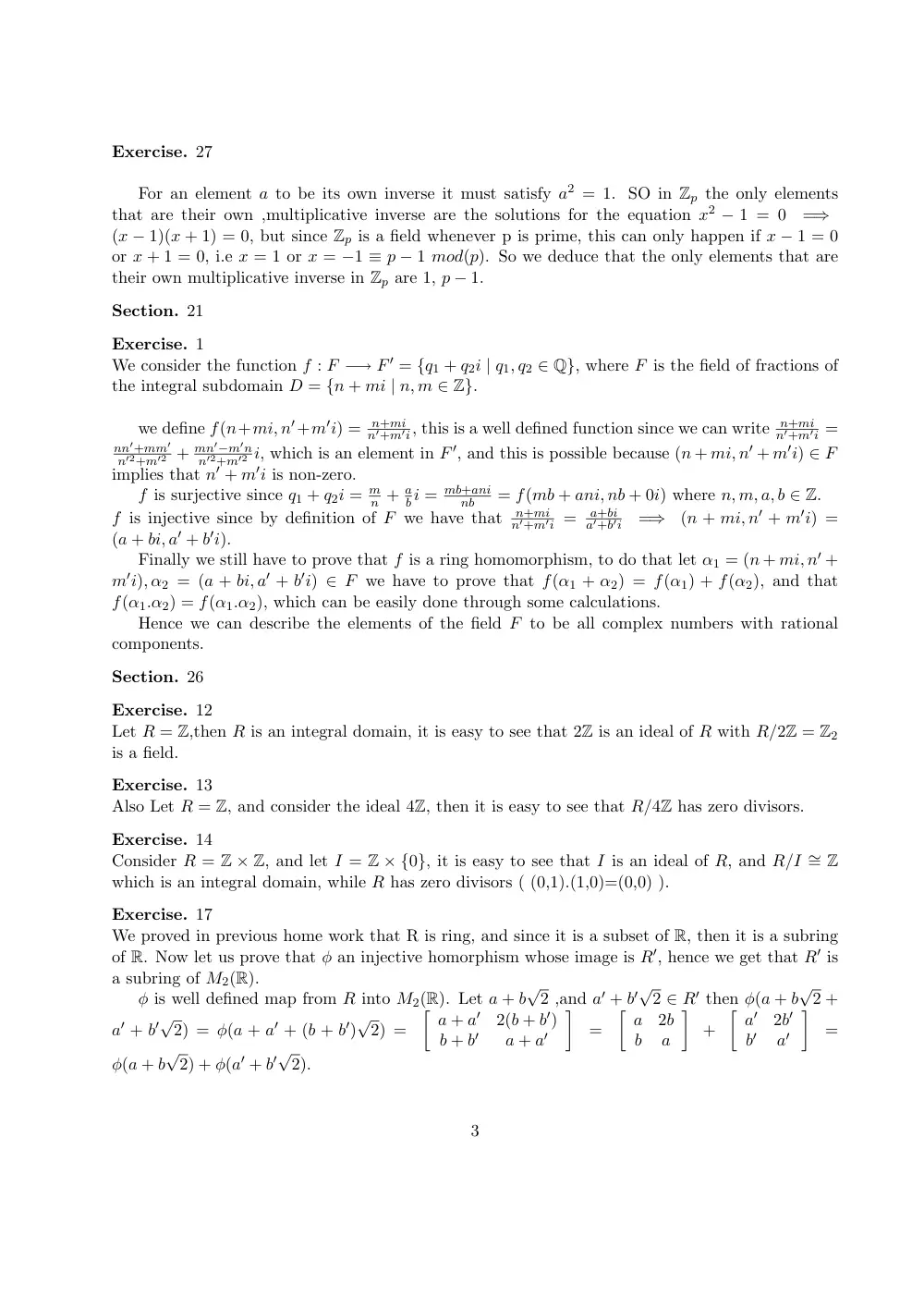
We consider the function f : F −→ F ′ = {q1 + q2i | q1, q2 ∈ Q}, where F is the field of fractions of
the integral subdomain D = {n + mi | n, m ∈ Z}.
we define f(n+mi, n′+m′i) =
n+mi
n′+m′i, this is a well defined function since we can write
n+mi
n′+m′i =
nn′+mm′
n′2+m′2 + mn′−m′n
n′2+m′2 i, which is an element in F ′, and this is possible because (n + mi, n′ + m′i) ∈ F
implies that n′ + m′i is non-zero.
f is surjective since q1 + q2i = m
n + a
bi = mb+ani
nb
= f(mb + ani, nb + 0i) where n, m, a, b ∈ Z.
f is injective since by definition of F we have that
n+mi
n′+m′i =
a+bi
a′+b′i
=⇒
(n + mi, n′ + m′i) =
(a + bi, a′ + b′i).
Finally we still have to prove that f is a ring homomorphism, to do that let α1 = (n + mi, n′ +
m′i), α2 = (a + bi, a′ + b′i) ∈ F we have to prove that f(α1 + α2) = f(α1) + f(α2), and that
f(α1.α2) = f(α1.α2), which can be easily done through some calculations.
Hence we can describe the elements of the field F to be all complex numbers with rational
components.
Section. 26
Exercise. 12
Let R = Z,then R is an integral domain, it is easy to see that 2Z is an ideal of R with R/2Z = Z2
is a field.
Exercise. 13
Also Let R = Z, and consider the ideal 4Z, then it is easy to see that R/4Z has zero divisors.
Exercise. 14
Consider R = Z × Z, and let I = Z × {0}, it is easy to see that I is an ideal of R, and R/I ∼= Z
which is an integral domain, while R has zero divisors ( (0,1).(1,0)=(0,0) ).
Exercise. 17
We proved in previous home work that R is ring, and since it is a subset of R, then it is a subring
of R. Now let us prove that φ an injective homorphism whose image is R′, hence we get that R′ is
a subring of M2(R).
φ is well defined map from R into M2(R). Let a + b
√
2 ,and a′ + b′√
2 ∈ R′ then φ(a + b
√
2 +
a′ + b′√
2) = φ(a + a′ + (b + b′)
√
2) =
� a + a′
2(b + b′)
b + b′
a + a′
�
=
� a
2b
b
a
�
+
� a′
2b′
b′
a′
�
=
φ(a + b
√
2) + φ(a′ + b′√
2).
3
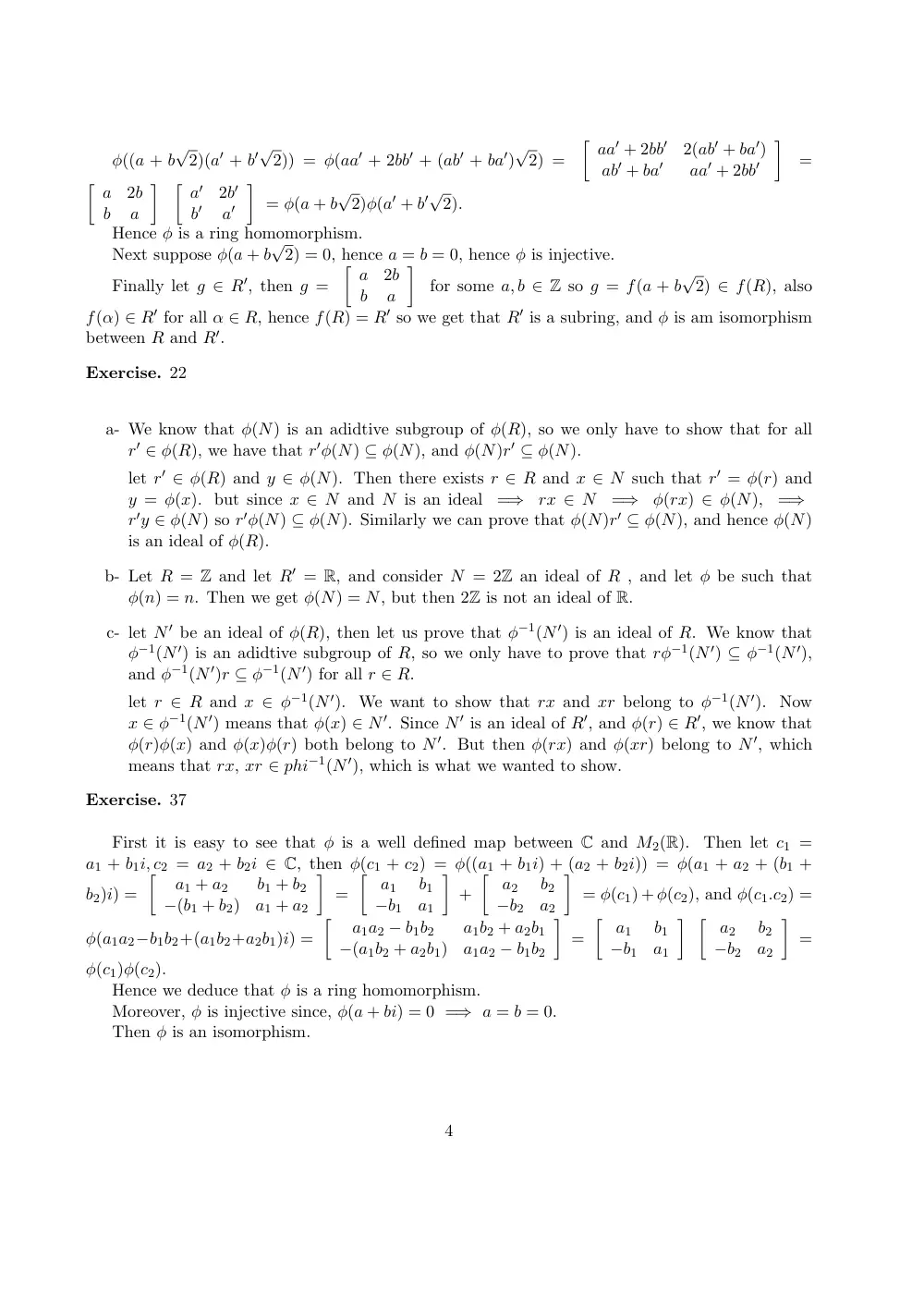
φ((a + b
√
2)(a′ + b′√
2)) = φ(aa′ + 2bb′ + (ab′ + ba′)
√
2) =
� aa′ + 2bb′
2(ab′ + ba′)
ab′ + ba′
aa′ + 2bb′
�
=
� a
2b
b
a
�
� a′
2b′
b′
a′
�
= φ(a + b
√
2)φ(a′ + b′√
2).
Hence φ is a ring homomorphism.
Next suppose φ(a + b
√
2) = 0, hence a = b = 0, hence φ is injective.
Finally let g ∈ R′, then g =
� a
2b
b
a
�
for some a, b ∈ Z so g = f(a + b
√
2) ∈ f(R), also
f(α) ∈ R′ for all α ∈ R, hence f(R) = R′ so we get that R′ is a subring, and φ is am isomorphism
between R and R′.
Exercise. 22
a- We know that φ(N) is an adidtive subgroup of φ(R), so we only have to show that for all
r′ ∈ φ(R), we have that r′φ(N) ⊆ φ(N), and φ(N)r′ ⊆ φ(N).
let r′ ∈ φ(R) and y ∈ φ(N). Then there exists r ∈ R and x ∈ N such that r′ = φ(r) and
y = φ(x). but since x ∈ N and N is an ideal
=⇒
rx ∈ N
=⇒
φ(rx) ∈ φ(N),
=⇒
r′y ∈ φ(N) so r′φ(N) ⊆ φ(N). Similarly we can prove that φ(N)r′ ⊆ φ(N), and hence φ(N)
is an ideal of φ(R).
b- Let R = Z and let R′ = R, and consider N = 2Z an ideal of R , and let φ be such that
φ(n) = n. Then we get φ(N) = N, but then 2Z is not an ideal of R.
c- let N′ be an ideal of φ(R), then let us prove that φ−1(N′) is an ideal of R. We know that
φ−1(N′) is an adidtive subgroup of R, so we only have to prove that rφ−1(N′) ⊆ φ−1(N′),
and φ−1(N′)r ⊆ φ−1(N′) for all r ∈ R.
let r ∈ R and x ∈ φ−1(N′). We want to show that rx and xr belong to φ−1(N′). Now
x ∈ φ−1(N′) means that φ(x) ∈ N′. Since N′ is an ideal of R′, and φ(r) ∈ R′, we know that
φ(r)φ(x) and φ(x)φ(r) both belong to N′. But then φ(rx) and φ(xr) belong to N′, which
means that rx, xr ∈ phi−1(N′), which is what we wanted to show.
Exercise. 37
First it is easy to see that φ is a well defined map between C and M2(R).
Then let c1 =
a1 + b1i, c2 = a2 + b2i ∈ C, then φ(c1 + c2) = φ((a1 + b1i) + (a2 + b2i)) = φ(a1 + a2 + (b1 +
b2)i) =
�
a1 + a2
b1 + b2
−(b1 + b2)
a1 + a2
�
=
� a1
b1
−b1
a1
�
+
� a2
b2
−b2
a2
�
= φ(c1) + φ(c2), and φ(c1.c2) =
φ(a1a2−b1b2+(a1b2+a2b1)i) =
�
a1a2 − b1b2
a1b2 + a2b1
−(a1b2 + a2b1)
a1a2 − b1b2
�
=
� a1
b1
−b1
a1
� � a2
b2
−b2
a2
�
=
φ(c1)φ(c2).
Hence we deduce that φ is a ring homomorphism.
Moreover, φ is injective since, φ(a + bi) = 0 =⇒ a = b = 0.
Then φ is an isomorphism.
4