
MATH 241 Homework 13, Fall 2011
American University of Beirut · Introduction to Abstract Algebra · 4 pages · Prof. Kamal Makdisi
More MATH 241 files
Show the text of this homework
Math 241
Problem Set 13 solution manual
Exercise. A13.1
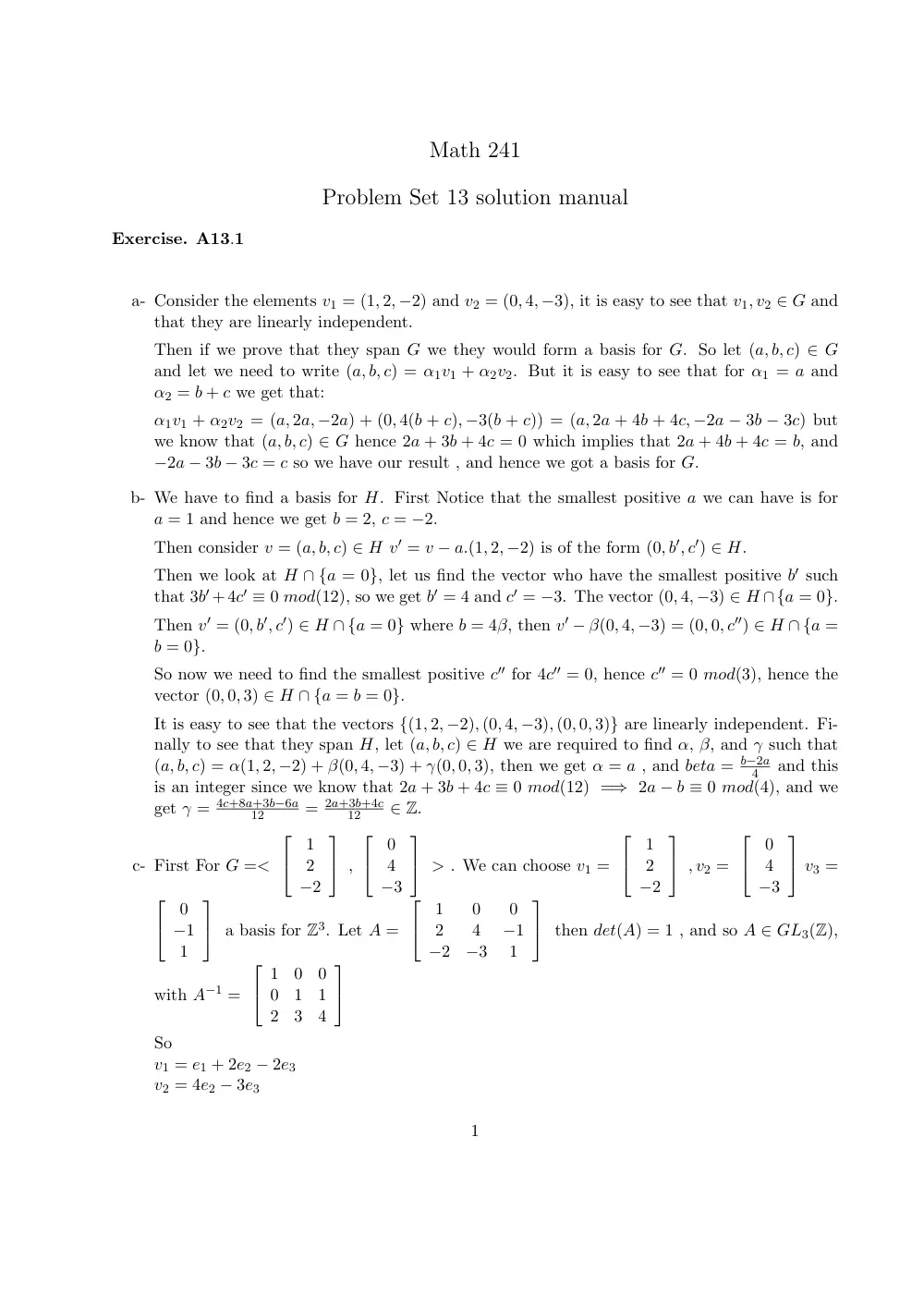
a- Consider the elements v1 = (1, 2, −2) and v2 = (0, 4, −3), it is easy to see that v1, v2 ∈ G and
that they are linearly independent.
Then if we prove that they span G we they would form a basis for G. So let (a, b, c) ∈ G
and let we need to write (a, b, c) = α1v1 + α2v2. But it is easy to see that for α1 = a and
α2 = b + c we get that:
α1v1 + α2v2 = (a, 2a, −2a) + (0, 4(b + c), −3(b + c)) = (a, 2a + 4b + 4c, −2a − 3b − 3c) but
we know that (a, b, c) ∈ G hence 2a + 3b + 4c = 0 which implies that 2a + 4b + 4c = b, and
−2a − 3b − 3c = c so we have our result , and hence we got a basis for G.
b- We have to find a basis for H. First Notice that the smallest positive a we can have is for
a = 1 and hence we get b = 2, c = −2.
Then consider v = (a, b, c) ∈ H v′ = v − a.(1, 2, −2) is of the form (0, b′, c′) ∈ H.
Then we look at H ∩ {a = 0}, let us find the vector who have the smallest positive b′ such
that 3b′ +4c′ ≡ 0 mod(12), so we get b′ = 4 and c′ = −3. The vector (0, 4, −3) ∈ H ∩{a = 0}.
Then v′ = (0, b′, c′) ∈ H ∩ {a = 0} where b = 4β, then v′ − β(0, 4, −3) = (0, 0, c′′) ∈ H ∩ {a =
b = 0}.
So now we need to find the smallest positive c′′ for 4c′′ = 0, hence c′′ = 0 mod(3), hence the
vector (0, 0, 3) ∈ H ∩ {a = b = 0}.
It is easy to see that the vectors {(1, 2, −2), (0, 4, −3), (0, 0, 3)} are linearly independent. Fi-
nally to see that they span H, let (a, b, c) ∈ H we are required to find α, β, and γ such that
(a, b, c) = α(1, 2, −2) + β(0, 4, −3) + γ(0, 0, 3), then we get α = a , and beta = b−2a
4
and this
is an integer since we know that 2a + 3b + 4c ≡ 0 mod(12) =⇒ 2a − b ≡ 0 mod(4), and we
get γ = 4c+8a+3b−6a
12
= 2a+3b+4c
12
∈ Z.
c- First For G =<
1
2
−2
,
0
4
−3
> . We can choose v1 =
1
2
−2
, v2 =
0
4
−3
v3 =
0
−1
1
a basis for Z3. Let A =
1
0
0
2
4
−1
−2
−3
1
then det(A) = 1 , and so A ∈ GL3(Z),
with A−1 =
1
0
0
0
1
1
2
3
4
So
v1 = e1 + 2e2 − 2e3
v2 = 4e2 − 3e3
1
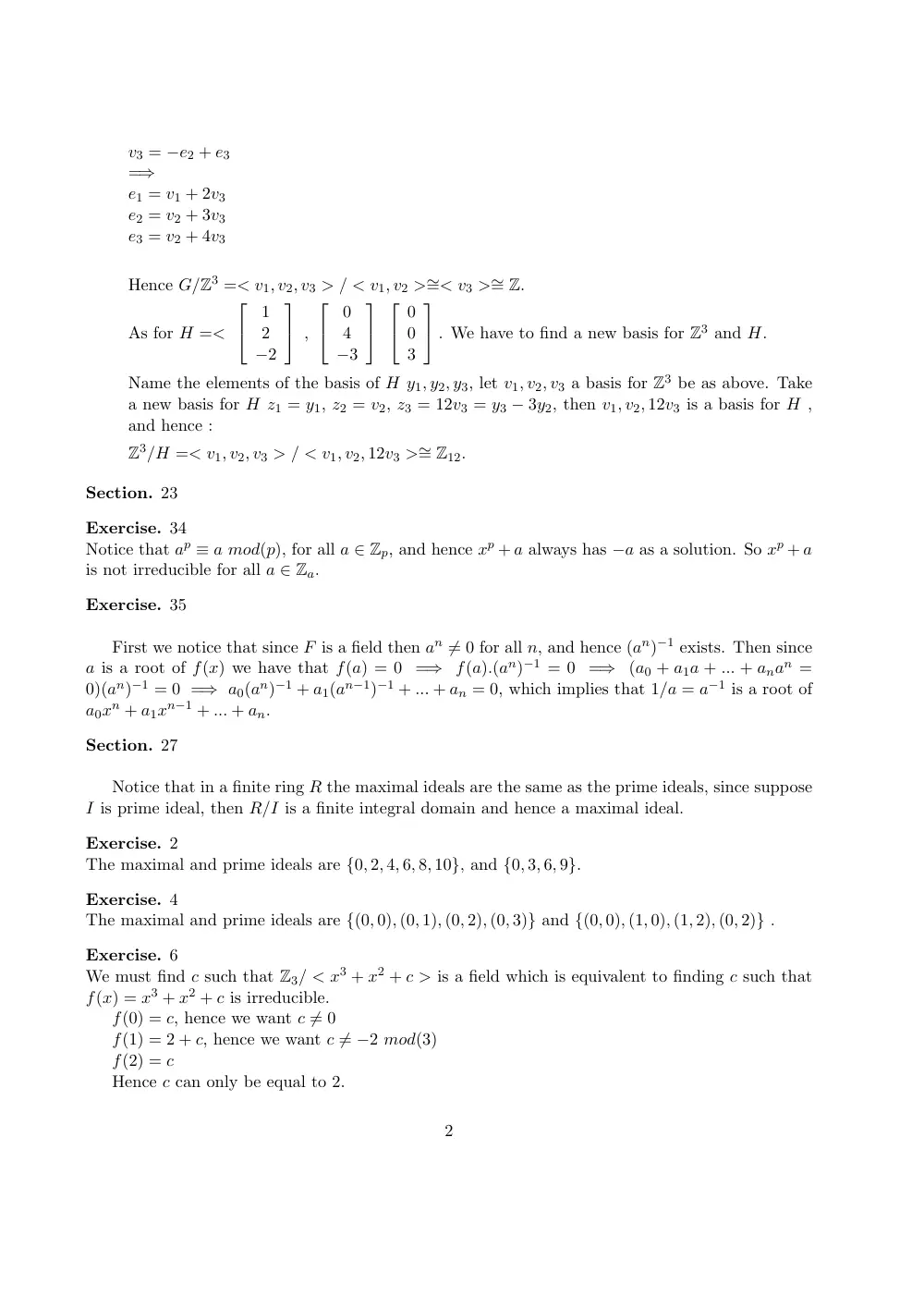
v3 = −e2 + e3
=⇒
e1 = v1 + 2v3
e2 = v2 + 3v3
e3 = v2 + 4v3
Hence G/Z3 =< v1, v2, v3 > / < v1, v2 >∼=< v3 >∼= Z.
As for H =<
1
2
−2
,
0
4
−3
0
0
3
. We have to find a new basis for Z3 and H.
Name the elements of the basis of H y1, y2, y3, let v1, v2, v3 a basis for Z3 be as above. Take
a new basis for H z1 = y1, z2 = v2, z3 = 12v3 = y3 − 3y2, then v1, v2, 12v3 is a basis for H ,
and hence :
Z3/H =< v1, v2, v3 > / < v1, v2, 12v3 >∼= Z12.
Section. 23
Exercise. 34
Notice that ap ≡ a mod(p), for all a ∈ Zp, and hence xp + a always has −a as a solution. So xp + a
is not irreducible for all a ∈ Za.
Exercise. 35
First we notice that since F is a field then an ̸= 0 for all n, and hence (an)−1 exists. Then since
a is a root of f(x) we have that f(a) = 0 =⇒ f(a).(an)−1 = 0 =⇒ (a0 + a1a + ... + anan =
0)(an)−1 = 0 =⇒ a0(an)−1 + a1(an−1)−1 + ... + an = 0, which implies that 1/a = a−1 is a root of
a0xn + a1xn−1 + ... + an.
Section. 27
Notice that in a finite ring R the maximal ideals are the same as the prime ideals, since suppose
I is prime ideal, then R/I is a finite integral domain and hence a maximal ideal.
Exercise. 2
The maximal and prime ideals are {0, 2, 4, 6, 8, 10}, and {0, 3, 6, 9}.
Exercise. 4
The maximal and prime ideals are {(0, 0), (0, 1), (0, 2), (0, 3)} and {(0, 0), (1, 0), (1, 2), (0, 2)} .
Exercise. 6
We must find c such that Z3/ < x3 + x2 + c > is a field which is equivalent to finding c such that
f(x) = x3 + x2 + c is irreducible.
f(0) = c, hence we want c ̸= 0
f(1) = 2 + c, hence we want c ̸= −2 mod(3)
f(2) = c
Hence c can only be equal to 2.
2
Exercise. 18
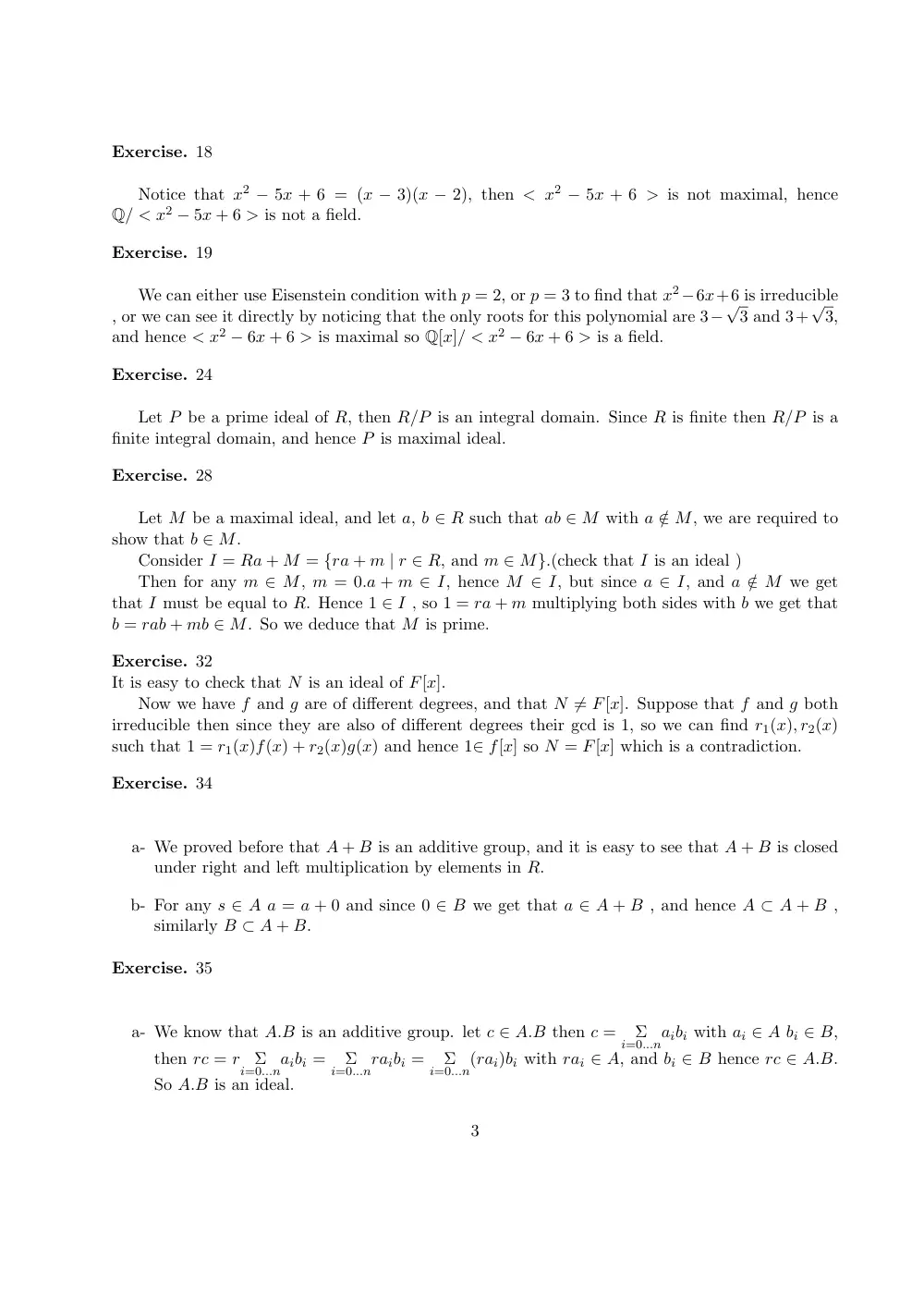
Notice that x2 − 5x + 6 = (x − 3)(x − 2), then < x2 − 5x + 6 > is not maximal, hence
Q/ < x2 − 5x + 6 > is not a field.
Exercise. 19
We can either use Eisenstein condition with p = 2, or p = 3 to find that x2−6x+6 is irreducible
, or we can see it directly by noticing that the only roots for this polynomial are 3−
√
3 and 3+
√
3,
and hence < x2 − 6x + 6 > is maximal so Q[x]/ < x2 − 6x + 6 > is a field.
Exercise. 24
Let P be a prime ideal of R, then R/P is an integral domain. Since R is finite then R/P is a
finite integral domain, and hence P is maximal ideal.
Exercise. 28
Let M be a maximal ideal, and let a, b ∈ R such that ab ∈ M with a /∈ M, we are required to
show that b ∈ M.
Consider I = Ra + M = {ra + m | r ∈ R, and m ∈ M}.(check that I is an ideal )
Then for any m ∈ M, m = 0.a + m ∈ I, hence M ∈ I, but since a ∈ I, and a /∈ M we get
that I must be equal to R. Hence 1 ∈ I , so 1 = ra + m multiplying both sides with b we get that
b = rab + mb ∈ M. So we deduce that M is prime.
Exercise. 32
It is easy to check that N is an ideal of F[x].
Now we have f and g are of different degrees, and that N ̸= F[x]. Suppose that f and g both
irreducible then since they are also of different degrees their gcd is 1, so we can find r1(x), r2(x)
such that 1 = r1(x)f(x) + r2(x)g(x) and hence 1∈ f[x] so N = F[x] which is a contradiction.
Exercise. 34
a- We proved before that A + B is an additive group, and it is easy to see that A + B is closed
under right and left multiplication by elements in R.
b- For any s ∈ A a = a + 0 and since 0 ∈ B we get that a ∈ A + B , and hence A ⊂ A + B ,
similarly B ⊂ A + B.
Exercise. 35
a- We know that A.B is an additive group. let c ∈ A.B then c =
Σ
i=0...naibi with ai ∈ A bi ∈ B,
then rc = r
Σ
i=0...naibi =
Σ
i=0...nraibi =
Σ
i=0...n(rai)bi with rai ∈ A, and bi ∈ B hence rc ∈ A.B.
So A.B is an ideal.
3
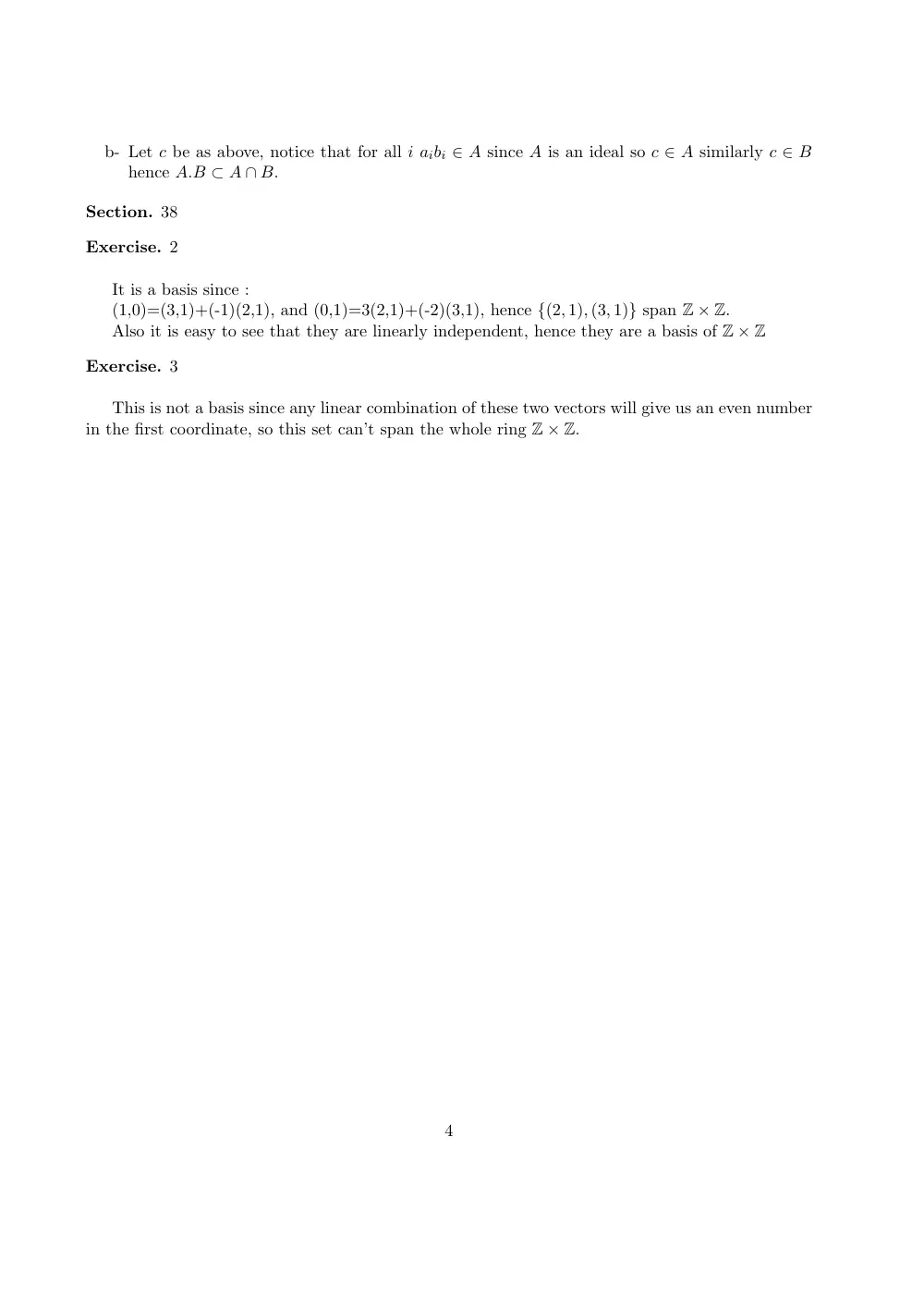
b- Let c be as above, notice that for all i aibi ∈ A since A is an ideal so c ∈ A similarly c ∈ B
hence A.B ⊂ A ∩ B.
Section. 38
Exercise. 2
It is a basis since :
(1,0)=(3,1)+(-1)(2,1), and (0,1)=3(2,1)+(-2)(3,1), hence {(2, 1), (3, 1)} span Z × Z.
Also it is easy to see that they are linearly independent, hence they are a basis of Z × Z
Exercise. 3
This is not a basis since any linear combination of these two vectors will give us an even number
in the first coordinate, so this set can’t span the whole ring Z × Z.
4