
MATH 241 Homework 10, Fall 2011
American University of Beirut · Introduction to Abstract Algebra · 4 pages · Prof. Kamal Makdisi


More MATH 241 files
Show the text of this homework
Math 241
Problem Set 10 solution manual
Exercise. A10.1
i G = S4, then |G| = 4! = 24 = 23.3.
A sylow 2-subgroup of S4 is a subgroup of order 8, so we can consider D4.
A sylow 3-subgroup of S4 is a subgroup of order 3, so we can consider the subgroup generated
by any 3-cycle. eg: < (123) >.
ii G = S5, then |G| = 5! = 120 = 23.3.5.
A sylow 2-subgroup of S5 is a subgroup of order 8.
Notice that the elements of D4 when
considered as pemutations in S5 will still form a subgroup whose order would be 8.
A sylow 3-subgroup of S5 is a subgroup of order 3, so we can consider the subgroup generated
by any 3-cycle.
A sylow 5-subgroup of S5 is a subgroup of order 5, so we can consider the subgroup generated
by any 5-cycle.
iii G = Z100 × Z30, then |G| = 3000 = 23.3.53
A sylow 3-subgroup of Z100 × Z30 is a subgroup of order 3, so we can consider the subgroup
< (0, 10) >= {(0, 0), (0, 10), (0, 20)}.
A sylow 2-subgroup of Z100 × Z30 is a subgroup of order 8, so we can consider the subgroup
< (25, 0), (0, 15) >= {(0, 0), (25, 0), (50, 0), (75, 0), (0, 15), (25, 15), (50, 15), (75, 15)}.
A sylow 5-subgroup of Z100 × Z30 is a subgroup of order 125, so we can consider the subgroup
< (4, 0), (0, 6) >= {(a, b) | a ≡ 0 mod(4), and b ≡ 0 mod(6)}.
iv G = GL2(Z7), then |G| = (72 − 1)(72 − 7) = 2016 = 25.32.7.
A sylow 7-subgroup of G is a subgroup of order 7, so we can consider the subgroup:
{
� 1
0
0
1
� � 1
1
0
1
� � 1
2
0
1
� � 1
3
0
1
� � 1
4
0
1
� � 1
5
0
1
� � 1
6
0
1
�
} =<
� 1
1
0
1
�
>.
A sylow 3-subgroup of G is a subgroup of order 9, so we can consider the subgroup:
{
� a
0
0
b
�
| a, b ∈ {1, 2, 4}}.
A sylow 2-subgroup of G is a subgroup of order 25, so we can consider the subgroup:
So consider first the subgroup H′ =<
� 2
−4
4
2
�
> , H′ is a subgroup of order 16. Then our
Sylow subgroup is H = H′ ∪
� 1
0
0
−1
�
H′
1
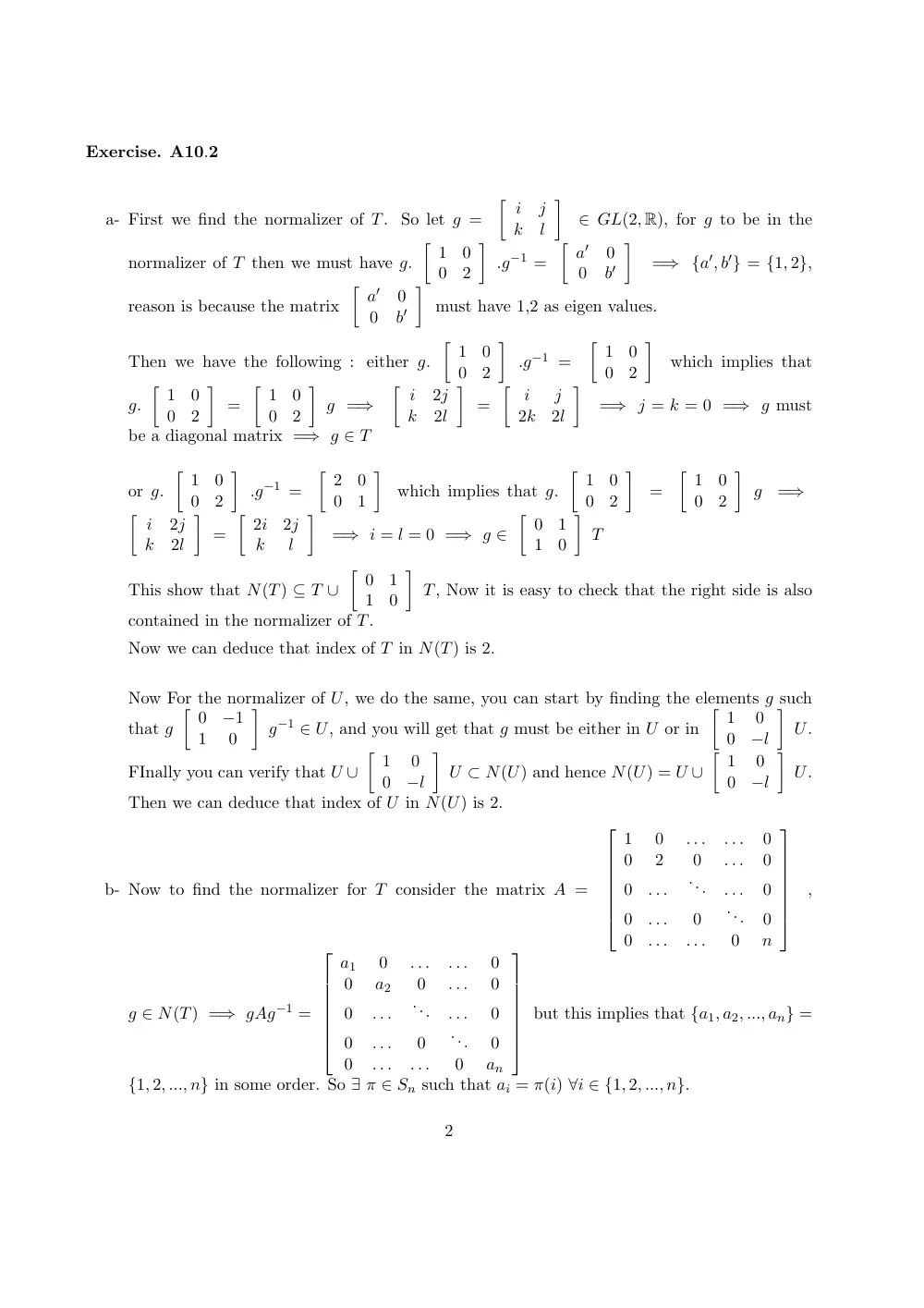
Exercise. A10.2
a- First we find the normalizer of T. So let g =
� i
j
k
l
�
∈ GL(2, R), for g to be in the
normalizer of T then we must have g.
� 1
0
0
2
�
.g−1 =
� a′
0
0
b′
�
=⇒ {a′, b′} = {1, 2},
reason is because the matrix
� a′
0
0
b′
�
must have 1,2 as eigen values.
Then we have the following : either g.
� 1
0
0
2
�
.g−1 =
� 1
0
0
2
�
which implies that
g.
� 1
0
0
2
�
=
� 1
0
0
2
�
g =⇒
� i
2j
k
2l
�
=
�
i
j
2k
2l
�
=⇒ j = k = 0 =⇒ g must
be a diagonal matrix =⇒ g ∈ T
or g.
� 1
0
0
2
�
.g−1 =
� 2
0
0
1
�
which implies that g.
� 1
0
0
2
�
=
� 1
0
0
2
�
g
=⇒
� i
2j
k
2l
�
=
� 2i
2j
k
l
�
=⇒ i = l = 0 =⇒ g ∈
� 0
1
1
0
�
T
This show that N(T) ⊆ T ∪
� 0
1
1
0
�
T, Now it is easy to check that the right side is also
contained in the normalizer of T.
Now we can deduce that index of T in N(T) is 2.
Now For the normalizer of U, we do the same, you can start by finding the elements g such
that g
� 0
−1
1
0
�
g−1 ∈ U, and you will get that g must be either in U or in
� 1
0
0
−l
�
U.
FInally you can verify that U ∪
� 1
0
0
−l
�
U ⊂ N(U) and hence N(U) = U ∪
� 1
0
0
−l
�
U.
Then we can deduce that index of U in N(U) is 2.
b- Now to find the normalizer for T consider the matrix A =
1
0
. . .
. . .
0
0
2
0
. . .
0
0
. . .
...
. . .
0
0
. . .
0
...
0
0
. . .
. . .
0
n
,
g ∈ N(T) =⇒ gAg−1 =
a1
0
. . .
. . .
0
0
a2
0
. . .
0
0
. . .
...
. . .
0
0
. . .
0
...
0
0
. . .
. . .
0
an
but this implies that {a1, a2, ..., an} =
{1, 2, ..., n} in some order. So ∃ π ∈ Sn such that ai = π(i) ∀i ∈ {1, 2, ..., n}.
2
So gAg−1 =
π(1)
0
. . .
. . .
0
0
π(2)
0
. . .
0
0
. . .
...
. . .
0
0
. . .
0
...
0
0
. . .
. . .
0
π(n)
= Pπ
1
0
. . .
. . .
0
0
2
0
. . .
0
0
. . .
...
. . .
0
0
. . .
0
...
0
0
. . .
. . .
0
n
P −1
π
where
Pπ is a permutation matrix.
so we get that g ∈ Pπ.Stab(A) = Pπ.T for some π ∈ Sn.
Hence N(T) =
∪
π∈SNPπ.T, and then N(T)/T = { ¯Pπ | π ∈ Sn} ∼= Sn.
Section. 37
Exercise. 5
Let G be a group of order 96. G must contain a sylow 2-subgroup of order 25. If G containes 1
sylow 2-subgroup then we know that this subgroup is normal and hence G is not simple.
So consider that G containes more than one sylow 2-subgroups H and K. H ∩K is a subgroup if
H and of K (H ̸= K), by a counting argument we can see that the order of H ∩K is 16. Moreover,
the normalizer of H ∩ K containes both subgroups H, and K, hence its order should be a divisor
of 94 which is greater than 32, hence N(H ∩ K) − G, so H ∩ K is normal in G.
Section. 18
Exercise. 11
It is easy to see that this set is closed under addition and multicplication, for example (a+b
√
2)(a′+
b′√
2) = aa′ +2bb′ +
√
2(ab′ +ba′) with aa′ +2bb′, ab′ +ba′ ∈ Z . Moreover, 0=0+0
√
2 and 1=1+0
√
2
both belong to the set. Assotiativity and distributativity follows directly from the properties of the
usual addition and multiplication in R. So we have a ring. This ring is commutative since usual
multiplication is commutative.
This ring is not a field since 2 is not a unit, for if it was then ∃ x ∈ R such that 2x = 1, then
x = 1/2 contradiction ( 1/2 = a + b
√
2 with a, b ∈ Z then
√
2 = 1/2−a
b
which is impossibe.
Exercise. 12
Similarly as above it is easy to see that this set is a commutative ring. Now let x1 = a + b
√
2
be an non-zero element in the ring , notice that then a2 − 2b2 ̸= 0 since a, b ∈ Q ,and then the
element x2 =
a
a2−2b2 −
b
a2−2b2
√
2 is an element in the ring with the property x1.x2 = 1. Then our
ring is a field.
Exercise. 15
The units in Z × Z are : (1,1), (-1,1), (1,-1), (-1,-1).
Exercise. 20
a- The number of elements in M2(Z2) is 16, since each entery of the matrix can be either 0, or
1.
3
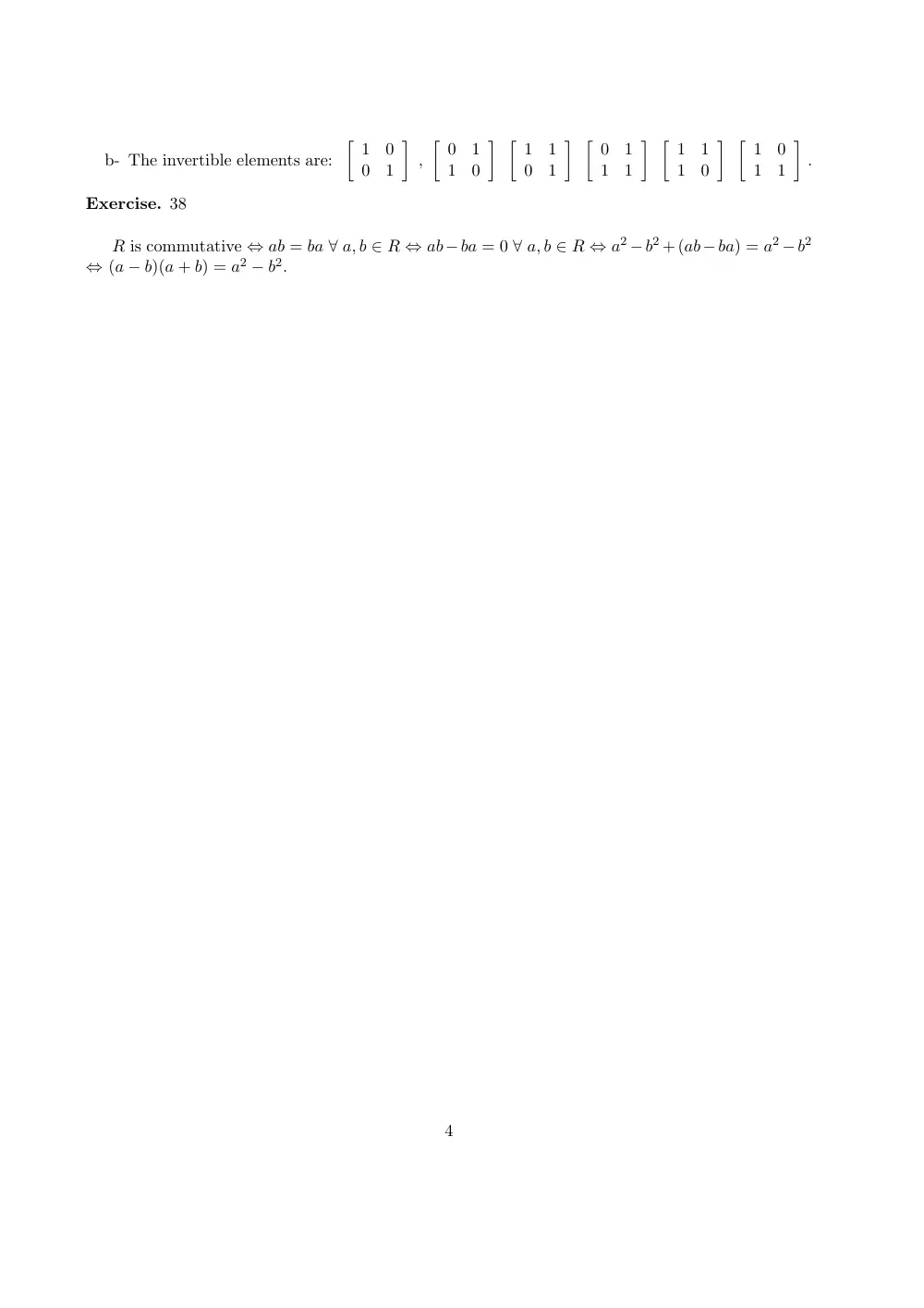
b- The invertible elements are:
� 1
0
0
1
�
,
� 0
1
1
0
� � 1
1
0
1
� � 0
1
1
1
� � 1
1
1
0
� � 1
0
1
1
�
.
Exercise. 38
R is commutative ⇔ ab = ba ∀ a, b ∈ R ⇔ ab−ba = 0 ∀ a, b ∈ R ⇔ a2 −b2 +(ab−ba) = a2 −b2
⇔ (a − b)(a + b) = a2 − b2.
4