
MATH 251 Final, Fall 2003
American University of Beirut · Numerical Computing · 8 pages

More MATH 251 files
- Final Multiple Previouses · Fall 2015Final examView
- Final No Solution · Spring 2012Final exam · with solutionView
- Final Without Solution · Spring 2011Final exam · with solutionView
- Final · Fall 2011Final examView
- Final · Fall 2010Final examView
- Final · Fall 2006Final examView
- Syllabus · Summer 2018LabView
- Syllabus · Summer 2018LabView
Show the text of this final exam
AMERICAN UNIVERSITY OF BEIRUT
Faculty of Arts and Sciences
Computer Science Department
CMPS 251
FINAL EXAM
FALL 2003-2004
Closed Book, Two hours
GIVE YOUR ANSWERS ON THE QUESTION SHEET
SUBMIT WITH BOOKLET
STUDENT NAME
ID NUMBER
1
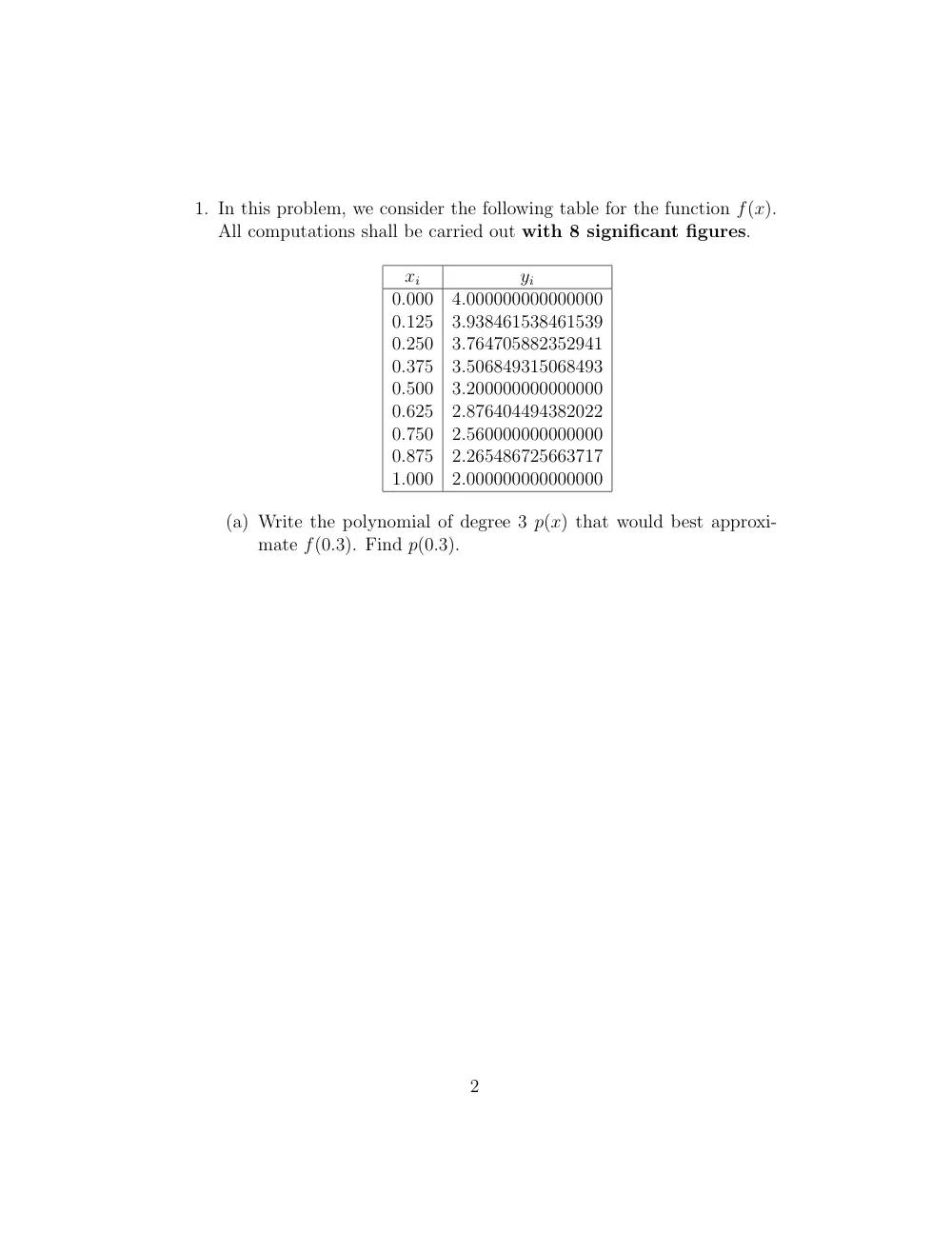
1. In this problem, we consider the following table for the function f(x).
All computations shall be carried out with 8 significant figures.
xi
yi
0.000
4.000000000000000
0.125
3.938461538461539
0.250
3.764705882352941
0.375
3.506849315068493
0.500
3.200000000000000
0.625
2.876404494382022
0.750
2.560000000000000
0.875
2.265486725663717
1.000
2.000000000000000
(a) Write the polynomial of degree 3 p(x) that would best approxi-
mate f(0.3). Find p(0.3).
2
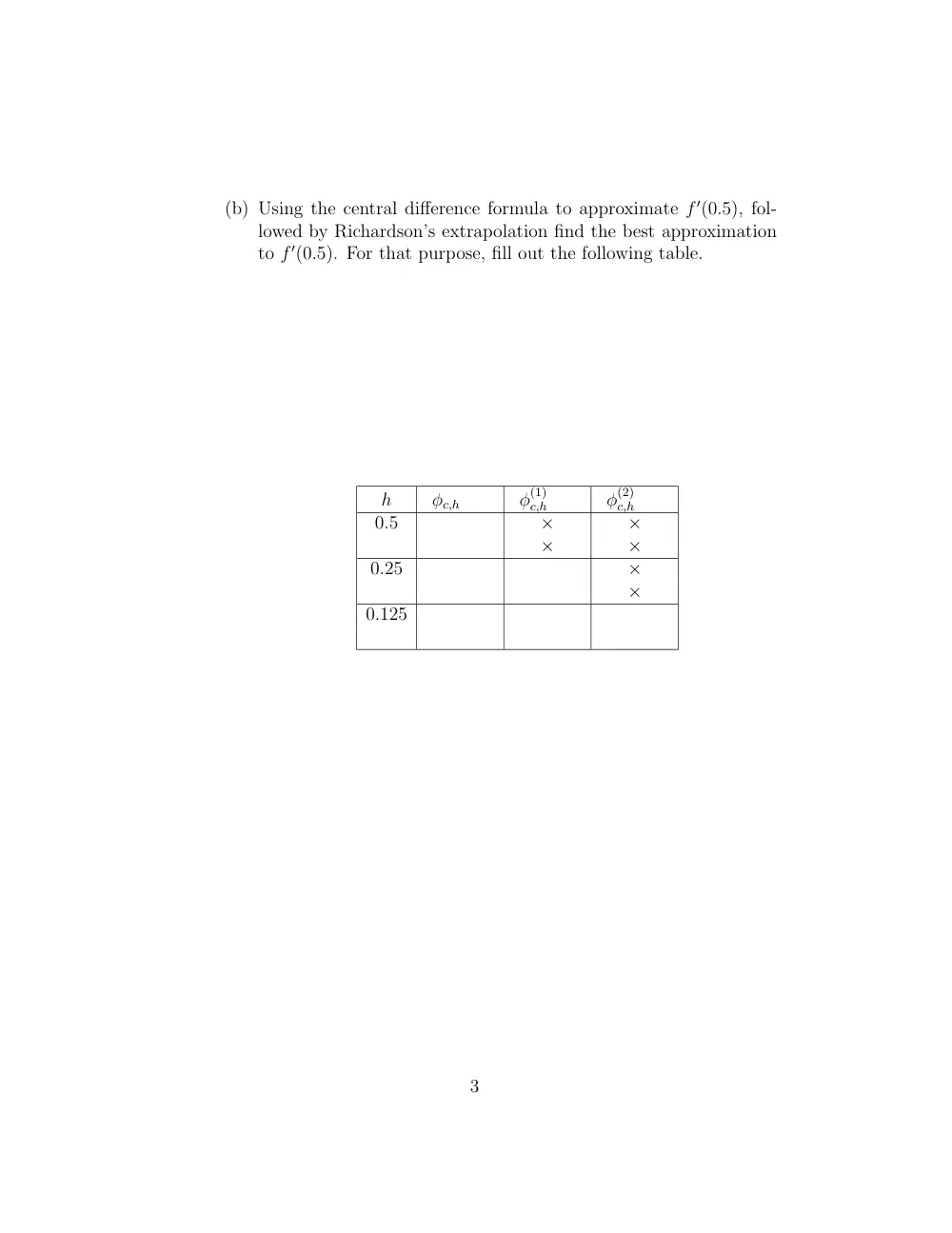
(b) Using the central difference formula to approximate f ′(0.5), fol-
lowed by Richardson’s extrapolation find the best approximation
to f ′(0.5). For that purpose, fill out the following table.
h
φc,h
φ(1)
c,h
φ(2)
c,h
0.5
×
×
×
×
0.25
×
×
0.125
3
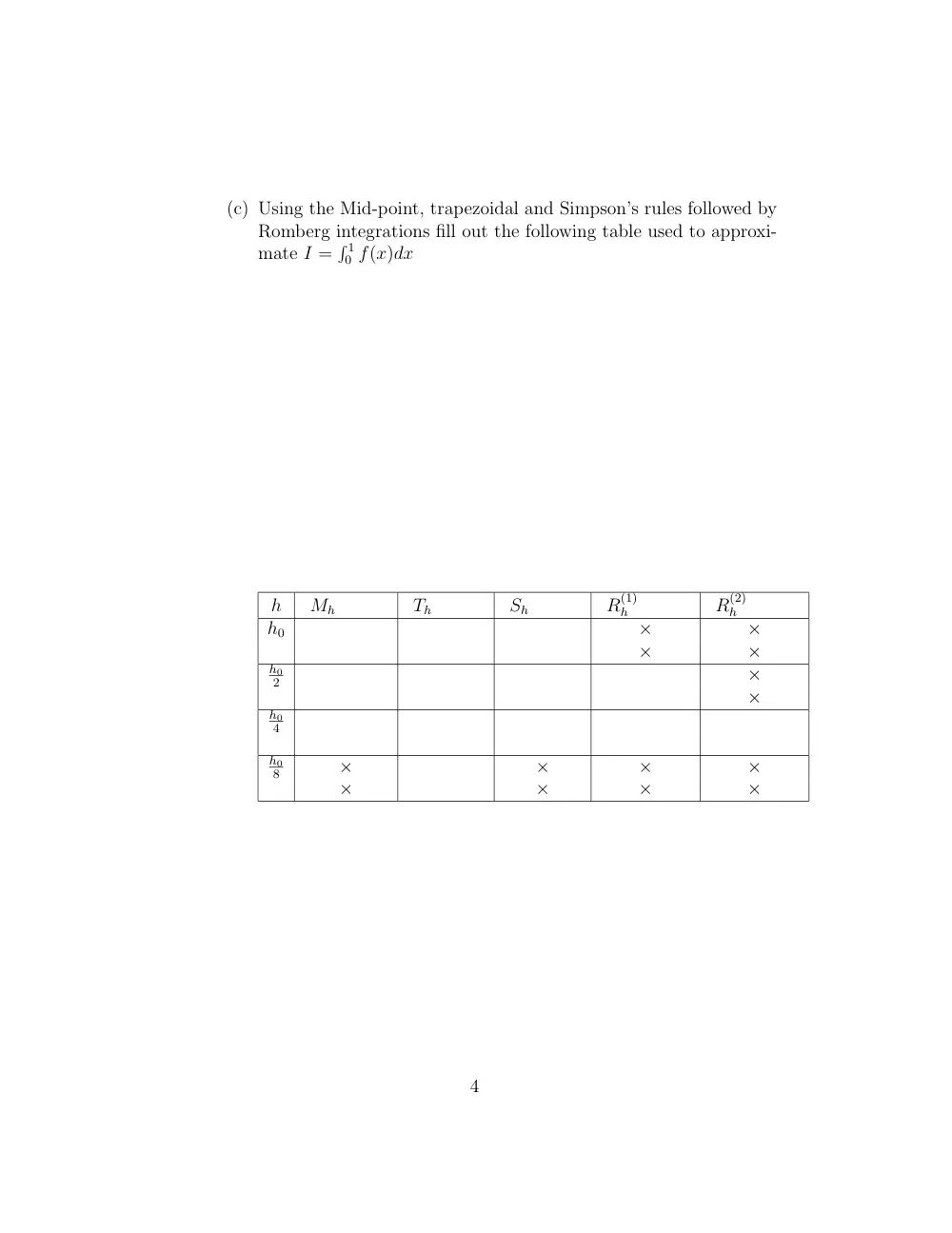
(c) Using the Mid-point, trapezoidal and Simpson’s rules followed by
Romberg integrations fill out the following table used to approxi-
mate I =
� 1
0 f(x)dx
h
Mh
Th
Sh
R(1)
h
R(2)
h
h0
×
×
×
×
h0
2
×
×
h0
4
h0
8
×
×
×
×
×
×
×
×
4
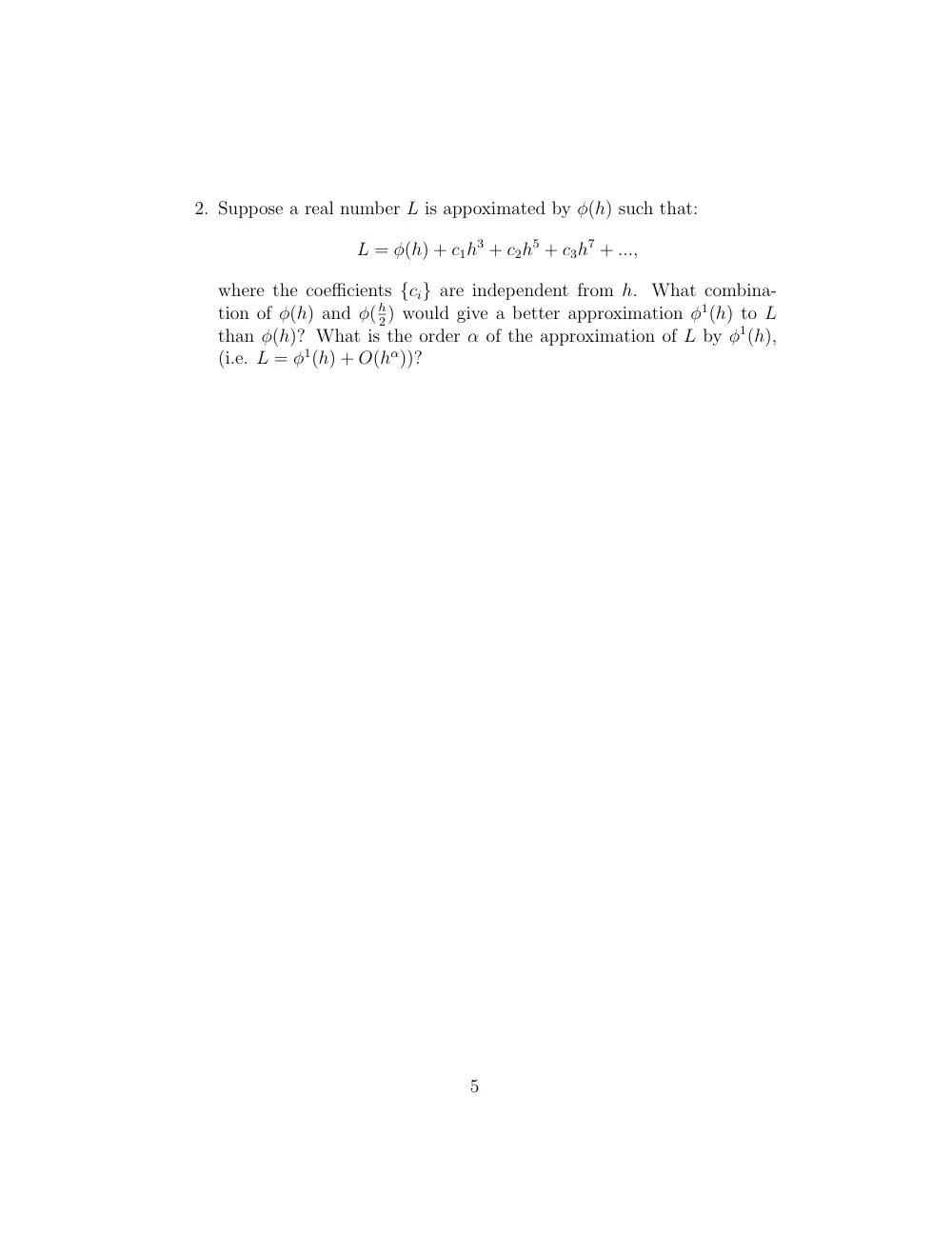
2. Suppose a real number L is appoximated by φ(h) such that:
L = φ(h) + c1h3 + c2h5 + c3h7 + ...,
where the coefficients {ci} are independent from h. What combina-
tion of φ(h) and φ( h
2) would give a better approximation φ1(h) to L
than φ(h)? What is the order α of the approximation of L by φ1(h),
(i.e. L = φ1(h) + O(hα))?
5
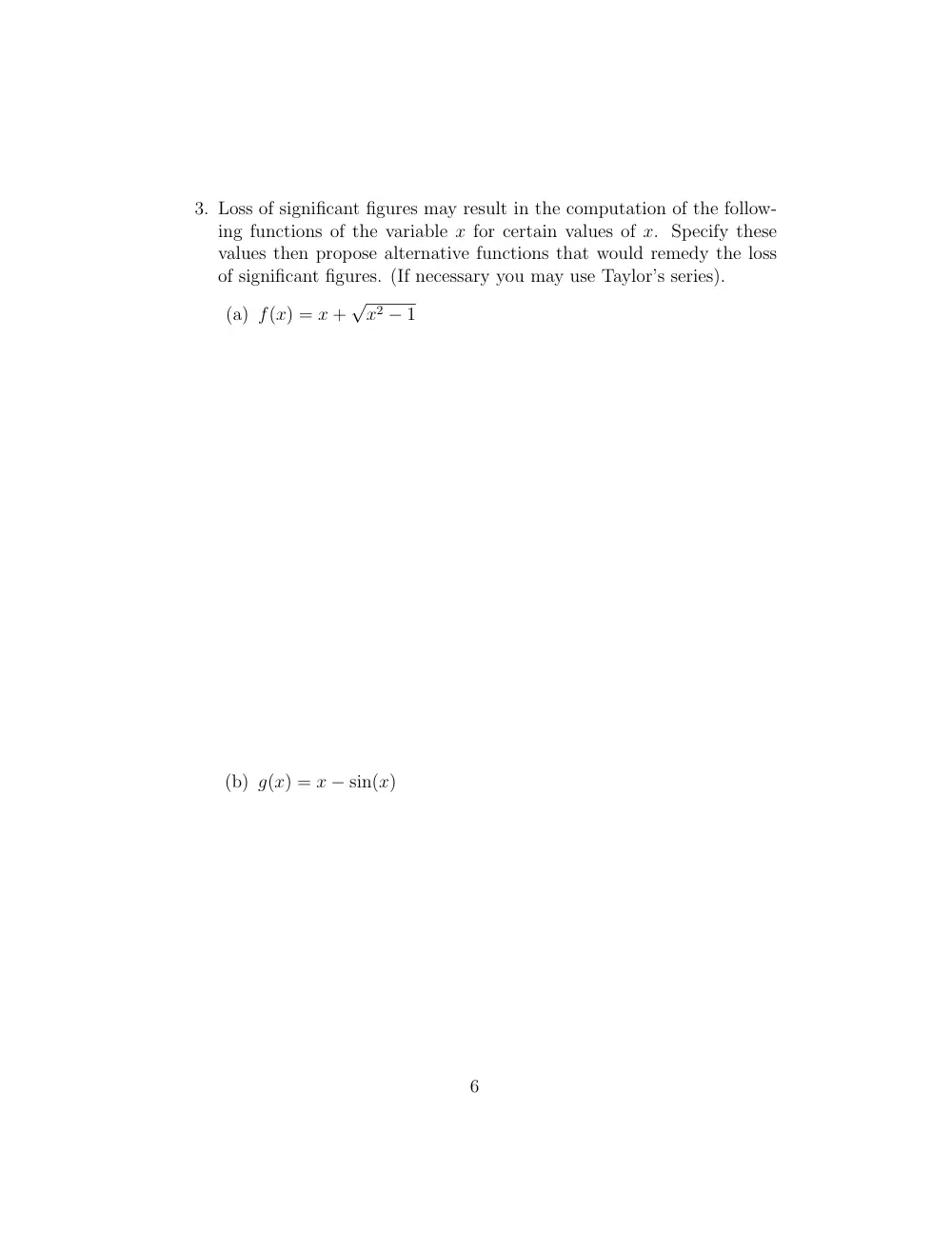
3. Loss of significant figures may result in the computation of the follow-
ing functions of the variable x for certain values of x. Specify these
values then propose alternative functions that would remedy the loss
of significant figures. (If necessary you may use Taylor’s series).
(a) f(x) = x +
√
x2 − 1
(b) g(x) = x − sin(x)
6
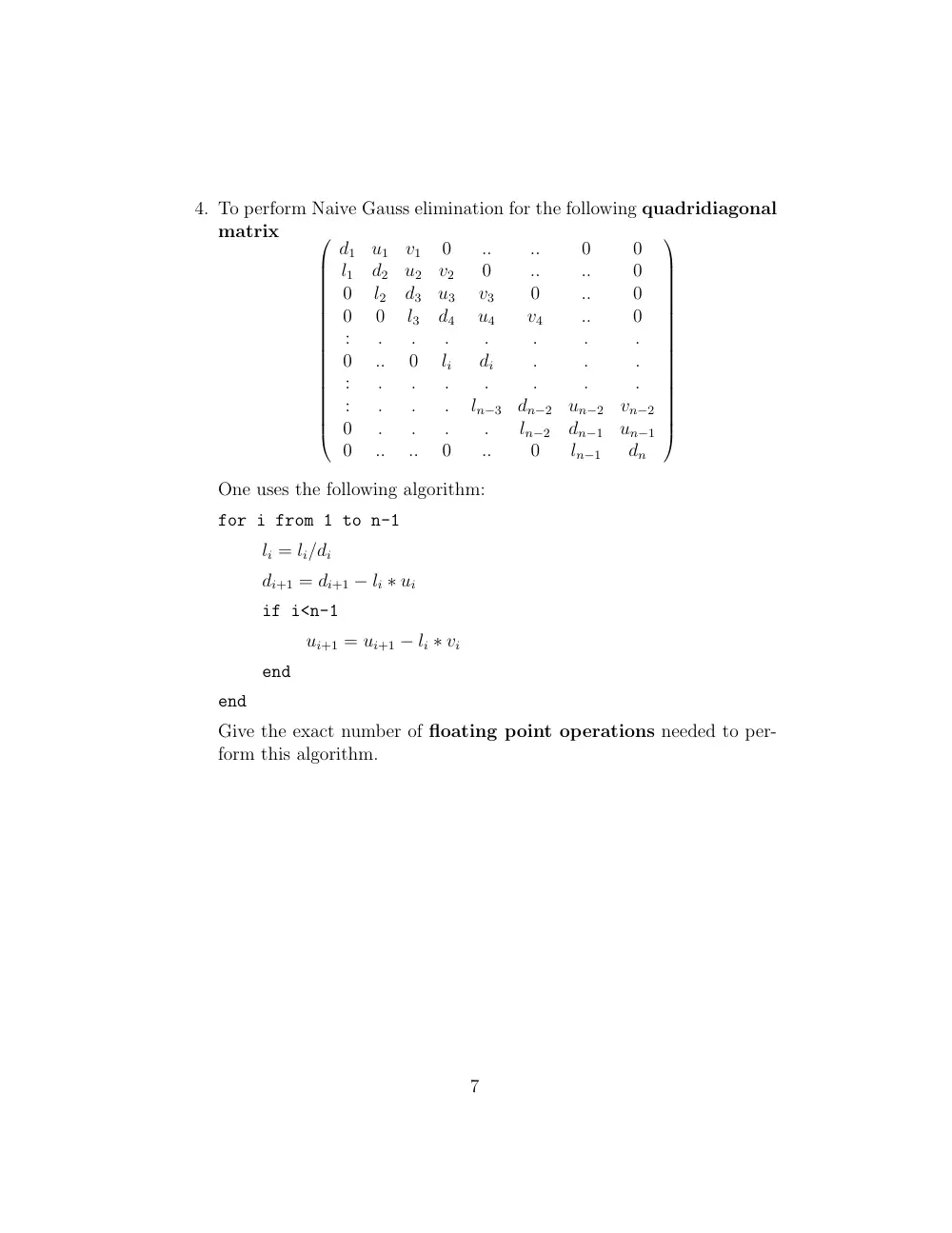
4. To perform Naive Gauss elimination for the following quadridiagonal
matrix
d1
u1
v1
0
..
..
0
0
l1
d2
u2
v2
0
..
..
0
0
l2
d3
u3
v3
0
..
0
0
0
l3
d4
u4
v4
..
0
:
.
.
.
.
.
.
.
0
..
0
li
di
.
.
.
:
.
.
.
.
.
.
.
:
.
.
.
ln−3
dn−2
un−2
vn−2
0
.
.
.
.
ln−2
dn−1
un−1
0
..
..
0
..
0
ln−1
dn
One uses the following algorithm:
for i from 1 to n-1
li = li/di
di+1 = di+1 − li ∗ ui
if i<n-1
ui+1 = ui+1 − li ∗ vi
end
end
Give the exact number of floating point operations needed to per-
form this algorithm.
7
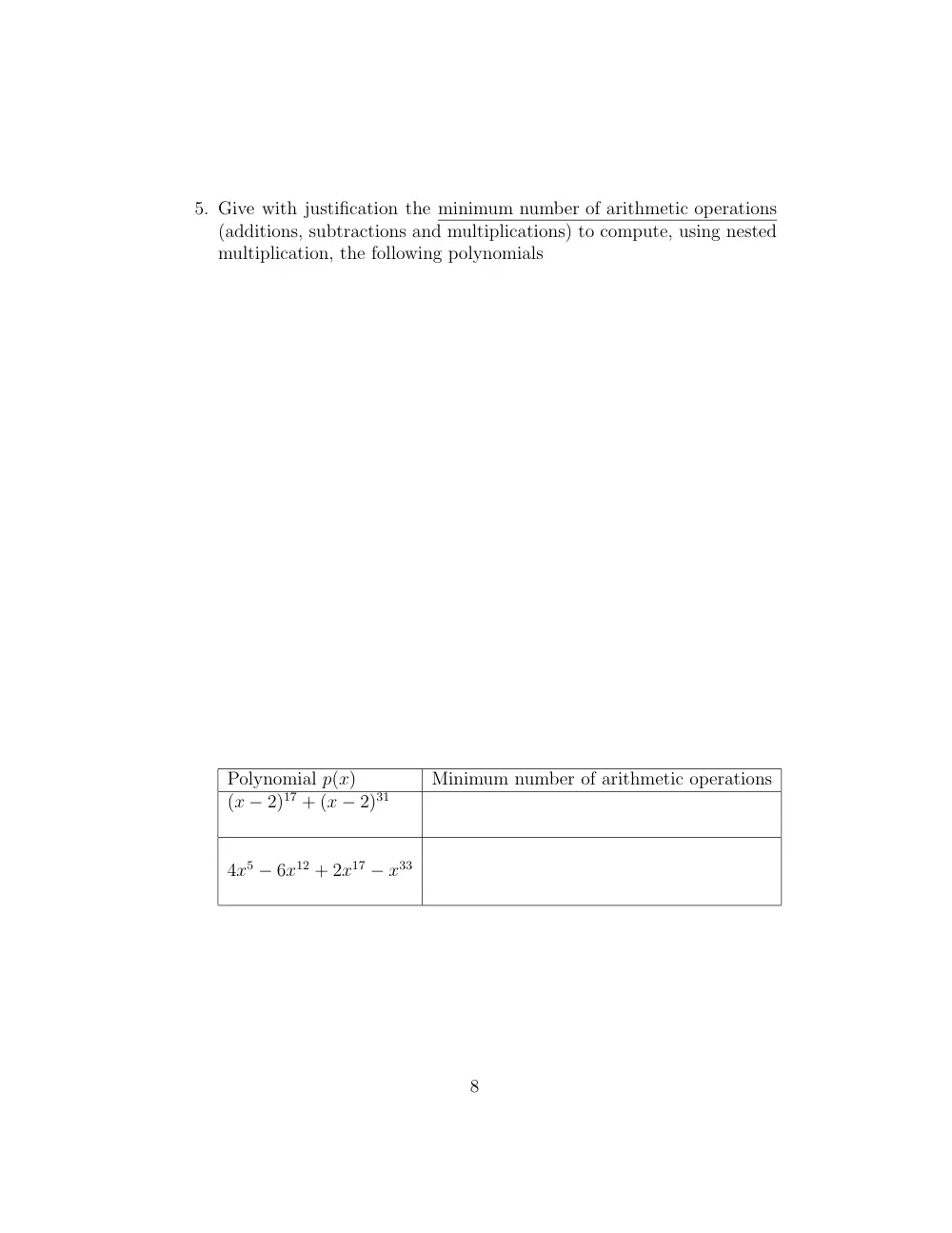
5. Give with justification the minimum number of arithmetic operations
(additions, subtractions and multiplications) to compute, using nested
multiplication, the following polynomials
Polynomial p(x)
Minimum number of arithmetic operations
(x − 2)17 + (x − 2)31
4x5 − 6x12 + 2x17 − x33
8