
MATH 251 Final, Fall 2006
American University of Beirut · Numerical Computing · 11 pages




Showing the first 10 of 11 pages. Download the PDF to see all of it.
More MATH 251 files
- Final Multiple Previouses · Fall 2015Final examView
- Final No Solution · Spring 2012Final exam · with solutionView
- Final Without Solution · Spring 2011Final exam · with solutionView
- Final · Fall 2011Final examView
- Final · Fall 2010Final examView
- Final · Fall 2003Final examView
- Syllabus · Summer 2018LabView
- Syllabus · Summer 2018LabView
Show the text of this final exam
AMERICAN UNIVERSITY OF BEIRUT
Faculty of Arts and Sciences
Mathematics Department
MATH-CMPS 251
FINAL EXAMINATION
FALL 2006-2007
Closed Book, Two hours
(ONLY NON-PROGRAMMABLE AND NON-GRAPHIC
CALCULATORS ARE ALLOWED)
STUDENT NAME
ID NUMBER
Problem
Out of
Grade
1
10
2
15
3
30
4
15
TOTAL
70
1
1. (10 points) Loss of significant figures may result in the computation of
the following functions of the variable x for certain values of x. Specify
these values then propose alternativefunctions that would remedy the
loss of significant figures. (If necessary you may use Taylor’s series).
(a) f(x) = ln(x +
√
x2 + 1)
(b) g(x) =
√
x4 + 4 − 2
2
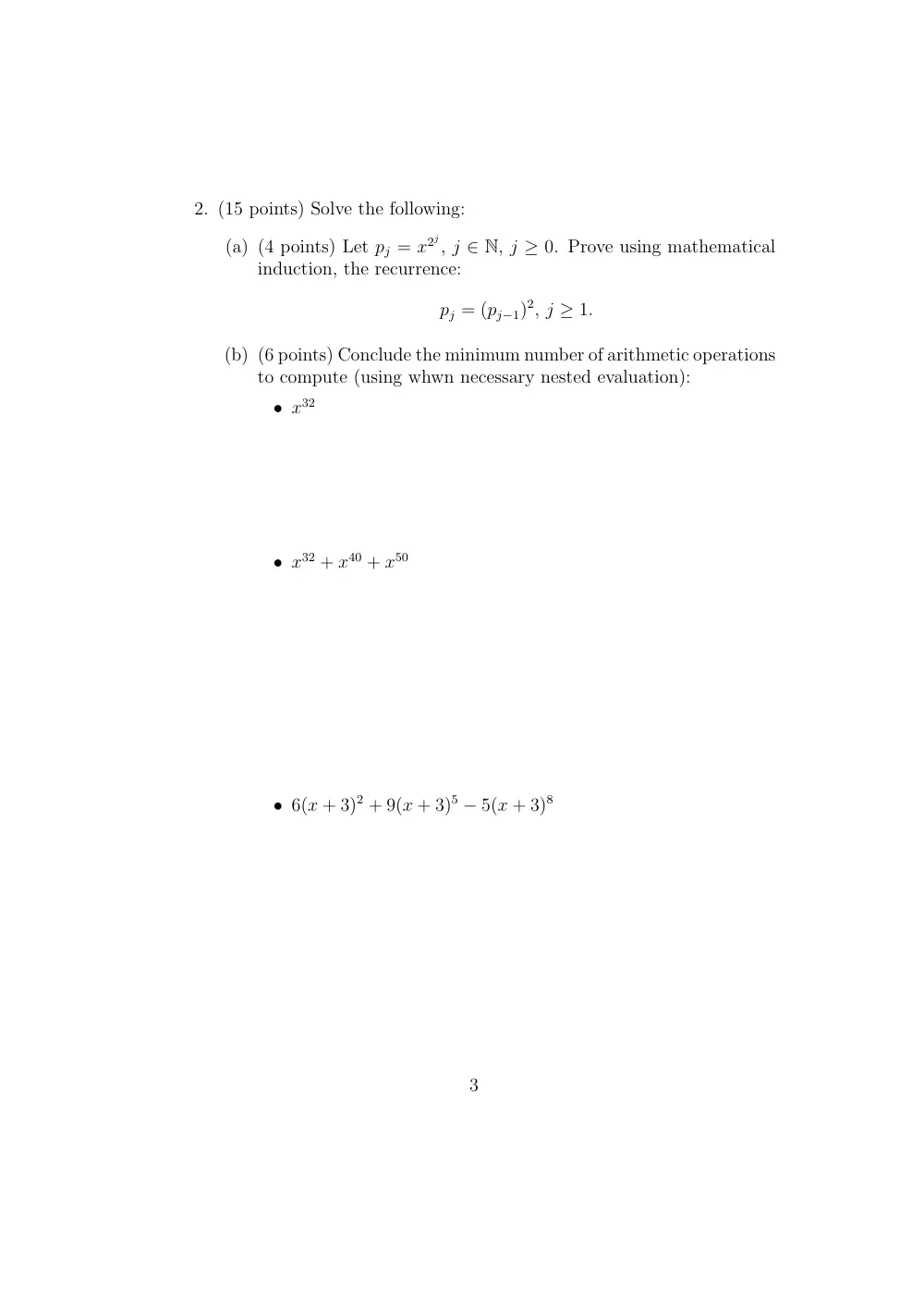
2. (15 points) Solve the following:
(a) (4 points) Let pj = x2j, j ∈ N, j ≥ 0. Prove using mathematical
induction, the recurrence:
pj = (pj−1)2, j ≥ 1.
(b) (6 points) Conclude the minimum number of arithmetic operations
to compute (using whwn necessary nested evaluation):
• x32
• x32 + x40 + x50
• 6(x + 3)2 + 9(x + 3)5 − 5(x + 3)8
3
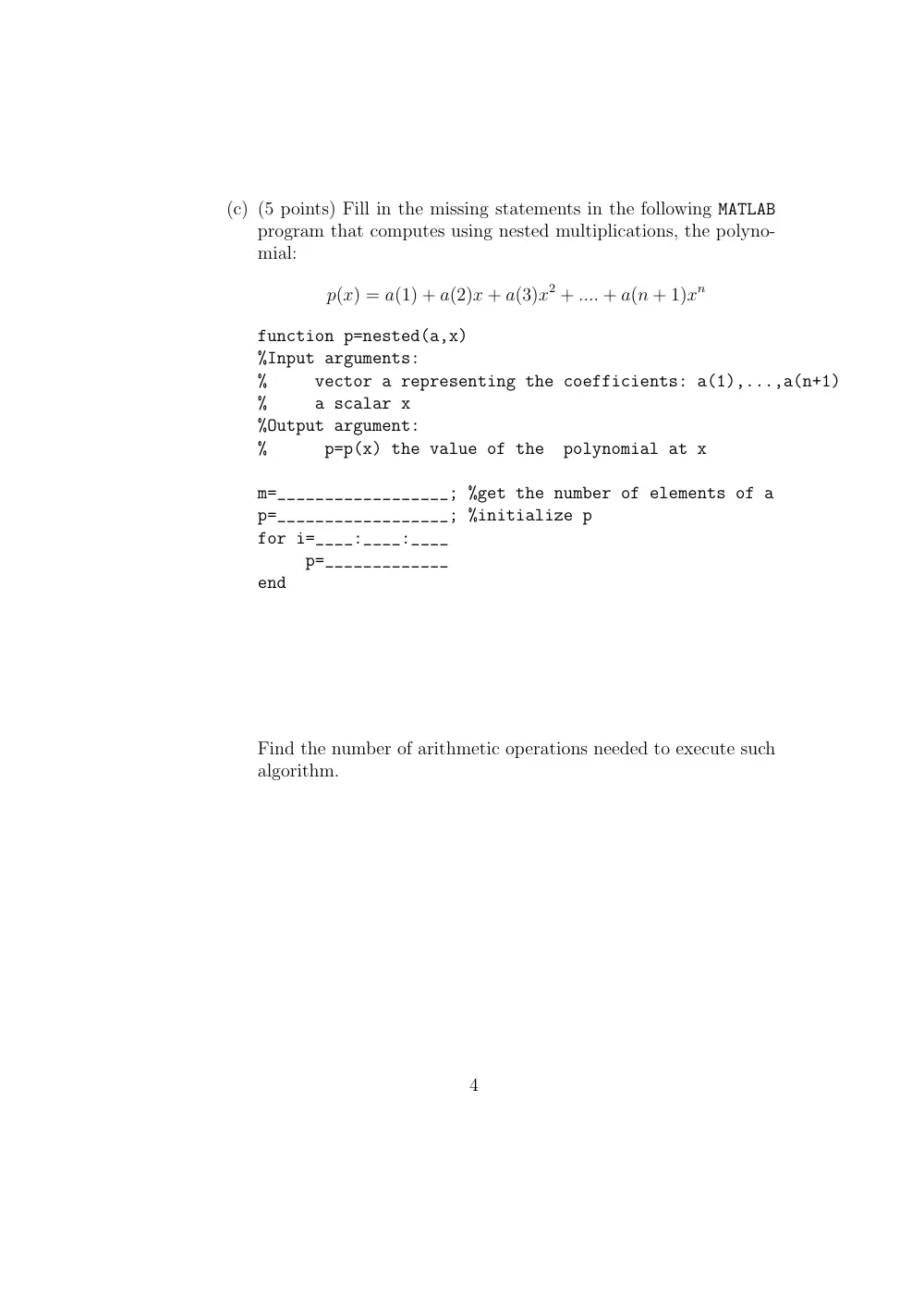
(c) (5 points) Fill in the missing statements in the following MATLAB
program that computes using nested multiplications, the polyno-
mial:
p(x) = a(1) + a(2)x + a(3)x2 + .... + a(n + 1)xn
function p=nested(a,x)
%Input arguments:
%
vector a representing the coefficients: a(1),...,a(n+1)
%
a scalar x
%Output argument:
%
p=p(x) the value of the
polynomial at x
m=__________________; %get the number of elements of a
p=__________________; %initialize p
for i=____:____:____
p=_____________
end
Find the number of arithmetic operations needed to execute such
algorithm.
4
3. (30 points) In this problem, we consider the following table for the func-
tion f(x). All computations shall be carried out with 8 significant
figures.
xi
yi
1.000
1.58760060
1.125
1.68889110
1.250
1.80095954
1.375
1.92555928
1.500
2.06463973
1.625
2.22037684
1.750
2.39520718
1.875
2.59186604
2.000
2.81343020
(a) (5 points) Write the polynomial of degree 3, p(x), that would best
approximate f(1.4). Find p(1.4).
5
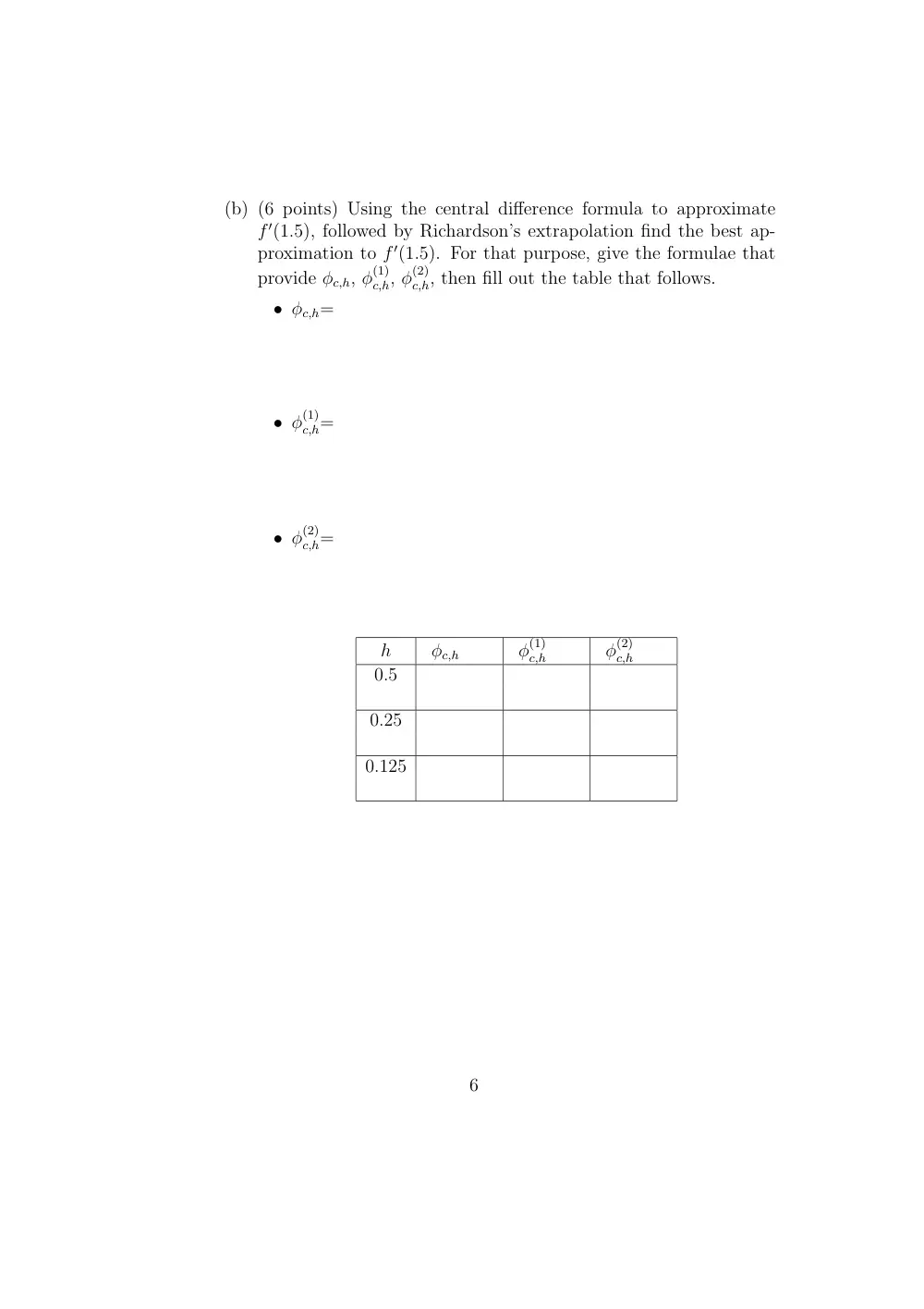
(b) (6 points) Using the central difference formula to approximate
f ′(1.5), followed by Richardson’s extrapolation find the best ap-
proximation to f ′(1.5). For that purpose, give the formulae that
provide φc,h, φ(1)
c,h, φ(2)
c,h, then fill out the table that follows.
• φc,h=
• φ(1)
c,h=
• φ(2)
c,h=
h
φc,h
φ(1)
c,h
φ(2)
c,h
0.5
0.25
0.125
6
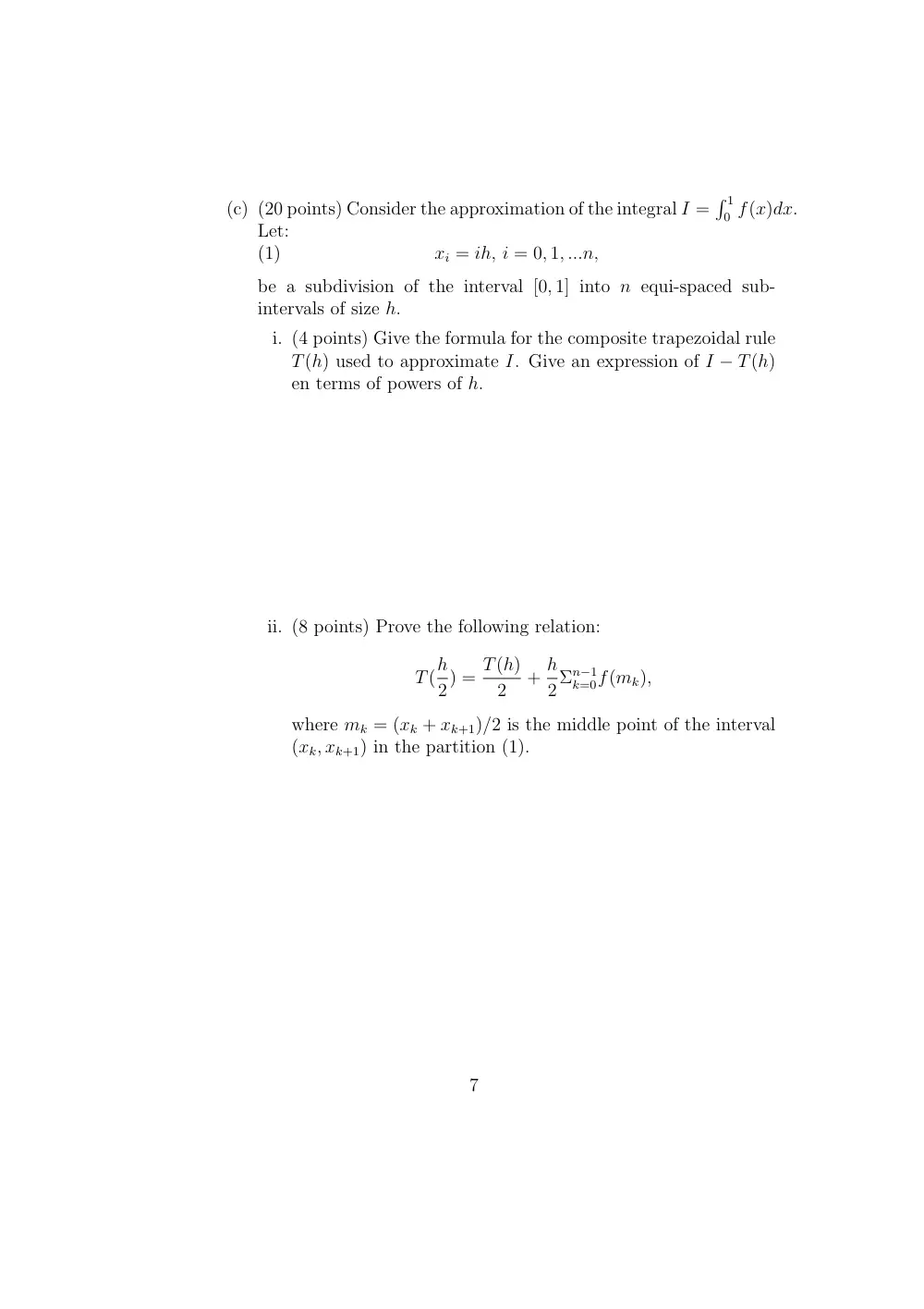
(c) (20 points) Consider the approximation of the integral I =
� 1
0 f(x)dx.
Let:
xi = ih, i = 0, 1, ...n,
(1)
be a subdivision of the interval [0, 1] into n equi-spaced sub-
intervals of size h.
i. (4 points) Give the formula for the composite trapezoidal rule
T(h) used to approximate I. Give an expression of I − T(h)
en terms of powers of h.
ii. (8 points) Prove the following relation:
T(h
2) = T(h)
2
+ h
2Σn−1
k=0f(mk),
where mk = (xk + xk+1)/2 is the middle point of the interval
(xk, xk+1) in the partition (1).
7
(Answer Sheet)
8
iii. (8 points) Give the formulae for T (j)(h), j = 1, 2, 3,
• T (1)(h)=
• T (2)(h)=
• T (3)(h)=
then fill up the empty spaces of the table:
h
T(h)
T (1)(h)
T (2)(h)
T (3)(h)
1
0.5
0.25
0.125
9
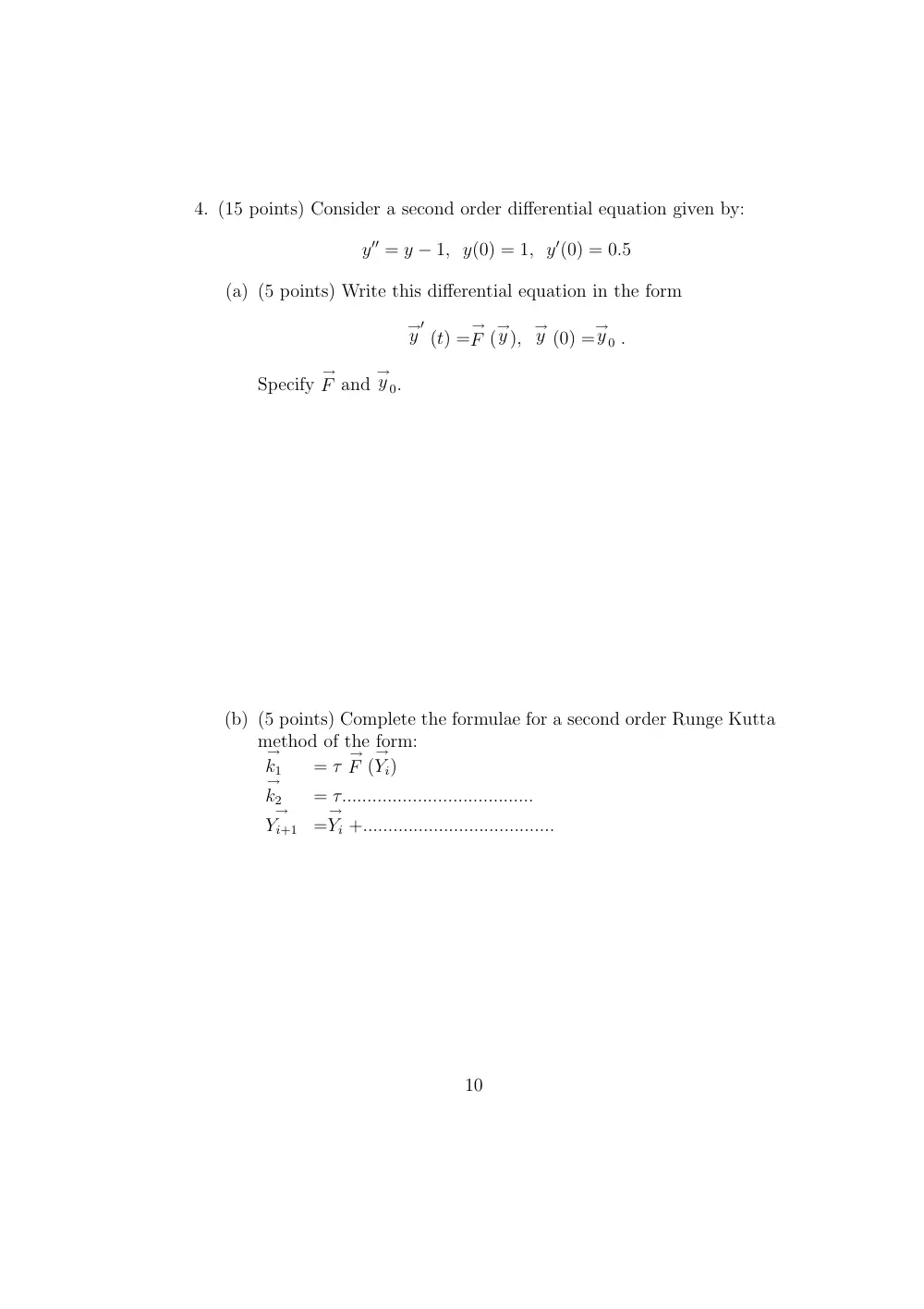
4. (15 points) Consider a second order differential equation given by:
y′′ = y − 1, y(0) = 1, y′(0) = 0.5
(a) (5 points) Write this differential equation in the form
→y
′
(t) =
→
F (
→y),
→y (0) =
→y 0 .
Specify
→
F and
→y 0.
(b) (5 points) Complete the formulae for a second order Runge Kutta
method of the form:
→
k1
= τ
→
F (
→
Yi)
→
k2
= τ......................................
→
Yi+1
=
→
Yi +......................................
10
(c) (5 points) Find approximations to y(0.125) and y′(0.125) using
such Runge Kutta method
11