
PHIL 210 Final, Fall 1995
American University of Beirut · Ethics · 1 page
Stuck on a question? A tutor can walk you through it.
More PHIL 210 files
- Notes Final Exam · Fall 2015Final examView
- Notes Kant Nadine Abou Zaki · Fall 2016NotesView
- Notes Midterm · Fall 2015NotesView
- Exam 1 First Test (1) · Spring 2013ExamView
- Exam 1 First Test (2) · Spring 2013ExamView
- Paper First Paper · Spring 2013FileView
- Notes · Summer 2011NotesView
- Notes · Summer 2011NotesView
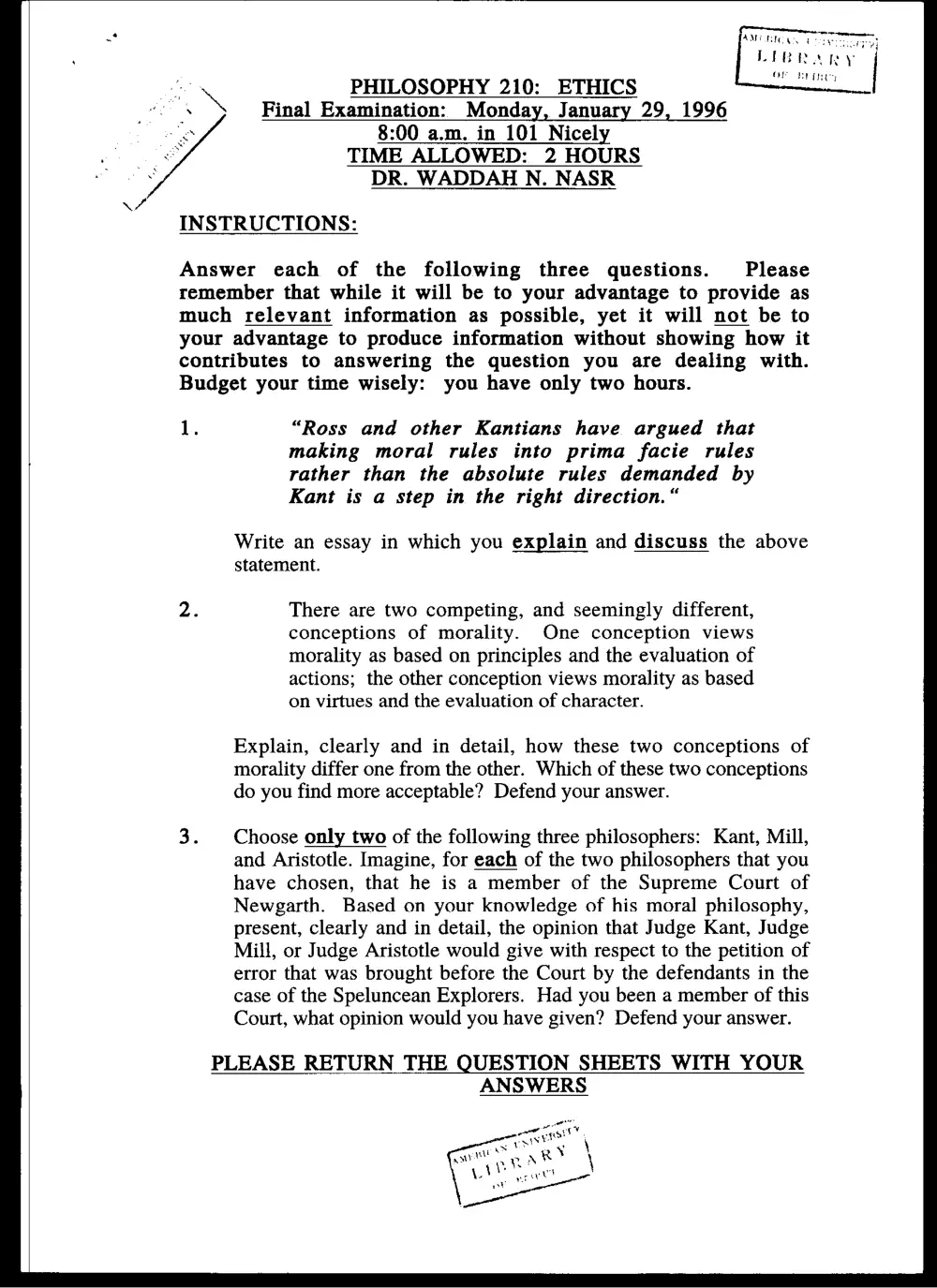
Show the text of this final exam
AMUNIGAN bopeomar py]
LIBRARY.
OF Nt ihe
oo PHILOSOPHY 210: ETHICS
7s ~ Final Examination: Monday, January 29, 1996
ot 8:00 a.m. in 101 Nicely
TIME ALLOWED: 2 HOURS
DR. WADDAH N. NASR
INSTRUCTIONS:
Answer each of the following three questions. Please
remember that while it will be to your advantage to provide as
much relevant information as possible, yet it will not be to
your advantage to produce information without showing how it
contributes to answering the question you are dealing with.
Budget your time wisely: you have only two hours.
1. “Ross and other Kantians have argued that
making moral rules into prima facie rules
rather than the absolute rules demanded by
Kant is a step in the right direction.“
Write an essay in which you explain and discuss the above
statement.
2. There are two competing, and seemingly different,
conceptions of morality. One conception views
morality as based on principles and the evaluation of
actions; the other conception views morality as based
on virtues and the evaluation of character.
Explain, clearly and in detail, how these two conceptions of
morality differ one from the other. Which of these two conceptions
do you find more acceptable? Defend your answer.
3. Choose only two of the following three philosophers: Kant, Mill,
and Aristotle. Imagine, for each of the two philosophers that you
have chosen, that he is a member of the Supreme Court of
Newgarth. Based on your knowledge of his moral philosophy,
present, clearly and in detail, the opinion that Judge Kant, Judge
Mill, or Judge Aristotle would give with respect to the petition of
error that was brought before the Court by the defendants in the
case of the Speluncean Explorers. Had you been a member of this
Court, what opinion would you have given? Defend your answer.
PLEASE RETURN THE QUESTION SHEETS WITH YOUR
ANSWERS