
PHYS 103 Final, Fall 1998
American University of Beirut · Physics for the Life Sciences · 3 pages
More PHYS 103 files
Show the text of this final exam
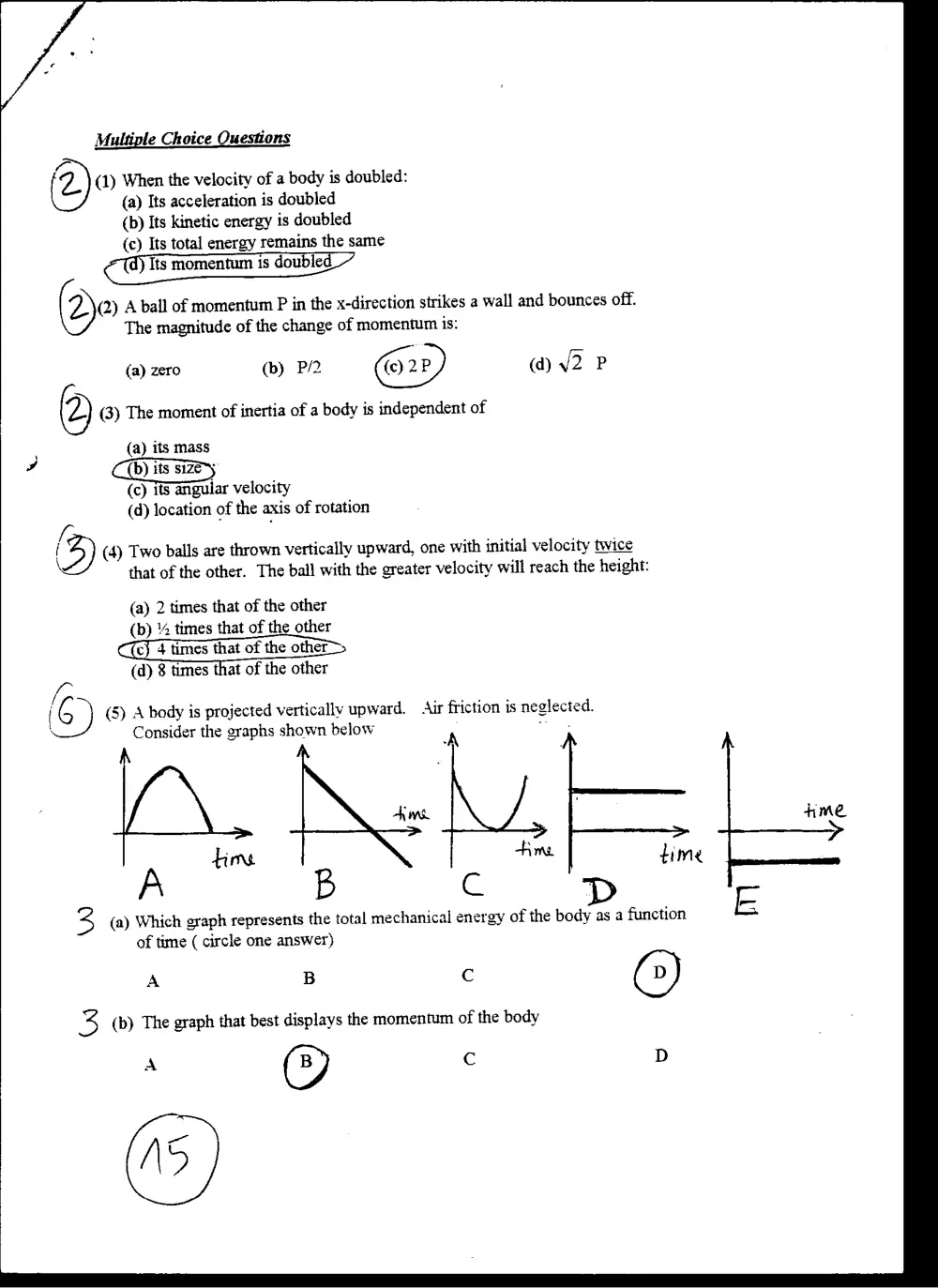
Multiple Choice Questions
>
(2) (1) When the velocity of a body is doubled:
(a) Its acceleration is doubled
(b) Its kinetic energy is doubled
(c) Its total energy remains the same
@ Its momentum is doubled ~
2 (2) A ball of momentum P in the x-direction strikes a wall and bounces off.
The magnitude of the change of momentum is:
(a) zero (b) P/2 2) (@) ¥2 P
2 (3) The moment of inertia of a body is independent of
(a) its mass
(c) its angular velocity
(d) location of the axis of rotation
Lr.
(3) (4) Two balls are thrown vertically upward, one with initial velocity twice
that of the other. The ball with the greater velocity will reach the height:
(a) 2 times that of the other
(b) 4 times that of the other
©) 4 times that of the other>
(d) $ times that of the other
(5) A body is projected vertically upward. Air friction i is neglected.
Consider the graphs shown below
AN MEL
Z (a) Which graph represents B total mechanical energy of the ot. as a function
of time ( circle one answer)
A B Cc ©)
3 (b) The graph that best displays the momentum of the body
A c D
mM
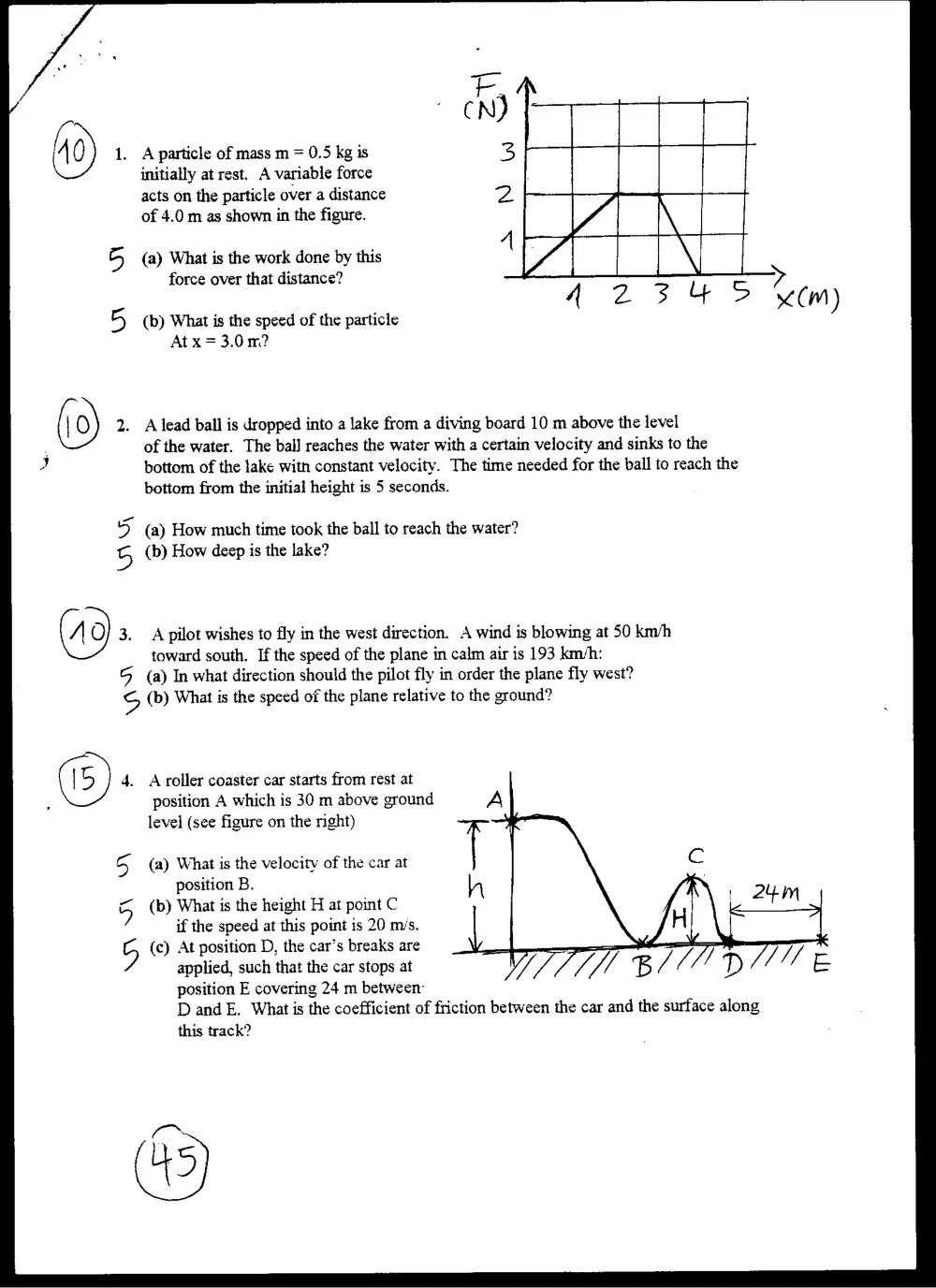
1. A particle of mass m = 0.5 kg is
initially at rest. A variable force
acts on the particle over a distance
of 4.0 m as shown in the figure.
(a) What is the work done by this
force over that distance?
4 234 5 Sm)
(b) What is the speed of the particle
Atx=3.0m?
. A lead ball is dropped into a lake from a diving board 10 m above the level
of the water. The bal] reaches the water with a certain velocity and sinks to the
bottom of the lake witn constant velocity. The time needed for the ball to reach the
bottom from the initial height is 5 seconds.
5 (a) How much time took the ball to reach the water?
5 (b) How deep is the lake?
vA O} 3. A pilot wishes to fly in the west direction. A wind is blowing at 50 km/h
toward south. If the speed of the plane in calm air is 193 knv/h:
5 (a) In what direction should the pilot fly in order the plane fly west?
S (b) What is the speed of the plane relative to the ground?
4. A roller coaster car starts from rest at
position A which is 30 m above ground
level (see figure on the right)
5 (a) What is the velocity of the car at
position B.
5 (b) What is the height H at point C
if the speed at this point is 20 m/s.
5 (c) At position D, the car’s breaks are
applied, such that the car stops at
position E covering 24 m between
D and E. What is the coefficient of friction between the car and the surface along
this track?
K5
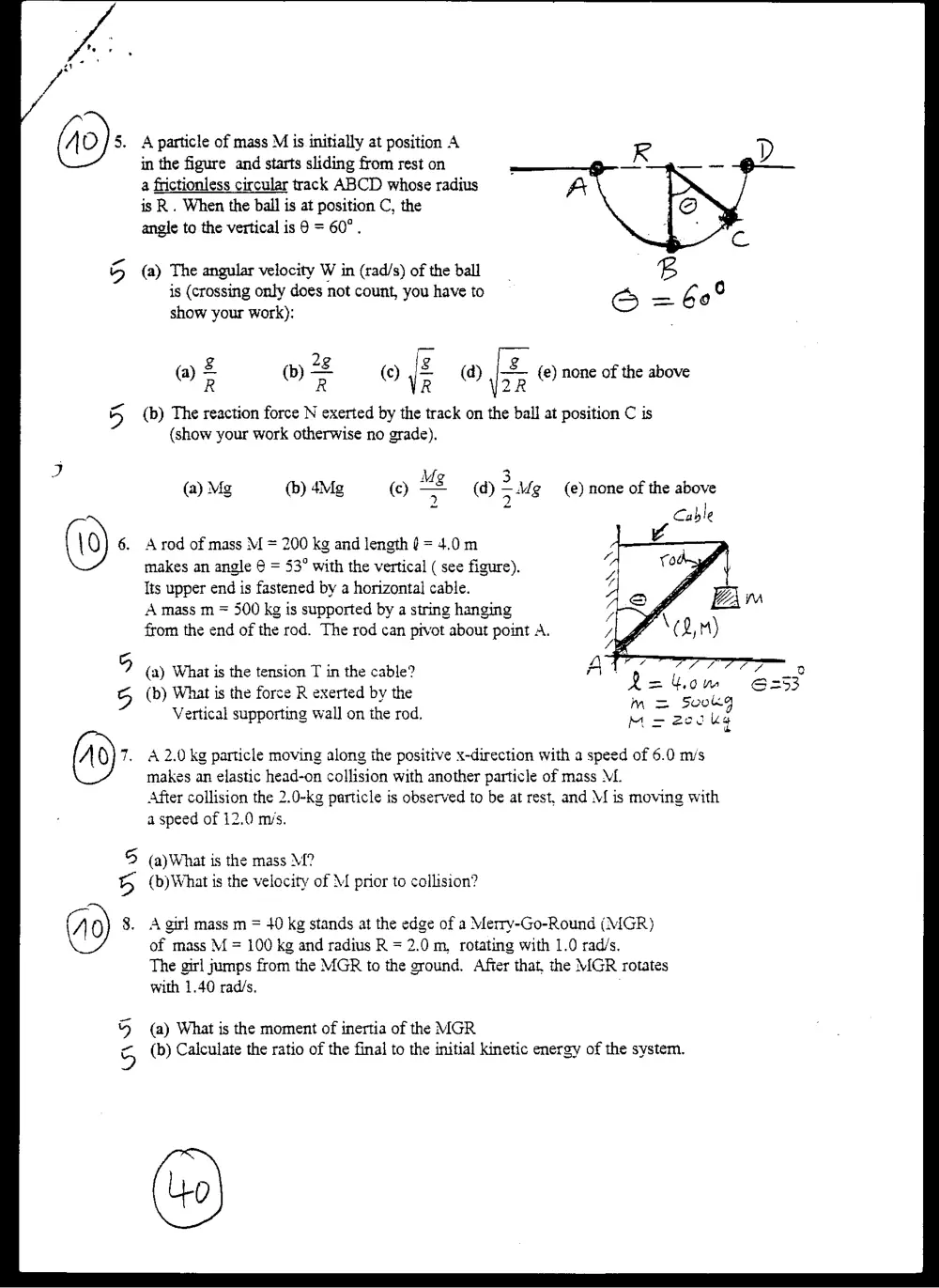
5.
A particle of mass M is initially at position A
in the figure and starts sliding from rest on
a frictionless circular track ABCD whose radius
is R . When the ball is at position C, the
angle to the vertical is 6 = 60°.
(a) The angular velocity W in (rad/s) of the ball B
is (crossing only does not count, you have to SS) _ 6 o 0
show your work): ~
zg 2g ig ra
(a) R (b) R (c) | R (ad) is (e) none of the above
(b) The reaction force N exerted by the track on the ball at position C is
(show your work otherwise no grade).
Mg
2
(a) Mg (b) 4Mg (c) (d) 2 ug (e) none of the above
Cable
. Arod of mass M = 200 kg and length ¢@= 4.0m
makes an angle @ = 53° with the vertical ( see figure).
Its upper end is fastened by a horizontal cable.
A mass m = 500 kg is supported by a string hanging
from the end of the rod. The rod can ptvot about point A.
(a) What is the tension T in the cable?
(b) What is the force R exerted by the
Vertical supporting wall on the rod.
A 2.0 kg particle moving along the positive x-direction with a speed of 6.0 m/s
makes an elastic head-on collision with another particle of mass M.
After collision the 2.0-kg particle is observed to be at rest, and M is moving with
a speed of 12.0 m/s.
(a) What is the mass M?
(b) What is the velocity of M prior to collision?
. A girl mass m = 40 kg stands at the edge of a Merry-Go-Round (MGR)
5
2
of mass M = 100 kg and radius R = 2.0 m, rotating with 1.0 rad/s.
The girl jamps from the MGR to the ground. Afier that, the MGR rotates
with 1.40 rad/s.
(a) What is the moment of inertia of the MGR
(b) Calculate the ratio of the final to the initial kinetic energy of the system.