
PHYS 103 Final, Fall 2007
American University of Beirut · Physics for the Life Sciences · 15 pages


Showing the first 10 of 15 pages. Download the PDF to see all of it.
More PHYS 103 files
Show the text of this final exam
PHYSICS 103
Final exam
TIME: 120 minutes
Jan. 28, 2008
DO NOT OPEN THIS EXAM BEFORE YOU ARE TOLD TO BEGIN
NAME________________________________________________
ID Number ________________________
Grading
A
B
C
TOTAL
Score:________
Check if solution is continued on the back.
1
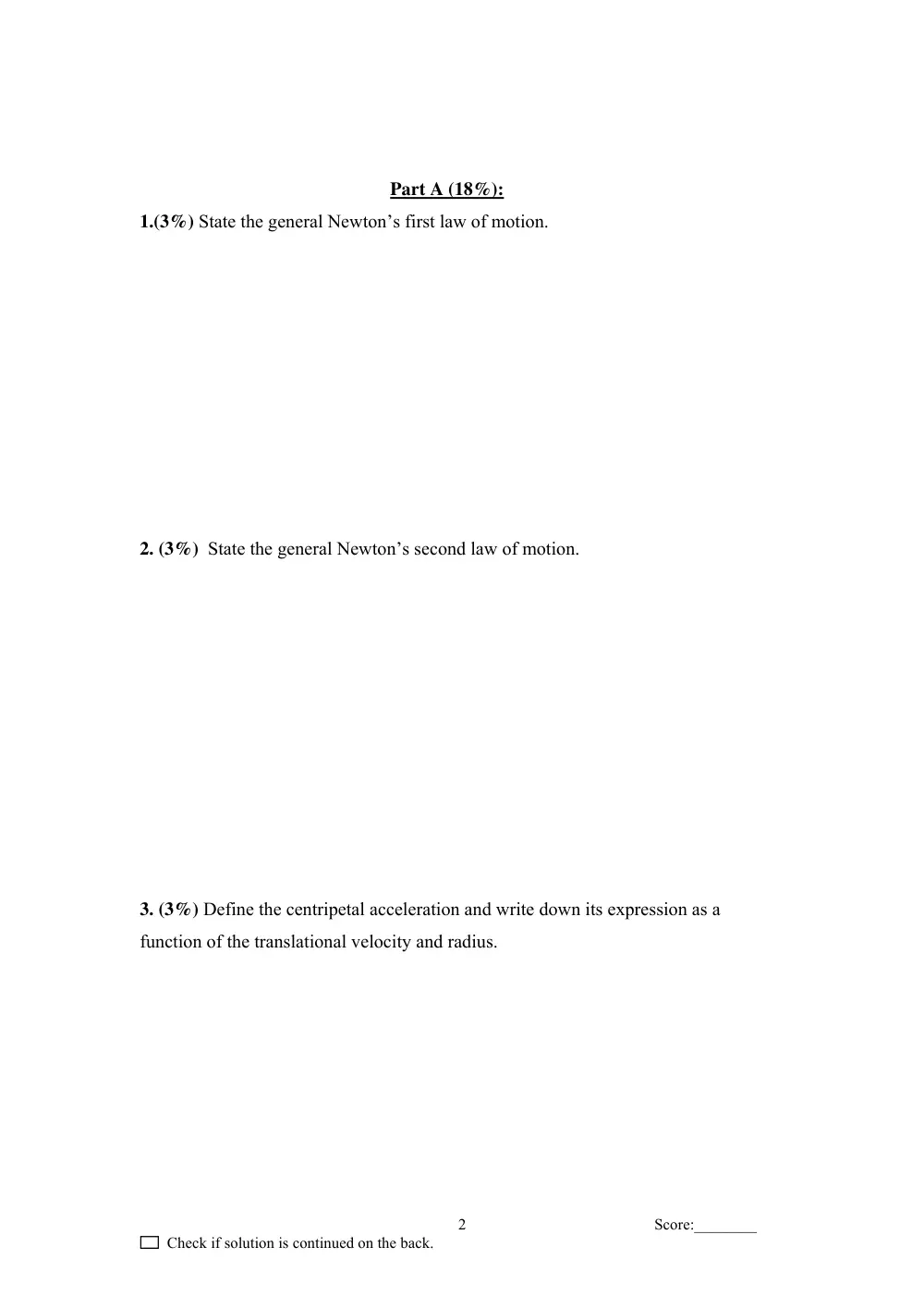
Part A (18%):
1.(3%) State the general Newton’s first law of motion.
2. (3%) State the general Newton’s second law of motion.
3. (3%) Define the centripetal acceleration and write down its expression as a
function of the translational velocity and radius.
Score:________
Check if solution is continued on the back.
2
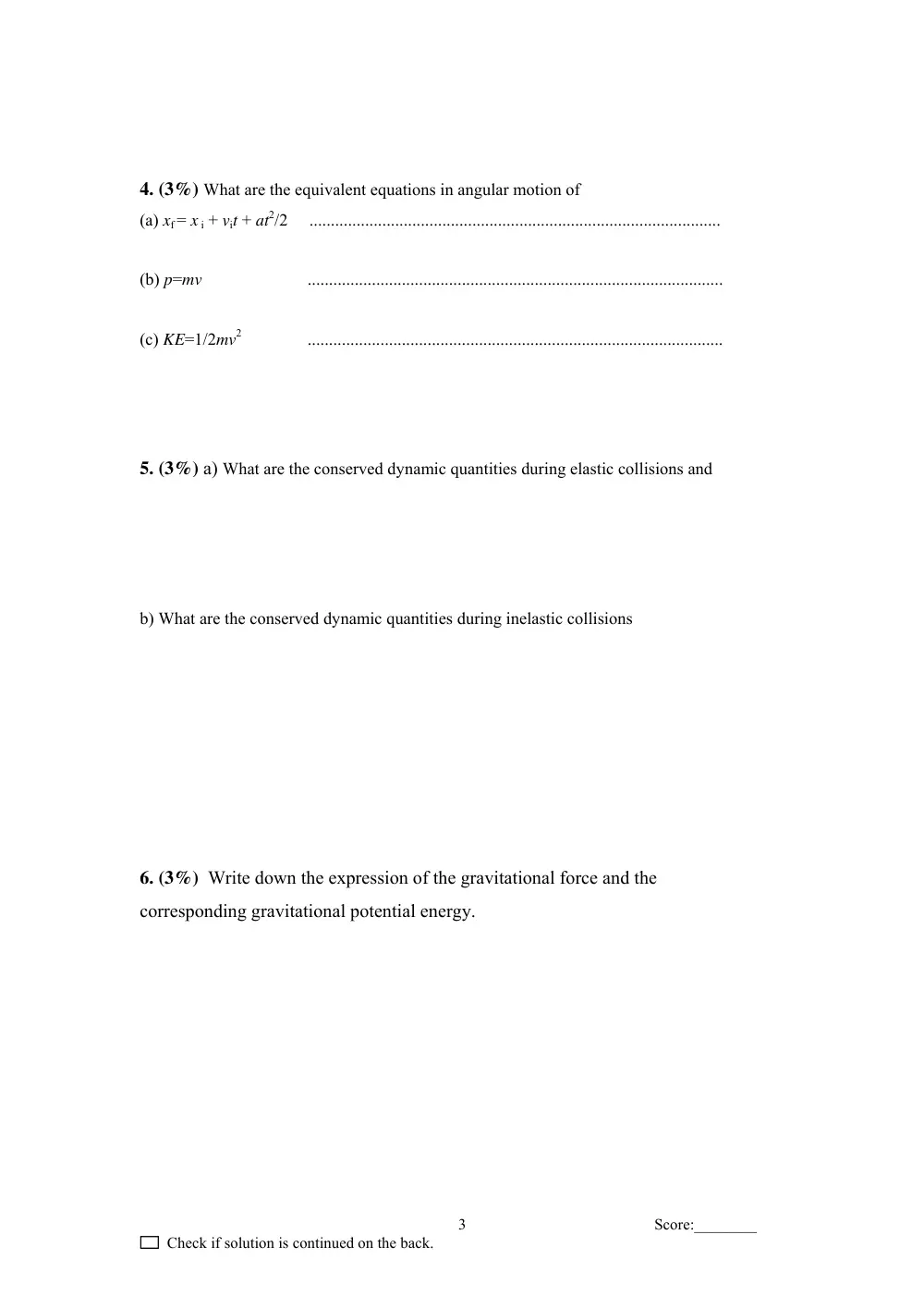
4. (3%) What are the equivalent equations in angular motion of
(a) xf = x i + vit + at2/2 ................................................................................................
(b) p=mv
.................................................................................................
(c) KE=1/2mv2
.................................................................................................
5. (3%) a) What are the conserved dynamic quantities during elastic collisions and
b) What are the conserved dynamic quantities during inelastic collisions
6. (3%) Write down the expression of the gravitational force and the
corresponding gravitational potential energy.
Score:________
Check if solution is continued on the back.
3
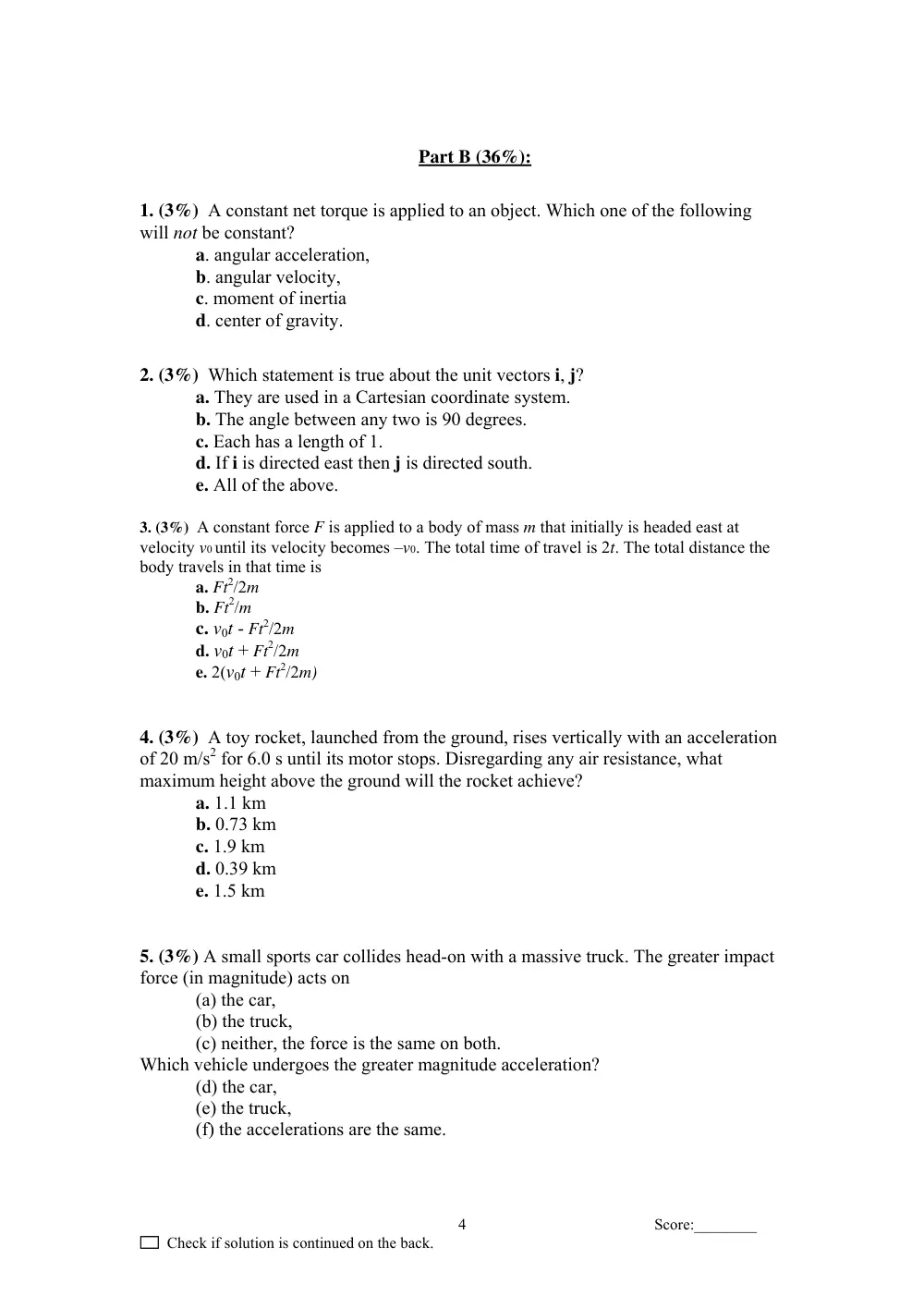
Part B (36%):
1. (3%) A constant net torque is applied to an object. Which one of the following
will not be constant?
a. angular acceleration,
b. angular velocity,
c. moment of inertia
d. center of gravity.
2. (3%) Which statement is true about the unit vectors i, j?
a. They are used in a Cartesian coordinate system.
b. The angle between any two is 90 degrees.
c. Each has a length of 1.
d. If i is directed east then j is directed south.
e. All of the above.
3. (3%) A constant force F is applied to a body of mass m that initially is headed east at
velocity v0 until its velocity becomes –v0. The total time of travel is 2t. The total distance the
body travels in that time is
a. Ft2/2m
b. Ft2/m
c. v0t - Ft2/2m
d. v0t + Ft2/2m
e. 2(v0t + Ft2/2m)
4. (3%) A toy rocket, launched from the ground, rises vertically with an acceleration
of 20 m/s2 for 6.0 s until its motor stops. Disregarding any air resistance, what
maximum height above the ground will the rocket achieve?
a. 1.1 km
b. 0.73 km
c. 1.9 km
d. 0.39 km
e. 1.5 km
5. (3%) A small sports car collides head-on with a massive truck. The greater impact
force (in magnitude) acts on
(a) the car,
(b) the truck,
(c) neither, the force is the same on both.
Which vehicle undergoes the greater magnitude acceleration?
(d) the car,
(e) the truck,
(f) the accelerations are the same.
Score:________
Check if solution is continued on the back.
4
6. (3%) An object of mass m moves to the right with a speed v. It collides head-on
with an object of mass 3m moving with speed v/3 in the opposite direction. If the two
objects stick together, what is the speed of the combined object, of mass 4m, after the
collision?
a. 0
b. v/2
c. v
d. 2v
e. –v/2
7. (3%) The same constant force is used to accelerate two carts of the same mass,
initially at rest, on horizontal frictionless tracks. The force is applied to cart A for
twice as long a time as it is applied to cart B. The work the force does on A is WA;
that on B is WB. Which statement is correct?
a. WA = WB.
b. WA = 2 WB.
c. WA = 2 WB.
d. WA = 4 WB.
e. WB = 2WA.
8. (3%) A 30 kg child sitting 5.0 m from the center of a merry-go-round has a
constant speed of 5.0 m/s. While she remains seated in the same spot and travels in a
circle, the work the seat performs on her in one complete rotation is
a. 0 J.
b. 150 J.
c. 1500 J.
d. 4700 J.
e. 46,000 J.
9. (3%) A ball falls to the ground from height h and bounces to height h′. Momentum
is conserved in the ball-earth system
a. no matter what height h′ it reaches.
b. only if h′ < h.
c. only if h′ = h.
d. only if h′ > h.
e. only if h′ ≥ h.
10. (3%) The angular speed of the minute hand of a clock, in rad/s, is
a. π/1800.
b. π/60.
c. π/30.
d. π.
e. 120π.
Score:________
Check if solution is continued on the back.
5
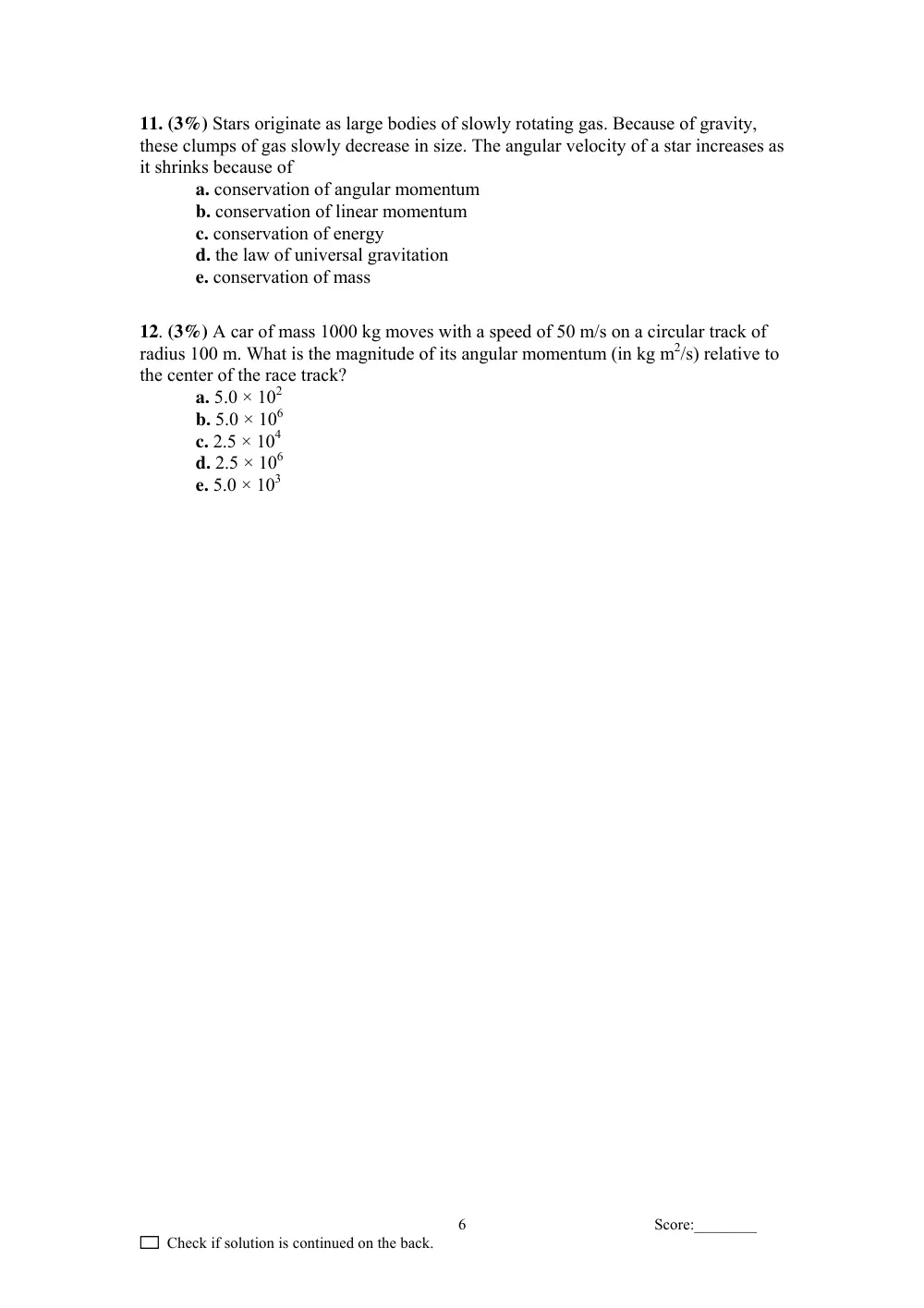
11. (3%) Stars originate as large bodies of slowly rotating gas. Because of gravity,
these clumps of gas slowly decrease in size. The angular velocity of a star increases as
it shrinks because of
a. conservation of angular momentum
b. conservation of linear momentum
c. conservation of energy
d. the law of universal gravitation
e. conservation of mass
12. (3%) A car of mass 1000 kg moves with a speed of 50 m/s on a circular track of
radius 100 m. What is the magnitude of its angular momentum (in kg m2/s) relative to
the center of the race track?
a. 5.0 × 10²
b. 5.0 × 10⁶
c. 2.5 × 10⁴
d. 2.5 × 10⁶
e. 5.0 × 10³
Score:________
Check if solution is continued on the back.
6
Part C (46%)
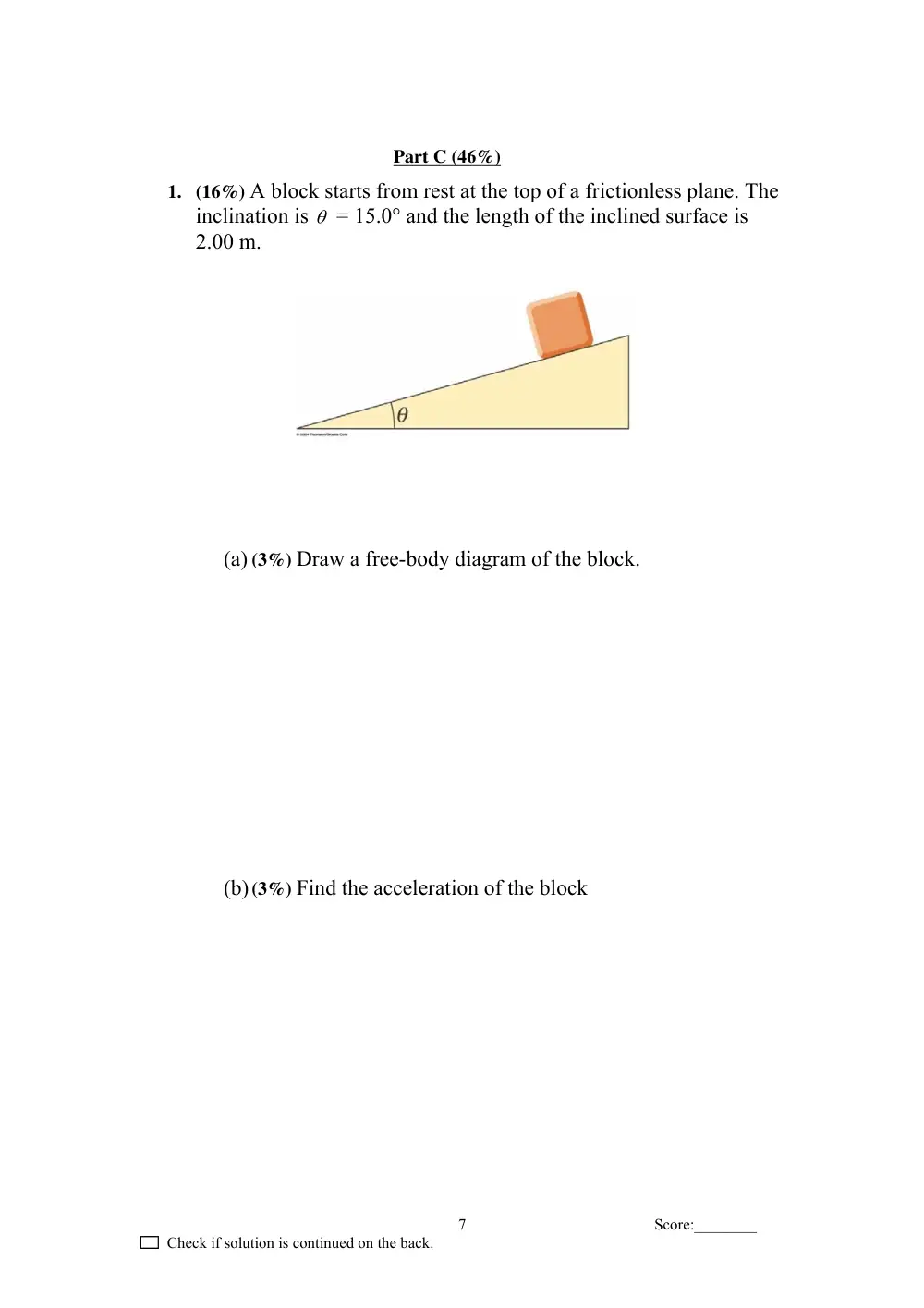
1. (16%) A block starts from rest at the top of a frictionless plane. The
inclination is θ = 15.0° and the length of the inclined surface is
2.00 m.
(a) (3%) Draw a free-body diagram of the block.
(b) (3%) Find the acceleration of the block
Score:________
Check if solution is continued on the back.
7
(c) (3%) Find its speed when it reaches the bottom of the incline.
(d) (3%) Assume that the plane is no longer frictionless but has a
kinematic friction of μk=0.4. Re-determine the acceleration
of the block.
Score:________
Check if solution is continued on the back.
8
(e) (4%) How much work did the block as it slides the whole
surface.
2. (10%) A bug is on the rim of a 25 cm radius disk. The disk moves from rest to an
angular speed of 78 rev/min in 3.0 s.
(a) (3%) What is the angular acceleration of the bug?
(b) (3%) When the disk is at its final speed, what is the angular velocity of the
bug?
Score:________
Check if solution is continued on the back.
9
(c) (4%) One second after the bug starts from rest, what are its angular
acceleration, centripetal acceleration, and total acceleration?
3. (14%) A space station is constructed in the shape of a hollow ring of mass 5.00 ×
104 kg with radius 100 m. The moment of inertia for the ring is MR2 and other parts
have negligible mass.
At rest when constructed, the ring is rotated about its axis so that the people inside
experience an effective free-fall acceleration equal to 1g.
Score:________
Check if solution is continued on the back.
10
(a) (3%) assuming that this artificial gravitation is caused only by centripetal
acceleration, determine the angular velocity necessary to achieve 1g.
(b) (3%) The rotation is achieved by firing two small rockets attached
tangentially to opposite points on the outside of the ring. Initially the ring was
at rest, what angular momentum does the space station acquire?
(c) (4%) How long must the rockets be fired if each exerts a thrust of 125 N?
Score:________
Check if solution is continued on the back.
11
(d) (4%) Assume that the total mass of the ring includes the mass of one hundred
crew member each weighing 65.0 kg. If all the crew members move to the
center, determine the angular speed change at the rim of the space station.
4. (6%) Determine the expression of the minimum velocity needed for an object to be
launched with from the surface of the earth so as it soars into space.
Score:________
Check if solution is continued on the back.
12
Score:________
Check if solution is continued on the back.
13
SCRATCH PAPER
Nothing on this page will be graded
Score:________
Check if solution is continued on the back.
14
Score:________
Check if solution is continued on the back.
15
Score:________
Check if solution is continued on the back.
15