
PHYS 103 Final, Spring 1996
American University of Beirut · Physics for the Life Sciences · 5 pages


More PHYS 103 files
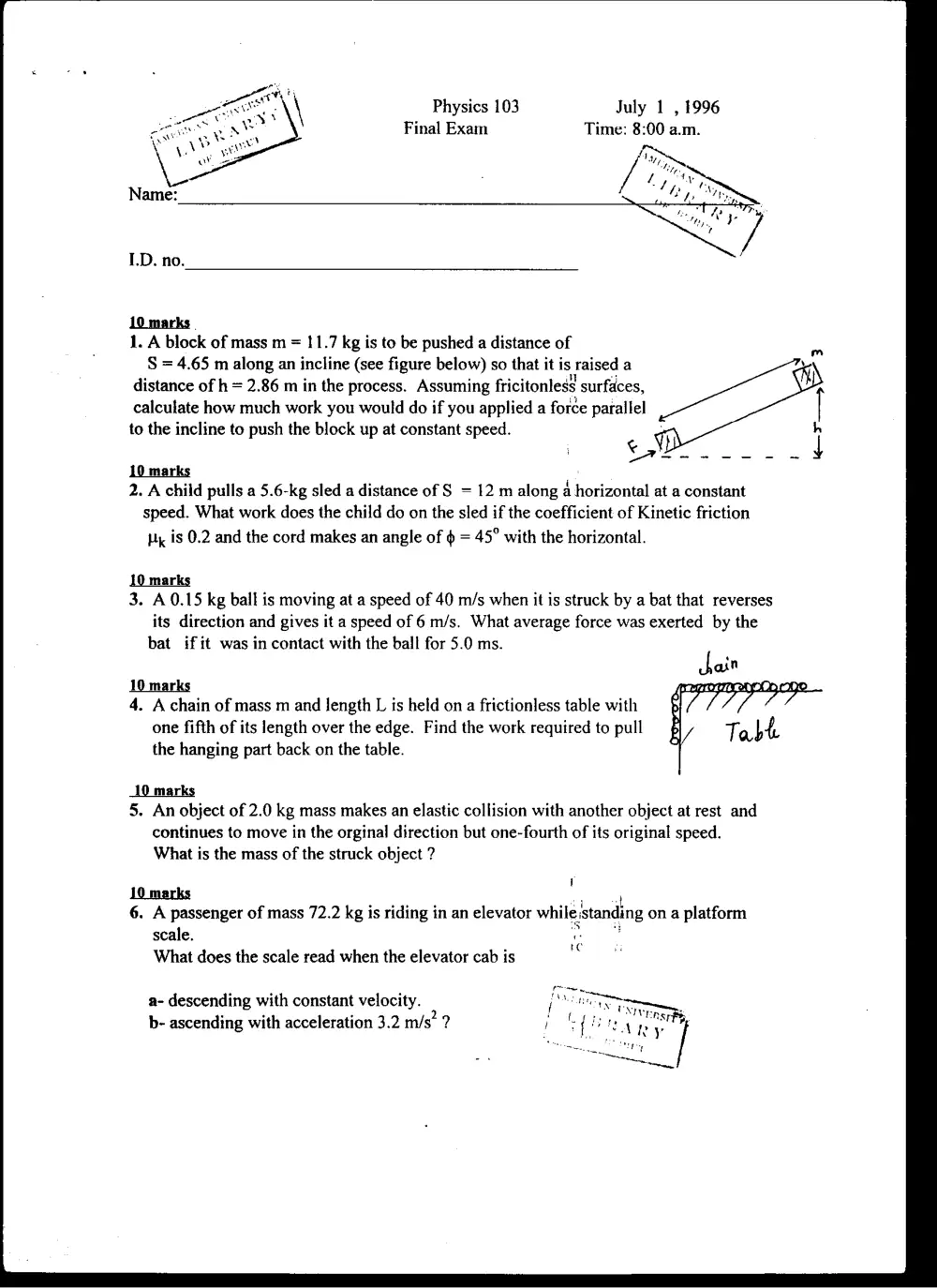
Show the text of this final exam
Physics 103 July 1 , 1996
Final Exam Time: 8:00 a.m.
10 marks |
1. A block of mass m = 11.7 kg is to be pushed a distance of
S = 4.65 m along an incline (see figure below) so that it is raised a ,
distance of h = 2.86 m in the process. Assuming fricitonless surfaces,
calculate how much work you would do if you applied a force parallel i
h
to the incline to push the block up at constant speed.
10 marks
2. A child pulls a 5.6-kg sled a distance of S = 12 m along a horizontal at a constant
speed. What work does the child do on the sled if the coefficient of Kinetic friction
Hy is 0.2 and the cord makes an angle of = 45° with the horizontal.
10 marks
3. A 0.15 kg ball is moving at a speed of 40 m/s when it is struck by a bat that reverses
its direction and gives it a speed of 6 m/s. What average force was exerted by the
bat if it was in contact with the ball for 5.0 ms. J
qin
10 marks
4. A chain of mass m and length L is held on a frictionless table with
one fifth of its length over the edge. Find the work required to pull T abt
the hanging part back on the table.
10 marks
5. An object of 2.0 kg mass makes an elastic collision with another object at rest and
continues to move in the orginal direction but one-fourth of its original speed.
What is the mass of the struck object ?
10 marks
7 it
6. A passenger of mass 72.2 kg is riding in an elevator while:standing on a platform
scale. mF
What does the scale read when the elevator cab is re
a- descending with constant velocity. j
b- ascending with acceleration 3.2 m/s” ? pk {
10 marks
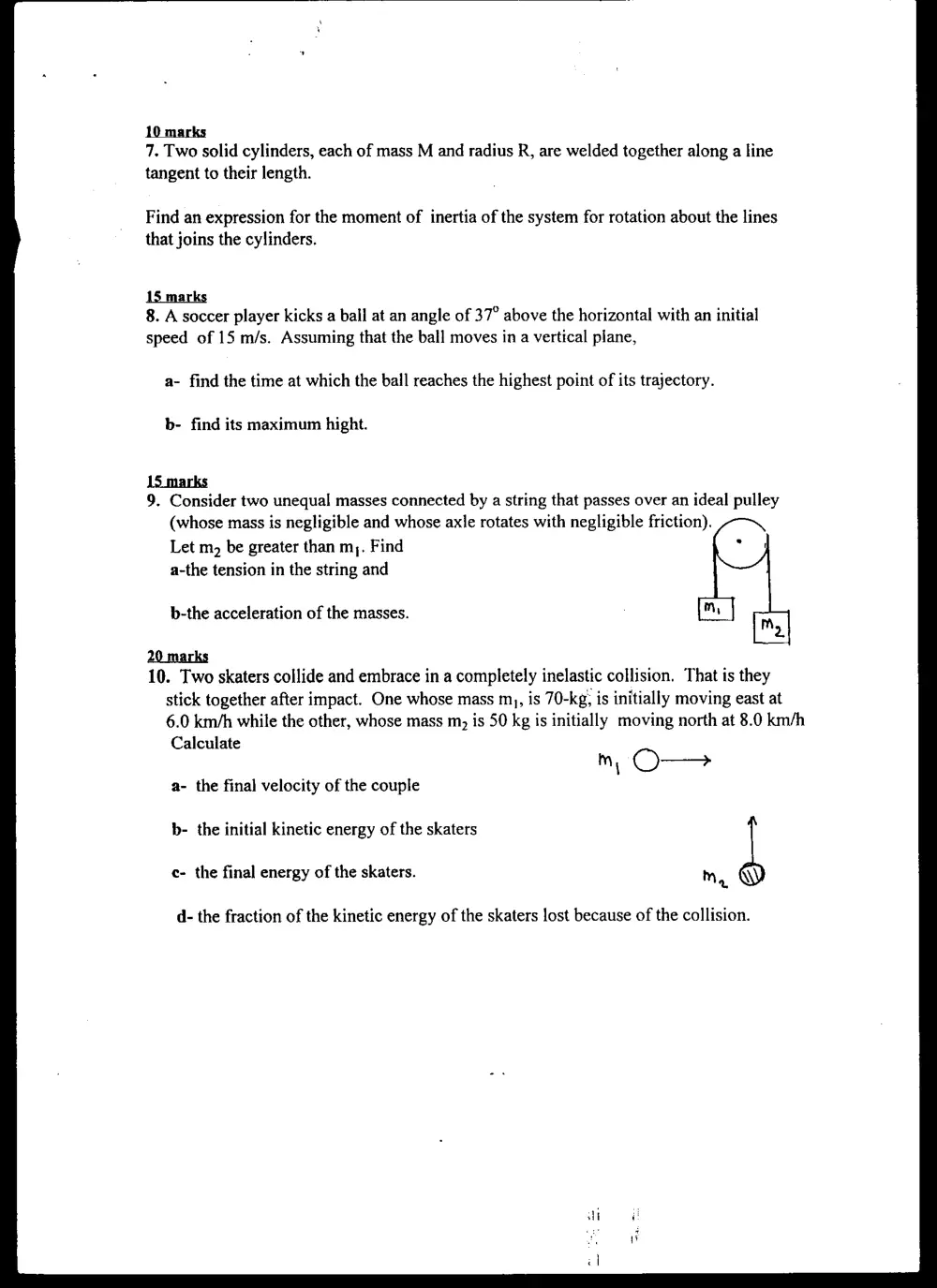
7. Two solid cylinders, each of mass M and radius R, are welded together along a line
tangent to their length.
Find an expression for the moment of inertia of the system for rotation about the lines
that joins the cylinders.
15 marks
8. A soccer player kicks a ball at an angle of 37° above the horizontal with an initial
speed of 15 m/s. Assuming that the ball moves in a vertical plane,
a- find the time at which the ball reaches the highest point of its trajectory.
b- find its maximum hight.
1S.marks
9. Consider two unequal masses connected by a string that passes over an ideal pulley
(whose mass is negligible and whose axle rotates with negligible friction).
Let mg be greater than my. Find
a-the tension in the string and
b-the acceleration of the masses.
20 marks
10. Two skaters collide and embrace in a completely inelastic collision. That is they
stick together after impact. One whose mass m,, is 70-kg} is initially moving east at
6.0 km/h while the other, whose mass mj is 50 kg is initially moving north at 8.0 km/h
Calculate
m, O-—>
a- the final velocity of the couple
b- the initial kinetic energy of the skaters
c- the final energy of the skaters. ma
d- the fraction of the kinetic energy of the skaters lost because of the collision.
ali i
153. marks
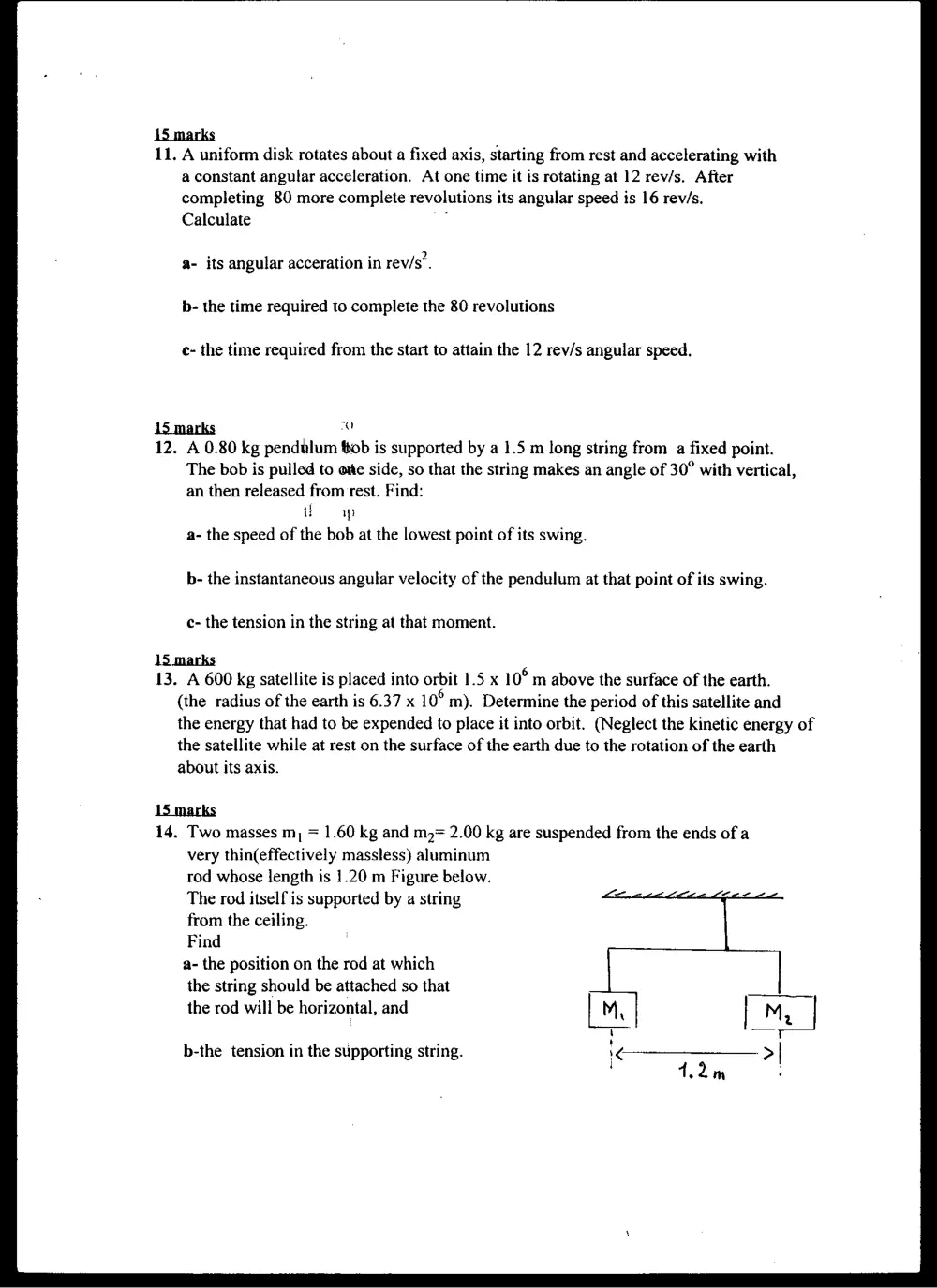
11. A uniform disk rotates about a fixed axis, starting from rest and accelerating with
a constant angular acceleration. At one time it is rotating at 12 rev/s. After
completing 80 more complete revolutions its angular speed is 16 rev/s.
Calculate :
. ar 2
a- its angular acceration in rev/s".
b- the time required to complete the 80 revolutions
c- the time required from the start to attain the 12 rev/s angular speed.
15. marks “a
12. A 0.80 kg pendulum bob is supported by a 1.5 m long string from a fixed point.
The bob is puiled to ere side, so that the string makes an angle of 30° with vertical,
an then released from rest. Find:
i yp)
a- the speed of the bob at the lowest point of its swing.
b- the instantaneous angular velocity of the pendulum at that point of its swing.
c- the tension in the string at that moment.
13.marks
13. A 600 kg satellite is placed into orbit 1.5 x 10° m above the surface of the earth.
(the radius of the earth is 6.37 x 10° m). Determine the period of this satellite and
the energy that had to be expended to place it into orbit. (Neglect the kinetic energy of
the satellite while at rest on the surface of the earth due to the rotation of the earth
about its axis.
15. marks
14. Two masses m, = 1.60 kg and m)= 2.00 kg are suspended from the ends of a
very thin(effectively massless) aluminum
rod whose length is 1.20 m Figure below.
The rod itself is supported by a string = —
from the ceiling.
Find
a- the position on the rod at which |
the string should be attached so that
the rod will be horizontal, and y ‘ | M,
b-the tension in the supporting string. ‘¢-—-_____— > |
1 :
20 marks
15. A merry-go-round at a playground consists of a circular piece of wood 8.0 cm thick
and4.00 m in diameter. The disk has a mass of 200 kg. Initially, Ithe merry-go-round
is at rest. Four children, each having a mass of 30.0 kg, push tangentially along its
circumference, running along with the merry-go-round as it turns until they are
running at a speed of 15.0 km/h when they jump onto the disk. Assume that each
pushes with a constant force of 20.0 N.
a- What is the angular acceleration of the merry-go-round?
b- How far does each child run before jumping abroad?
e- How much work has each child done?
d- What is the kinetic energy of the system after the children have jumped abroad?
to
al-
ed,
ytal
ach
bu-
yject
cer;
Table 9.1
Cylindrical! shell about axis N I= MR
Solid cylinder about axis ~N 1=4MR?
es.
* Ri OR
ty
Li
Thin rod about perpendicular line | 1=4MiL
through center ci a
L
Thin rod about perpendicular line \ | 1=4ML*
through one end we .
Kl -
Ny ;
Thin spherical! shell about diameter wees 1=4MR?
‘ae
Solid sphere about diameter ao 1=4MR?
ee
Solid rectangular parallelepiped about " 1 &M(a? + b?)
axis through center perpendicular to face ~ a
™
b
and the total moment of inertia of the object about AA’ is
1=DAL= Damir (9.13)
7 i
It is this summation that may pose difficulties. We shall not carry out such
calculation here, but give the moments of inertia of some simple geometrical
objects in Table 9.!. '
The fact that the elemental moments of inertia A J,depend on the distances
r,of the masses Am, from the rotation axis means that fhe moment of inertia
of an object is not a fixed quantity but depends on the location of the axis
about which the moment of inertia is calculated. A particular object does havea
unique mass; it does not have a unique moment of inertia. Its moment of
inertia depends not only on its total mass and the distribution of that mass in
space— that is, the shape of the object—but also on the orientation and
position of the axis of rotation.
177
9.4 Moment of Inertia