
PHYS 103 Final, Fall 2005
American University of Beirut · Physics for the Life Sciences · 10 pages


More PHYS 103 files
Show the text of this final exam
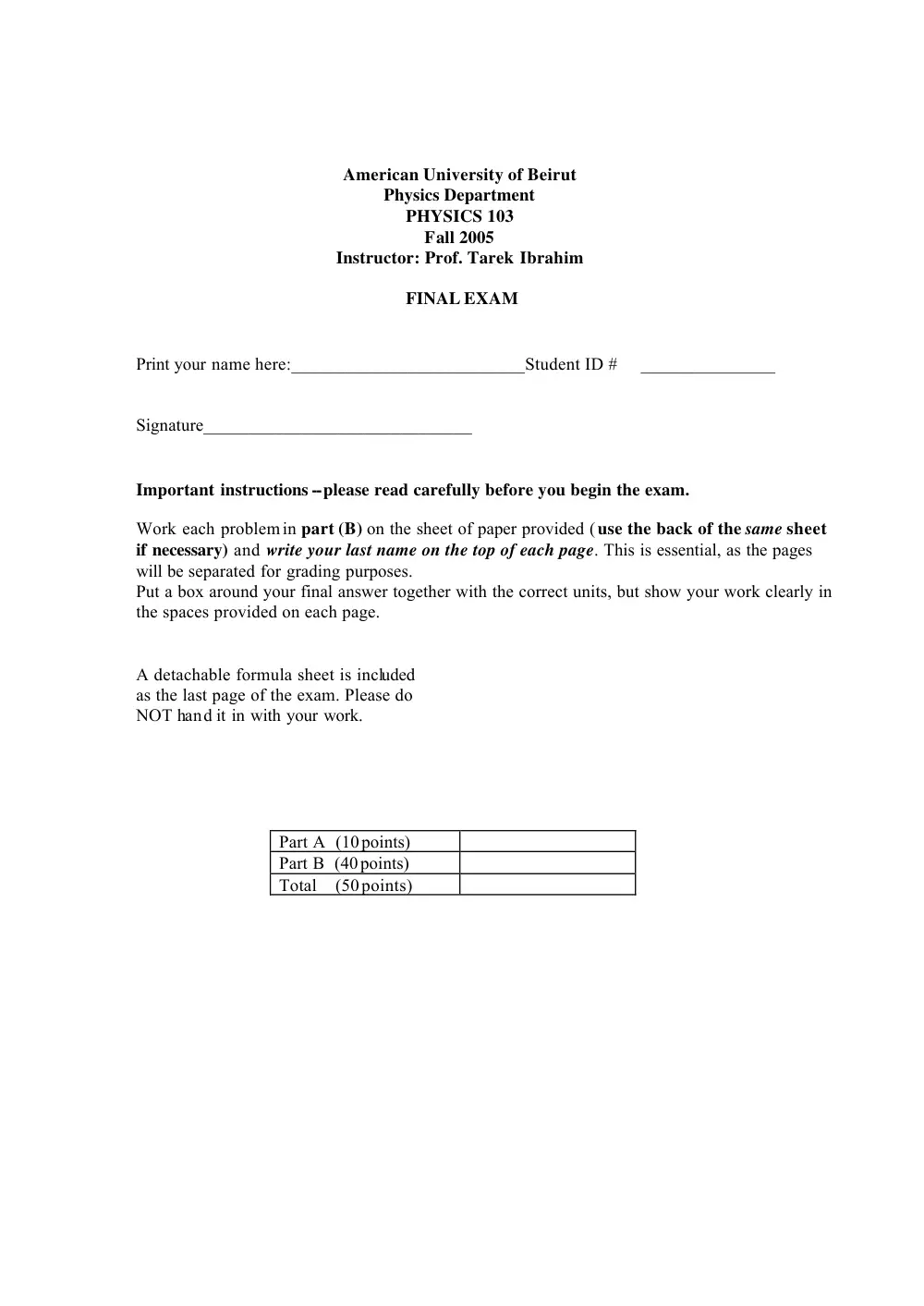
American University of Beirut
Physics Department
PHYSICS 103
Fall 2005
Instructor: Prof. Tarek Ibrahim
FINAL EXAM
Print your name here:__________________________Student ID # _______________
Signature______________________________
Important instructions --please read carefully before you begin the exam.
Work each problem in part (B) on the sheet of paper provided (use the back of the same sheet
if necessary) and write your last name on the top of each page. This is essential, as the pages
will be separated for grading purposes.
Put a box around your final answer together with the correct units, but show your work clearly in
the spaces provided on each page.
A detachable formula sheet is included
as the last page of the exam. Please do
NOT hand it in with your work.
Part A (10 points)
Part B (40 points)
Total (50 points)
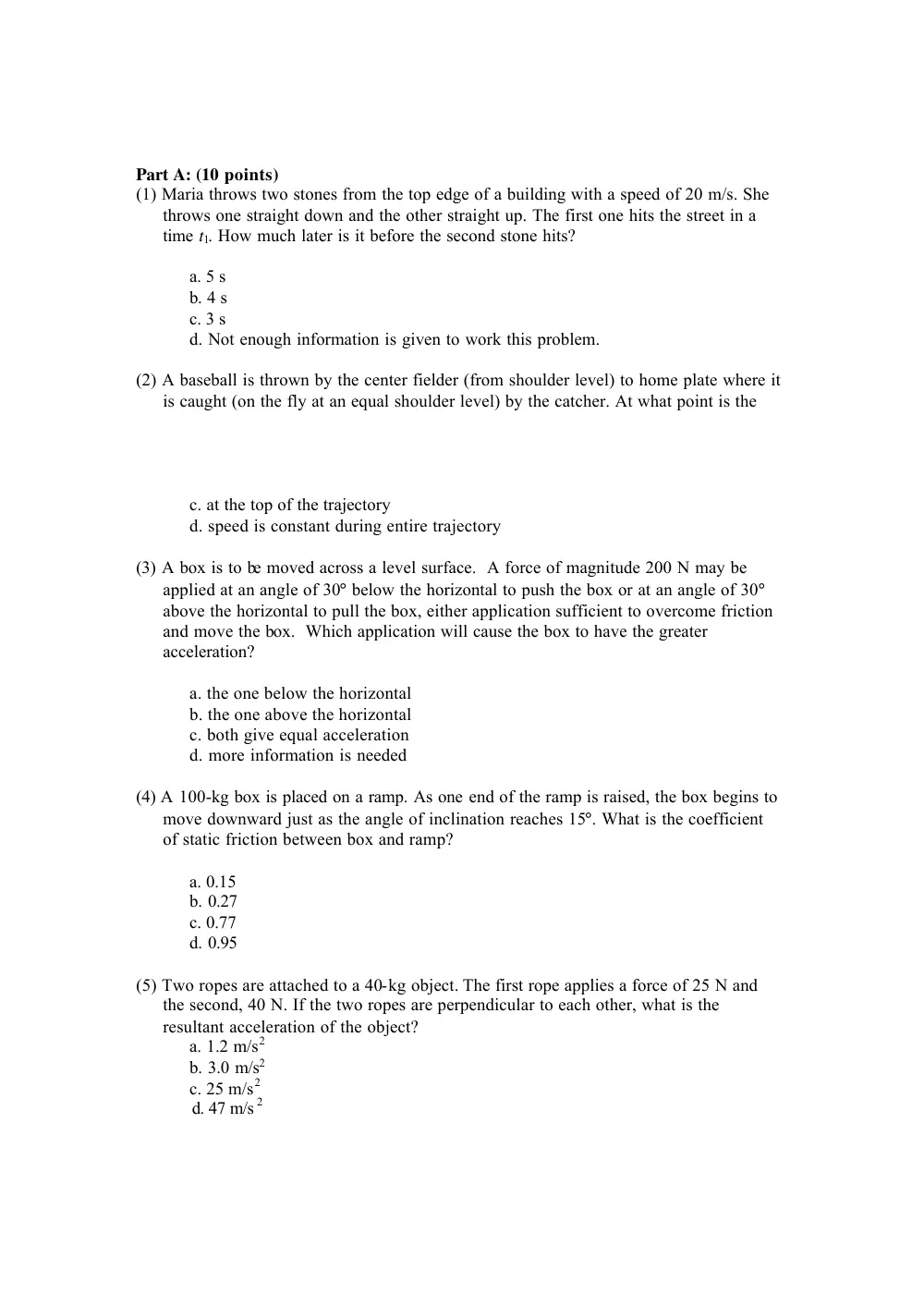
Part A: (10 points)
(1) Maria throws two stones from the top edge of a building with a speed of 20 m/s. She
throws one straight down and the other straight up. The first one hits the street in a
time t1. How much later is it before the second stone hits?
a. 5 s
b. 4 s
c. 3 s
d. Not enough information is given to work this problem.
(2) A baseball is thrown by the center fielder (from shoulder level) to home plate where it
is caught (on the fly at an equal shoulder level) by the catcher. At what point is the
c. at the top of the trajectory
d. speed is constant during entire trajectory
(3) A box is to be moved across a level surface. A force of magnitude 200 N may be
applied at an angle of 30° below the horizontal to push the box or at an angle of 30°
above the horizontal to pull the box, either application sufficient to overcome friction
and move the box. Which application will cause the box to have the greater
acceleration?
a. the one below the horizontal
b. the one above the horizontal
c. both give equal acceleration
d. more information is needed
(4) A 100-kg box is placed on a ramp. As one end of the ramp is raised, the box begins to
move downward just as the angle of inclination reaches 15°. What is the coefficient
of static friction between box and ramp?
a. 0.15
b. 0.27
c. 0.77
d. 0.95
(5) Two ropes are attached to a 40-kg object. The first rope applies a force of 25 N and
the second, 40 N. If the two ropes are perpendicular to each other, what is the
resultant acceleration of the object?
a. 1.2 m/s2
b. 3.0 m/s2
c. 25 m/s2
d. 47 m/s 2
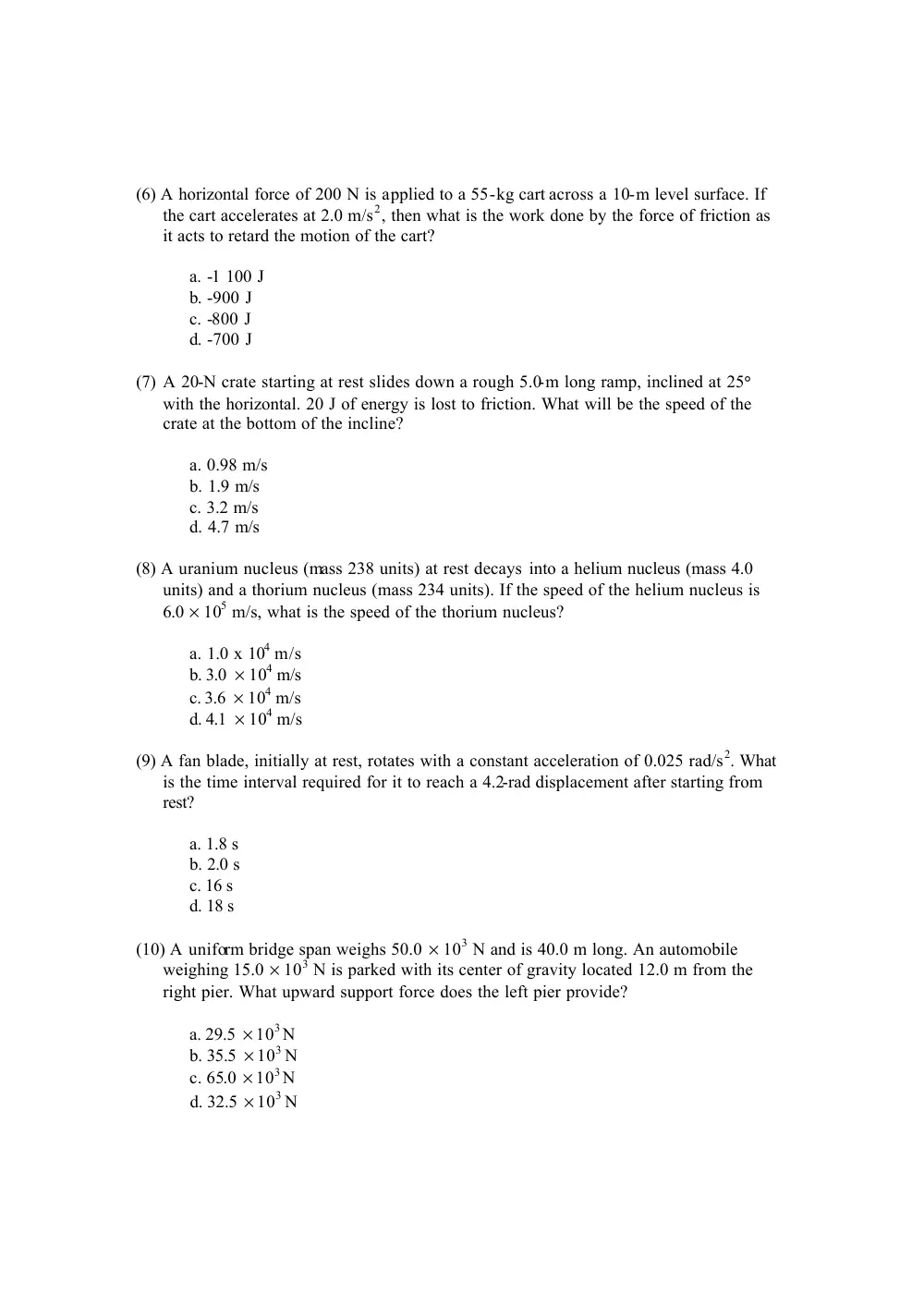
(6) A horizontal force of 200 N is applied to a 55-kg cart across a 10-m level surface. If
the cart accelerates at 2.0 m/s2, then what is the work done by the force of friction as
it acts to retard the motion of the cart?
a. -1 100 J
b. -900 J
c. -800 J
d. -700 J
(7) A 20-N crate starting at rest slides down a rough 5.0-m long ramp, inclined at 25°
with the horizontal. 20 J of energy is lost to friction. What will be the speed of the
crate at the bottom of the incline?
a. 0.98 m/s
b. 1.9 m/s
c. 3.2 m/s
d. 4.7 m/s
(8) A uranium nucleus (mass 238 units) at rest decays into a helium nucleus (mass 4.0
units) and a thorium nucleus (mass 234 units). If the speed of the helium nucleus is
6.0 × 10⁵ m/s, what is the speed of the thorium nucleus?
a. 1.0 x 10⁴ m/s
b. 3.0 × 10⁴ m/s
c. 3.6 × 10⁴ m/s
d. 4.1 × 10⁴ m/s
(9) A fan blade, initially at rest, rotates with a constant acceleration of 0.025 rad/s2. What
is the time interval required for it to reach a 4.2-rad displacement after starting from
rest?
a. 1.8 s
b. 2.0 s
c. 16 s
d. 18 s
(10) A uniform bridge span weighs 50.0 × 10³ N and is 40.0 m long. An automobile
weighing 15.0 × 10³ N is parked with its center of gravity located 12.0 m from the
right pier. What upward support force does the left pier provide?
a. 29.5 × 10³ N
b. 35.5 × 10³ N
c. 65.0 × 10³ N
d. 32.5 × 10³ N
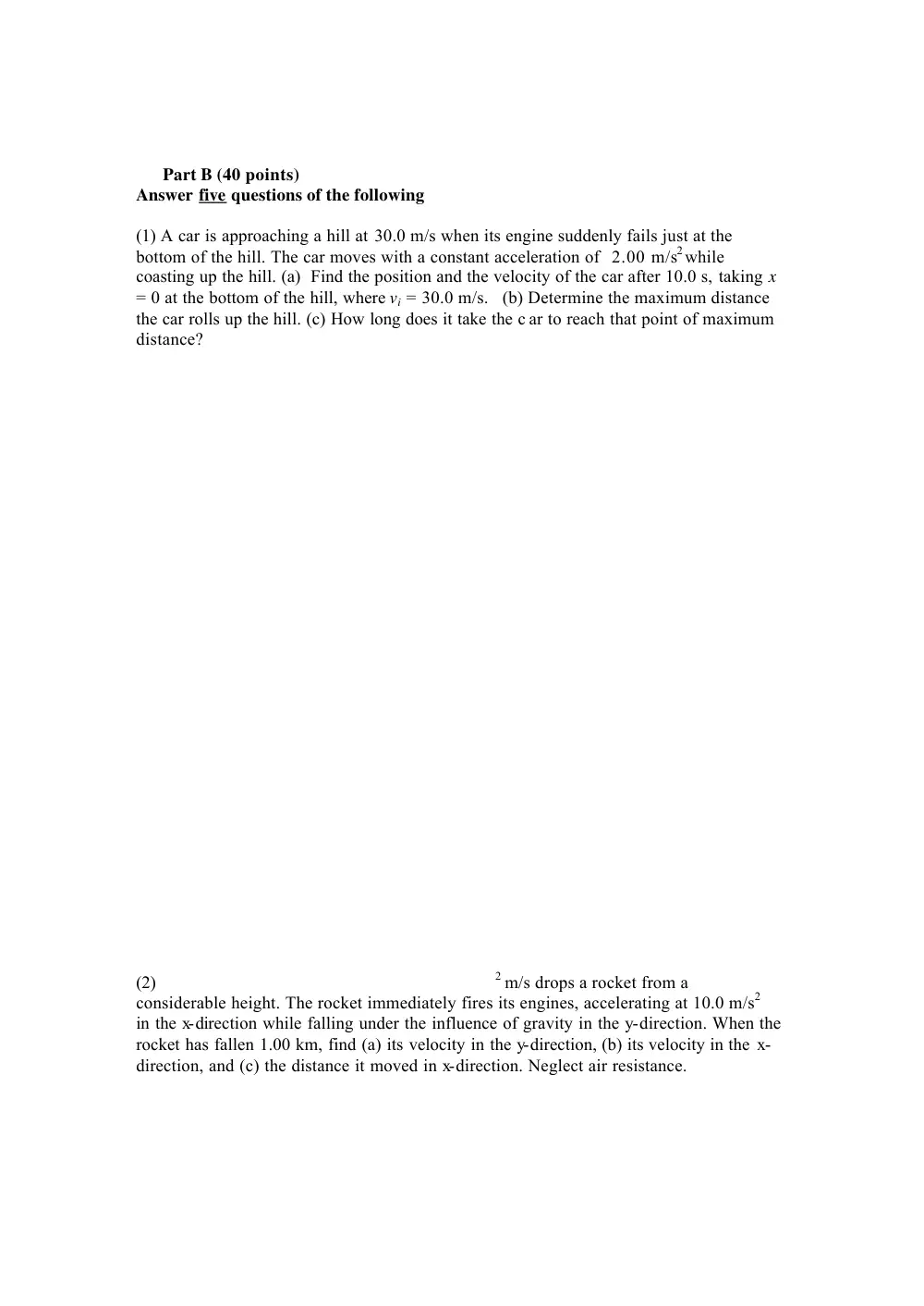
Part B (40 points)
Answer five questions of the following
(1) A car is approaching a hill at 30.0 m/s when its engine suddenly fails just at the
bottom of the hill. The car moves with a constant acceleration of 2.00 m/s2 while
coasting up the hill. (a) Find the position and the velocity of the car after 10.0 s, taking x
= 0 at the bottom of the hill, where vi = 30.0 m/s. (b) Determine the maximum distance
the car rolls up the hill. (c) How long does it take the c ar to reach that point of maximum
distance?
(2)
2 m/s drops a rocket from a
considerable height. The rocket immediately fires its engines, accelerating at 10.0 m/s2
in the x-direction while falling under the influence of gravity in the y-direction. When the
rocket has fallen 1.00 km, find (a) its velocity in the y-direction, (b) its velocity in the x-
direction, and (c) the distance it moved in x-direction. Neglect air resistance.
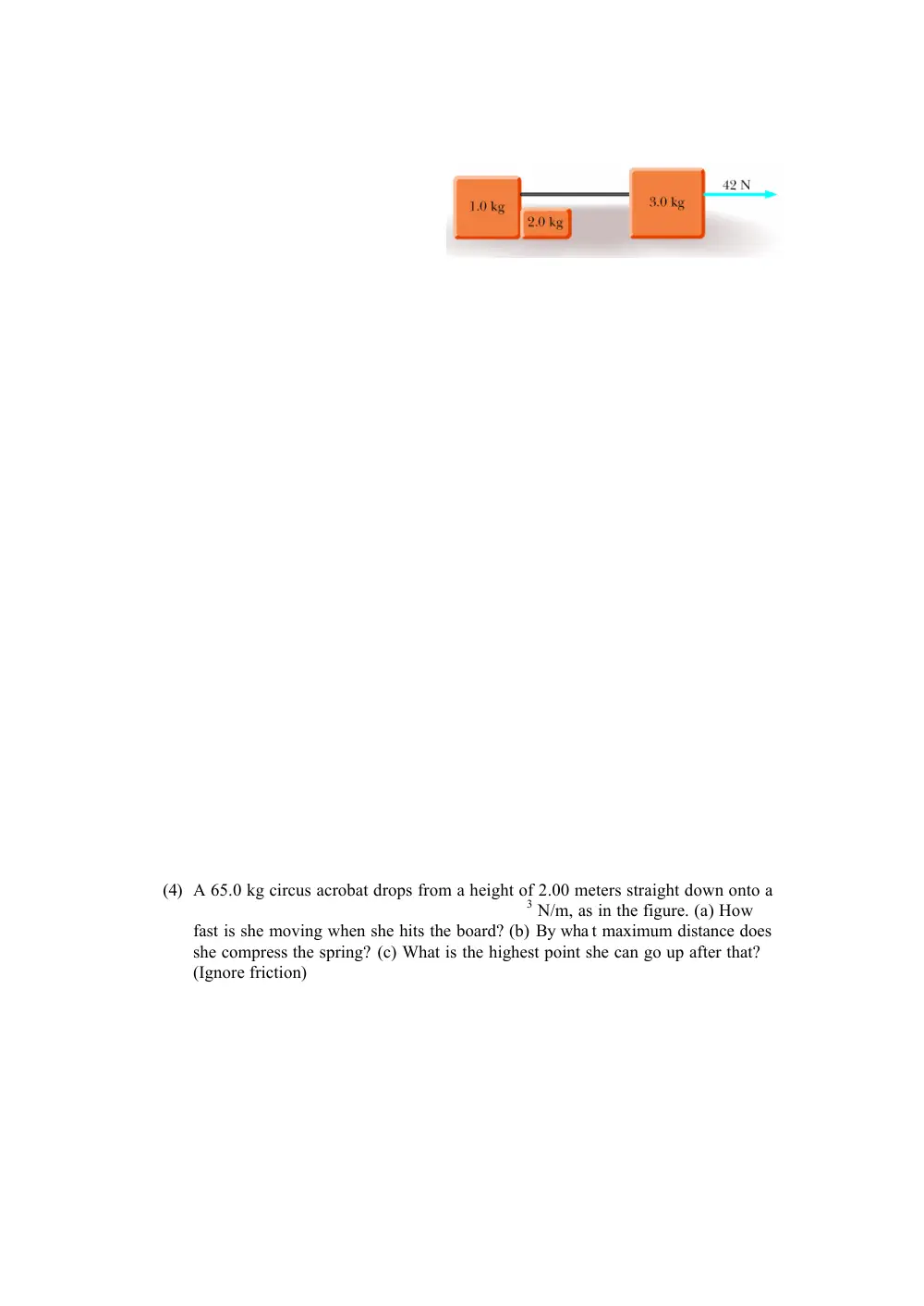
(3) Assume that the three blocks in the figure, move on a frictionless surface and that a
42-N force acts as shown on the 3.0-kg block. Determine (a) the acceleration given this
system, (b) the tension in the cord connecting the 3.0-kg and the 1.0-kg blocks, and (c)
the force exerted by the 1.0-kg block on the 2.0-kg block.
(4) A 65.0 kg circus acrobat drops from a height of 2.00 meters straight down onto a
3 N/m, as in the figure. (a) How
fast is she moving when she hits the board? (b) By wha t maximum distance does
she compress the spring? (c) What is the highest point she can go up after that?
(Ignore friction)
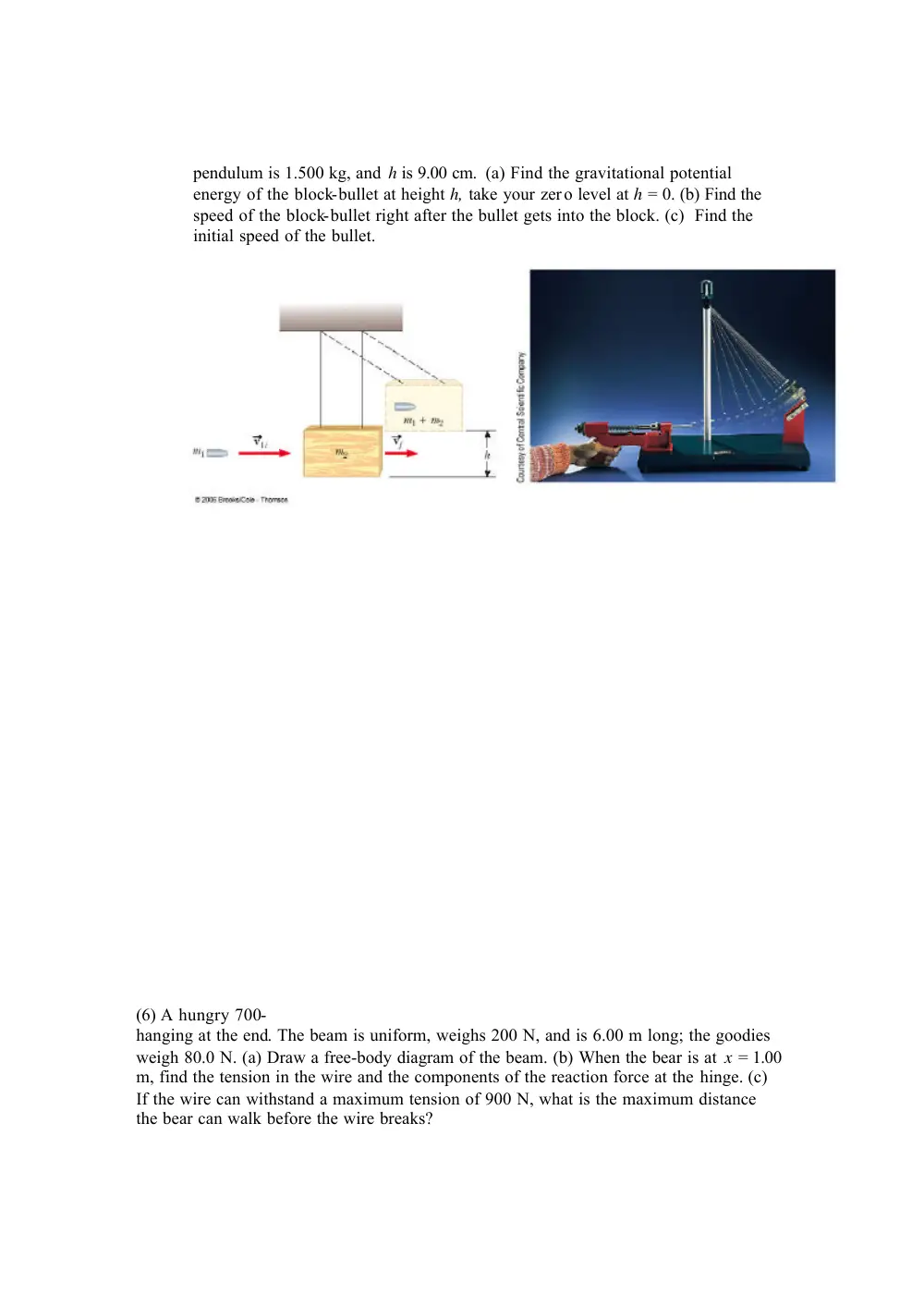
(5) The ballistic pendulum is a device used to measure the speed of a fast-moving
bullet. The bullet is fired into a large block of wood suspended from some light
wires. The bullet is stopped by the block, and the entire system swings up to a
height h. It is possible to obtain the initial speed of the bullet by measuring h and
the two masses. Assume that the mass of the bullet is 5.00 g, the mass of the
pendulum is 1.500 kg, and h is 9.00 cm. (a) Find the gravitational potential
energy of the block-bullet at height h, take your zero level at h = 0. (b) Find the
speed of the block-bullet right after the bullet gets into the block. (c) Find the
initial speed of the bullet.
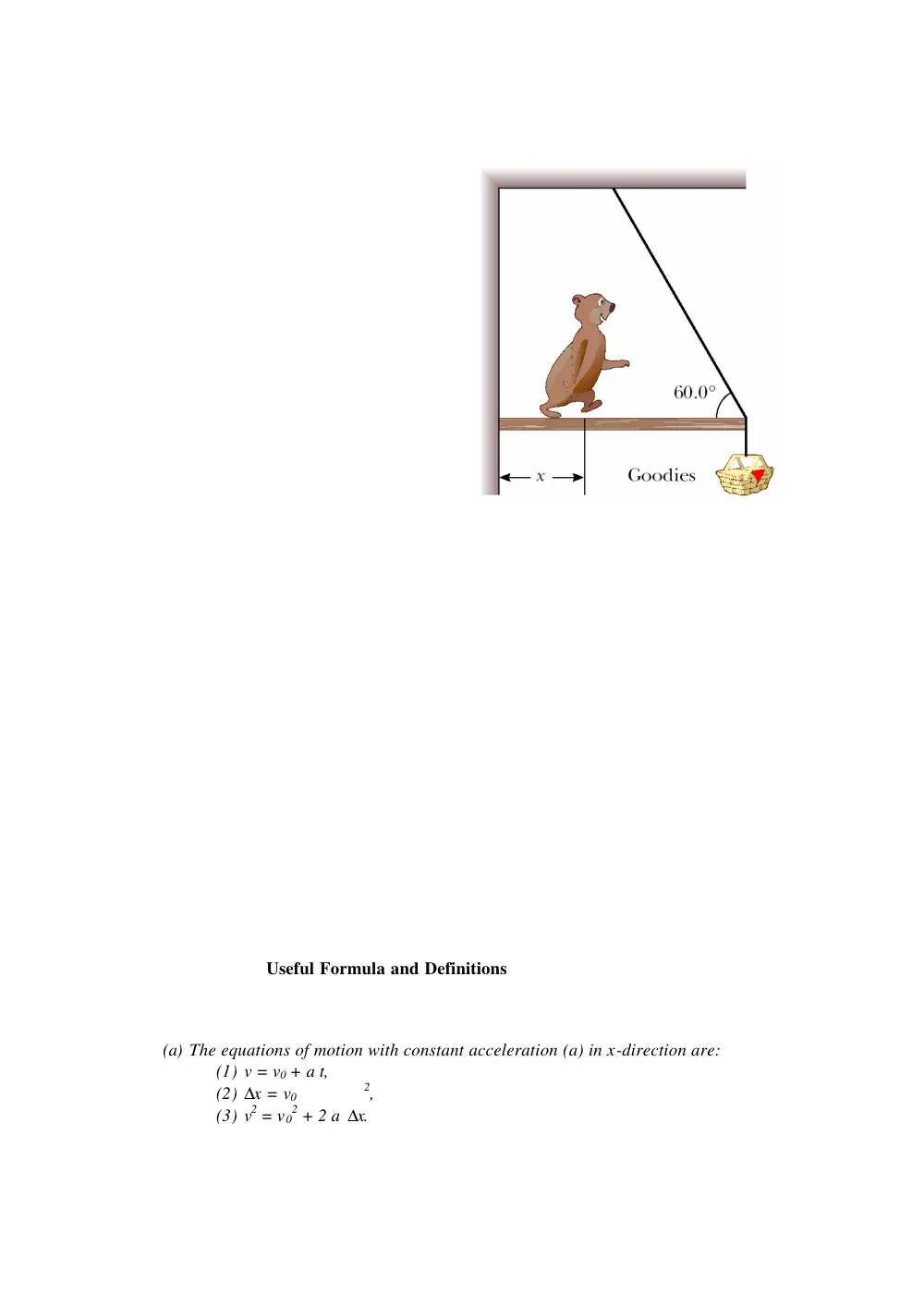
(6) A hungry 700-
hanging at the end. The beam is uniform, weighs 200 N, and is 6.00 m long; the goodies
weigh 80.0 N. (a) Draw a free-body diagram of the beam. (b) When the bear is at x = 1.00
m, find the tension in the wire and the components of the reaction force at the hinge. (c)
If the wire can withstand a maximum tension of 900 N, what is the maximum distance
the bear can walk before the wire breaks?
Useful Formula and Definitions
(a) The equations of motion with constant acceleration (a) in x-direction are:
(1) v = v0 + a t,
(2) ∆x = v0
2,
(3) v2 = v0
2 + 2 a ∆x.
(b) The free fall acceleration magnitude is 9.8 m/s 2 and it is pointing downward.
(c) Vector A makes an angle θ with x-axis has the components
Ax =| A| cos θ and Ay = |A| sin θ, |A|2 = Ax
2 + Ay
2
, tan θ = Ay/ Ax
(d) If R = A + B, Rx= Ax + Bx and Ry= Ay + By
(e) W = m g
(f) Friction force F is F = µ N
(g) Σ F = m a
(h) W = |F| |d| cos θ
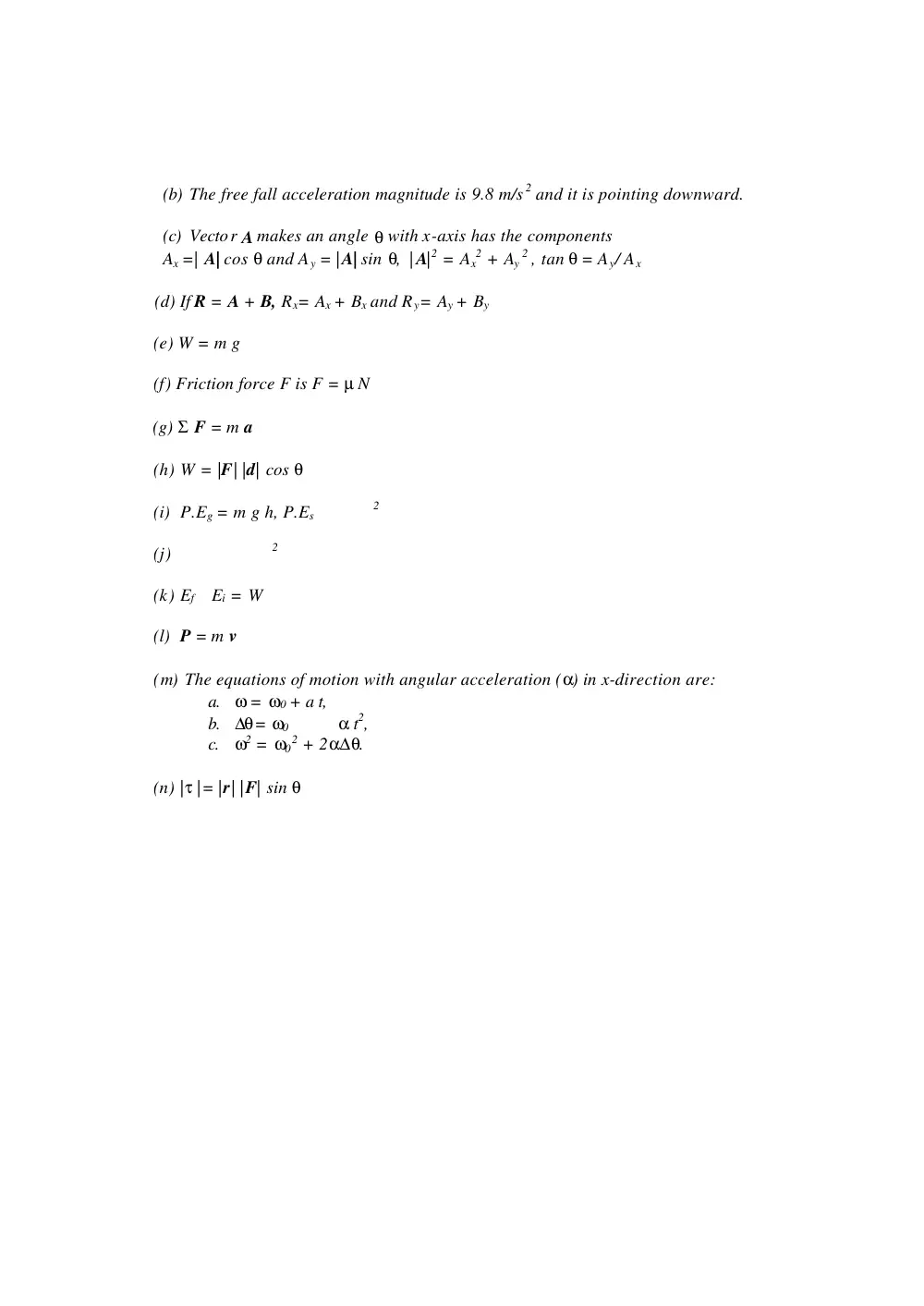
(i) P.Eg = m g h, P.Es
2
(j)
2
(k) Ef Ei = W
(l) P = m v
(m) The equations of motion with angular acceleration (α) in x-direction are:
a. ω = ω0 + a t,
b. ∆θ= ω0
α t2,
c. ω2 = ω0
2 + 2α∆θ.
(n) |τ |= |r| |F| sin θ