
PHYS 210L Lab Solved Report, Fall 2012
American University of Beirut · Introductory Physics Laboratory II · 9 pages · with solution

More PHYS 210L files
- Lab Report · Fall 2017LabView
- Lab Spectrometer · Fall 2014LabView
- Lab Sound Waves Report Solution · Fall 2012Lab · with solutionView
- Lab Solved Report Standing Waves String · Fall 2012Lab · with solutionView
- Lab Meq Heat Solved Report · Fall 2012Lab · with solutionView
- Lab Solved Report Michelson · Fall 2010Lab · with solutionView
- Lab Solved Report Interference and Diffraction · Fall 2010Lab · with solutionView
- Lab Solved Report Spectrometer · Fall 2010Lab · with solutionView
Show the text of this lab
PHYSICS 210L
Thermal Expansion of Solids
1. Determination of the coefficient of linear expansion
(a) Copper:
L0 (mm)
Rrm (k
)
Trm (C)
Rhot (k
)
Thot (C)
T (C)
L (mm)
700
91.0
27
9.0
85
58
0.89
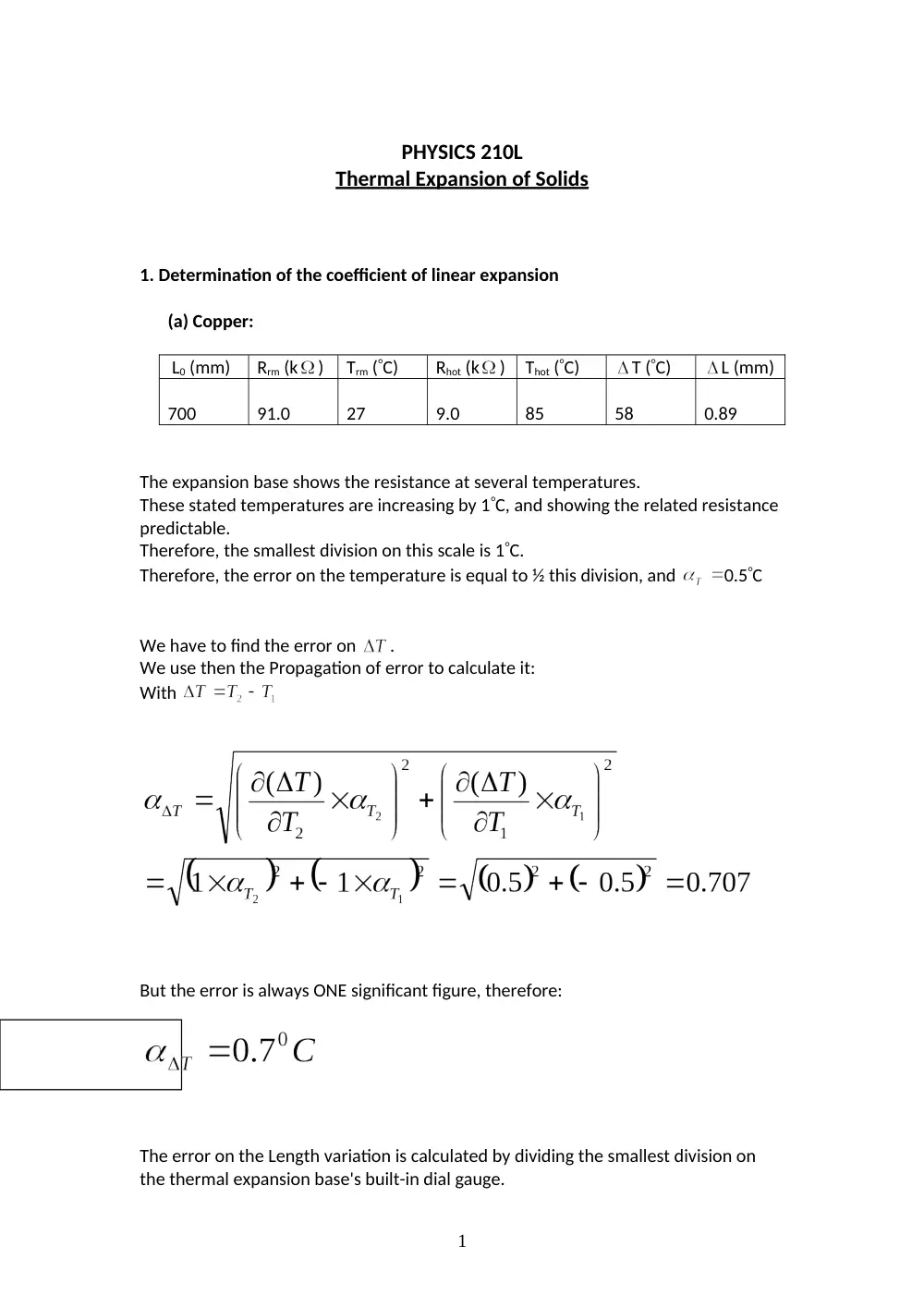
The expansion base shows the resistance at several temperatures.
These stated temperatures are increasing by 1C, and showing the related resistance
predictable.
Therefore, the smallest division on this scale is 1C.
Therefore, the error on the temperature is equal to ½ this division, and
0.5C
We have to find the error on
.
We use then the Propagation of error to calculate it:
With
But the error is always ONE significant figure, therefore:
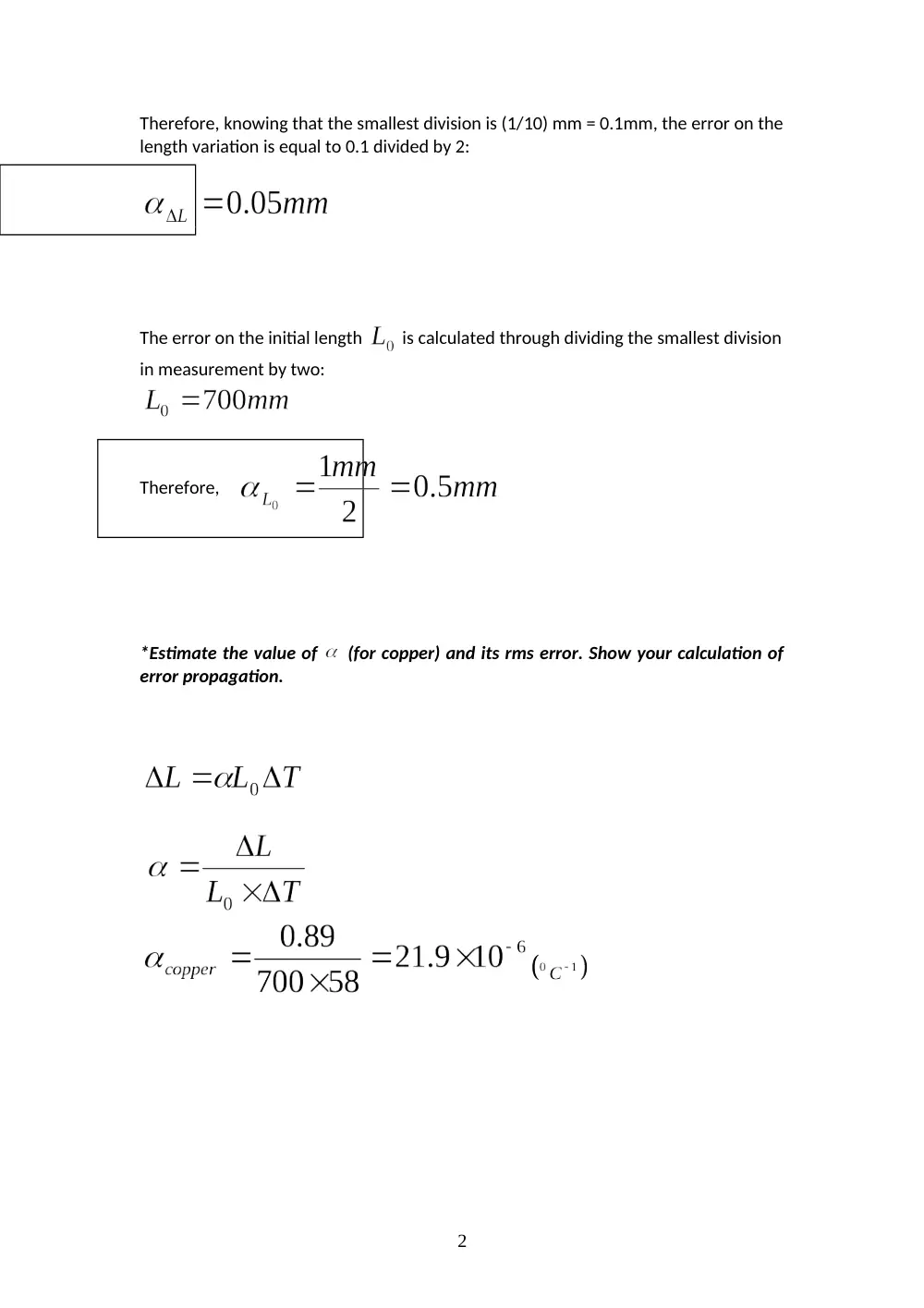
The error on the Length variation is calculated by dividing the smallest division on
the thermal expansion base's built-in dial gauge.
1
Therefore, knowing that the smallest division is (1/10) mm = 0.1mm, the error on the
length variation is equal to 0.1 divided by 2:
The error on the initial length
is calculated through dividing the smallest division
in measurement by two:
Therefore,
*Estimate the value of
(for copper) and its rms error. Show your calculation of
error propagation.
2
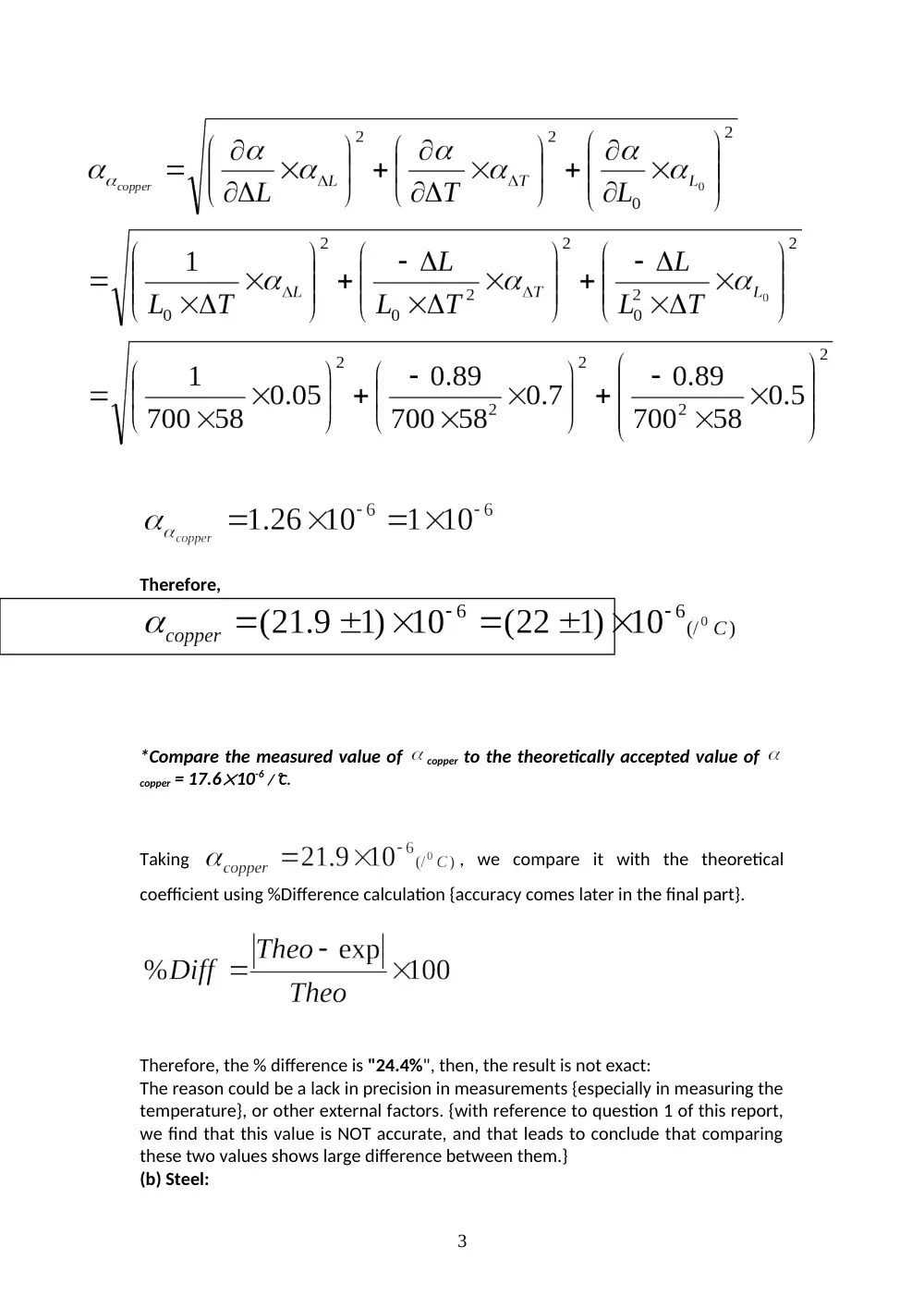
Therefore,
*Compare the measured value of
copper to the theoretically accepted value of
copper = 17.610-6 /C.
Taking
, we compare it with the theoretical
coefficient using %Difference calculation {accuracy comes later in the final part}.
Therefore, the % difference is "24.4%", then, the result is not exact:
The reason could be a lack in precision in measurements {especially in measuring the
temperature}, or other external factors. {with reference to question 1 of this report,
we find that this value is NOT accurate, and that leads to conclude that comparing
these two values shows large difference between them.}
(b) Steel:
3
L0 (mm)
Rrm(k
)
Trm (C)
Rhot(k
)
Thot (C)
T (C)
L (mm)
700
91.1
27
8.6
87
60
0.63
*Estimate the value of
(for Steel) and its rms error. Show your calculation of
error propagation.
4
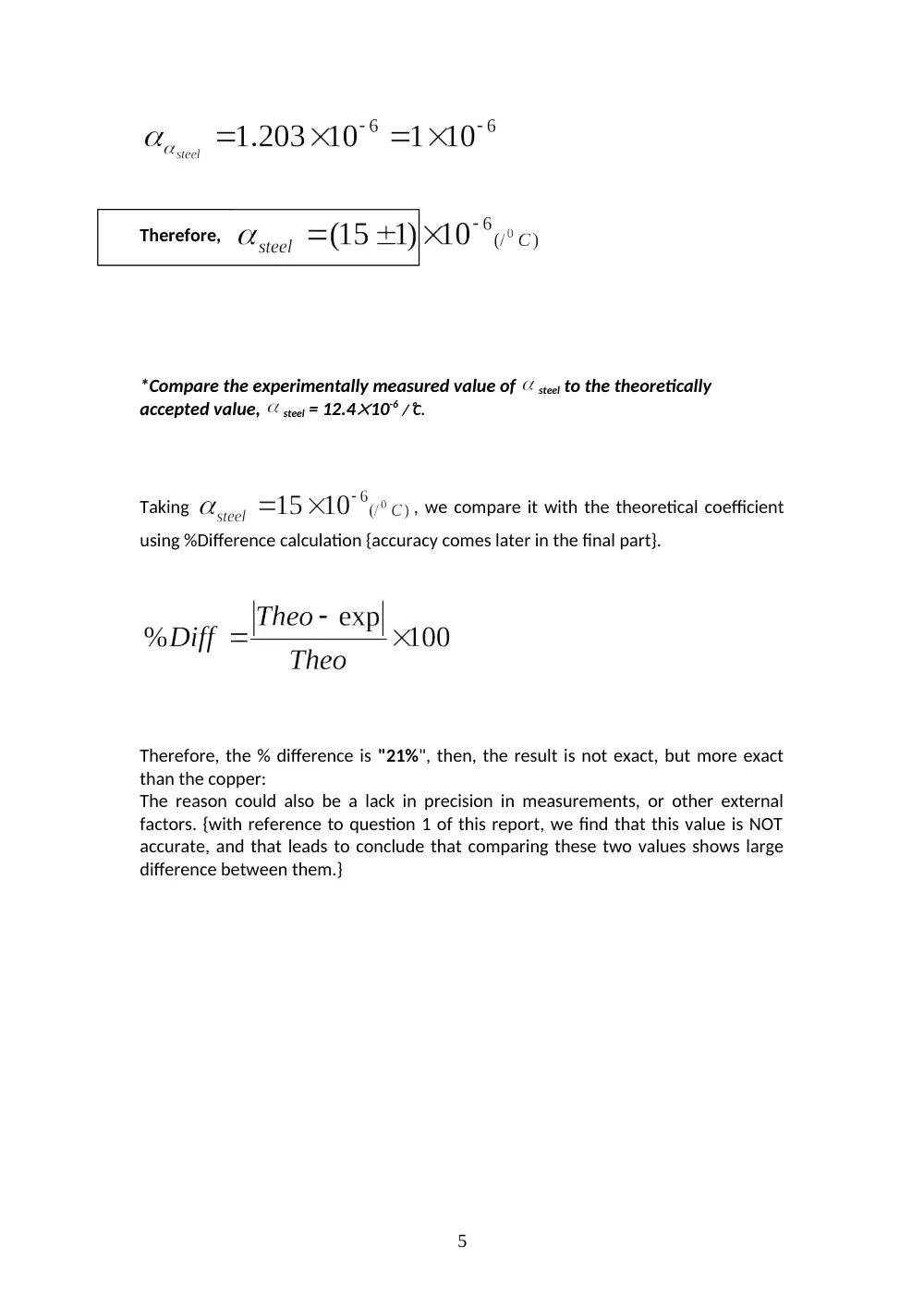
Therefore,
*Compare the experimentally measured value of
steel to the theoretically
accepted value,
steel = 12.410-6 /C.
Taking
, we compare it with the theoretical coefficient
using %Difference calculation {accuracy comes later in the final part}.
Therefore, the % difference is "21%", then, the result is not exact, but more exact
than the copper:
The reason could also be a lack in precision in measurements, or other external
factors. {with reference to question 1 of this report, we find that this value is NOT
accurate, and that leads to conclude that comparing these two values shows large
difference between them.}
5
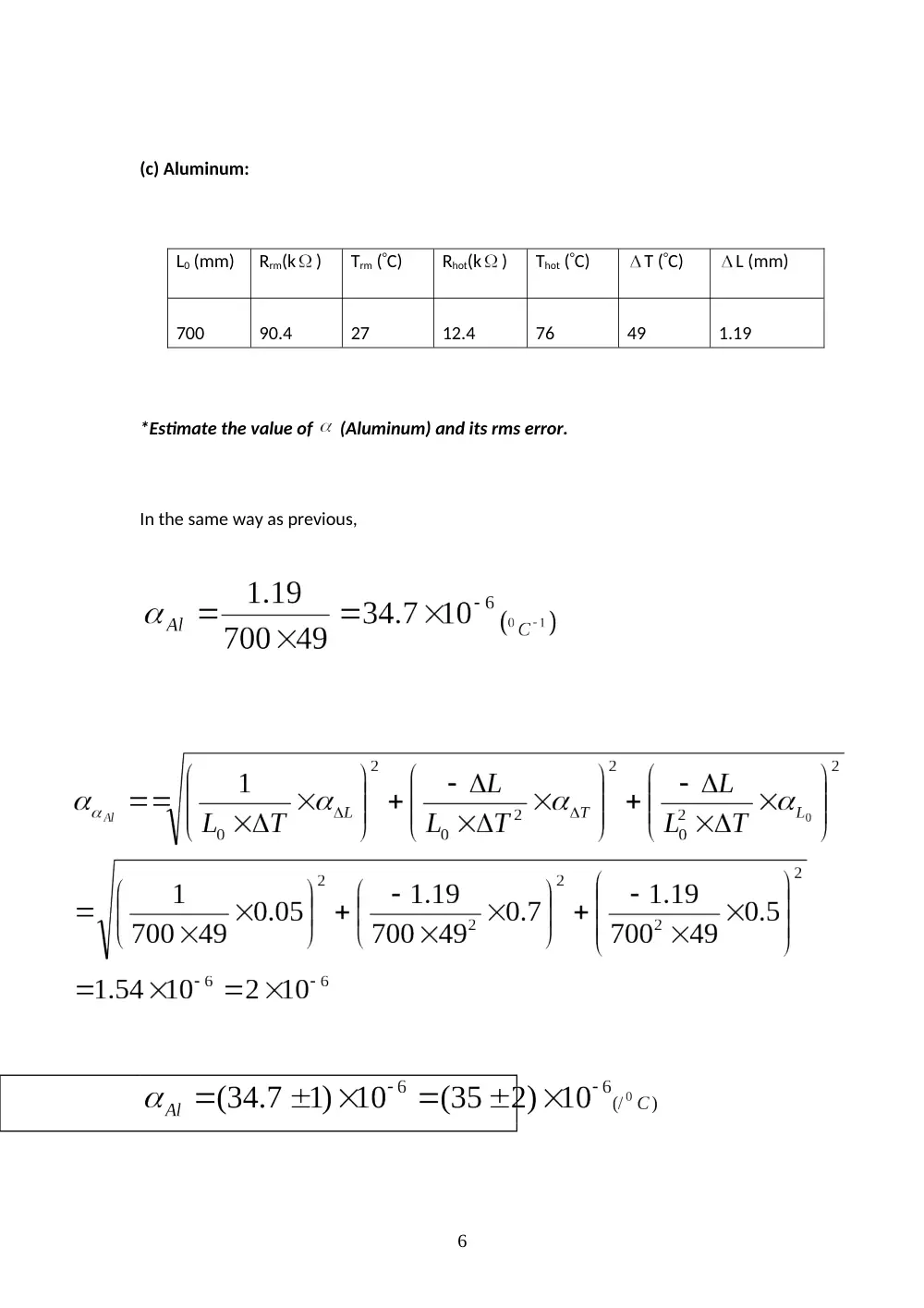
(c) Aluminum:
L0 (mm)
Rrm(k
)
Trm (C)
Rhot(k
)
Thot (C)
T (C)
L (mm)
700
90.4
27
12.4
76
49
1.19
*Estimate the value of
(Aluminum) and its rms error.
In the same way as previous,
6
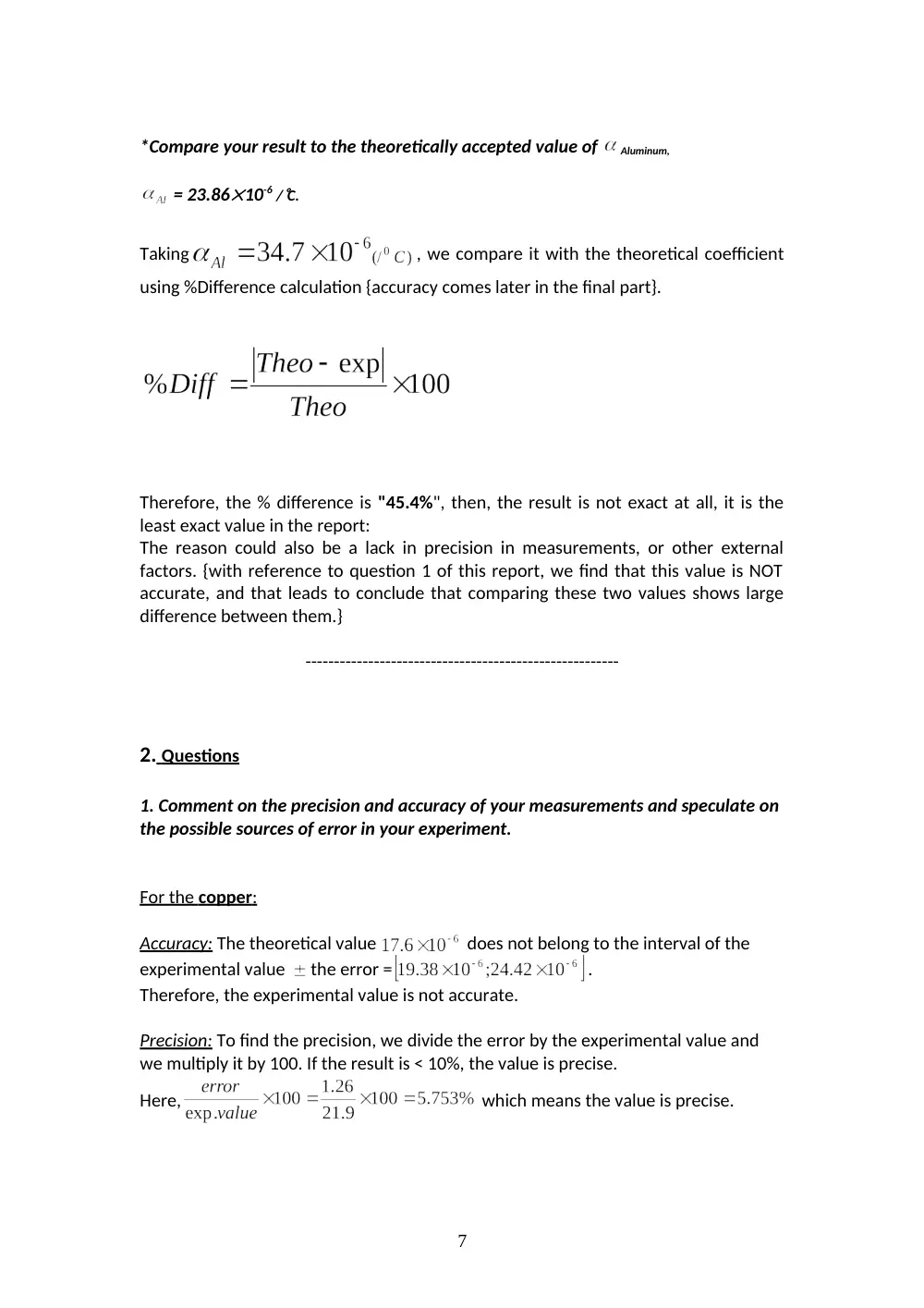
*Compare your result to the theoretically accepted value of
Aluminum,
= 23.8610-6 /C.
Taking
, we compare it with the theoretical coefficient
using %Difference calculation {accuracy comes later in the final part}.
Therefore, the % difference is "45.4%", then, the result is not exact at all, it is the
least exact value in the report:
The reason could also be a lack in precision in measurements, or other external
factors. {with reference to question 1 of this report, we find that this value is NOT
accurate, and that leads to conclude that comparing these two values shows large
difference between them.}
-------------------------------------------------------
2. Questions
1. Comment on the precision and accuracy of your measurements and speculate on
the possible sources of error in your experiment.
For the
copper
:
Accuracy: The theoretical value
does not belong to the interval of the
experimental value
the error =
.
Therefore, the experimental value is not accurate.
Precision: To find the precision, we divide the error by the experimental value and
we multiply it by 100. If the result is < 10%, the value is precise.
Here,
which means the value is precise.
7
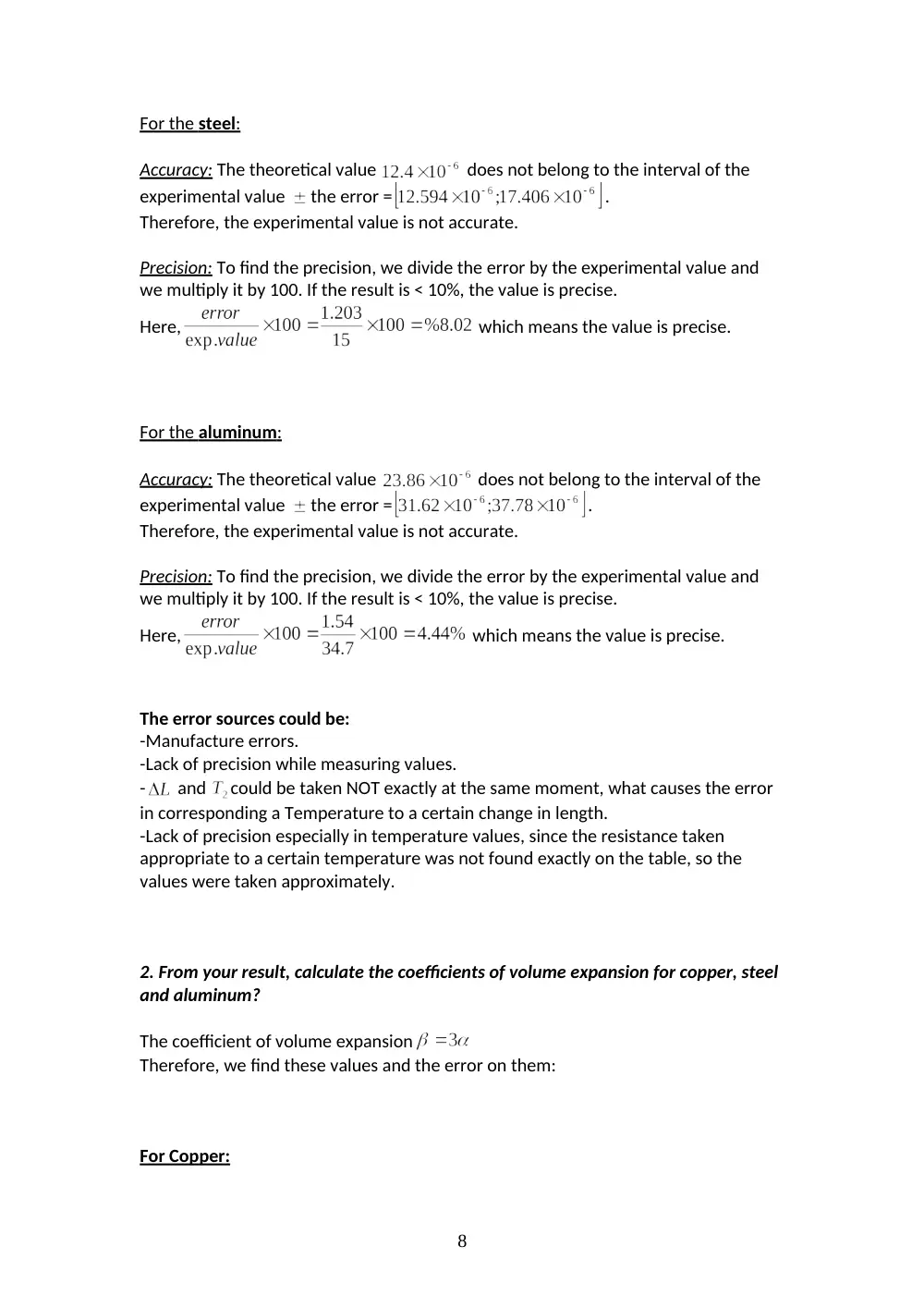
For the
steel
:
Accuracy: The theoretical value
does not belong to the interval of the
experimental value
the error =
.
Therefore, the experimental value is not accurate.
Precision: To find the precision, we divide the error by the experimental value and
we multiply it by 100. If the result is < 10%, the value is precise.
Here,
which means the value is precise.
For the
aluminum
:
Accuracy: The theoretical value
does not belong to the interval of the
experimental value
the error =
.
Therefore, the experimental value is not accurate.
Precision: To find the precision, we divide the error by the experimental value and
we multiply it by 100. If the result is < 10%, the value is precise.
Here,
which means the value is precise.
The error sources could be:
-Manufacture errors.
-Lack of precision while measuring values.
-
and
could be taken NOT exactly at the same moment, what causes the error
in corresponding a Temperature to a certain change in length.
-Lack of precision especially in temperature values, since the resistance taken
appropriate to a certain temperature was not found exactly on the table, so the
values were taken approximately.
2. From your result, calculate the coefficients of volume expansion for copper, steel
and aluminum?
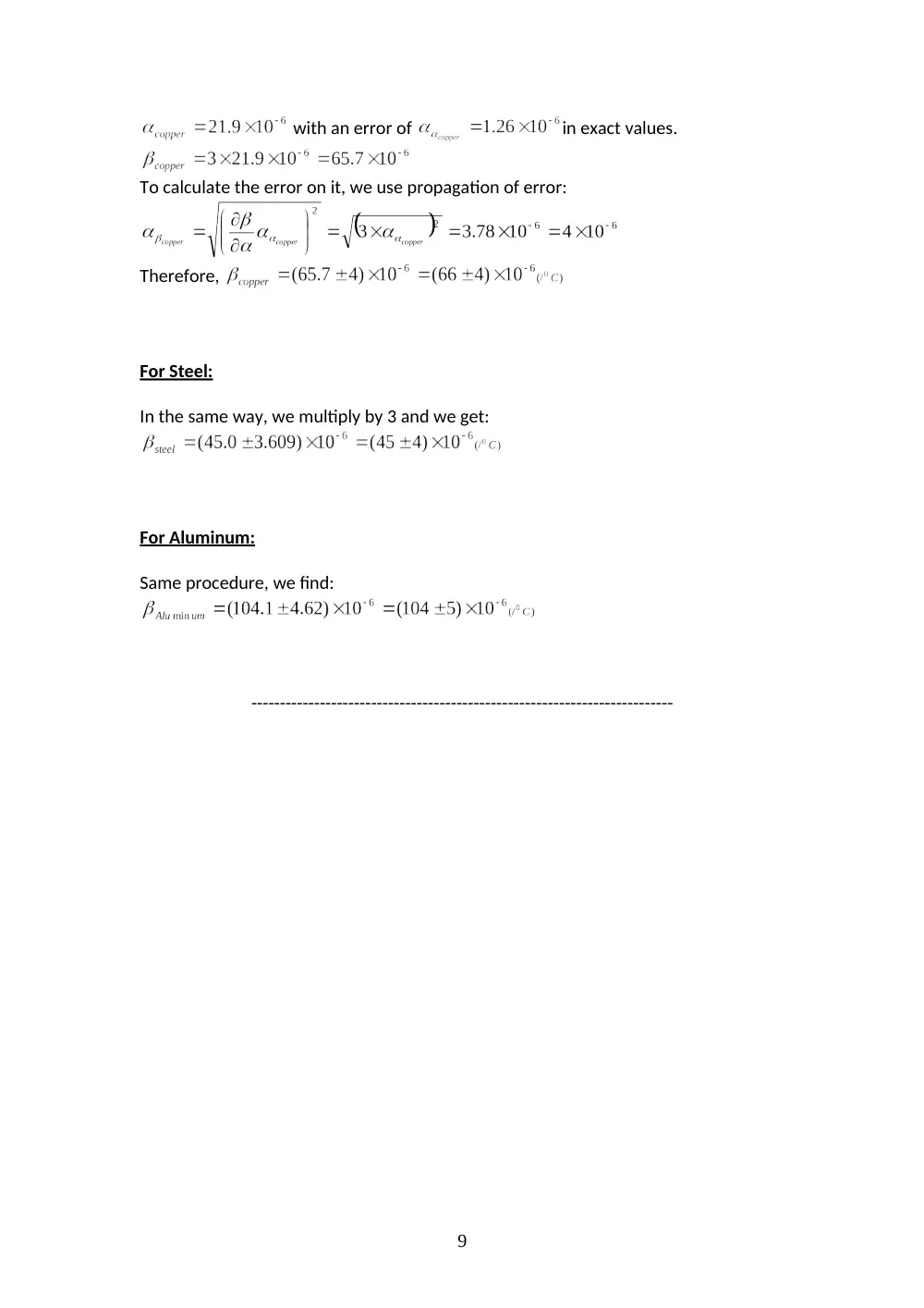
The coefficient of volume expansion
Therefore, we find these values and the error on them:
For Copper:
8
with an error of
in exact values.
To calculate the error on it, we use propagation of error:
Therefore,
For Steel:
In the same way, we multiply by 3 and we get:
For Aluminum:
Same procedure, we find:
--------------------------------------------------------------------------
9