
PHYS 210L Lab Solved Report Interference and Diffraction, Fall 2010
American University of Beirut · Introductory Physics Laboratory II · 4 pages · with solution

More PHYS 210L files
- Lab Report · Fall 2017LabView
- Lab Spectrometer · Fall 2014LabView
- Lab Sound Waves Report Solution · Fall 2012Lab · with solutionView
- Lab Solved Report Standing Waves String · Fall 2012Lab · with solutionView
- Lab Solved Report · Fall 2012Lab · with solutionView
- Lab Meq Heat Solved Report · Fall 2012Lab · with solutionView
- Lab Solved Report Michelson · Fall 2010Lab · with solutionView
- Lab Solved Report Spectrometer · Fall 2010Lab · with solutionView
Show the text of this lab
Physics 210L
Interference & Diffraction
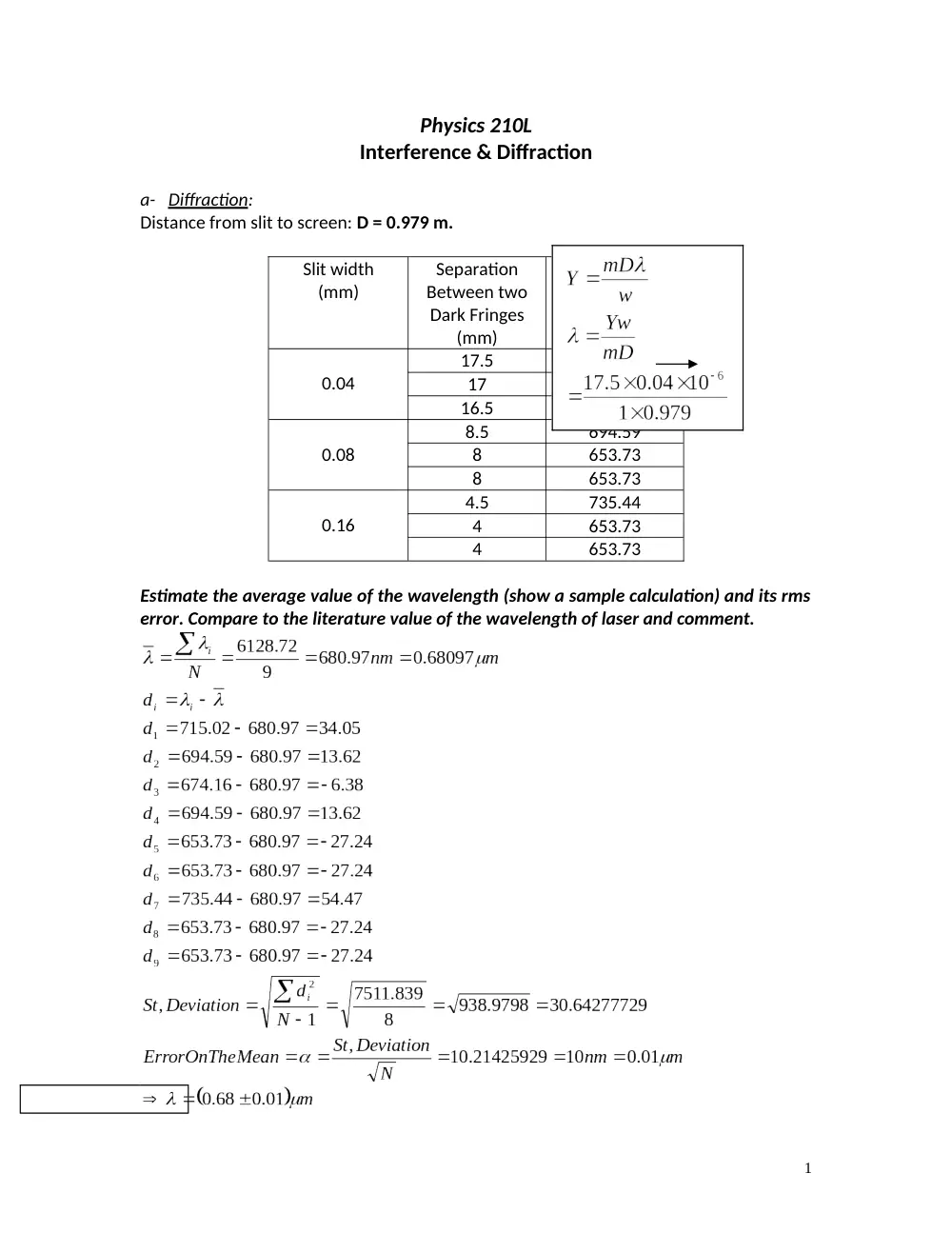
a- Diffraction
:
Distance from slit to screen: D = 0.979 m.
Slit width
(mm)
Separation
Between two
Dark Fringes
(mm)
Wavelength of
laser
(nm)
0.04
17.5
715.02
17
694.59
16.5
674.16
0.08
8.5
694.59
8
653.73
8
653.73
0.16
4.5
735.44
4
653.73
4
653.73
Estimate the average value of the wavelength (show a sample calculation) and its rms
error. Compare to the literature value of the wavelength of laser and comment.
1
Comparing with the literature value of the laser
Accuracy: The theoretical value
belongs to the interval of the experimental
value
2 times the error =
Therefore, the experimental value is accurate.
The slight difference could be provoked by some errors like lack of precision or
manufacture errors…
Describe qualitatively what you would see if you use a white light instead of a laser.
White light is not monochromatic (It is polychromatic and constituted of seven colors).
So there wouldn't be the same phase differences for each ray of light coming out of the
slit. Thus we will see the diffraction pattern for each color separately (the diffraction
pattern of the seven colors will overlap).
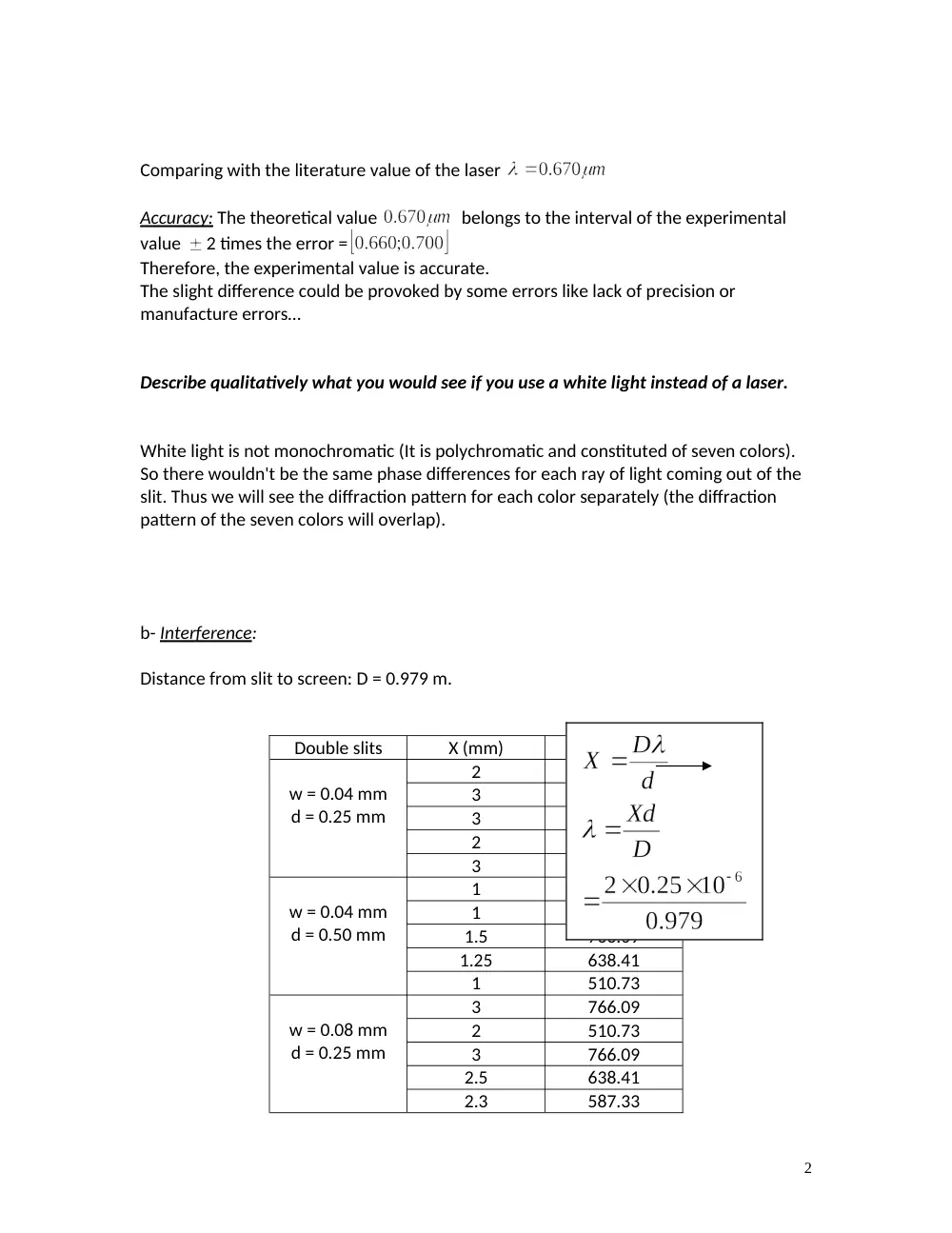
b- Interference:
Distance from slit to screen: D = 0.979 m.
Double slits
X (mm)
(nm)
w = 0.04 mm
d = 0.25 mm
2
510.73
3
766.09
3
766.09
2
510.73
3
766.09
w = 0.04 mm
d = 0.50 mm
1
510.73
1
510.73
1.5
766.09
1.25
638.41
1
510.73
w = 0.08 mm
d = 0.25 mm
3
766.09
2
510.73
3
766.09
2.5
638.41
2.3
587.33
2
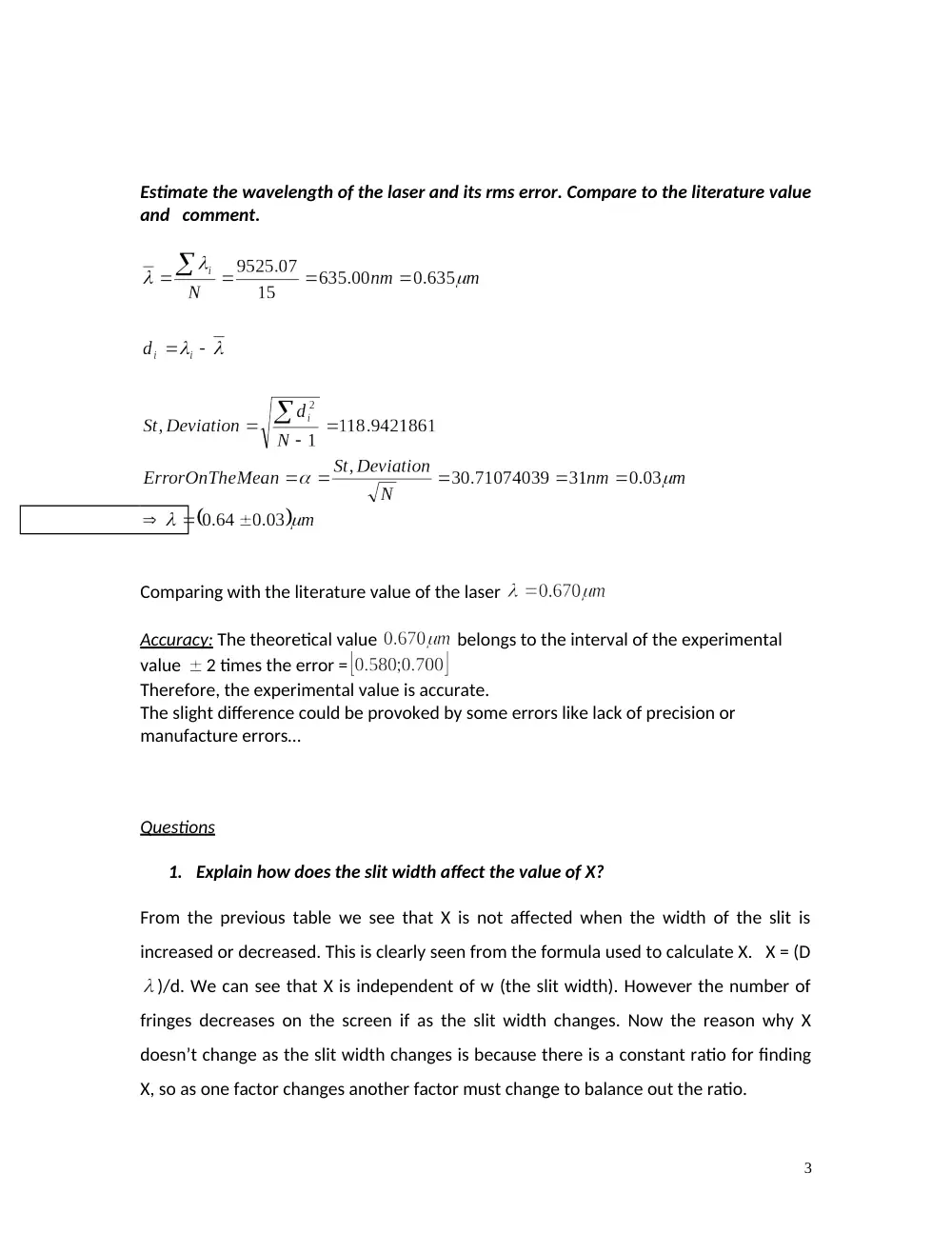
Estimate the wavelength of the laser and its rms error. Compare to the literature value
and comment.
Comparing with the literature value of the laser
Accuracy: The theoretical value
belongs to the interval of the experimental
value
2 times the error =
Therefore, the experimental value is accurate.
The slight difference could be provoked by some errors like lack of precision or
manufacture errors…
Questions
1. Explain how does the slit width affect the value of X?
From the previous table we see that X is not affected when the width of the slit is
increased or decreased. This is clearly seen from the formula used to calculate X. X = (D
)/d. We can see that X is independent of w (the slit width). However the number of
fringes decreases on the screen if as the slit width changes. Now the reason why X
doesn’t change as the slit width changes is because there is a constant ratio for finding
X, so as one factor changes another factor must change to balance out the ratio.
3
2. According to your results does the distance between maxima increase,
decrease or stay the same when the slit separation is increased?
From our observations, we found that as the separation between the slits increases, X
(distance between the fringes) decreases.
3. By what percentage, would the separation between two adjacent fringes
change if the experiment is performed using an Ar+-laser emitting at 514 nm?
If we use the conditions where w = 0.04 mm and d = 0.25mm then the Value X for the
original laser at a wavelength of 670 nm, is 2.5192 mm. While the value of X for the
Argon cation laser is 1.93264 mm. The percentage by how much the separation
between two adjacent fringes would change is therefore 23.3 %.
------------------------------------------------------------------------------------------------------------
4