
PHYS 211 Final, Fall 2007
American University of Beirut · Electricity and Magnetism · 7 pages
More PHYS 211 files
Show the text of this final exam
Physics 211 Final Exam
January 28, 2008
Your name:
ID number:
Time given: 120 minutes
Please provide your reasoning for each step of your solution (providing an answer
without a solution is not enough)
1
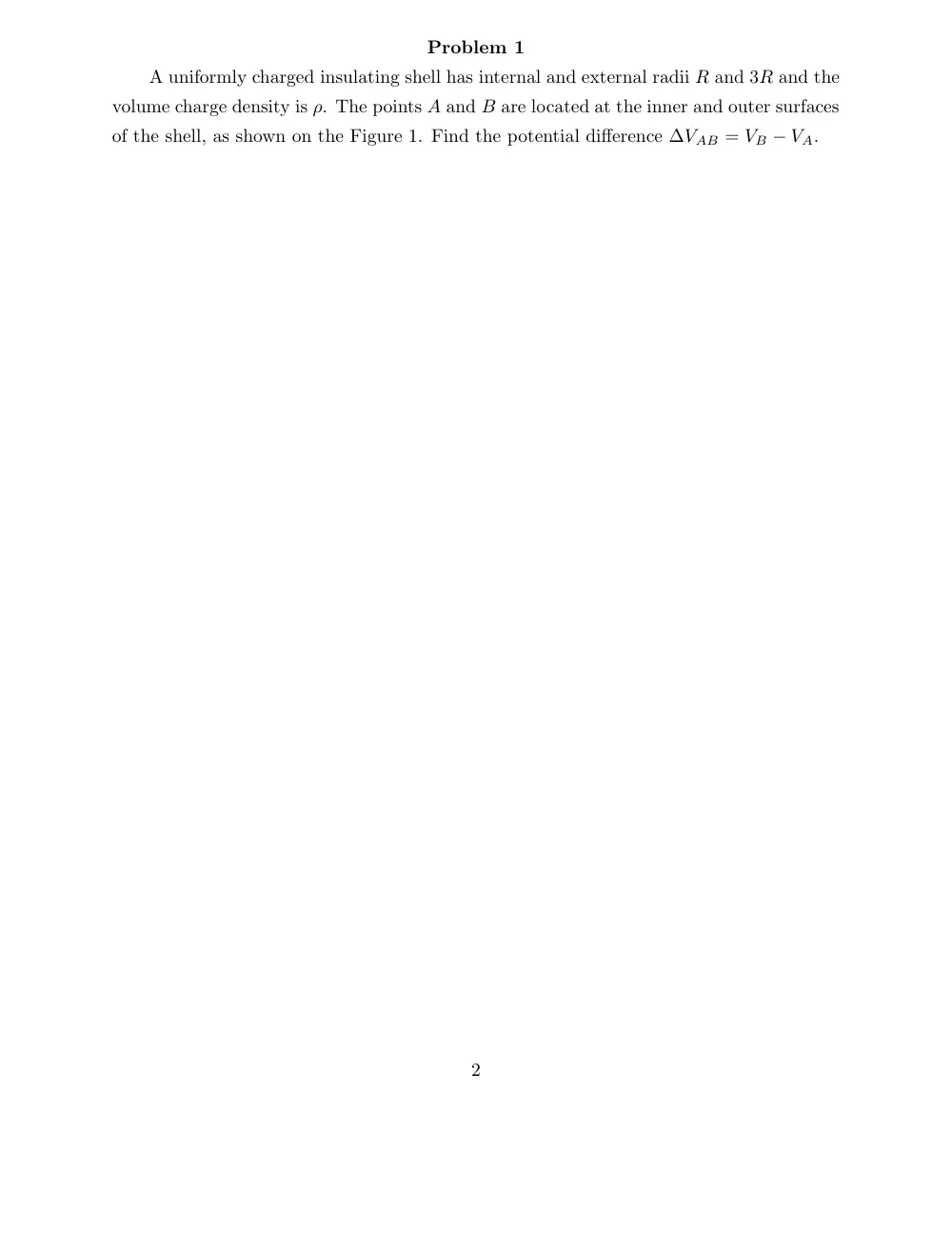
Problem 1
A uniformly charged insulating shell has internal and external radii R and 3R and the
volume charge density is ρ. The points A and B are located at the inner and outer surfaces
of the shell, as shown on the Figure 1. Find the potential difference ∆VAB = VB − VA.
2
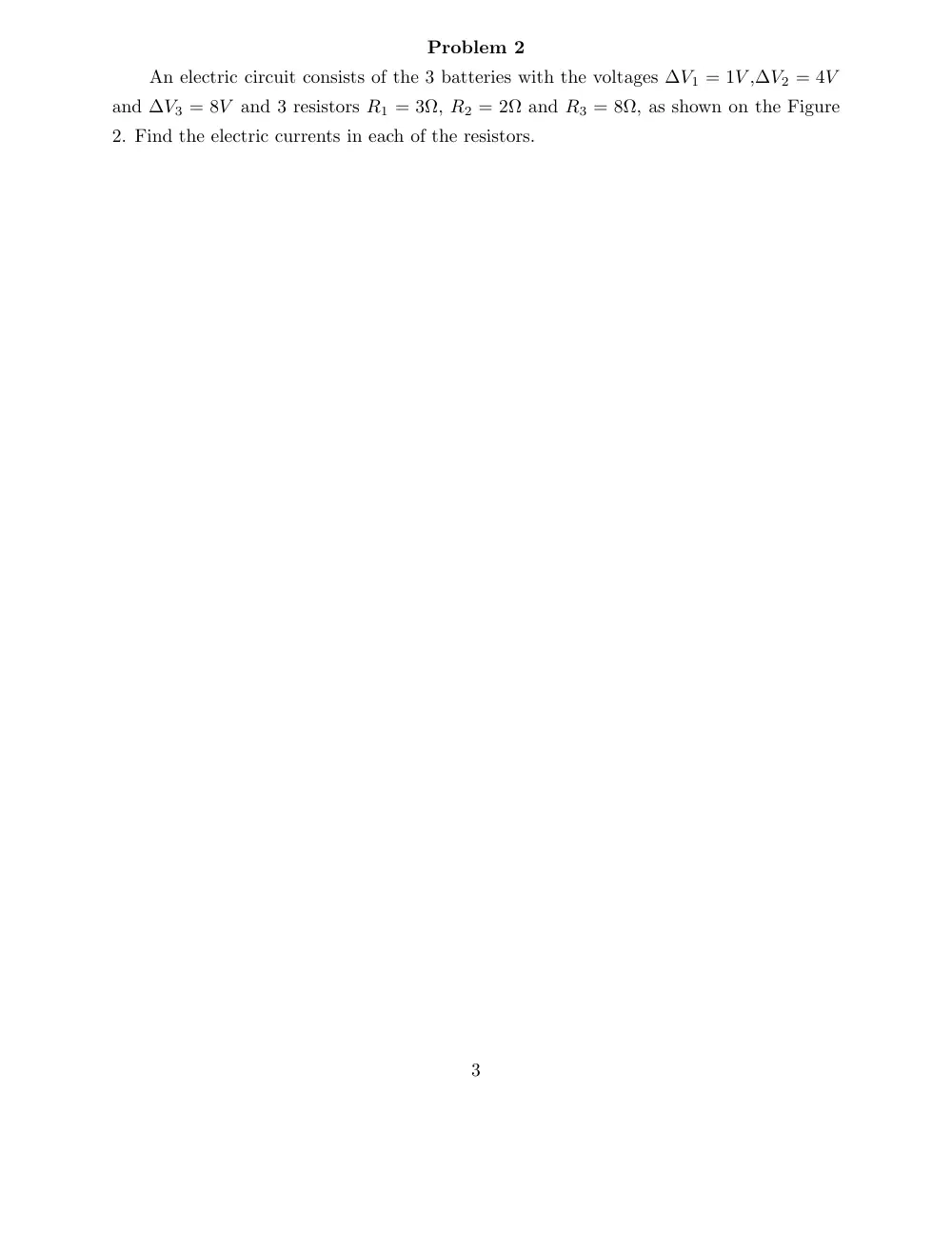
Problem 2
An electric circuit consists of the 3 batteries with the voltages ∆V1 = 1V ,∆V2 = 4V
and ∆V3 = 8V and 3 resistors R1 = 3Ω, R2 = 2Ω and R3 = 8Ω, as shown on the Figure
2. Find the electric currents in each of the resistors.
3
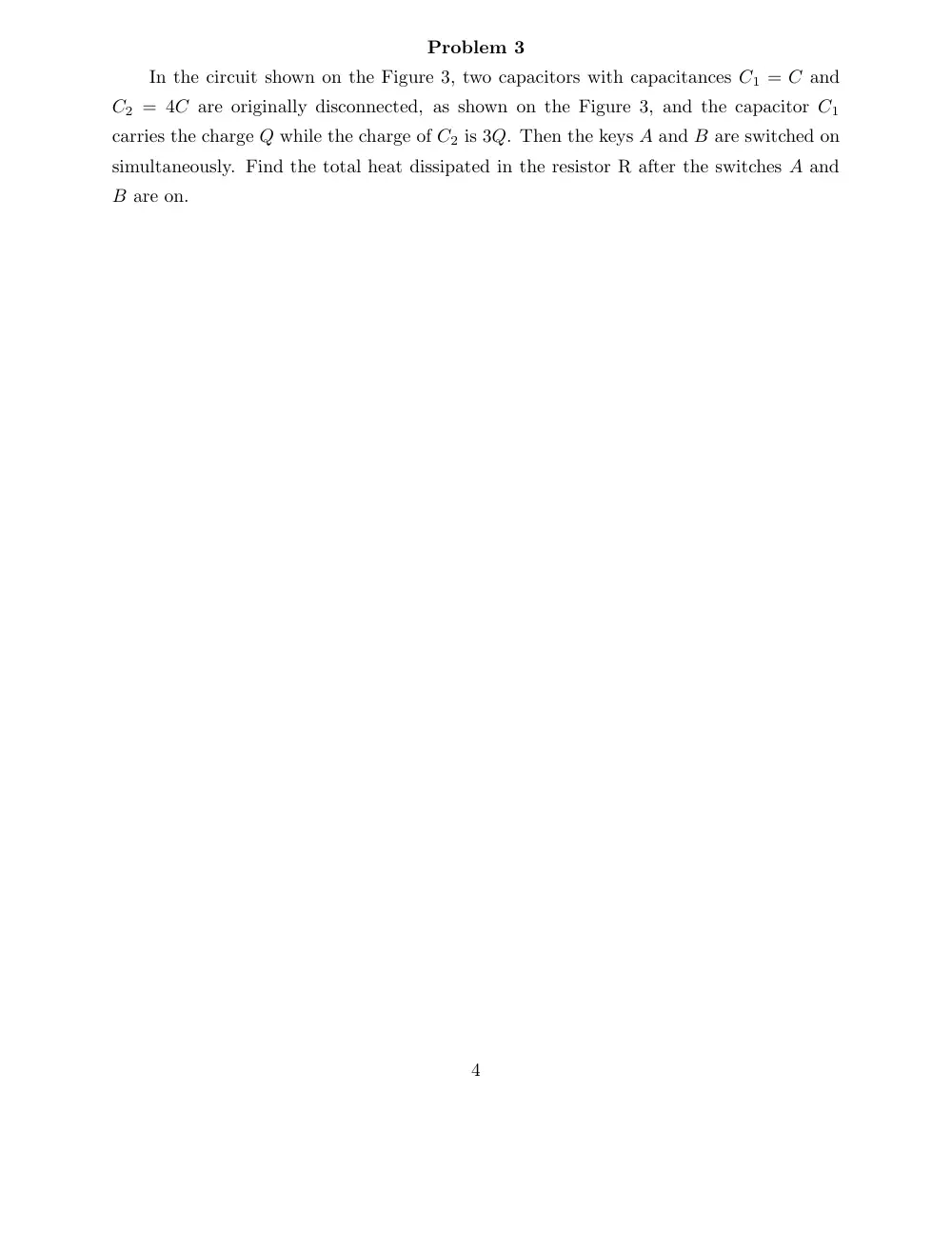
Problem 3
In the circuit shown on the Figure 3, two capacitors with capacitances C1 = C and
C2 = 4C are originally disconnected, as shown on the Figure 3, and the capacitor C1
carries the charge Q while the charge of C2 is 3Q. Then the keys A and B are switched on
simultaneously. Find the total heat dissipated in the resistor R after the switches A and
B are on.
4
Problem 4
Two point charges q1 = 10−4C and q2 = 10−3C are separated by the distance d =
10−2m along the x-axis and move with velocities vecv1 = 2⃗i + 3⃗j( m
s ) and ⃗v2 = 3⃗i + 4⃗j( m
s )
respectively. Find the magnetic interaction force between two charges.
5
Problem 5
A conductor with the cylindrical cross-secrion of the radius R carries the radially
symmetric current density j(r) = αr2; r ≤ R where α is a given constant (the current is
into the page). Find the magnetic field as the function of the distance from the conductor’s
symmetry axis, both inside and outside the conductor.
6
Problem 6
A rectangular contour , consisting of the resistor R and two conducting rods ( each
of them having the same resistance 2R) is placed in a uniform magnetic field B (into the
page) , perpendicular to the plane of the contour. The rods move with velocities v and
3v respectively, as shown on the Figure 6. Find the magnitude and the direction of the
current in the resistor R.
7