
PHYS 211 Final, Summer 1998
American University of Beirut · Electricity and Magnetism · 10 pages
More PHYS 211 files
Show the text of this final exam
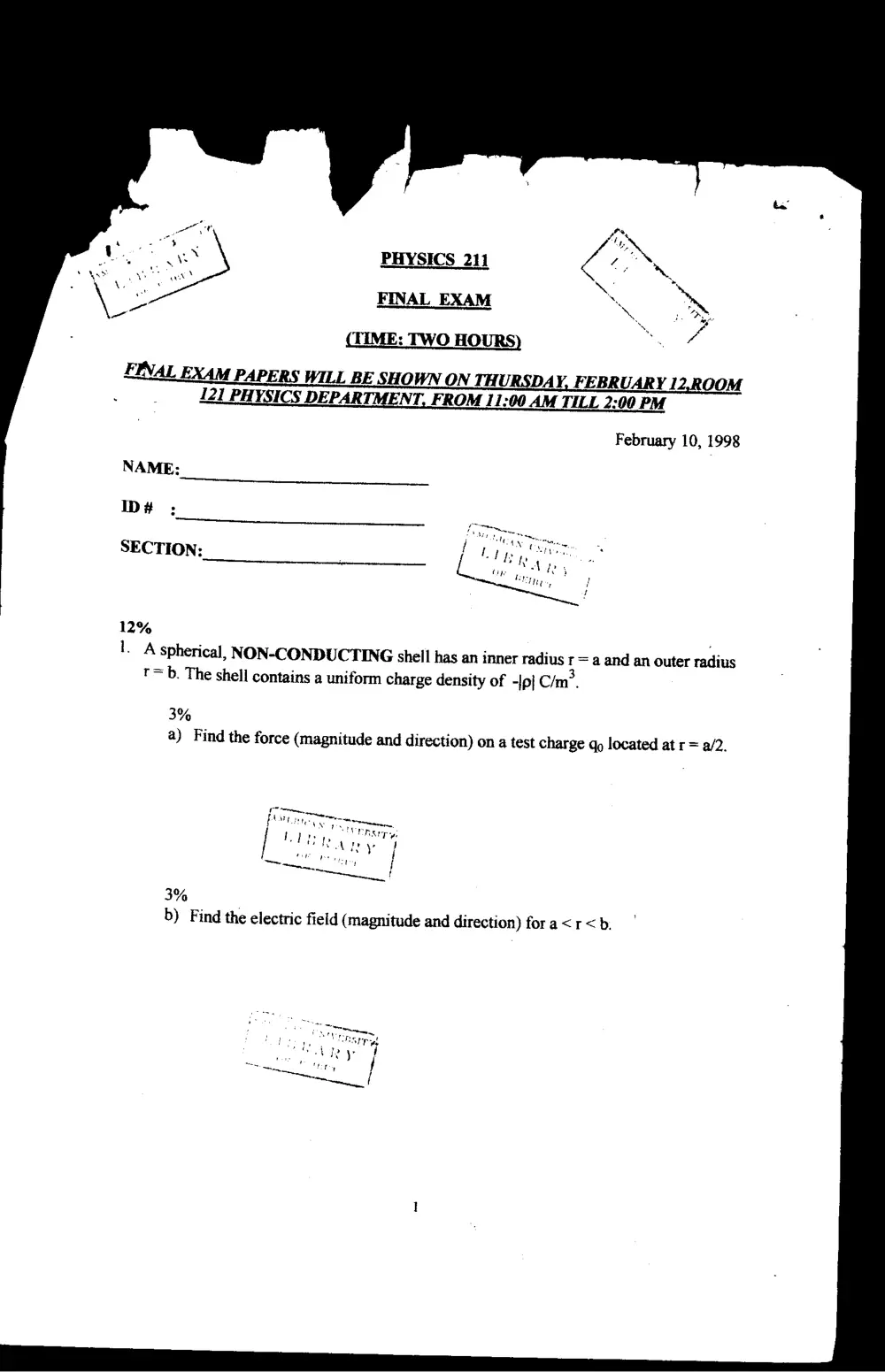
PHYSICS 211
FINAL EXAM
(TIME: TWO HOURS)
FINAL EXAM PAPERS WILL BE SHOWN ON THURSDAY, FEBRUARY 12 ‘OOM
; 121 PHYSICS DEPARTMENT, >FROM 11:00 AM TILL 2:00 PM
February 10, 1998
NAME:
ID#
SECTION:
12% .
LA spherical, NON-CONDUCTING shell has an inner radius r = a and an outer radius
™=b. The shell contains a uniform charge density of -|p| C/m?.
3%
a) Find the force (magnitude and direction) on a test charge qo located at r = 2/2.
3%
b) Find the electric field (magnitude and direction) for a < r <b.
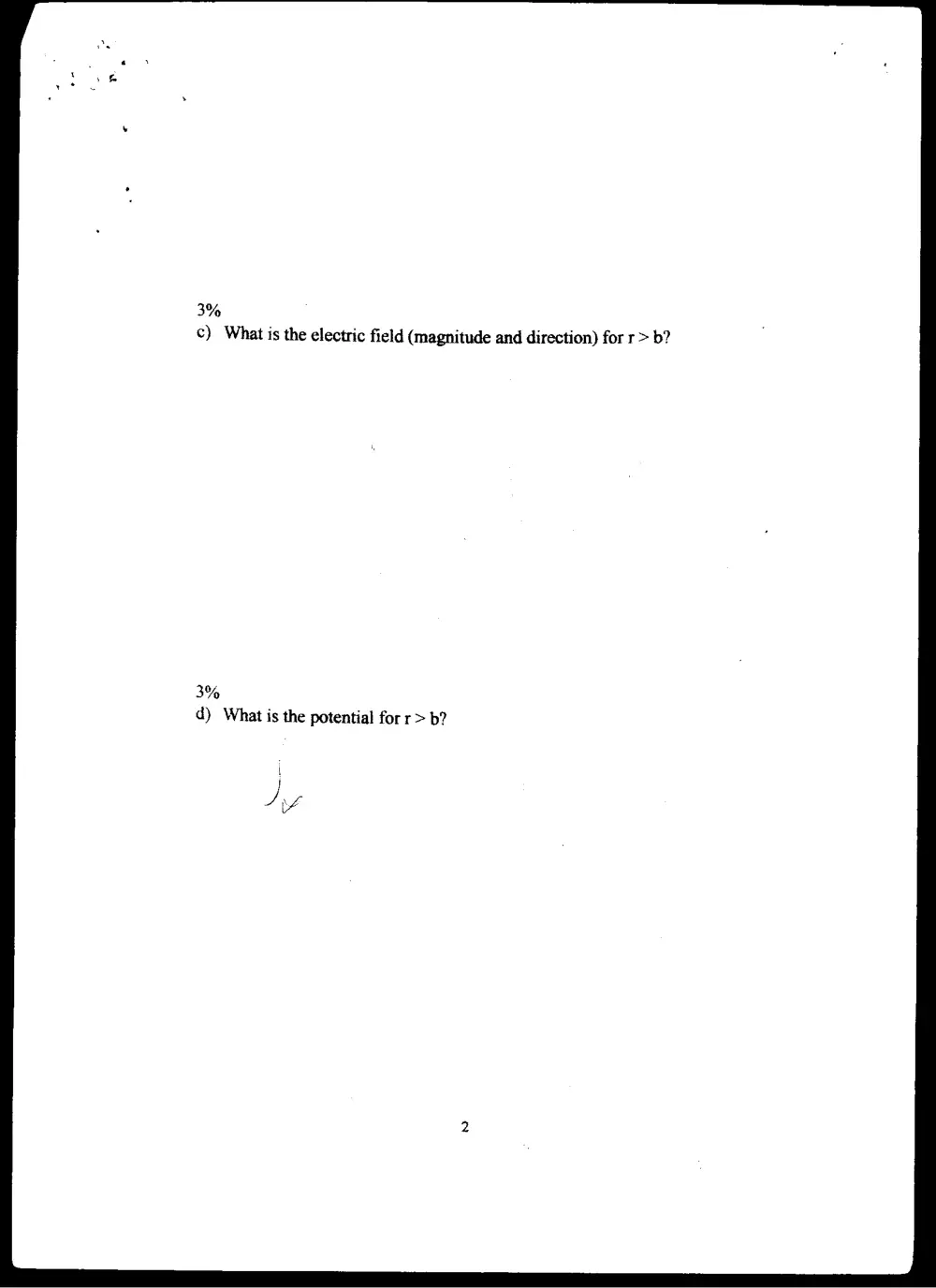
3%
¢) What is the electric field (magnitude and direction) for r > b?
3%
d) What is the potential for r > b?
Ay
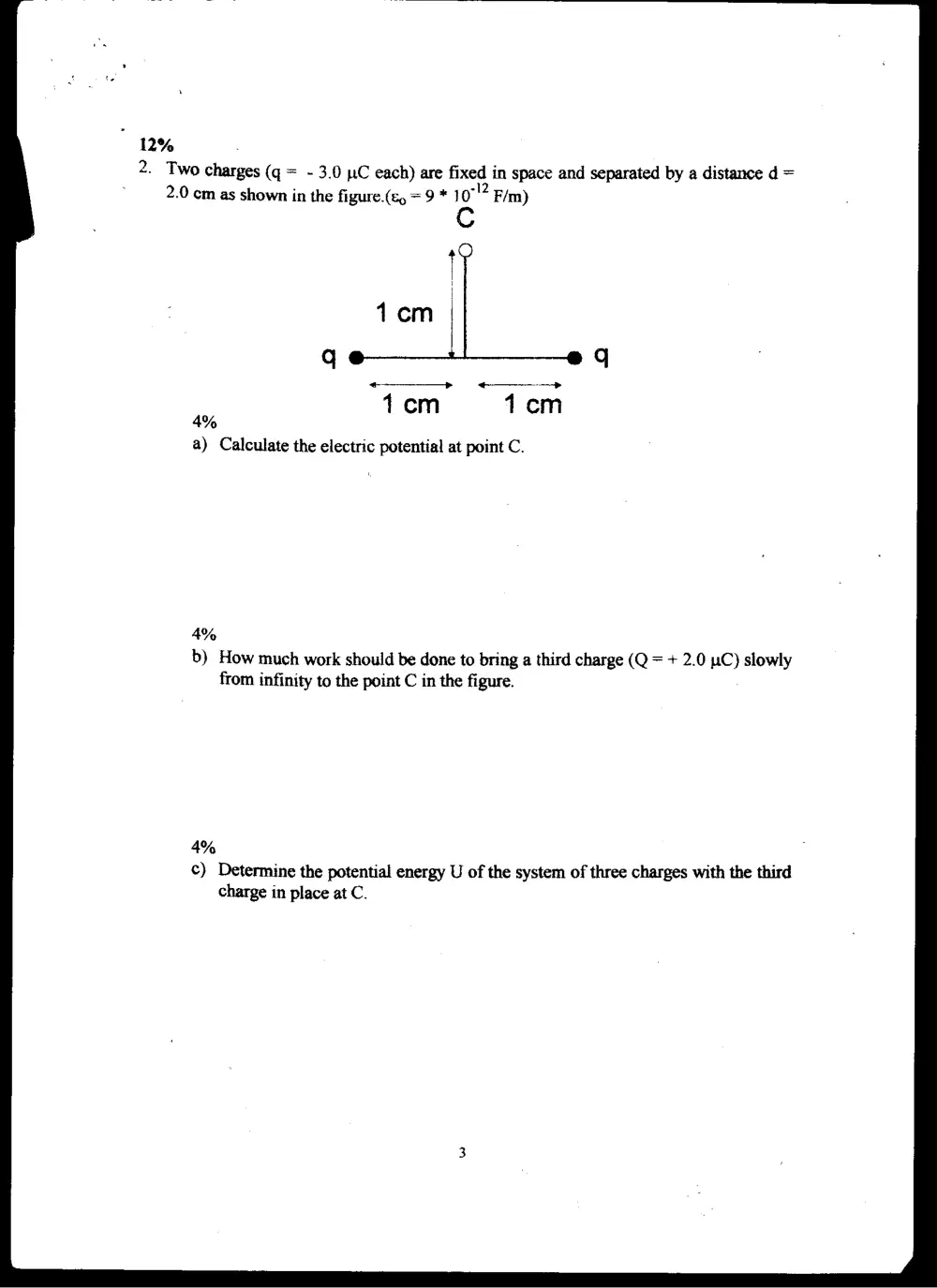
12%
2. Two charges (q= - 3.0 nC each) are fixed in space and separated by a distance d =
2.0 cm as shown in the figure.(tg = 9 * 107"? F/m)
I
1cm
1 cm 1cm
4%
a) Calculate the electric potential at point C.
A%
b) How much work should be done to bring a third charge (Q = + 2.0 uc) slowly
from infinity to the point C in the figure.
4%
¢) Determine the potential energy U of the system of three charges with the third
charge in place at C.
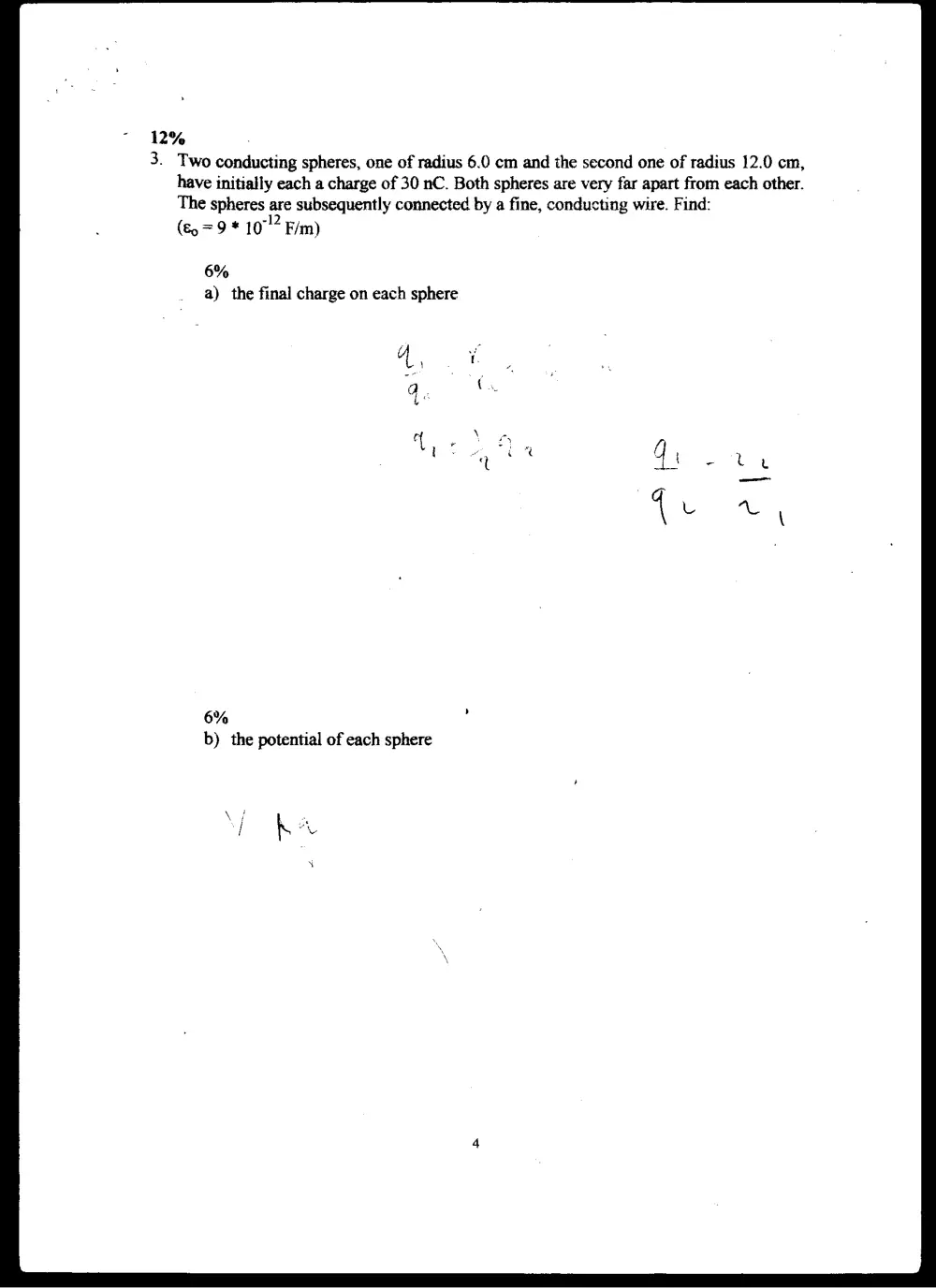
12%
3. Two conducting spheres, one of radius 6.0 cm and the second one of radius 12.0 cm,
have initially each a charge of 30 nC. Both spheres are very far apart from each other.
The spheres are subsequently connected by a fine, conducting wire. Find:
(6) =9* 10)? E/m)
6%
a) the final charge on each sphere
6%
b) the potential of each sphere
18%
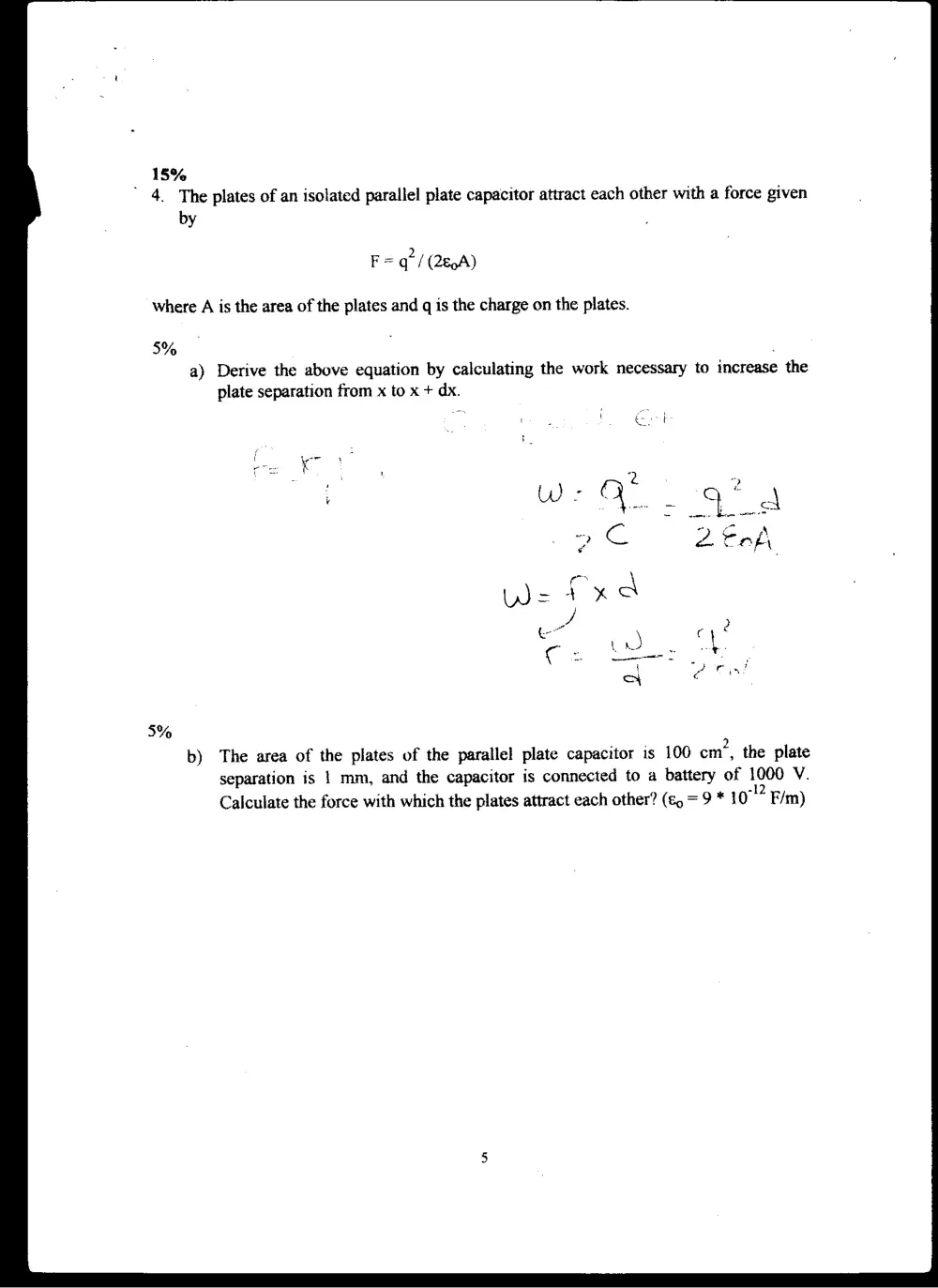
’ 4. The plates of an isolated parallel plate capacitor attract each other with a force given
by
F = q7/ (260A)
where A is the area of the plates and q is the charge on the plates.
5% .
a) Derive the above equation by calculating the work necessary to increase the
plate separation from x to x + dx.
- Eel
y we, 2
; W > OQ ~- Goa
2 C Zork
rt
ve) = + X® A
/
er ) an 2
~ { a ae ee
a co
3%
b) The area of the plates of the parallel plate capacitor is 100 cm’, the plate
separation is 1 mm, and the capacitor is connected to a battery of 1000 V.
Calculate the force with which the plates attract each other? (c, = 9 * 107 2 Fim)
3%
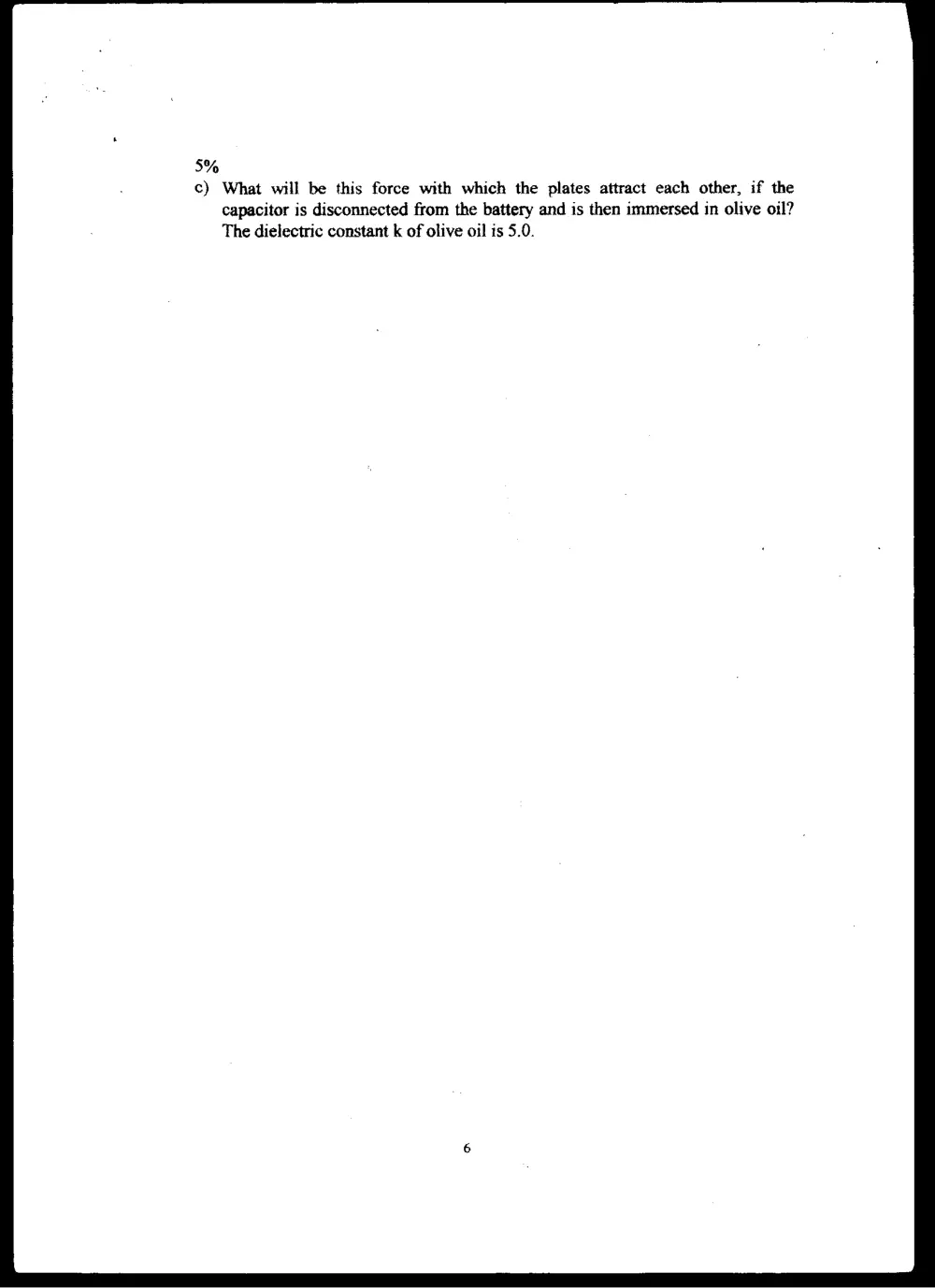
c) What will be this force with which the plates attract each other, if the
capacitor is disconnected from the battery and is then immersed in olive oil?
The dielectric constant k of olive oil is 5.0.
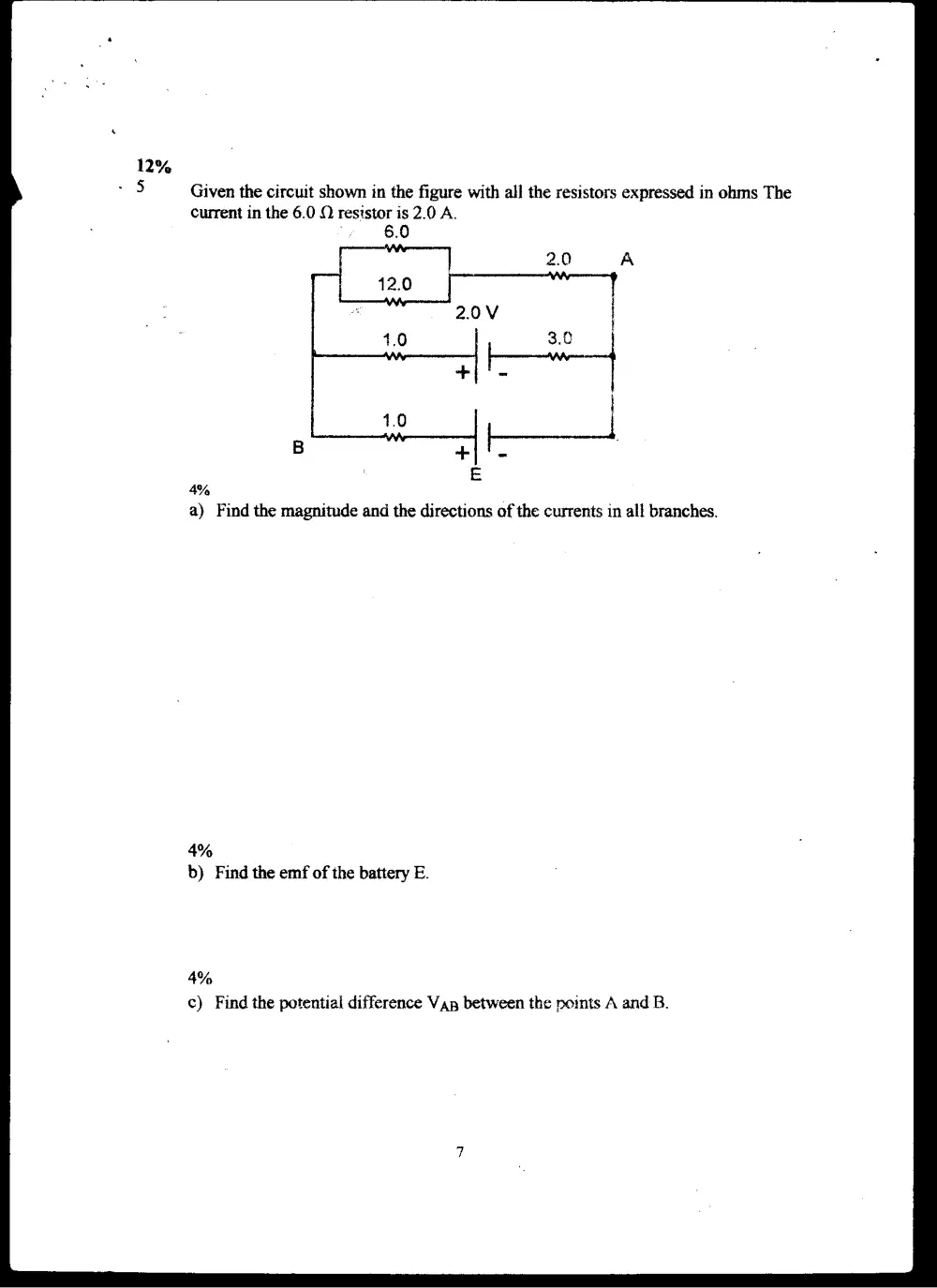
Given the circuit shown in the figure with all the resistors expressed in ohms The
current in the 6.0 (0 resistor is 2.0 A.
. 6.0
4%
a) Find the magnitude and the directions of the currents in all branches.
4%
b) Find the emf of the battery E.
4%
c) Find the potential difference Van between the points A and B.
12%
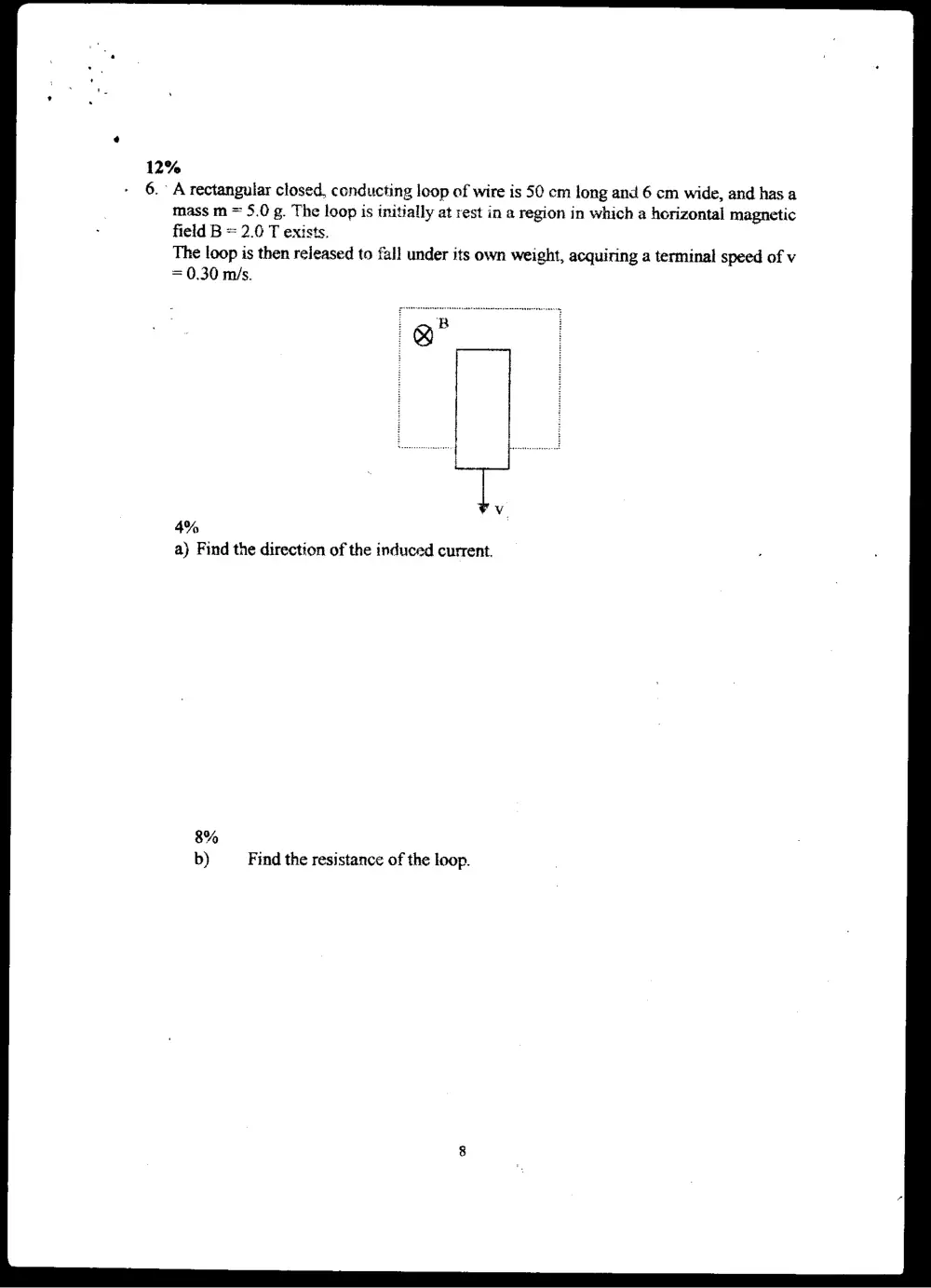
6. A rectangular closed, conducting loop of wire is 50 cm long and 6 cm wide, and has a
mass m = 5.0 g. The loop is initially at rest in a region in which a horizontal magnetic
field B = 2.0 T exists.
The loop is then released to fall under its own weight, acquiring a terminal speed of v
= 0.30 m/s.
4%
a) Find the direction of the induced current.
8%
b) Find the resistance of the loop.
1s% |
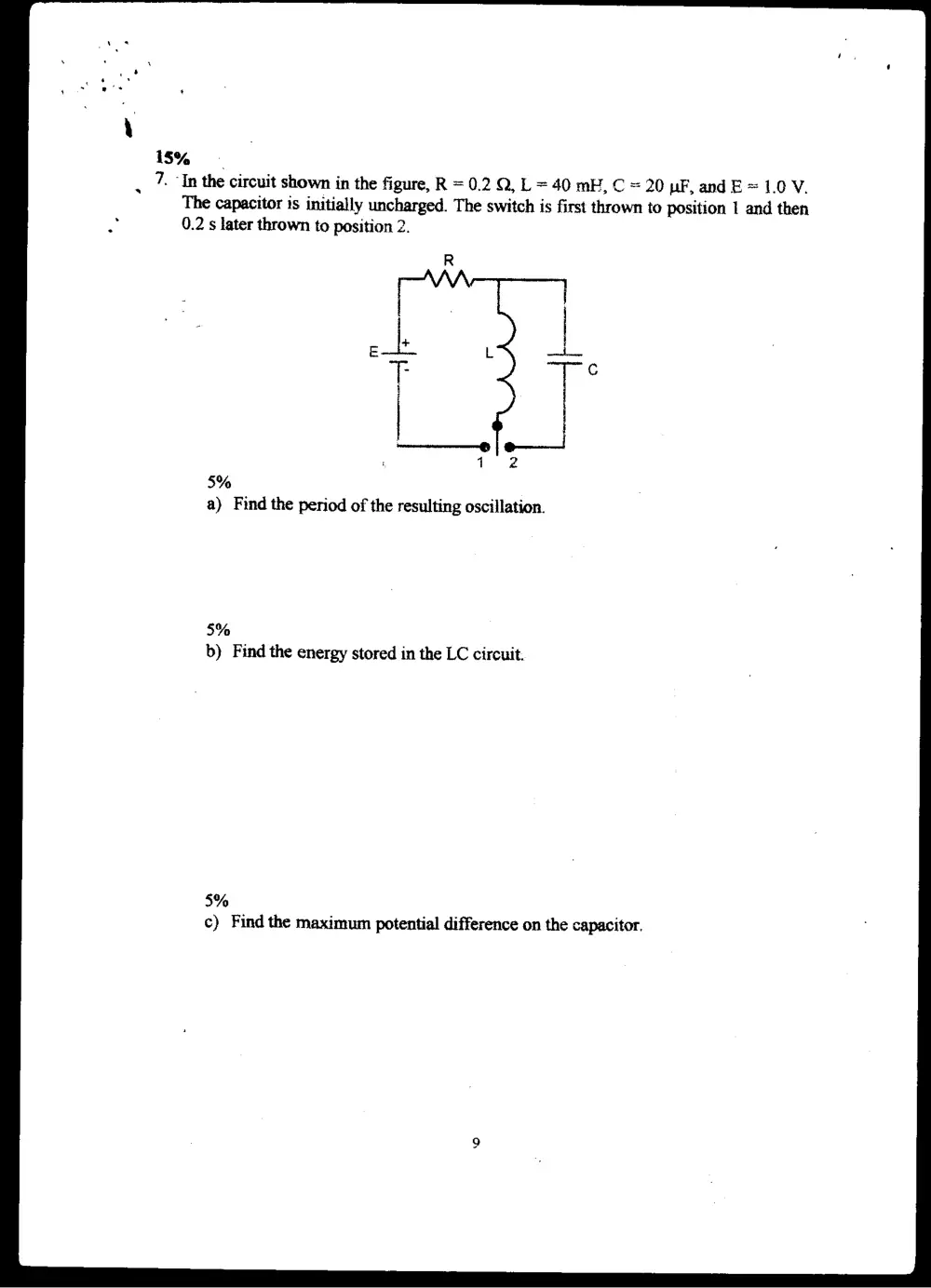
. 7. “In the circuit shown in the figure, R = 0.2 Q, L = 40 mH, C = 20 pF, and E = 1.0 V.
The capacitor is initially uncharged. The switch is first thrown to position 1 and then
0.2 s later thrown to position 2.
5%
a) Find the period of the resulting oscillation.
5%
b) Find the energy stored in the LC circuit.
5%
c) Find the maximum potential difference on the capacitor.
10%
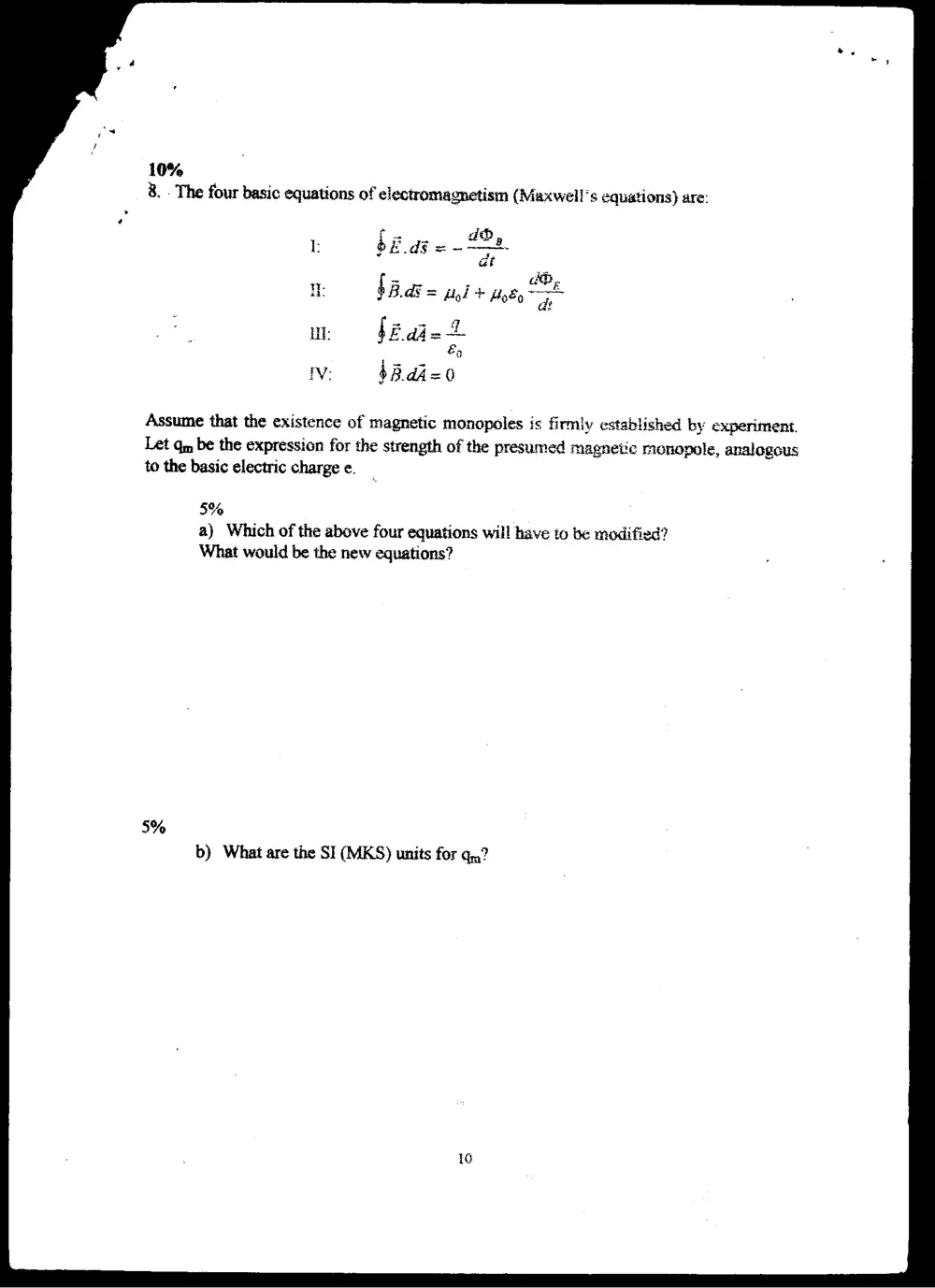
8. . The four basic equations of electromagnetism (Maxwell's equations) are:
Assume that the existence of magnetic monopoles is firmly established by experiment.
Let qm be the expression for the strength of the presumed magnetic monopole, analogous
to the basic electric charge e.
5%
a) Which of the above four equations will have to be modified?
What would be the new equations?
5%
b) What are the SI (MKS) units for qu?