
PHYS 212 Final
American University of Beirut · Modern Physics · 3 pages
More PHYS 212 files
- Final · Fall 2008Final examView
- Final · Fall 2007Final examView
- Final · Fall 1997Final examView
- Final · Spring 1997Final examView
- Final · Fall 1996Final examView
- Final · Spring 1996Final examView
- Final · Fall 1995Final examView
- Useful File A Math Free Guide to the Basics of Special Relativity · Spring 2018FileView
Show the text of this final exam
AUB Physics Department
Final Exam Physics 212 June 20, 1995
Name: —_ : oo -
Useful information: 7 -
k= 9x10 ImvC c= 16x10" CMe = O51 Mev Act Kes 3:29: 10° WAP
he = 12400 eV. A=6.58x10"° eV.s_ e/ m, =1.759x10'! Cikg
m,= 1.008666u —-m,=1.007277u 1u= 931.5 MeVic™
Boltzmann constant k. = 1.38 10-23 VK.
Some lighter elements: ,H, 2He, 3Li, 4Be, 5B, 6C, 7N, gO, oF
Part A.
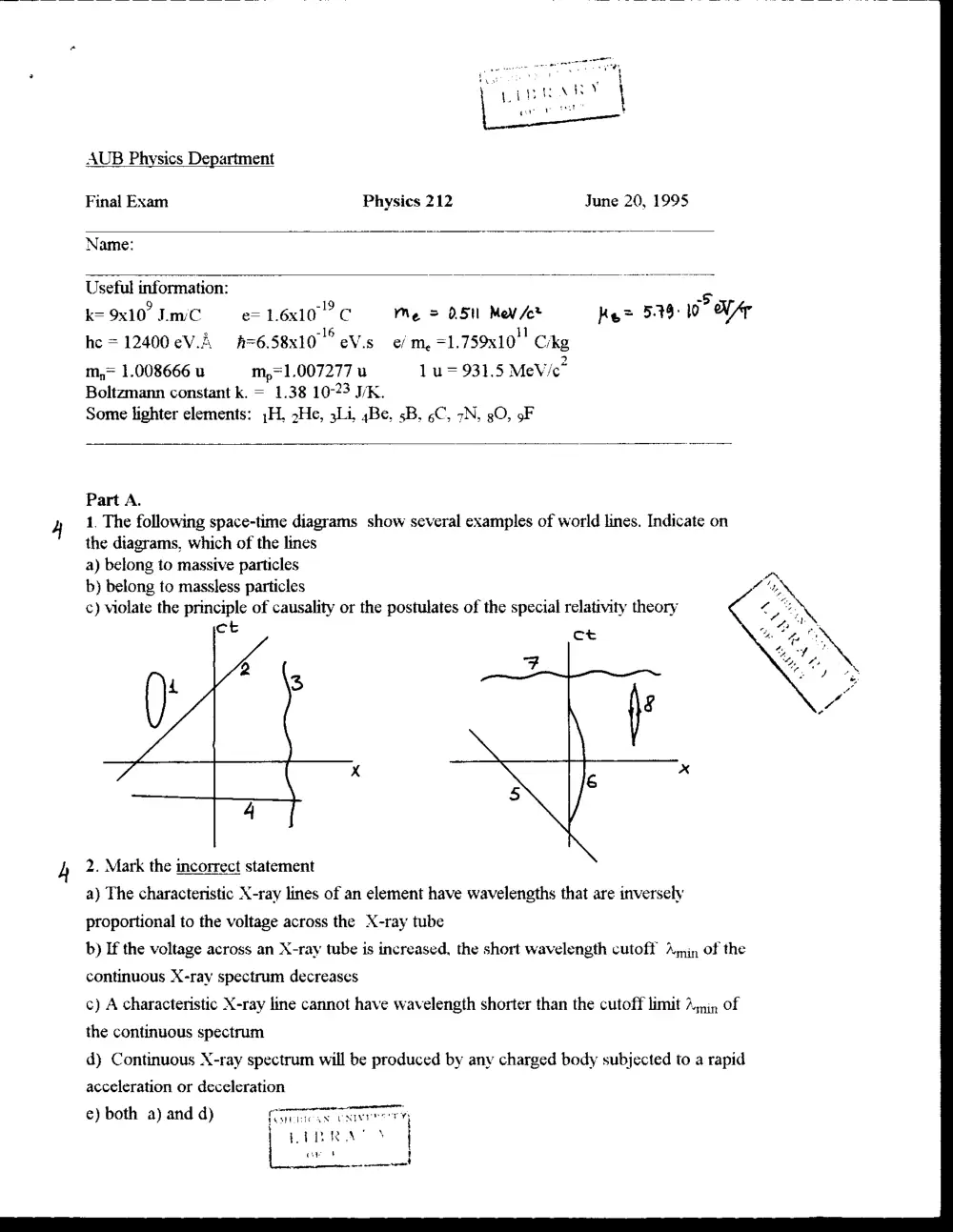
4 1. The following space-time diagrams show several examples of world lines. Indicate on
the diagrams, which of the lines
a) belong to massive particles
b) belong to massless particles
c) violate the principle of causality or the postulates of the special relativity theory
(on of ct
F
—| er
F
X x
» 6
4 2. Mark the incorrect statement
a) The characteristic X-ray lines of an element have wavelengths that are inversely
proportional to the voltage across the X-ray tube
b) If the voltage across an X-ray tube is increased, the short wavelength cutoff Amin of the
continuous X-ray spectrum decreases
¢) A characteristic X-ray line cannot have wavelength shorter than the cutoff limit nin of
the continuous spectrum
d) Continuous X-ray spectrum will be produced by anv charged body subjected to a rapid
acceleration or deceleration
e) both a) and d) reavemreueeraneeNemsesta
EER RATS
ori ot t
eet
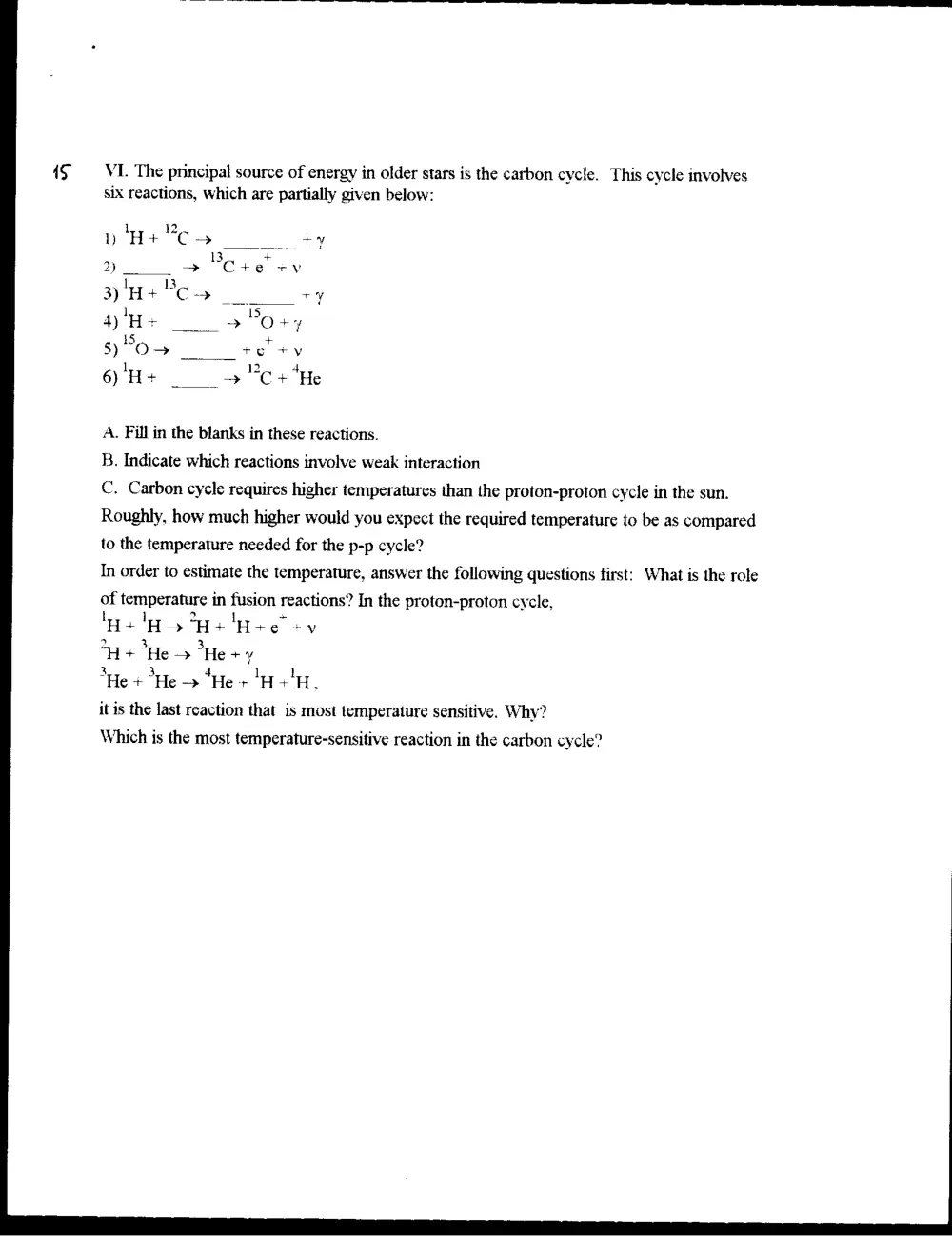
4§ VI. The principal source of energy in older stars is the carbon cycle. This cycle involves
six reactions, which are partially given below:
1 12,
1) H+ “C5 +
a !
13 +
2) >» “Cre rv
3) 'H+ o> ~y
4) ‘H+ >» Pory
5)°o> +e ey
6) H+ + P+ He
A. Fill in the blanks in these reactions.
B. Indicate which reactions involve weak interaction
C. Carbon cycle requires higher temperatures than the proton-proton cycle in the sun.
Roughly, how much higher would you expect the required temperature to be as compared
to the temperature needed for the p-p cycle?
In order to estimate the temperature, answer the following questions first: What is the role
of temperature in fusion reactions? In the proton-proton cycle,
'H+'H > He Hee + y
“H+ "He > “He +7
“He + “He > “He + 'H+'H,
it is the last reaction that is most temperature sensitive. Why?
Which is the most temperature-sensitive reaction in the carbon cycle?
4 3. Consider the electronic states in a hydrogen atom. Mark the incorrect statement (if any)
a) There are 2 degenerate states with the same energy in the level with the principal
quantum number n=1.
b) An electron in an s-state (/=O) will not interact with the external magnetic field
c) The average kinetic energy of the electron in the ground state is 13.6 eV
d) In the 2p state, the z-component of the orbital angular momentum can have three
different values
4. It follows from the uncertainty principle that
4 a) each particle must have an antiparticle
b) even at absolute zero atoms in a crystalline lattice have to vibrate with the amplitude of
atleast kTvhA
¢) the values of quantum numbers » and / for an electron in the hydrogen atom cannot
be specified with arbitrary precision
d) electron in the hydrogen atom cannot move along elliptical trajectories
e) none of the above
Part B
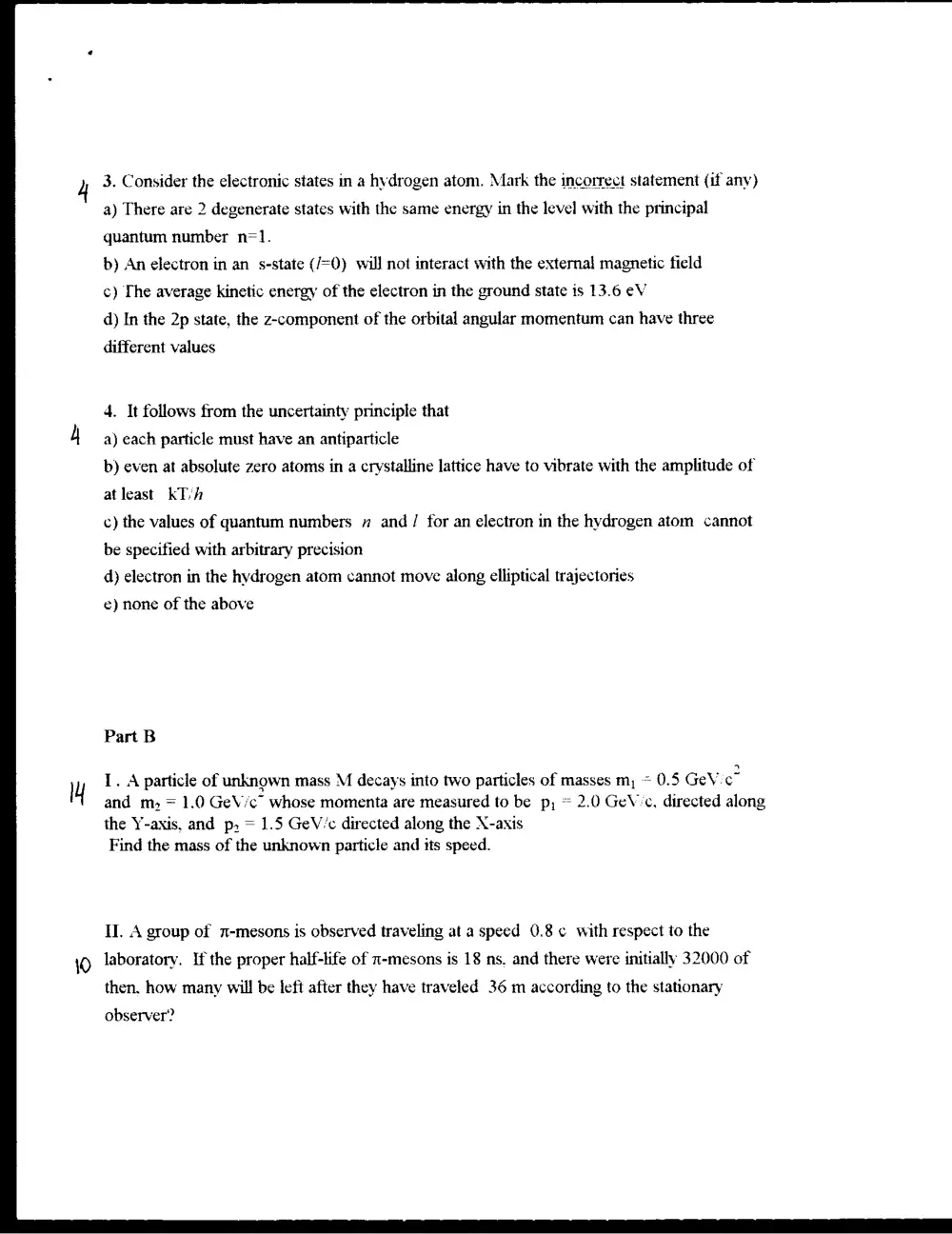
y 1. A particle of unknown mass M decays into two particles of masses m, = 0.5 GeVic™
and m, = 1.0 GeV/c” whose momenta are measured to be p, = 2.0 GeW’c, directed along
the Y-axis, and p, = 1.5 GeV/c directed along the X-axis
Find the mass of the unknown particle and its speed.
II. A group of 7-mesons is observed traveling at a speed 0.8 ¢ with respect to the
10 laboratory. If the proper half-life of a-mesons is 18 ns, and there were initially 32000 of
then, how many will be left after they have traveled 36 m according to the stationary
observer?