
PHYS 212 Final, Fall 1996
American University of Beirut · Modern Physics · 3 pages
More PHYS 212 files
- Final · Fall 2008Final examView
- Final · Fall 2007Final examView
- Final · Fall 1997Final examView
- Final · Spring 1997Final examView
- Final · Spring 1996Final examView
- Final · Fall 1995Final examView
- FinalFinal examView
- Useful File A Math Free Guide to the Basics of Special Relativity · Spring 2018FileView
Show the text of this final exam
ae
Per AREY
Lith aAk
poo teers |
a 3
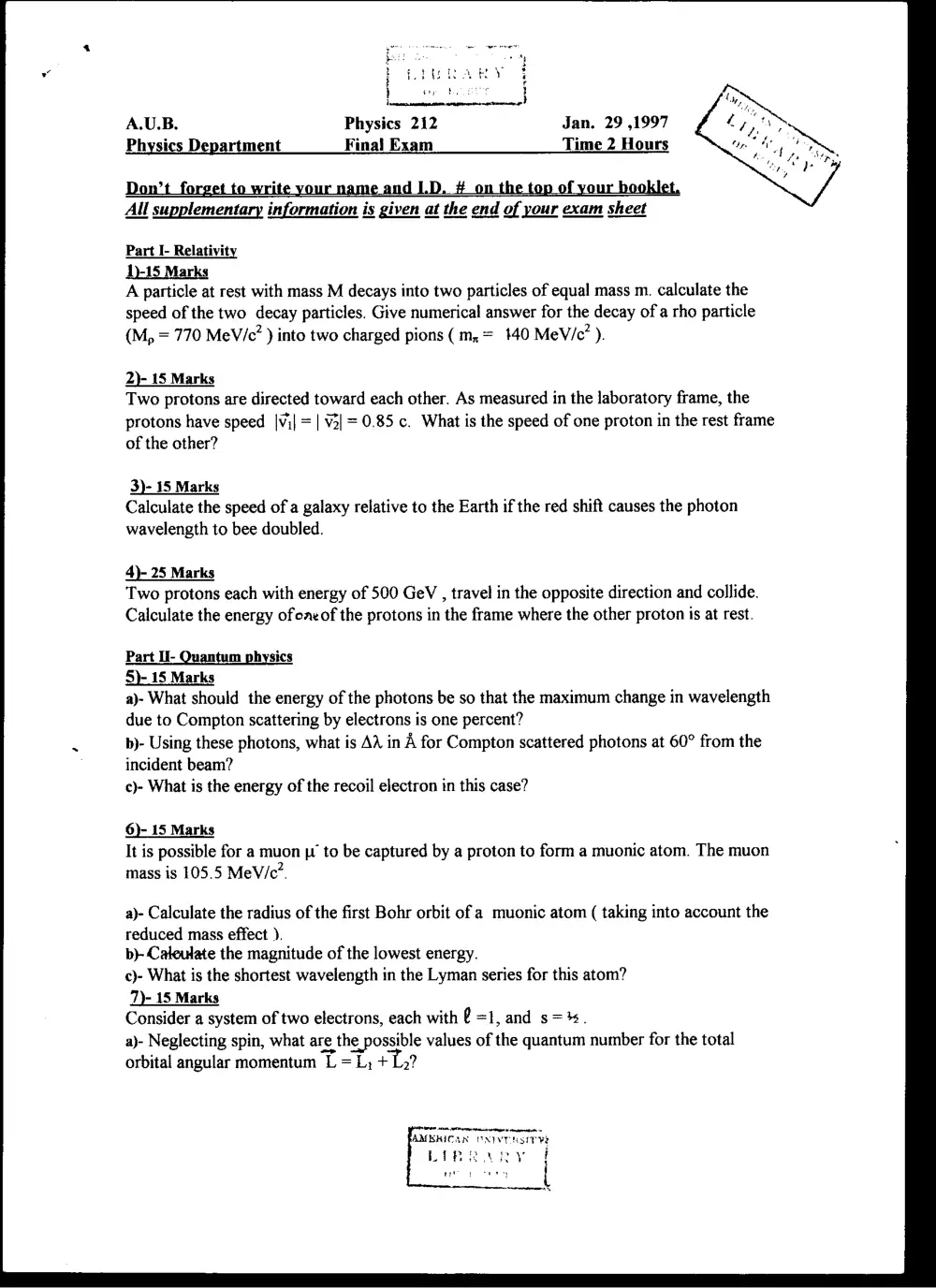
A.U.B. Physics 212 Jan. 29 ,1997
Physics Department Final Exam Time 2 Hours
gei to wre yo 0 ¢ And LL.D). + On the £0)
All supplementary information is given at the end of your exam sheet
Part I- Relativity
4)-15 Marks
A particle at rest with mass M decays into two particles of equal mass m. calculate the
speed of the two decay particles. Give numerical answer for the decay of a rho particle
(M, = 770 MeV/c’ ) into two charged pions (m,= 40 MeV/c’ ).
2)- 15 Marks
Two protons are directed toward each other. As measured in the laboratory frame, the
protons have speed |Vi| = | ¥2| = 0.85 c. What is the speed of one proton in the rest frame
of the other?
3)- 15 Marks
Calculate the speed of a galaxy relative to the Earth if the red shift causes the photon
wavelength to bee doubled.
4)- 25 Marks
Two protons each with energy of 500 GeV , travel in the opposite direction and collide.
Calculate the energy ofeaeof the protons in the frame where the other proton is at rest.
Part H- Quantum physics
§)- 15 Marks
a)- What should the energy of the photons be so that the maximum change in wavelength
due to Compton scattering by electrons is one percent?
b)- Using these photons, what is AA in A for Compton scattered photons at 60° from the
incident beam?
c)- What is the energy of the recoil electron in this case?
6)- 15 Marks
It is possible for a muon p to be captured by a proton to form a muonic atom. The muon
mass is 105.5 MeV/c”.
a)- Calculate the radius of the first Bohr orbit of a muonic atom ( taking into account the
reduced mass effect ).
b)- Caleulate the magnitude of the lowest energy.
c)- What is the shortest wavelength in the Lyman series for this atom?
7)- 15 Marks
Consider a system of two electrons, each with @ =1, and s=%.
a)- Neglecting spin, what are the possible values of the quantum number for the total
orbital angular momentum L = L; +1?
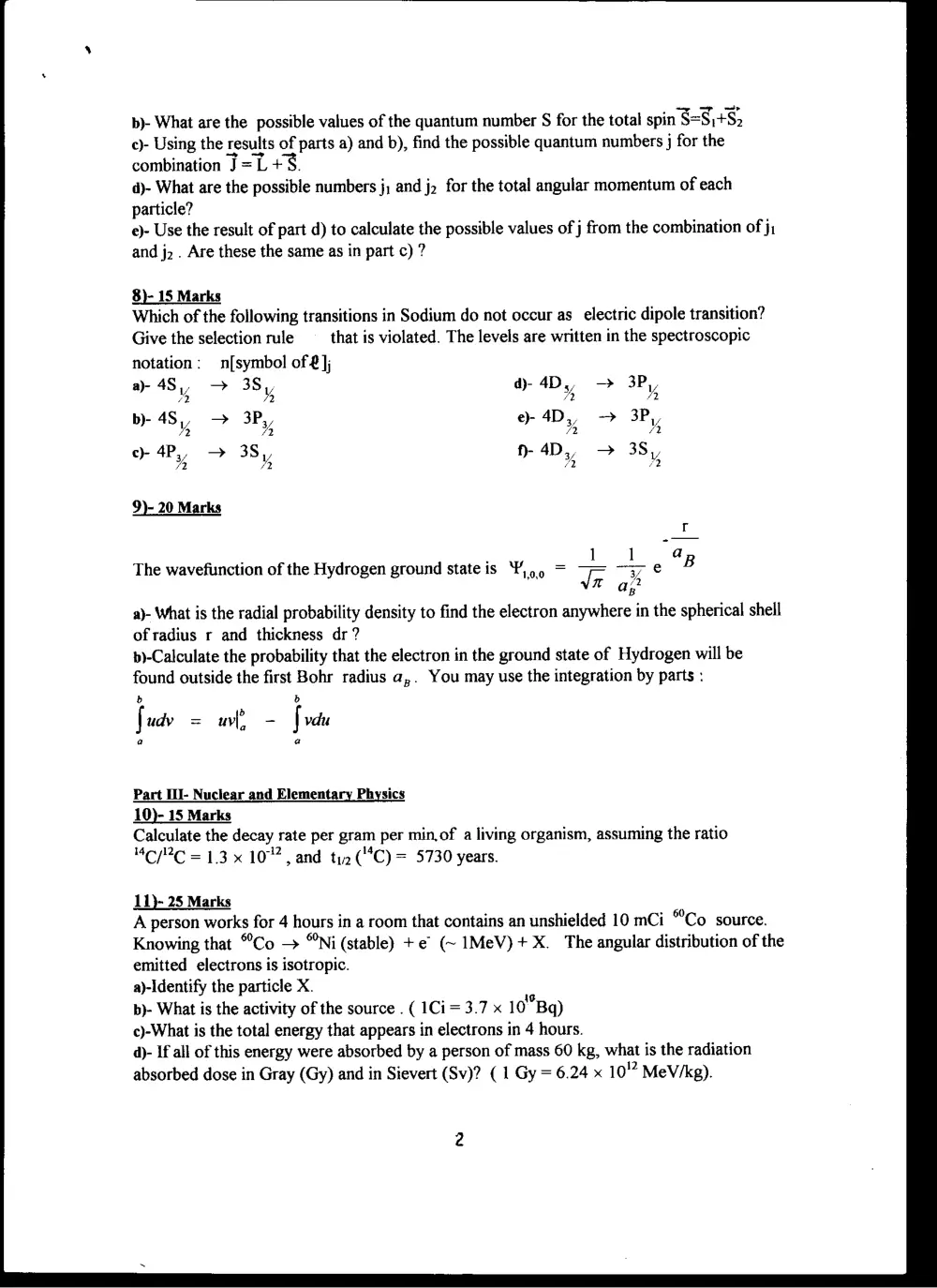
b)- What are the possible values of the quantum number S for the total spin $=8,+8,
c)- Using the results of parts a) and b), find the possible quantum numbers j for the
combination J=L +8.
d)- What are the possible numbers j; and jz for the total angular momentum of each
particle?
e)- Use the result of part d) to calculate the possible values of j from the combination of j;
and jz . Are these the same as in part c) ?
8)- 15 Marks
Which of the following transitions in Sodium do not occur as_ electric dipole transition?
Give the selection rule that is violated. The levels are written in the spectroscopic
notation: n[symbol of 2];
- 48 38, - 4D 3P
a) y > Ss y d) ¥ > 3Py
-4 - 4 3P
b) Sy > 3P;, e) D,, > 3Py
c} 4Ps, > 38 f)- 4D, > 38y
9)- 20 Marks
r
. . 1 1 4%
The wavefunction of the Hydrogen ground stateis ‘Y,,, = = ~3z7 &
™ va a;
a)- What is the radial probability density to find the electron anywhere in the spherical shell
of radius r and thickness dr?
b)-Calculate the probability that the electron in the ground state of Hydrogen will be
found outside the first Bohr radius a,. You may use the integration by parts :
6
{ua = wh - frau
a
Part II- Nuclear and Elementary Physics
10)- 15 Marks
Calculate the decay rate per gram per min,of a living organism, assuming the ratio
4c = 13 x 107, and ty2("C) = 5730 years.
11)- 25 Marks
A person works for 4 hours in a room that contains an unshielded 10 mCi Co source.
Knowing that Co —> Ni (stable) +e (~ 1MeV) +X. The angular distribution of the
emitted electrons is isotropic.
a)-Identify the particle X.
b)- What is the activity of the source . ( 1Ci = 3.7 x 10°Bq)
c)-What is the total energy that appears in electrons in 4 hours.
d)- If all of this energy were absorbed by a person of mass 60 kg, what is the radiation
absorbed dose in Gray (Gy) and in Sievert (Sv)? (1 Gy = 6.24 x 10” MeV/kg).
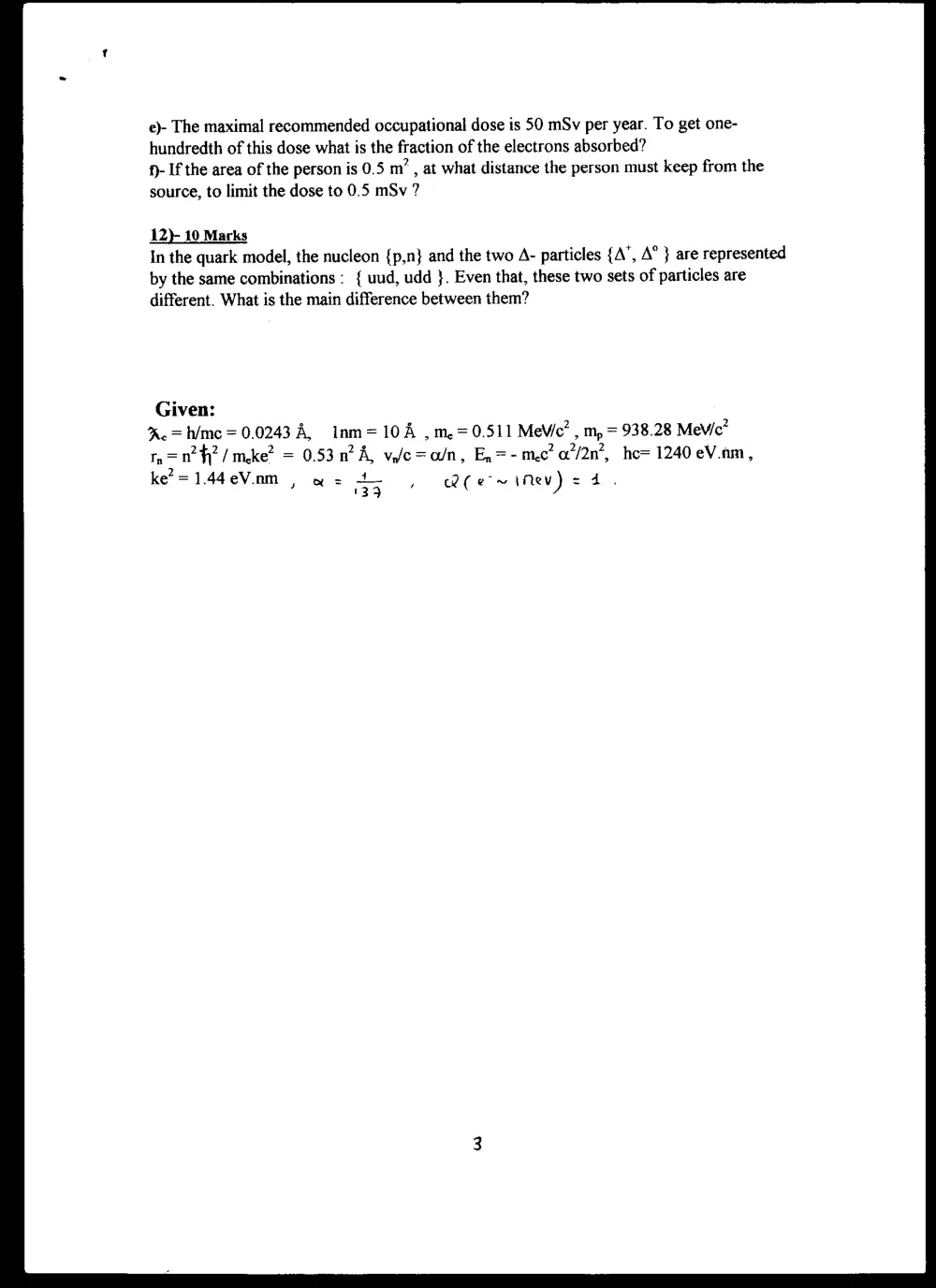
e)- The maximal recommended occupational dose is 50 mSv per year. To get one-
hundredth of this dose what is the fraction of the electrons absorbed?
f)- If the area of the person is 0.5 m’ , at what distance the person must keep from the
source, to limit the dose to 0.5 mSv ?
12)- 10 Marks
In the quark model, the nucleon {p,n} and the two A- particles {A‘, A° } are represented
by the same combinations : { wud, udd }. Even that, these two sets of particles are
different. What is the main difference between them?
Given:
Re =h/me = 0.0243A, iInm=10A ,m,=0.511 MeWc”, m, = 938.28 MeWc?
In = nF /mke? = 0.53 va A, vj/c=a/n, E,=- mc” o2/2n’, he= 1240 eV.nm,
ke?=1.44eV.nm , x = lew inev)y=s4.
’
ju
133 ,