
PHYS 212 Final, Spring 1997
American University of Beirut · Modern Physics · 3 pages

More PHYS 212 files
- Final · Fall 2008Final examView
- Final · Fall 2007Final examView
- Final · Fall 1997Final examView
- Final · Fall 1996Final examView
- Final · Spring 1996Final examView
- Final · Fall 1995Final examView
- FinalFinal examView
- Useful File A Math Free Guide to the Basics of Special Relativity · Spring 2018FileView
Show the text of this final exam
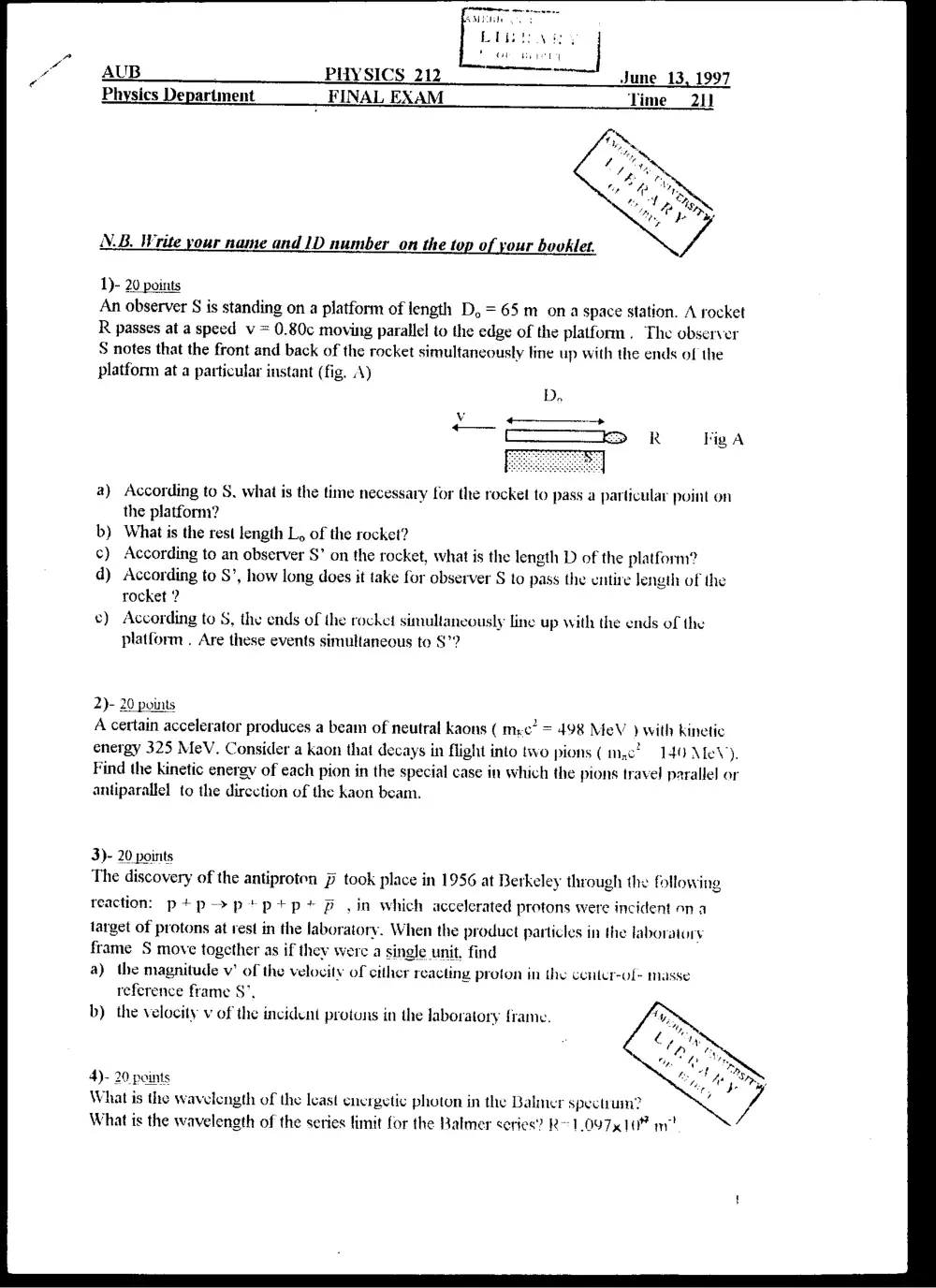
AUB . PHYSICS 212 : June_13, 1997
Physics Department FINAL EXAM Time 214
NB. Write your name and 1D number _on the top of your bugktet,
1)- 20 points
An observer S is standing on a platform of length D, = 65m ona space station. A rocket
R passes at a speed v = 0.80c moving parallel to the edge of the platform. The observer
S notes that the front and back of the rocket simultaneously line up with the ends of the
platform at a particular instant (fig. A)
Db.
+>
According to S, what is the time necessary for the rocket to pass a particular point on
the platform?
What is the rest length L, of the rocket?
According to an observer S’ on the rocket, what is the length D of the platform?
According to S’, how long does it take for observer S to pass the cntire Jength of the
rocket ?
According to S, the ends of the rocket simultaneously line up with the ends of the
platform . Are these events simultaneous to 8’?
2)- 20 points
A certain accelerator produces a beam of neutral kaons ( msc” = 498 MeV ) with kinetic
energy 325 MeV. Consider a kaon that decays in flight into two pions (mc? 140 MeV).
Find the kinetic energy of each pion in the special case in which the pions travel parallel or
antiparallel to the direction of the kaon beam.
3)- 20 points
The discovery of the antiproten jf took place in 1956 at Berkeley through the following
reaction: p+p—->ptp+p+ # ,in which accelerated protons were incident on a
target of protons at rest in the laboratory. When the product particles in the laboratory
frame S move together as if they were a single unit, find
a) the magnitude v’ of the velocity of cither reacting proton in the center-of- masse
reference frame S’,
b) the velocity v of the incident protons in the laboratory frame.
4)- 20 points
What is the wavelength of the least energetic photon in the Balmer speclruin?
What is the wavelength of the series limit for the Balmer series? R-1,097x 10% m?
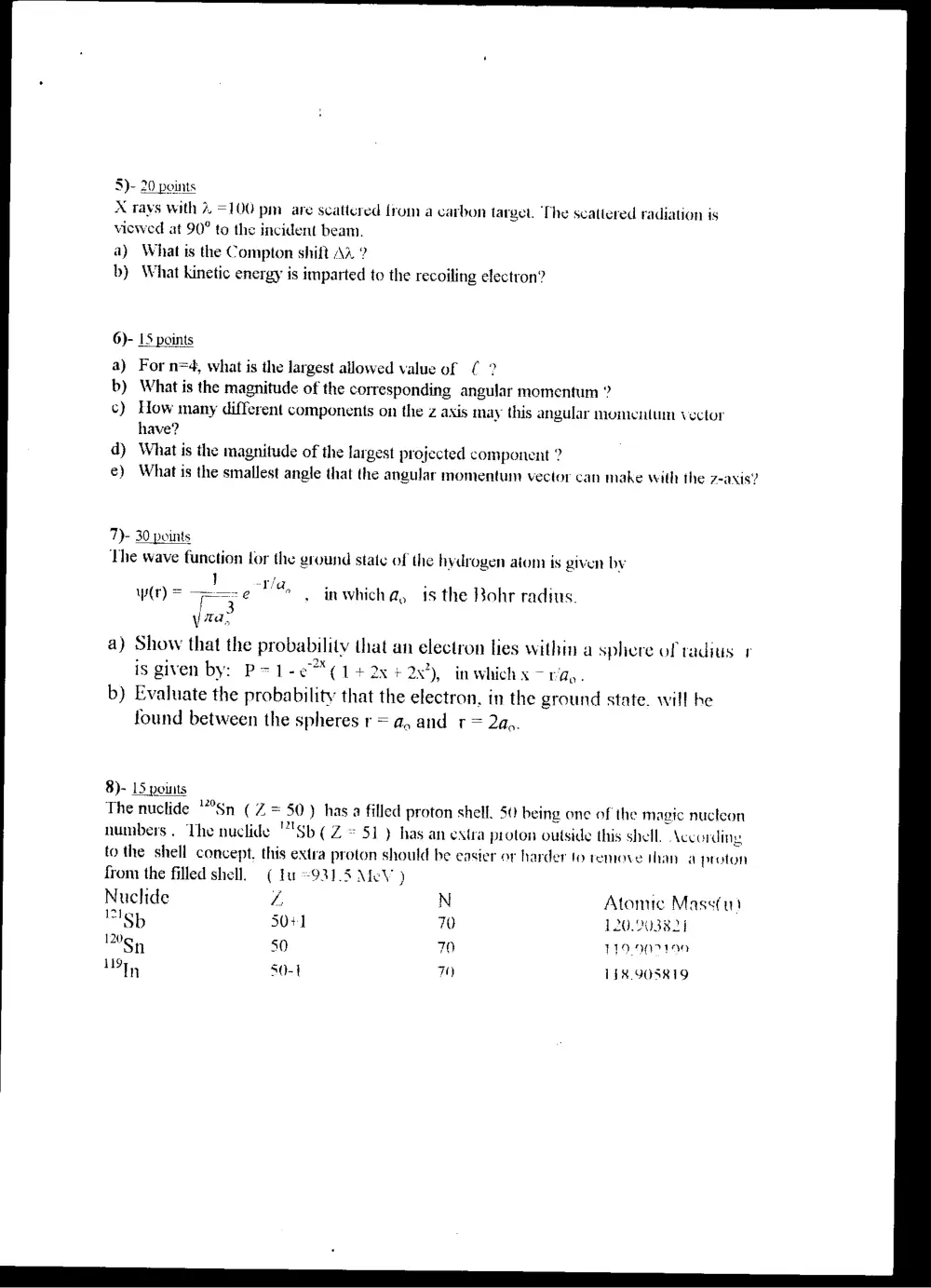
20 points
x Tays with 2. =100 pm are scattered from a carbon target. ‘The scattered radiation is
viewed at 90° to the incident beam.
a) What is the Compton shift Aa ?
b) What Kinetic energy is imparted to the recoiling electron?
6)- 15 points
a) For n=4, what is the largest allowed value of ( ?
b) What is the magnitude of the corresponding angular momentum ?
¢) How many different components on the z axis may this angular momentum vector
have?
d) What is the magnitude of the largest projected component ?
e) What is the smallest angle that the angular momentum vector can make with the 7-aNXis?
7)- 30 points
The wave function lor the ground state of the hydrogen atom is given by
wr) = rye Ma, in which a) 18 the Bohr radius.
za;
a) Show that the ih iacnd that an electron lies within a sphere of tadius r
is given by: P=1-e% (1425 +29 ), tinwhich x ~ ray.
b) Evaluate the arobetility that the electron, in the ground state, will he
found between the spheres r =a, and r= 2a».
8)- 15 points
The nuclide °Sn (Z = 50) has a filled proton shell, 50 being one of the magic nucteon
numbers. The nuclide ''Sb (Z= 51) has an extra proton outside this shell. According
to the shell concept, this extra proton should be easier or harder fo remove than a proton
from the filled shell. (fu =931.5 MeV )
Nuclide Z. N Atonic Mass(u)
"Sb 120.003821
206 y1QT9NI1OO
aaa ‘ 148.908R19
9)- 30 points
The © baryonhas S=-3. K* and K® have S$ 1.=° and = have $~ -2.
4
While © ,2° 25 .A° all have S =-1. All non sirange particles such as pn, pions
and 1,1)” have S= 0. Each baryon is assigned a barven number Bo +f.
a) It is desired to produce the © using a beam of K” incident on protons. What
other patticles are produced in this reaction? ( Use the three conservation faws for B.S
and Q ).
b) How might the Q decay ? ( knowing that the product particles can be A". E? Kk
and 1 ).
10)- 10 points
Analyze this process in terms of its quark content (u, d. ands).
Yeni n
Use data given in problem number 8 with the following table:
. _ Baryon number
2/3 “1/3
-1/3 +1/3