
PHYS 212 Final, Spring 1996
American University of Beirut · Modern Physics · 4 pages
More PHYS 212 files
- Final · Fall 2008Final examView
- Final · Fall 2007Final examView
- Final · Fall 1997Final examView
- Final · Spring 1997Final examView
- Final · Fall 1996Final examView
- Final · Fall 1995Final examView
- FinalFinal examView
- Useful File A Math Free Guide to the Basics of Special Relativity · Spring 2018FileView
Show the text of this final exam
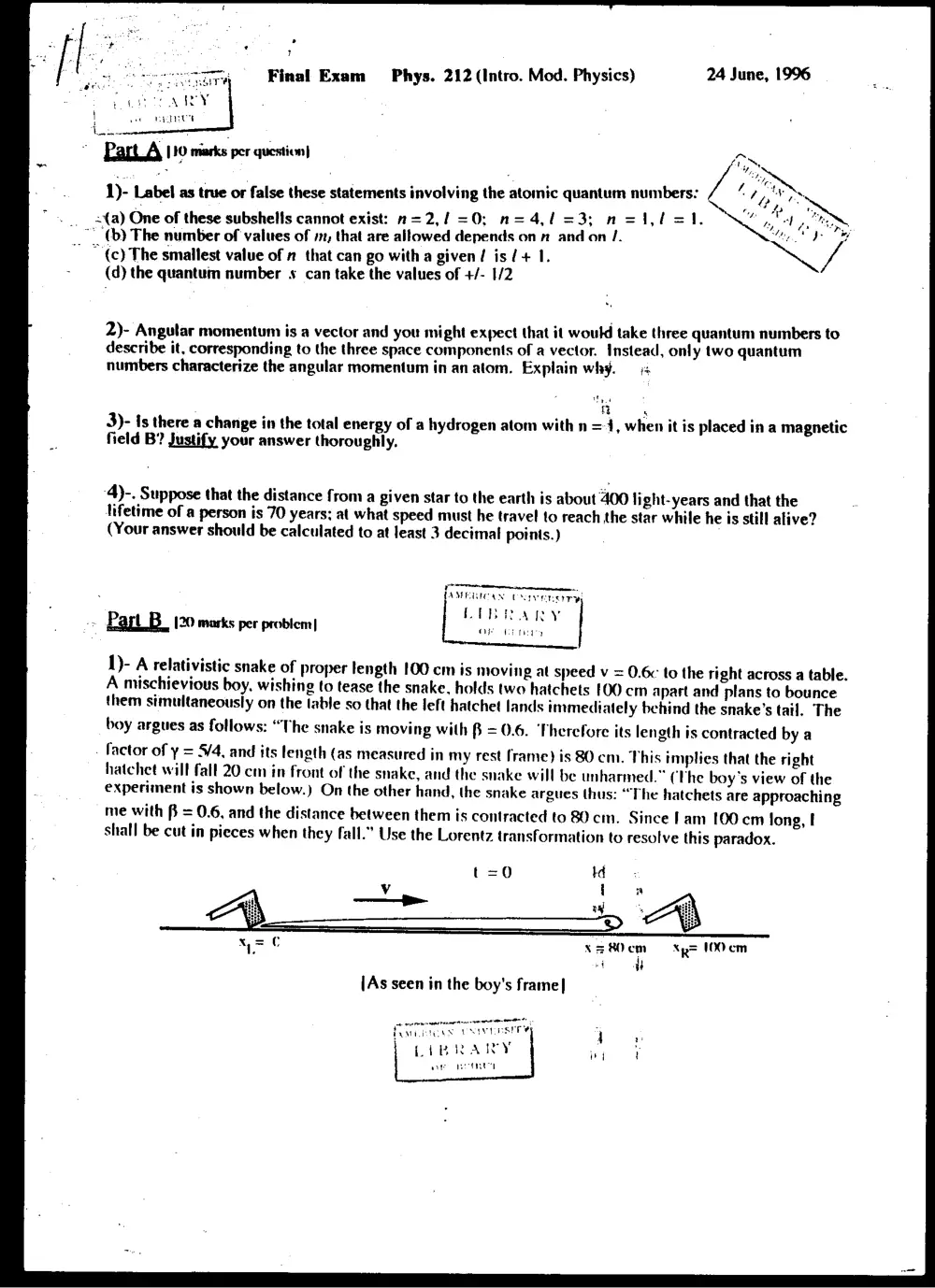
Final Exam = Phys. 212 (Intro. Mod. Physics) 24 June, 1996
° ParLA [10 niarks per question}
1)- Label as true or false these statements involving the atomic quantum numbers:
nym
=(a) One of these subshelfs cannot exist: n=2,/ =0: n=4,/ =3; n=1,/=1. %, “4
~ -*"(b) The number of values of #7, that are allowed depends on 1 and on /.
~ “(c) The smallest value of n that can go with a given / is /+ 1.
(d) the quantum number s can take the values of +/- 1/2
2)- Angutar momentum is a vector and you might expect that it would take three quantum numbers to
describe it, corresponding to the three space components of a vector. Instead, only two quantum
numbers characterize the angular momentum in an atom. Explain why.
“a
3)- Is there a change in the total energy of a hydrogen atom with n =-4, when it is placed in a magnetic
field B? Justify your answer thoroughly,
-4)-. Suppose that the distance froma given star to the earth is about 400 light-years and that the
lifetime of a person is 70 years; at what speed must he travel to reach the star while he is still alive?
(Your answer should be calculated to at least 3 decimal points.)
[aT enna nenccen =
AMELIOQN CNIvensrmy,
: LIBRARY
> Part B 120 marks per problem| OF Citas
1)- A relativistic snake of proper length 100 cm is moving at speed v = 0.6c to the right across a table.
A mischievious boy. wishing to tease the snake, holds two hatchets [00 cm apart and plans to bounce
them simultaneously on the lable so that the left hatchet lands immediately behind the snake's tail. The
boy argues as follows: “The snake is moving with 6 = 0.6. Therefore its length is contracted bya
- factor of y = 5/4, and its length (as measured in my rest frame) is 80 cm. This implies that the right
hatchet will fall 20 cm in front of the snake, and the snake will be unharmed.” (The boy's view of the
experiment is shown below.) On the other hand, the snake argues thus: “The hatchets are approaching
me with B = 0.6, and the distance between them is contracted to 80cm. Since [ am [00 cm Jong, I
shall be cut in pieces when they fall.” Use the Lorentz. transformation to resolve this paradox.
t=0
v
——p
LIBRARY
ne ROOT
”
ti ic
rm
‘ is
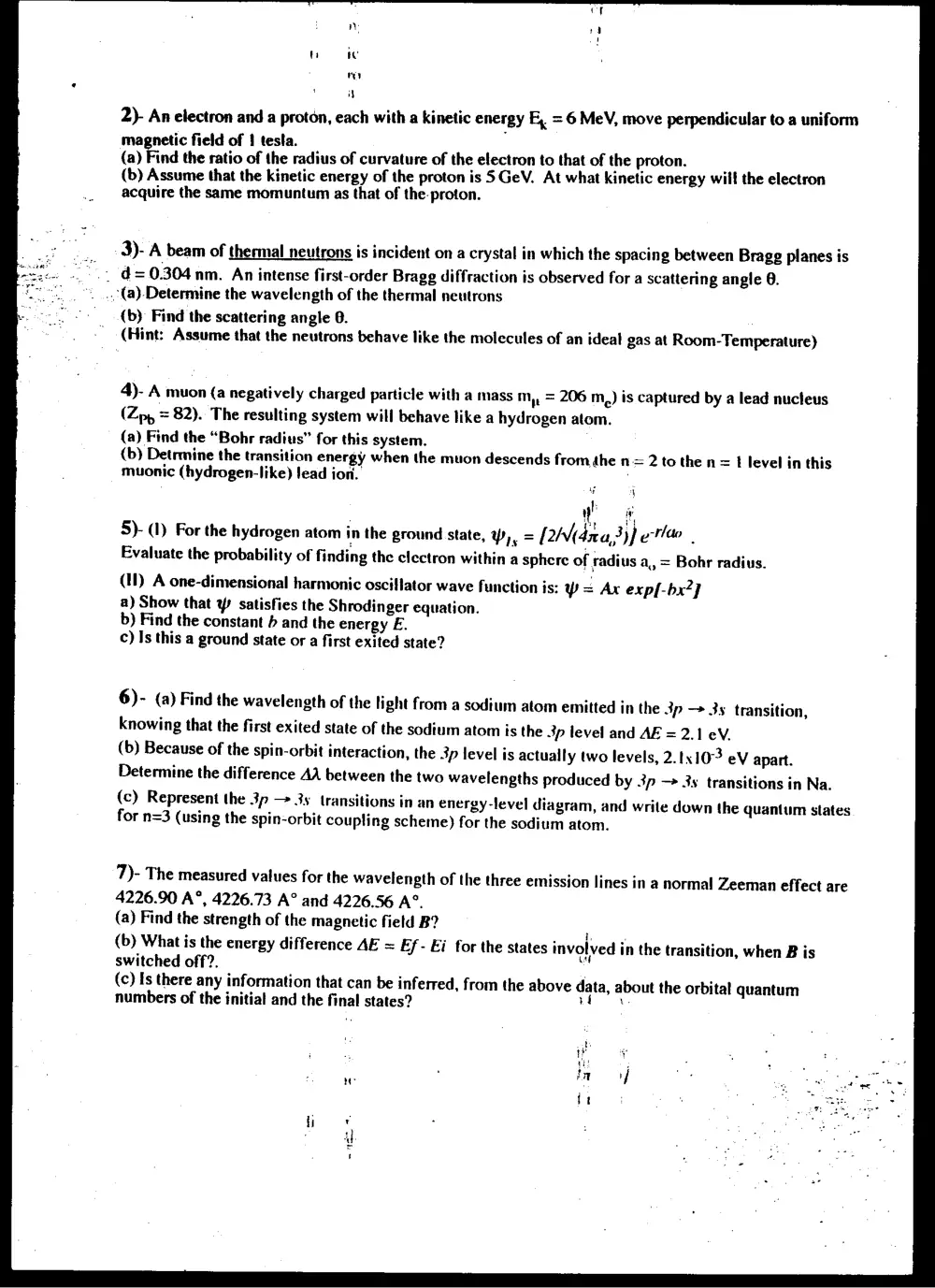
2)- An electron and a proton, each with a kinetic energy E,, = 6 MeV, move perpendicular to a uniform
magnetic field of | testa.
(a) Find the ratio of the radius of curvature of the electron to that of the proton.
(b) Assume that the kinetic energy of the proton is 5 GeV. At what kinetic energy will the electron
acquire the same momuntum as that of the-proton.
3)- A beam of thermal neutrons is incident on a crystal in which the spacing between Bragg planes is
: *. @=0.304 nm. An intense first-order Bragg diffraction is observed for a scattering angle 0.
"..,.(a)-Determine the wavelength of the thermal neutrons
(b) Find the scattering angle 6.
(Hint: Assume that the neutrons behave like the molecules of an ideal gas at Room-Temperature)
4)- A muon (a negatively charged particle with a mass m, = 206 m,) is captured by a lead nucteus
(Zp, = 82). The resulting system will behave like a hydrogen atom.
(a) Find the “Bohr radius” for this system.
(b) Detrmine the transition energy when the muon descends fromthe n= 2 to the n = f level in this
muonic (hydrogen-like) lead ion. :
4 ;
| Ws
5)- ()) For the hydrogen atom in the ground state, wy), = 22N(4x4,3)] etldo |
Evaluate the probability of finding the clectron within a sphere of radius a, = Bohr radius.
(I) A one-dimensional harmonic oscillator wave function is: wy = Ax exp[{-bx?]
a) Show that y satisfies the Shrodinger equation.
b) Find the constant and the energy E.
c) Is this a ground state or a first exited state?
6)- (a) Find the wavelength of the light from a sodium atom emitted in the 3p — 3s transition,
knowing that the first exited state of the sodium atom is the 3p level and AE = 2.1 eV.
(b) Because of the spin-orbit interaction, the 3p level is actually two levels, 2.1x10⁻³ eV apart.
Determine the difference AA between the two wavelengths produced by 3p —» 3s transitions in Na.
(c) Represent the 3p — 3s transitions in an energy-level diagram, and write down the quantum states
for n=3 (using the spin-orbit coupling scheme) for the sodium atom.
7)- The measured values for the wavelength of the three emission lines in a normal Zeeman effect are
4226.90 A°, 4226.73 A° and 4226.56 A°.
(a) Find the strength of the magnetic field B?
(b) What is the energy difference AE = Ef - Ei for the states involved in the transition, when B is
switched off?.
(c) Is there any information that can be inferred, from the above data, about the orbital quantum
numbers of the initial and the final states? ye
1-1 ,01 * #16071
“ELE
NSZ6LE
Lf .2-01 * 0605,
Lf .2-01 * oso's
Uf o-01 X £276
PR ty, SWS: e101 * OMELB
Dy 0l X Wwe
2 61-01 22091 —
OE 01 X OPCO'E
SL o_O X 7979'S
AVN 11 01 x e199
D/H ,.01 x xp
Wd 01 X I9S8R
Rif sosip
MoE cx-01 * 908E°1
Wome evieg
308/H Ol X 6L66'C.
1-(900-89) 01 x zzz0'9
B01 x LS
= Oy Goxudew my0g uonose
€ TBuspaem
° Bordmc> uansop
? a&req> stone
IwISVOD SSRI
MsSUOS 5 youRLY
WEIsUOS PeCONN AR
y.. IWBISUCD SEF f¥si2arun
r) (amnoea) a481 jo psads
'y saquine $s cipefoay
uovusew 1yog wood
ONS SneufgmOe:
CLES gO x S€05"1
OO gon x 9818°0
re-Ol X 16016 “wy
SF6E6 ot _O1 x z5067] SI9ROOT 42 Ol x spoT ay Sonne
ST8EG gt 01 & E06" A8ZL00°T Ol x Szg'7 ay Bolo
BIES 61-01 * 761 ooogOD'T 22-01 X 9009°T nue i
JUSTO = mT
L101 X 2091 @ (3104 GoNseya) gs 1
A® 6101 X C197 = FogI'y w= wy
A® e101 X 2p7'9 = TM 6ETO = £1
AW 8166 = 8% |. oT x 9099" = (arm sswar onuore) ame J
sv ome,
“WI 1.01 x 96p
“T= (run Fe1u0uonse) pry 1
(Gozo), oy = @ 47.01 = (WonsBue)y 3
Kyl x Ore =U Lor x 867 = OND sO x 199°] =m
UME = Nese ww]
| . fot Appendix H = A-15
cr: oa
. TRIGONOMETRIC IDENTITIES EXPONENTIAL EX PANSION
sin(90" ~ @) ~ cos @ entree ge ae.
* * c0x(90"—@)— sing ae Oe ee:
sin O/cos @ = tan @ :
sin? 6 + cos? @ = 4 sec? @— tan? ¢@ = 1 csc? 6— cot? @= | LOGARITHMIC EXPANSION
sin 20 = 2 sin @ cos @ ~ ©
Cot 20 = cos? 8 — sin? 0 = 2 cos? @— 1 1 —~ 2 sin? 9 IU xym ax BF + fx? — hd)
sinfer & A) — sin or cos f + cos.ar sin f i
coma ££) = cos a cos fF sin asin f TRIGONOMETRIC EXPANSIONS (0 in radians)
tan a + tan
tal Lr er
sin o£ sin P — 2 sin Hox +f) con Hor F f) eg
cosO—mt-= 42,
a, 4t
. > 9
~ BINOMIAL THEOREM ton 04 4 0, a
Waaypere rs oe, He Gten
Ot aprn te Ey Mat De, tes tet)
DERIVATIVES AND INTEGRALS
In what follows, the letters w and » stand for any functions of x, and a and m are constants.
To each of the indefinite integrals should be added an arbitrary constant of integration. The
! Xeni 1. [ans
2 ion -at 2. [owdemaf ude .
3 Fut My 3 (4+ de fudet fvde 7 p
a até +p) u o . bE. .
d ory 5 ,
4 —nome fran ee (m4-1) ‘ f ne ee
. 5. arms 3. [ &-min ie j
6.4 (may 4 Mt do du *
6 ao "ER 6. [«Ge-w- o> dy e
i, Lown % [oane
Eg
8. Asin x= cox 8. sin x dx = ~cos x
'
9 4 cot = —sin x 9. | con racm sin
ix +
10. F tan x= sect x to. [tenet ee i
' ’
tL 4 cot x= - ese! x ; i. Jf rier x de ~ pe jon 28
$2. f see x= tan x s00 x , [evacn-ten
a& a
13, Fs x= cot xese x 13. [xem aee Start nen
14, goree 4, [ pesac~—S ate tract new i
AS. Ft w= con wt 15. [reves
16 footw ann 16. [Urrew ae EE no z
———
e