
PSYC 201 Chapter 13, Spring 2018
American University of Beirut · Psyc-201 · 11 pages
Showing the first 10 of 11 pages. Download the PDF to see all of it.
More PSYC 201 files
- Chapter 12 · Spring 2018ChapterView
- Chapter 15 · Spring 2018ChapterView
- Chapter 17 · Spring 2018ChapterView
- Questions Chapter 1 Test Bank · Spring 2017ChapterView
- Questions Chapter 2 Test Bank · Spring 2017ChapterView
- Problems Chapter 7 · Summer 2016ChapterView
- Questions Chapter 10 · Spring 2015ChapterView
- Questions Chapter 12 · Fall 2015ChapterView
Show the text of this chapter
Page of
1
11
Social Psychology
1- Defining Social Psychology
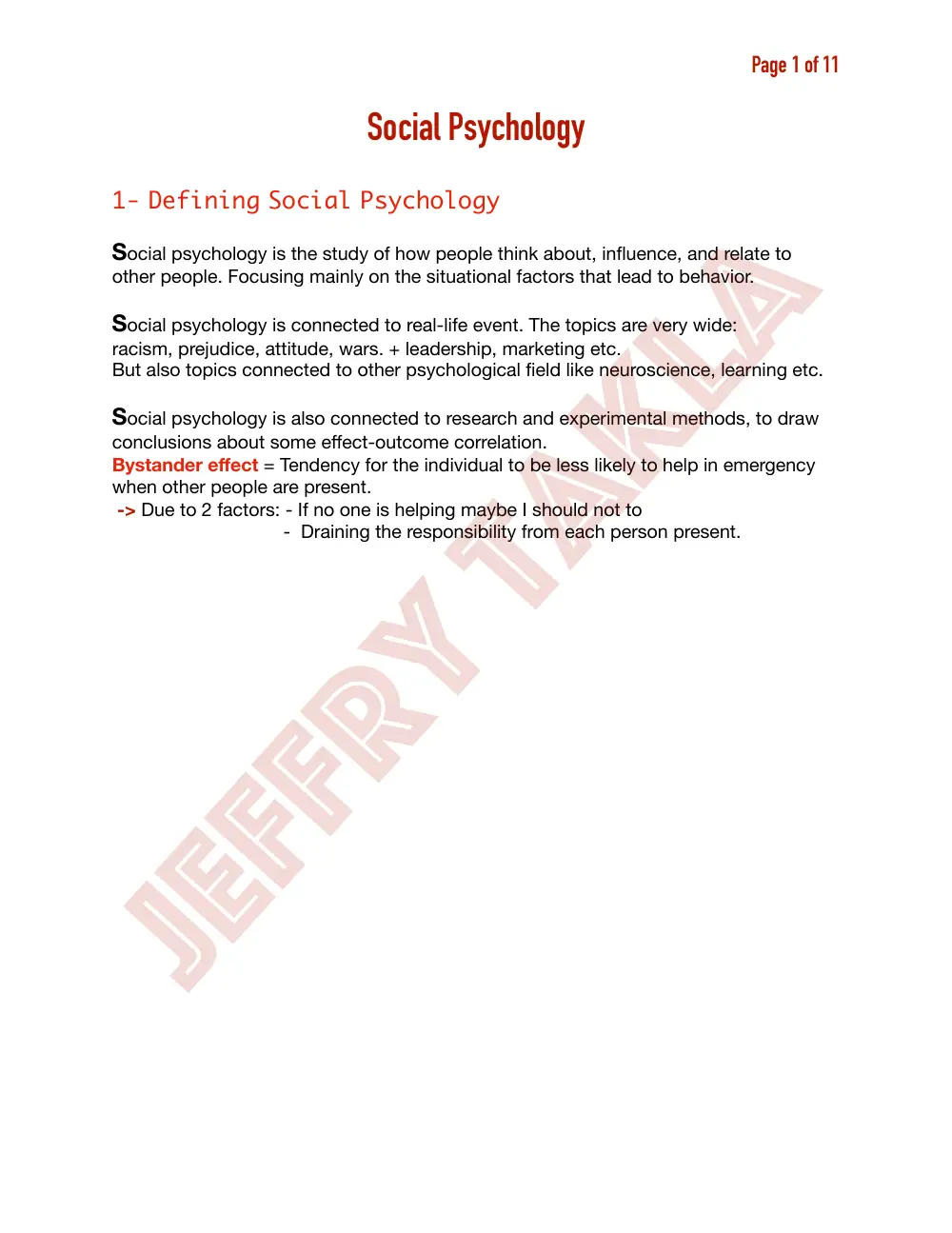
Social psychology is the study of how people think about, influence, and relate to
other people. Focusing mainly on the situational factors that lead to behavior.
Social psychology is connected to real-life event. The topics are very wide:
racism, prejudice, attitude, wars. + leadership, marketing etc.
But also topics connected to other psychological field like neuroscience, learning etc.
Social psychology is also connected to research and experimental methods, to draw
conclusions about some effect-outcome correlation.
Bystander effect = Tendency for the individual to be less likely to help in emergency
when other people are present.
-> Due to 2 factors: - If no one is helping maybe I should not to
- Draining the responsibility from each person present.
Jeffry Takla
Page of
2
11
2- Social Cognition
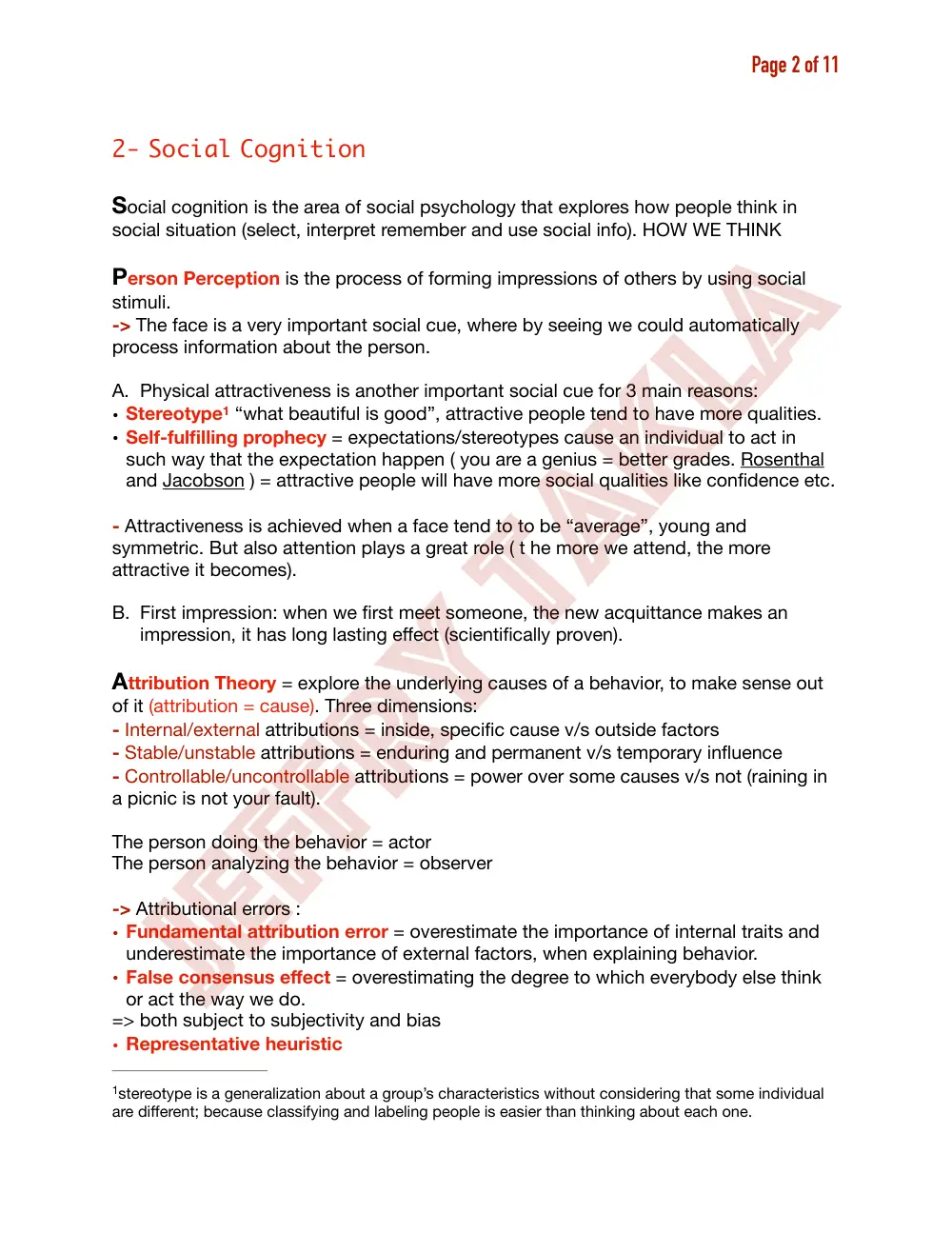
Social cognition is the area of social psychology that explores how people think in
social situation (select, interpret remember and use social info). HOW WE THINK
Person Perception is the process of forming impressions of others by using social
stimuli.
-> The face is a very important social cue, where by seeing we could automatically
process information about the person.
A. Physical attractiveness is another important social cue for 3 main reasons:
• Stereotype “what beautiful is good”, attractive people tend to have more qualities.
1
• Self-fulfilling prophecy = expectations/stereotypes cause an individual to act in
such way that the expectation happen ( you are a genius = better grades. Rosenthal
and Jacobson ) = attractive people will have more social qualities like confidence etc.
- Attractiveness is achieved when a face tend to to be “average”, young and
symmetric. But also attention plays a great role ( t he more we attend, the more
attractive it becomes).
B. First impression: when we first meet someone, the new acquittance makes an
impression, it has long lasting effect (scientifically proven).
Attribution Theory = explore the underlying causes of a behavior, to make sense out
of it (attribution = cause). Three dimensions:
- Internal/external attributions = inside, specific cause v/s outside factors
- Stable/unstable attributions = enduring and permanent v/s temporary influence
- Controllable/uncontrollable attributions = power over some causes v/s not (raining in
a picnic is not your fault).
The person doing the behavior = actor
The person analyzing the behavior = observer
-> Attributional errors :
• Fundamental attribution error = overestimate the importance of internal traits and
underestimate the importance of external factors, when explaining behavior.
• False consensus effect = overestimating the degree to which everybody else think
or act the way we do.
=> both subject to subjectivity and bias
• Representative heuristic
1stereotype is a generalization about a group’s characteristics without considering that some individual
are different; because classifying and labeling people is easier than thinking about each one.
Jeffry Takla
Page of
3
11
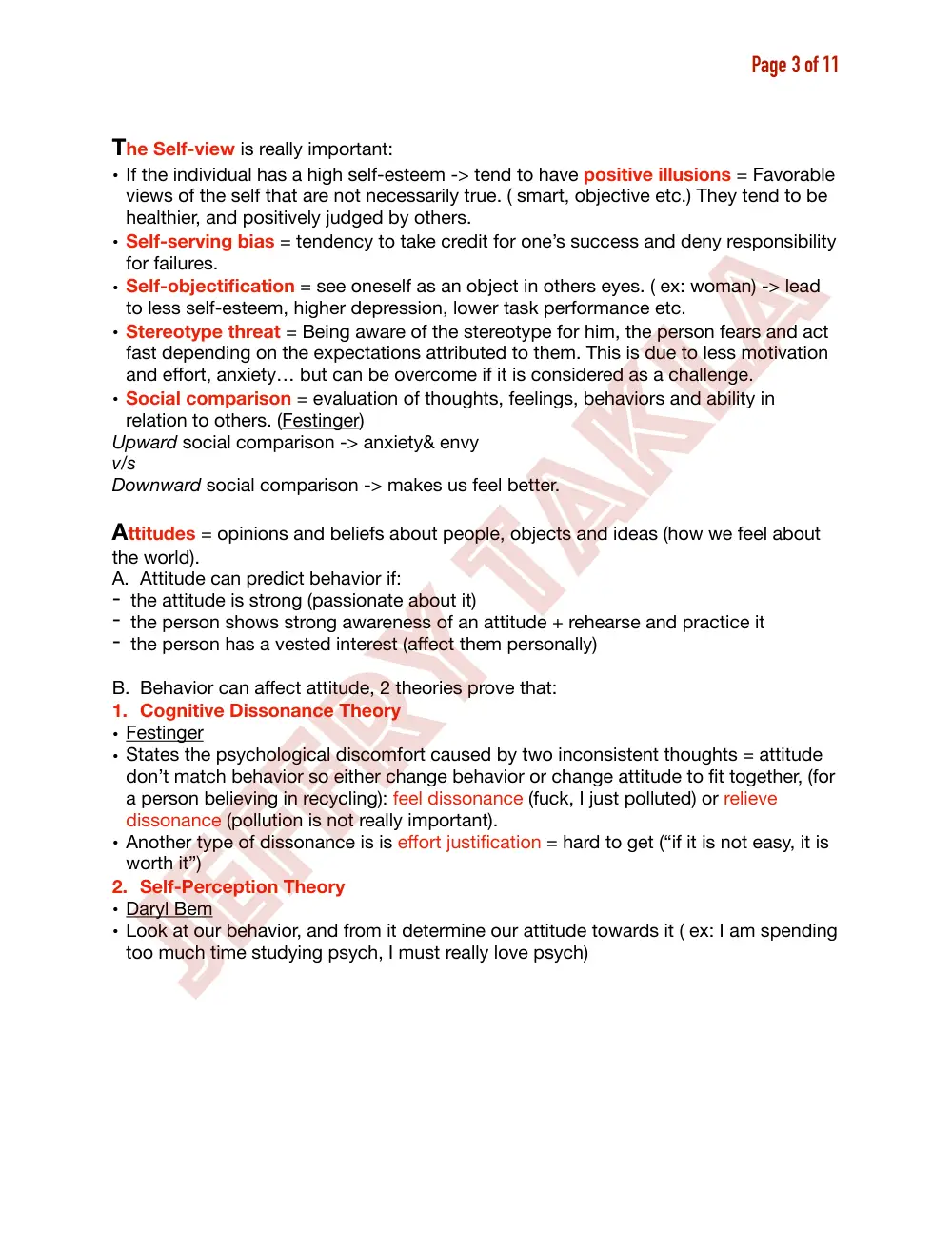
The Self-view is really important:
• If the individual has a high self-esteem -> tend to have positive illusions = Favorable
views of the self that are not necessarily true. ( smart, objective etc.) They tend to be
healthier, and positively judged by others.
• Self-serving bias = tendency to take credit for one’s success and deny responsibility
for failures.
• Self-objectification = see oneself as an object in others eyes. ( ex: woman) -> lead
to less self-esteem, higher depression, lower task performance etc.
• Stereotype threat = Being aware of the stereotype for him, the person fears and act
fast depending on the expectations attributed to them. This is due to less motivation
and effort, anxiety… but can be overcome if it is considered as a challenge.
• Social comparison = evaluation of thoughts, feelings, behaviors and ability in
relation to others. (Festinger)
Upward social comparison -> anxiety& envy
v/s
Downward social comparison -> makes us feel better.
Attitudes = opinions and beliefs about people, objects and ideas (how we feel about
the world).
A. Attitude can predict behavior if:
- the attitude is strong (passionate about it)
- the person shows strong awareness of an attitude + rehearse and practice it
- the person has a vested interest (affect them personally)
B. Behavior can affect attitude, 2 theories prove that:
1. Cognitive Dissonance Theory
• Festinger
• States the psychological discomfort caused by two inconsistent thoughts = attitude
don’t match behavior so either change behavior or change attitude to fit together, (for
a person believing in recycling): feel dissonance (fuck, I just polluted) or relieve
dissonance (pollution is not really important).
• Another type of dissonance is is effort justification = hard to get (“if it is not easy, it is
worth it”)
2. Self-Perception Theory
• Daryl Bem
• Look at our behavior, and from it determine our attitude towards it ( ex: I am spending
too much time studying psych, I must really love psych)
Jeffry Takla
Page of
4
11
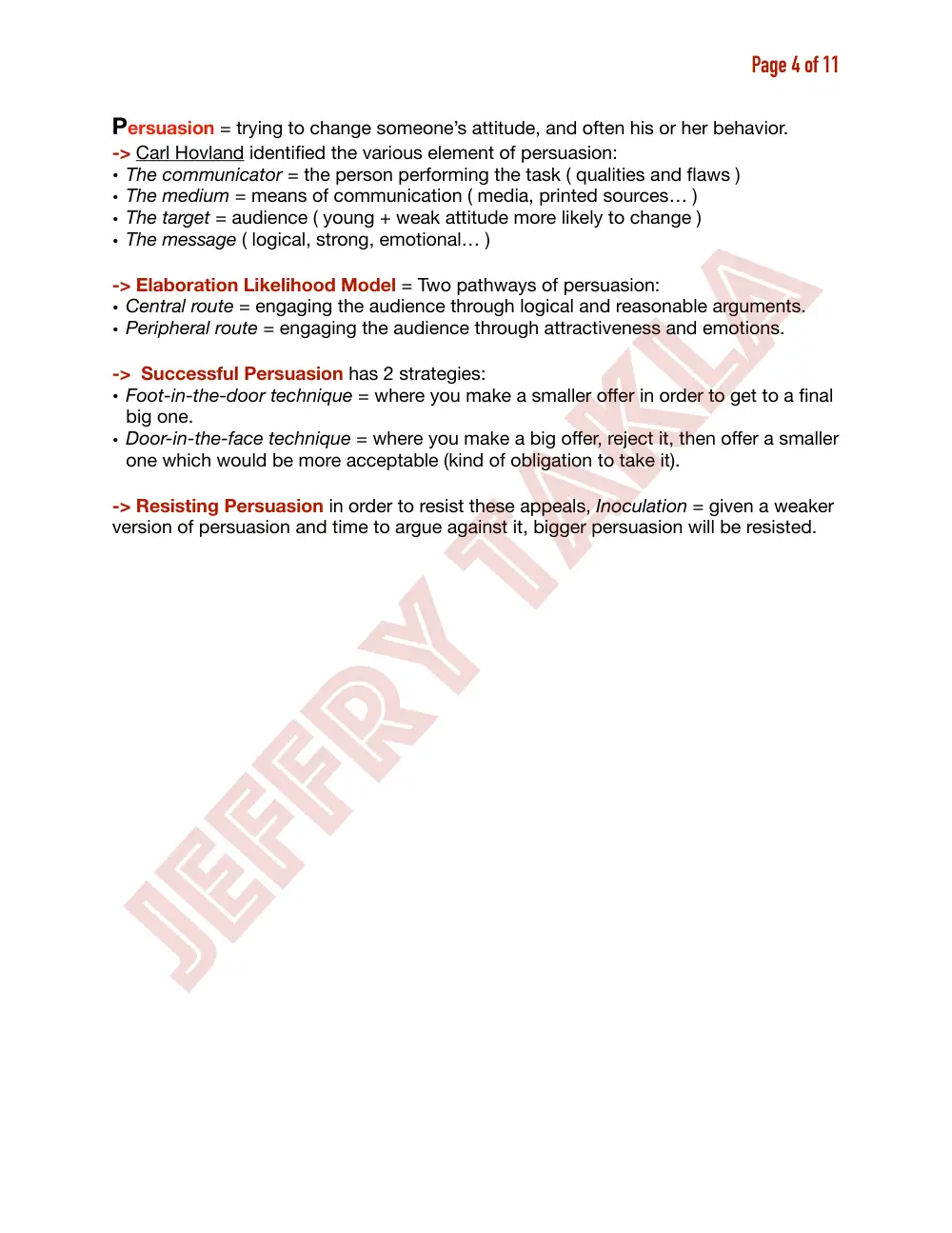
Persuasion = trying to change someone’s attitude, and often his or her behavior.
-> Carl Hovland identified the various element of persuasion:
• The communicator = the person performing the task ( qualities and flaws )
• The medium = means of communication ( media, printed sources… )
• The target = audience ( young + weak attitude more likely to change )
• The message ( logical, strong, emotional… )
-> Elaboration Likelihood Model = Two pathways of persuasion:
• Central route = engaging the audience through logical and reasonable arguments.
• Peripheral route = engaging the audience through attractiveness and emotions.
-> Successful Persuasion has 2 strategies:
• Foot-in-the-door technique = where you make a smaller offer in order to get to a final
big one.
• Door-in-the-face technique = where you make a big offer, reject it, then offer a smaller
one which would be more acceptable (kind of obligation to take it).
-> Resisting Persuasion in order to resist these appeals, Inoculation = given a weaker
version of persuasion and time to argue against it, bigger persuasion will be resisted.
Jeffry Takla
Page of
5
11
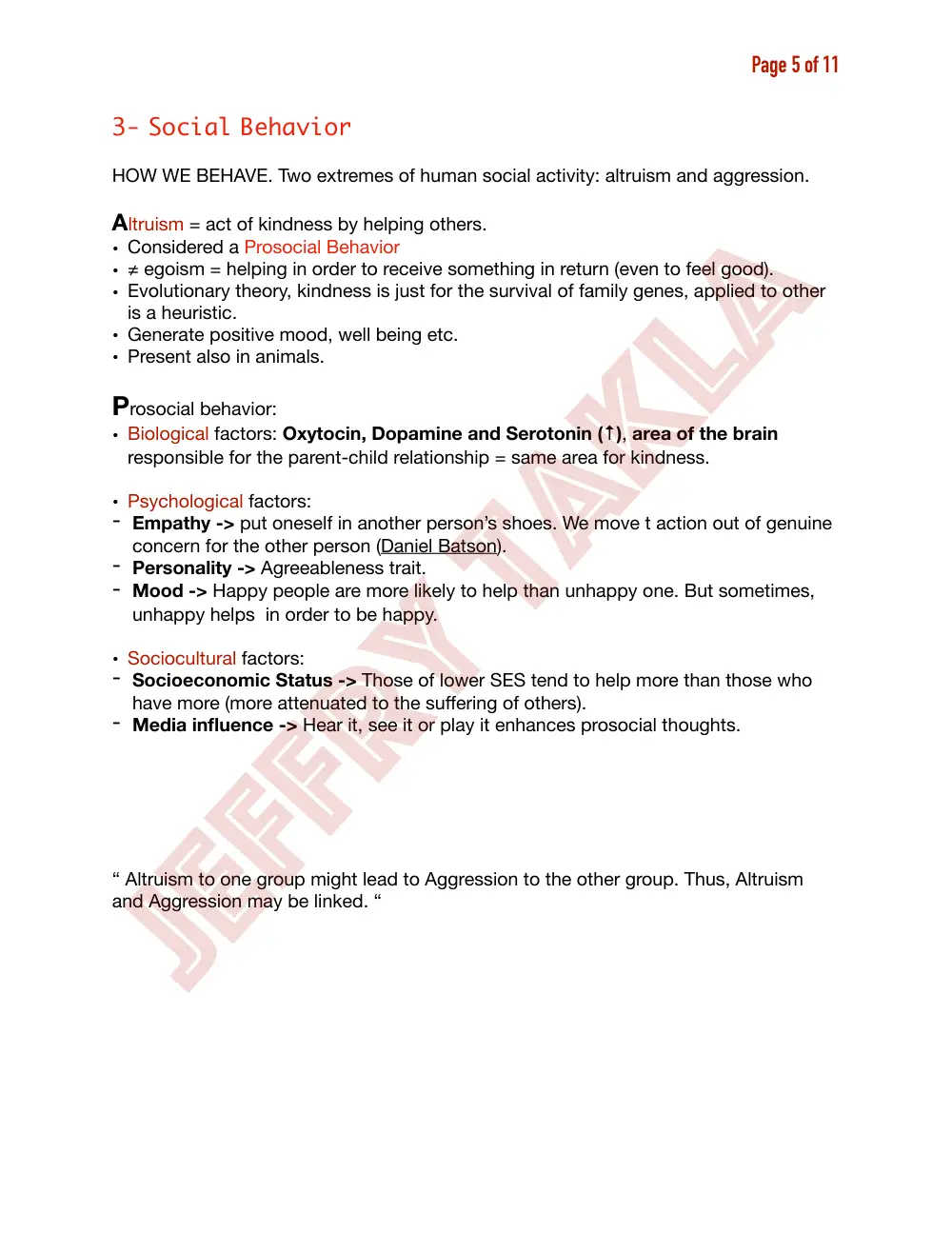
3- Social Behavior
HOW WE BEHAVE. Two extremes of human social activity: altruism and aggression.
Altruism = act of kindness by helping others.
• Considered a Prosocial Behavior
• ≠ egoism = helping in order to receive something in return (even to feel good).
• Evolutionary theory, kindness is just for the survival of family genes, applied to other
is a heuristic.
• Generate positive mood, well being etc.
• Present also in animals.
Prosocial behavior:
• Biological factors: Oxytocin, Dopamine and Serotonin (↑), area of the brain
responsible for the parent-child relationship = same area for kindness.
• Psychological factors:
- Empathy -> put oneself in another person’s shoes. We move t action out of genuine
concern for the other person (Daniel Batson).
- Personality -> Agreeableness trait.
- Mood -> Happy people are more likely to help than unhappy one. But sometimes,
unhappy helps in order to be happy.
• Sociocultural factors:
- Socioeconomic Status -> Those of lower SES tend to help more than those who
have more (more attenuated to the suffering of others).
- Media influence -> Hear it, see it or play it enhances prosocial thoughts.
“ Altruism to one group might lead to Aggression to the other group. Thus, Altruism
and Aggression may be linked. “
Jeffry Takla
Page of
6
11
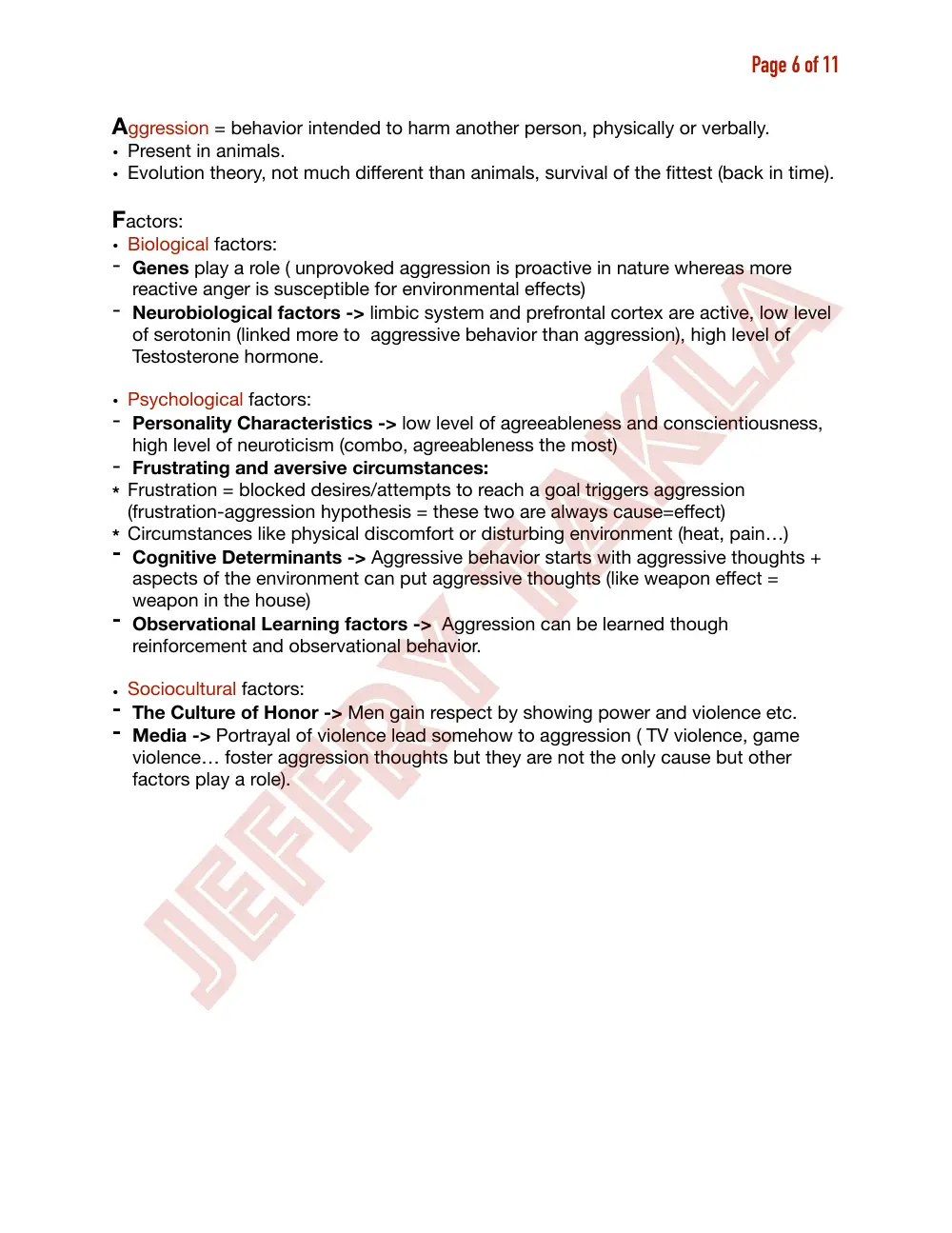
Aggression = behavior intended to harm another person, physically or verbally.
• Present in animals.
• Evolution theory, not much different than animals, survival of the fittest (back in time).
Factors:
• Biological factors:
- Genes play a role ( unprovoked aggression is proactive in nature whereas more
reactive anger is susceptible for environmental effects)
- Neurobiological factors -> limbic system and prefrontal cortex are active, low level
of serotonin (linked more to aggressive behavior than aggression), high level of
Testosterone hormone.
• Psychological factors:
- Personality Characteristics -> low level of agreeableness and conscientiousness,
high level of neuroticism (combo, agreeableness the most)
- Frustrating and aversive circumstances:
* Frustration = blocked desires/attempts to reach a goal triggers aggression
(frustration-aggression hypothesis = these two are always cause=effect)
* Circumstances like physical discomfort or disturbing environment (heat, pain…)
- Cognitive Determinants -> Aggressive behavior starts with aggressive thoughts +
aspects of the environment can put aggressive thoughts (like weapon effect =
weapon in the house)
- Observational Learning factors -> Aggression can be learned though
reinforcement and observational behavior.
• Sociocultural factors:
- The Culture of Honor -> Men gain respect by showing power and violence etc.
- Media -> Portrayal of violence lead somehow to aggression ( TV violence, game
violence… foster aggression thoughts but they are not the only cause but other
factors play a role).
Jeffry Takla
Page of
7
11
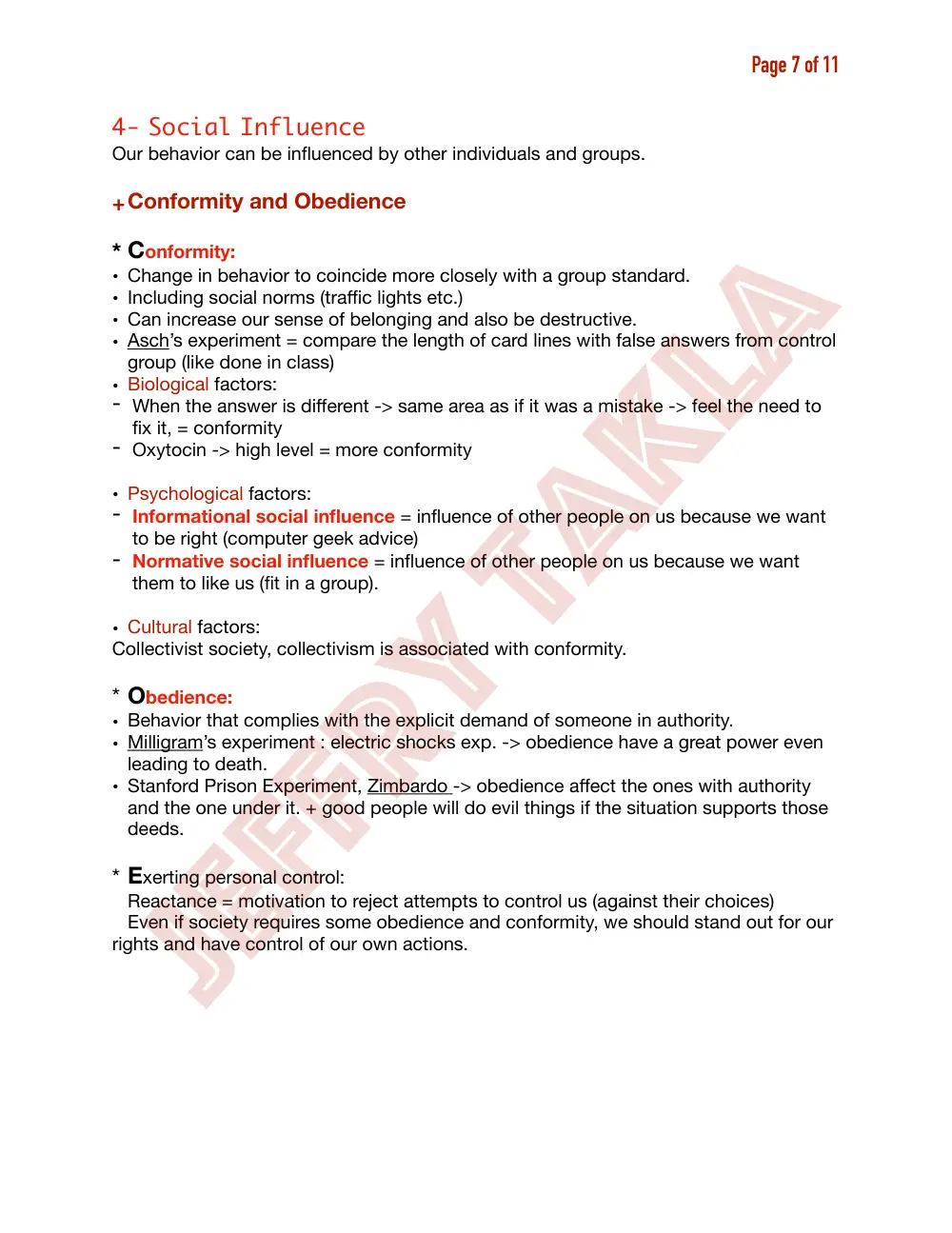
4- Social Influence
Our behavior can be influenced by other individuals and groups.
+Conformity and Obedience
* Conformity:
• Change in behavior to coincide more closely with a group standard.
• Including social norms (traffic lights etc.)
• Can increase our sense of belonging and also be destructive.
• Asch’s experiment = compare the length of card lines with false answers from control
group (like done in class)
• Biological factors:
- When the answer is different -> same area as if it was a mistake -> feel the need to
fix it, = conformity
- Oxytocin -> high level = more conformity
• Psychological factors:
- Informational social influence = influence of other people on us because we want
to be right (computer geek advice)
- Normative social influence = influence of other people on us because we want
them to like us (fit in a group).
• Cultural factors:
Collectivist society, collectivism is associated with conformity.
* Obedience:
• Behavior that complies with the explicit demand of someone in authority.
• Milligram’s experiment : electric shocks exp. -> obedience have a great power even
leading to death.
• Stanford Prison Experiment, Zimbardo -> obedience affect the ones with authority
and the one under it. + good people will do evil things if the situation supports those
deeds.
* Exerting personal control:
Reactance = motivation to reject attempts to control us (against their choices)
Even if society requires some obedience and conformity, we should stand out for our
rights and have control of our own actions.
Jeffry Takla
Page of
8
11
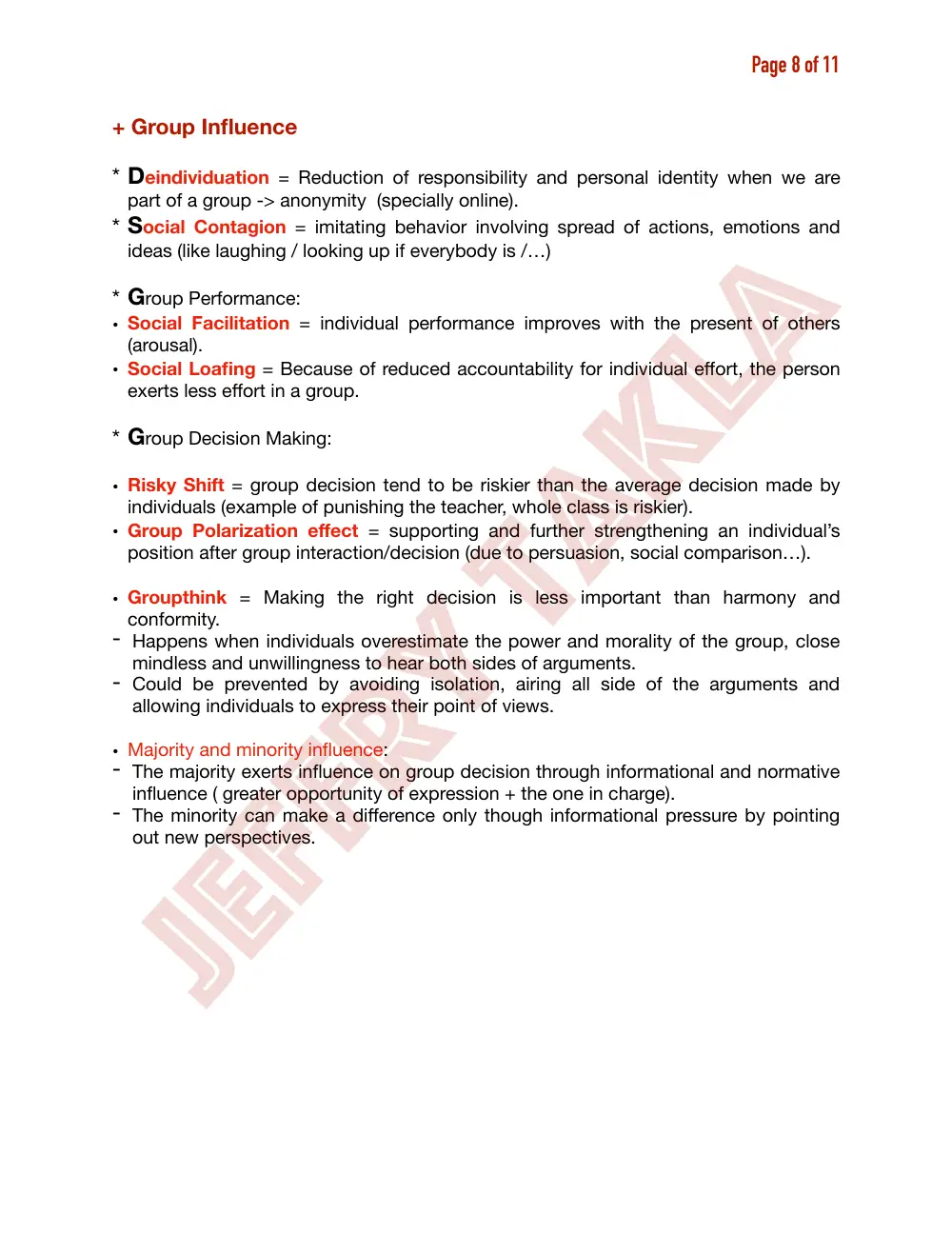
+ Group Influence
* Deindividuation = Reduction of responsibility and personal identity when we are
part of a group -> anonymity (specially online).
* Social Contagion = imitating behavior involving spread of actions, emotions and
ideas (like laughing / looking up if everybody is /…)
* Group Performance:
• Social Facilitation = individual performance improves with the present of others
(arousal).
• Social Loafing = Because of reduced accountability for individual effort, the person
exerts less effort in a group.
* Group Decision Making:
• Risky Shift = group decision tend to be riskier than the average decision made by
individuals (example of punishing the teacher, whole class is riskier).
• Group Polarization effect = supporting and further strengthening an individual’s
position after group interaction/decision (due to persuasion, social comparison…).
• Groupthink = Making the right decision is less important than harmony and
conformity.
- Happens when individuals overestimate the power and morality of the group, close
mindless and unwillingness to hear both sides of arguments.
- Could be prevented by avoiding isolation, airing all side of the arguments and
allowing individuals to express their point of views.
• Majority and minority influence:
- The majority exerts influence on group decision through informational and normative
influence ( greater opportunity of expression + the one in charge).
- The minority can make a difference only though informational pressure by pointing
out new perspectives.
Jeffry Takla
Page of
9
11
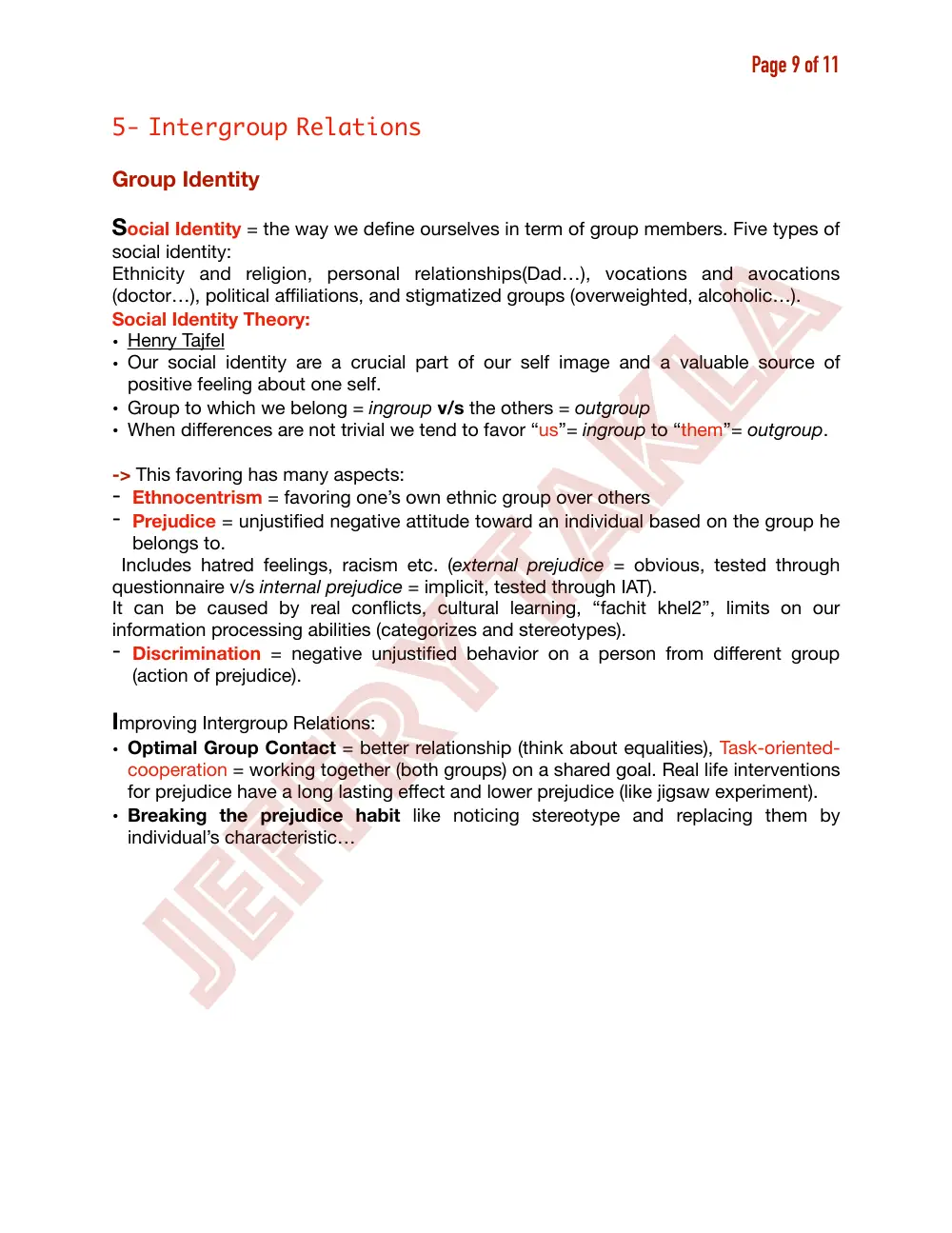
5- Intergroup Relations
Group Identity
Social Identity = the way we define ourselves in term of group members. Five types of
social identity:
Ethnicity and religion, personal relationships(Dad…), vocations and avocations
(doctor…), political affiliations, and stigmatized groups (overweighted, alcoholic…).
Social Identity Theory:
• Henry Tajfel
• Our social identity are a crucial part of our self image and a valuable source of
positive feeling about one self.
• Group to which we belong = ingroup v/s the others = outgroup
• When differences are not trivial we tend to favor “us”= ingroup to “them”= outgroup.
-> This favoring has many aspects:
- Ethnocentrism = favoring one’s own ethnic group over others
- Prejudice = unjustified negative attitude toward an individual based on the group he
belongs to.
Includes hatred feelings, racism etc. (external prejudice = obvious, tested through
questionnaire v/s internal prejudice = implicit, tested through IAT).
It can be caused by real conflicts, cultural learning, “fachit khel2”, limits on our
information processing abilities (categorizes and stereotypes).
- Discrimination = negative unjustified behavior on a person from different group
(action of prejudice).
Improving Intergroup Relations:
• Optimal Group Contact = better relationship (think about equalities), Task-oriented-
cooperation = working together (both groups) on a shared goal. Real life interventions
for prejudice have a long lasting effect and lower prejudice (like jigsaw experiment).
• Breaking the prejudice habit like noticing stereotype and replacing them by
individual’s characteristic…
Jeffry Takla
Page of
10
11
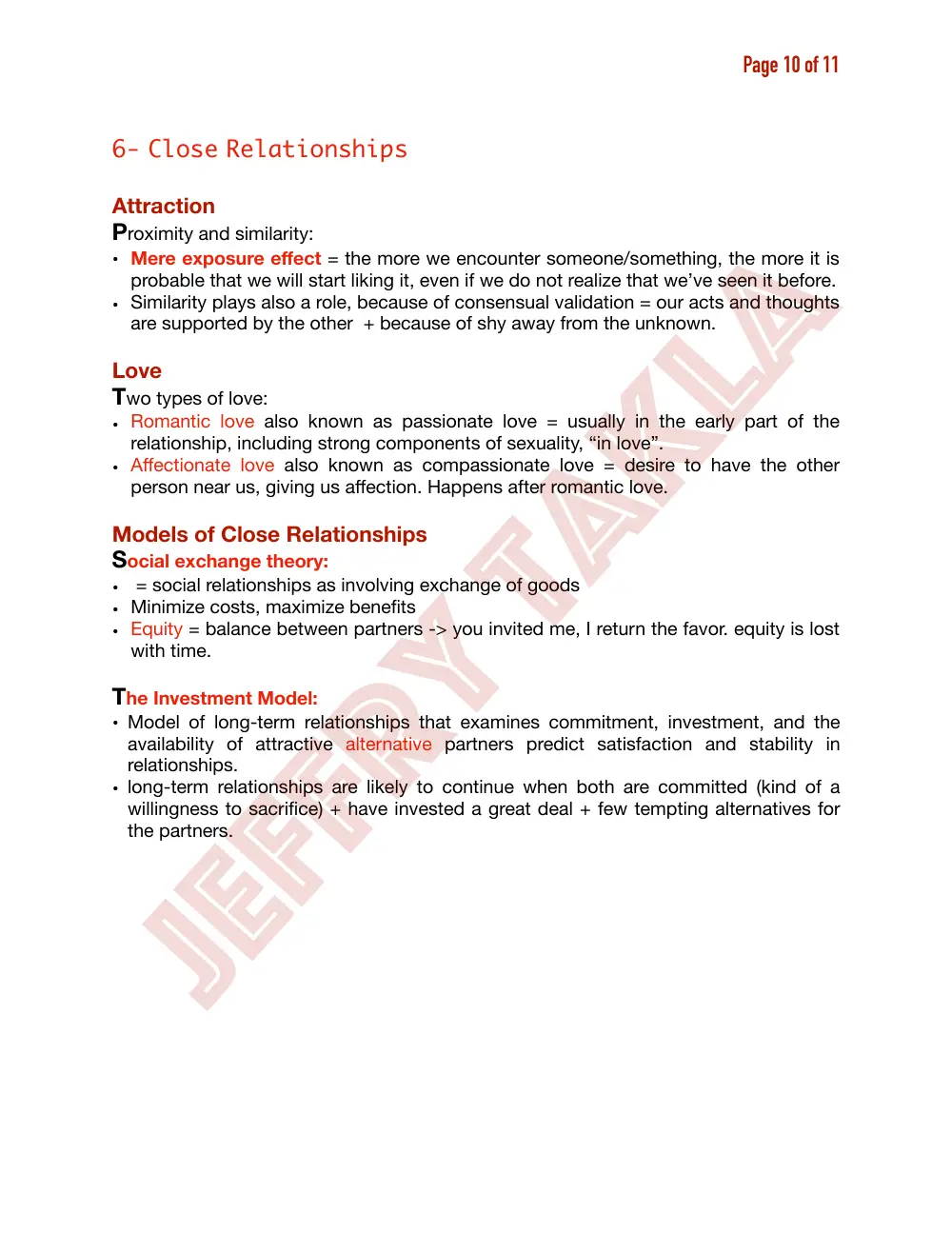
6- Close Relationships
Attraction
Proximity and similarity:
• Mere exposure effect = the more we encounter someone/something, the more it is
probable that we will start liking it, even if we do not realize that we’ve seen it before.
• Similarity plays also a role, because of consensual validation = our acts and thoughts
are supported by the other + because of shy away from the unknown.
Love
Two types of love:
• Romantic love also known as passionate love = usually in the early part of the
relationship, including strong components of sexuality, “in love”.
• Affectionate love also known as compassionate love = desire to have the other
person near us, giving us affection. Happens after romantic love.
Models of Close Relationships
Social exchange theory:
• = social relationships as involving exchange of goods
• Minimize costs, maximize benefits
• Equity = balance between partners -> you invited me, I return the favor. equity is lost
with time.
The Investment Model:
• Model of long-term relationships that examines commitment, investment, and the
availability of attractive alternative partners predict satisfaction and stability in
relationships.
• long-term relationships are likely to continue when both are committed (kind of a
willingness to sacrifice) + have invested a great deal + few tempting alternatives for
the partners.
Jeffry Takla
Page of
11
11
7- Social Psychology and Health and Wellness
• Social isolation is a strong risk factor for physical illness.
• Loneliness, pretty common, lead to more negative health outcomes and early death.
• Many strategies to cope with it: joining activities, volunteering for a believed cause,
interacting with others in order to feel better about yourself (trustworthy…). + See the
counseling center.
Jeffry Takla