
PSYC 201 Chapter 15, Spring 2018
American University of Beirut · Psyc-201 · 10 pages


More PSYC 201 files
- Chapter 12 · Spring 2018ChapterView
- Chapter 13 · Spring 2018ChapterView
- Chapter 17 · Spring 2018ChapterView
- Questions Chapter 1 Test Bank · Spring 2017ChapterView
- Questions Chapter 2 Test Bank · Spring 2017ChapterView
- Problems Chapter 7 · Summer 2016ChapterView
- Questions Chapter 10 · Spring 2015ChapterView
- Questions Chapter 12 · Fall 2015ChapterView
Show the text of this chapter
Page of
1
10
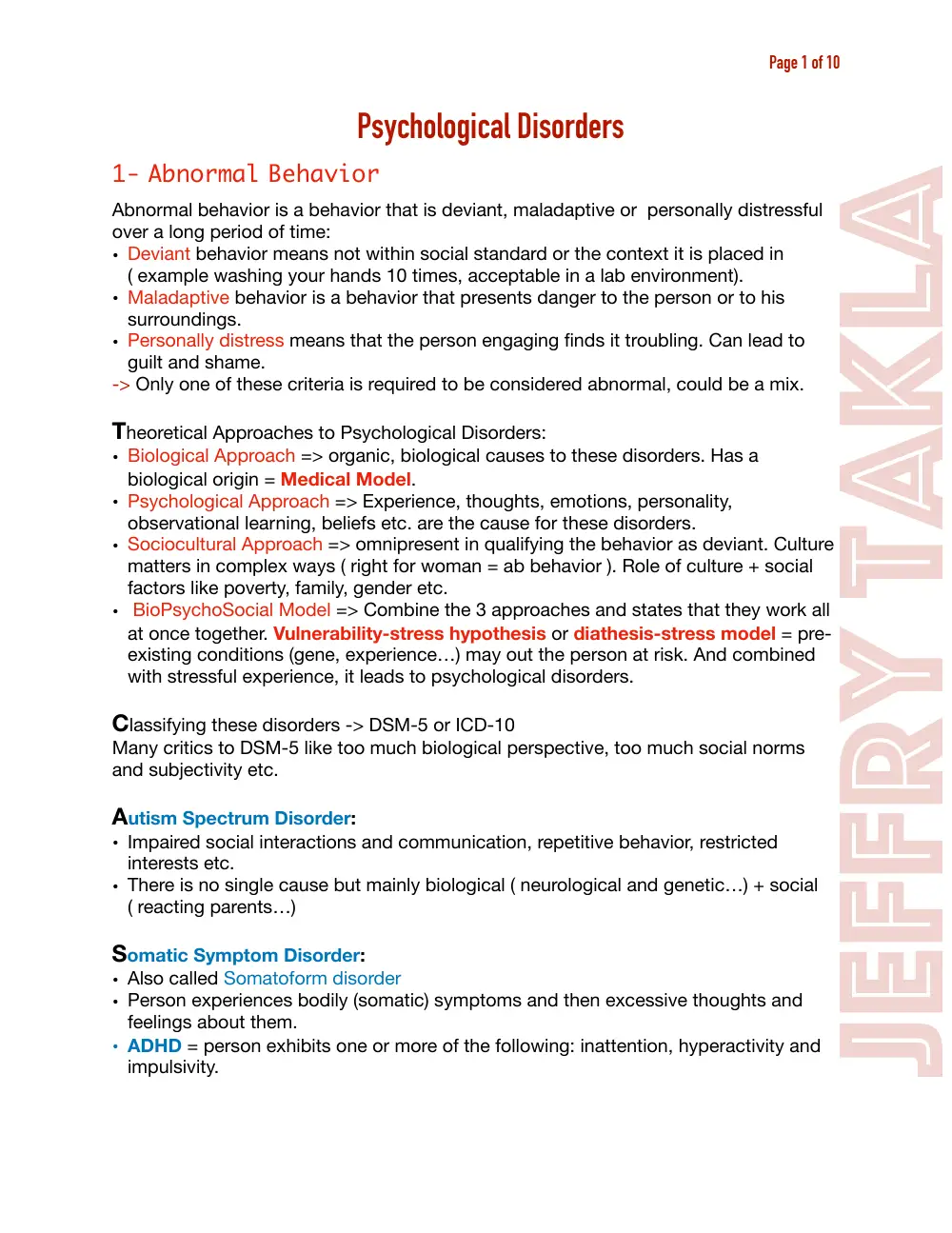
Psychological Disorders
1- Abnormal Behavior
Abnormal behavior is a behavior that is deviant, maladaptive or personally distressful
over a long period of time:
• Deviant behavior means not within social standard or the context it is placed in
( example washing your hands 10 times, acceptable in a lab environment).
• Maladaptive behavior is a behavior that presents danger to the person or to his
surroundings.
• Personally distress means that the person engaging finds it troubling. Can lead to
guilt and shame.
-> Only one of these criteria is required to be considered abnormal, could be a mix.
Theoretical Approaches to Psychological Disorders:
• Biological Approach => organic, biological causes to these disorders. Has a
biological origin = Medical Model.
• Psychological Approach => Experience, thoughts, emotions, personality,
observational learning, beliefs etc. are the cause for these disorders.
• Sociocultural Approach => omnipresent in qualifying the behavior as deviant. Culture
matters in complex ways ( right for woman = ab behavior ). Role of culture + social
factors like poverty, family, gender etc.
• BioPsychoSocial Model => Combine the 3 approaches and states that they work all
at once together. Vulnerability-stress hypothesis or diathesis-stress model = pre-
existing conditions (gene, experience…) may out the person at risk. And combined
with stressful experience, it leads to psychological disorders.
Classifying these disorders -> DSM-5 or ICD-10
Many critics to DSM-5 like too much biological perspective, too much social norms
and subjectivity etc.
Autism Spectrum Disorder:
• Impaired social interactions and communication, repetitive behavior, restricted
interests etc.
• There is no single cause but mainly biological ( neurological and genetic…) + social
( reacting parents…)
Somatic Symptom Disorder:
• Also called Somatoform disorder
• Person experiences bodily (somatic) symptoms and then excessive thoughts and
feelings about them.
• ADHD = person exhibits one or more of the following: inattention, hyperactivity and
impulsivity.
Jeffry Takla
Page of
2
10
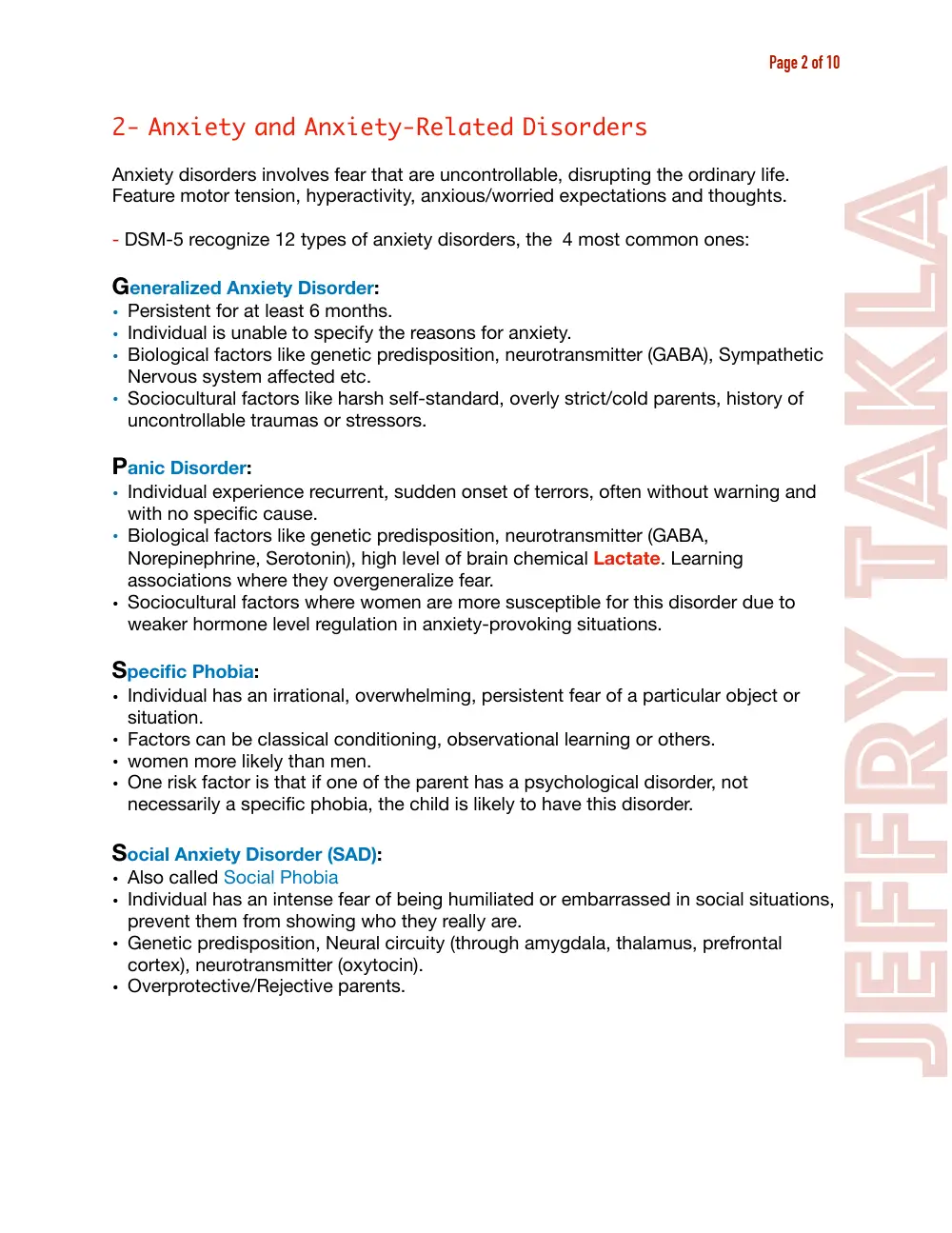
2- Anxiety and Anxiety-Related Disorders
Anxiety disorders involves fear that are uncontrollable, disrupting the ordinary life.
Feature motor tension, hyperactivity, anxious/worried expectations and thoughts.
- DSM-5 recognize 12 types of anxiety disorders, the 4 most common ones:
Generalized Anxiety Disorder:
• Persistent for at least 6 months.
• Individual is unable to specify the reasons for anxiety.
• Biological factors like genetic predisposition, neurotransmitter (GABA), Sympathetic
Nervous system affected etc.
• Sociocultural factors like harsh self-standard, overly strict/cold parents, history of
uncontrollable traumas or stressors.
Panic Disorder:
• Individual experience recurrent, sudden onset of terrors, often without warning and
with no specific cause.
• Biological factors like genetic predisposition, neurotransmitter (GABA,
Norepinephrine, Serotonin), high level of brain chemical Lactate. Learning
associations where they overgeneralize fear.
• Sociocultural factors where women are more susceptible for this disorder due to
weaker hormone level regulation in anxiety-provoking situations.
Specific Phobia:
• Individual has an irrational, overwhelming, persistent fear of a particular object or
situation.
• Factors can be classical conditioning, observational learning or others.
• women more likely than men.
• One risk factor is that if one of the parent has a psychological disorder, not
necessarily a specific phobia, the child is likely to have this disorder.
Social Anxiety Disorder (SAD):
• Also called Social Phobia
• Individual has an intense fear of being humiliated or embarrassed in social situations,
prevent them from showing who they really are.
• Genetic predisposition, Neural circuity (through amygdala, thalamus, prefrontal
cortex), neurotransmitter (oxytocin).
• Overprotective/Rejective parents.
Jeffry Takla
Page of
3
10
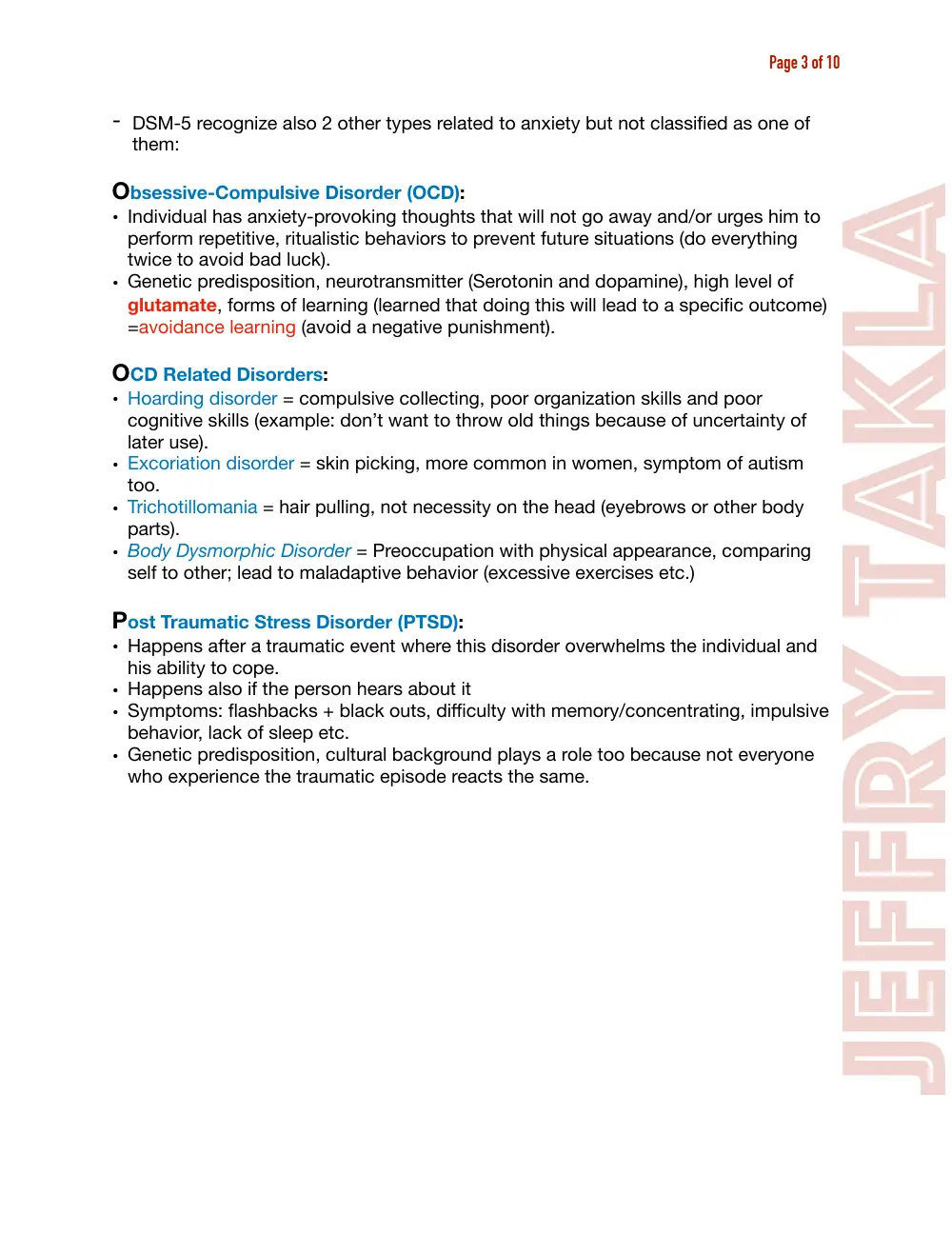
- DSM-5 recognize also 2 other types related to anxiety but not classified as one of
them:
Obsessive-Compulsive Disorder (OCD):
• Individual has anxiety-provoking thoughts that will not go away and/or urges him to
perform repetitive, ritualistic behaviors to prevent future situations (do everything
twice to avoid bad luck).
• Genetic predisposition, neurotransmitter (Serotonin and dopamine), high level of
glutamate, forms of learning (learned that doing this will lead to a specific outcome)
=avoidance learning (avoid a negative punishment).
OCD Related Disorders:
• Hoarding disorder = compulsive collecting, poor organization skills and poor
cognitive skills (example: don’t want to throw old things because of uncertainty of
later use).
• Excoriation disorder = skin picking, more common in women, symptom of autism
too.
• Trichotillomania = hair pulling, not necessity on the head (eyebrows or other body
parts).
• Body Dysmorphic Disorder = Preoccupation with physical appearance, comparing
self to other; lead to maladaptive behavior (excessive exercises etc.)
Post Traumatic Stress Disorder (PTSD):
• Happens after a traumatic event where this disorder overwhelms the individual and
his ability to cope.
• Happens also if the person hears about it
• Symptoms: flashbacks + black outs, difficulty with memory/concentrating, impulsive
behavior, lack of sleep etc.
• Genetic predisposition, cultural background plays a role too because not everyone
who experience the traumatic episode reacts the same.
Jeffry Takla
Page of
4
10
3- Disorders Involving Emotion and Mood
Depressive Disorders:
• The individual suffers from depression, not pleasure in life.
• Major Depressive Disorder (MDD) involves a significant depressive episode for at
least 2 weeks. Symptoms: trouble sleeping, fatigue, feeling worthless, no history of
euphoric mood, no interest etc.
• Persistent depressive disorder is for more than 2 months; poor concentration, sleep
and lack of energy.
• Biological factors: genetic predisposition, brain structure and function ( part relative
to identify reward), neurotransmitter (Serotonin). Only generate vulnerability, stressful
environment is a must.
• Psychological factors: learning & cognitive theories, learned helplessness + Thinking
about a negative experience over and over again + Pessimistic attributional style
(internal cause problem ) ≠ optimistic attributional style.
• Sociocultural factors: SES (low socioeconomic status) more likely to develop
depression, alcoholism, woman>men.
Bipolar Disorder:
• Extreme mood swings from mania (over euphoric, energetic etc) periods to
depressive ones, in cycles.
• Two types: Bipolar I where the euphoric episodes are so strong that hallucinations
might happen. Whereas Bipolar II is a milder version.
• Biological factor: Genetics plays great role here (high chance of twins having this
disorder), brain activity ( metabolic activity decrease in depression phase, increase in
the other), neurotransmitter (norepinephrine, serotonin).
• Sociocultural factors: childhood experiences (physical, sexual or verbal abuse)
• Could be confused with Disruptive Mood Dysregulation Disorder.
Jeffry Takla
Page of
5
10
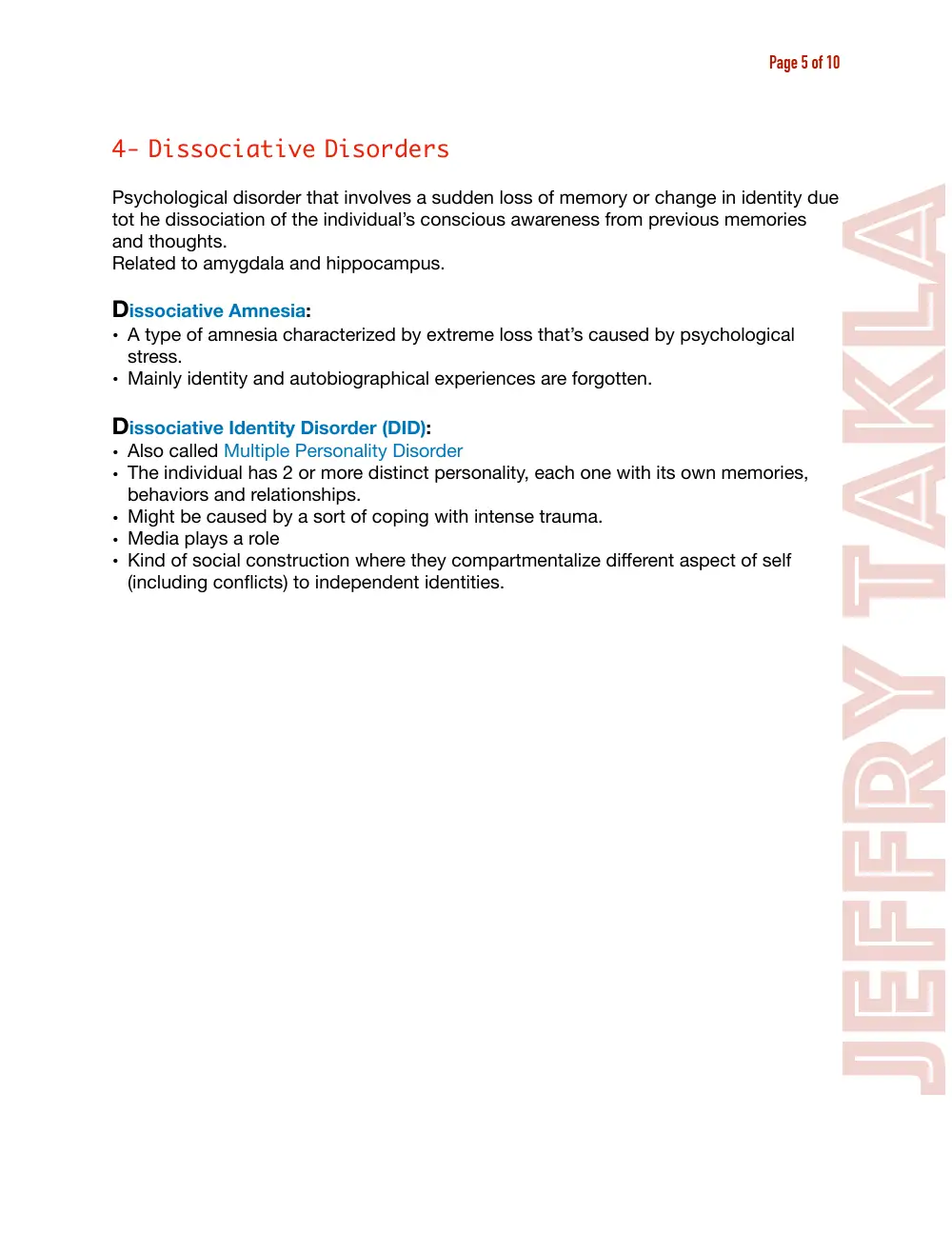
4- Dissociative Disorders
Psychological disorder that involves a sudden loss of memory or change in identity due
tot he dissociation of the individual’s conscious awareness from previous memories
and thoughts.
Related to amygdala and hippocampus.
Dissociative Amnesia:
• A type of amnesia characterized by extreme loss that’s caused by psychological
stress.
• Mainly identity and autobiographical experiences are forgotten.
Dissociative Identity Disorder (DID):
• Also called Multiple Personality Disorder
• The individual has 2 or more distinct personality, each one with its own memories,
behaviors and relationships.
• Might be caused by a sort of coping with intense trauma.
• Media plays a role
• Kind of social construction where they compartmentalize different aspect of self
(including conflicts) to independent identities.
Jeffry Takla
Page of
6
10
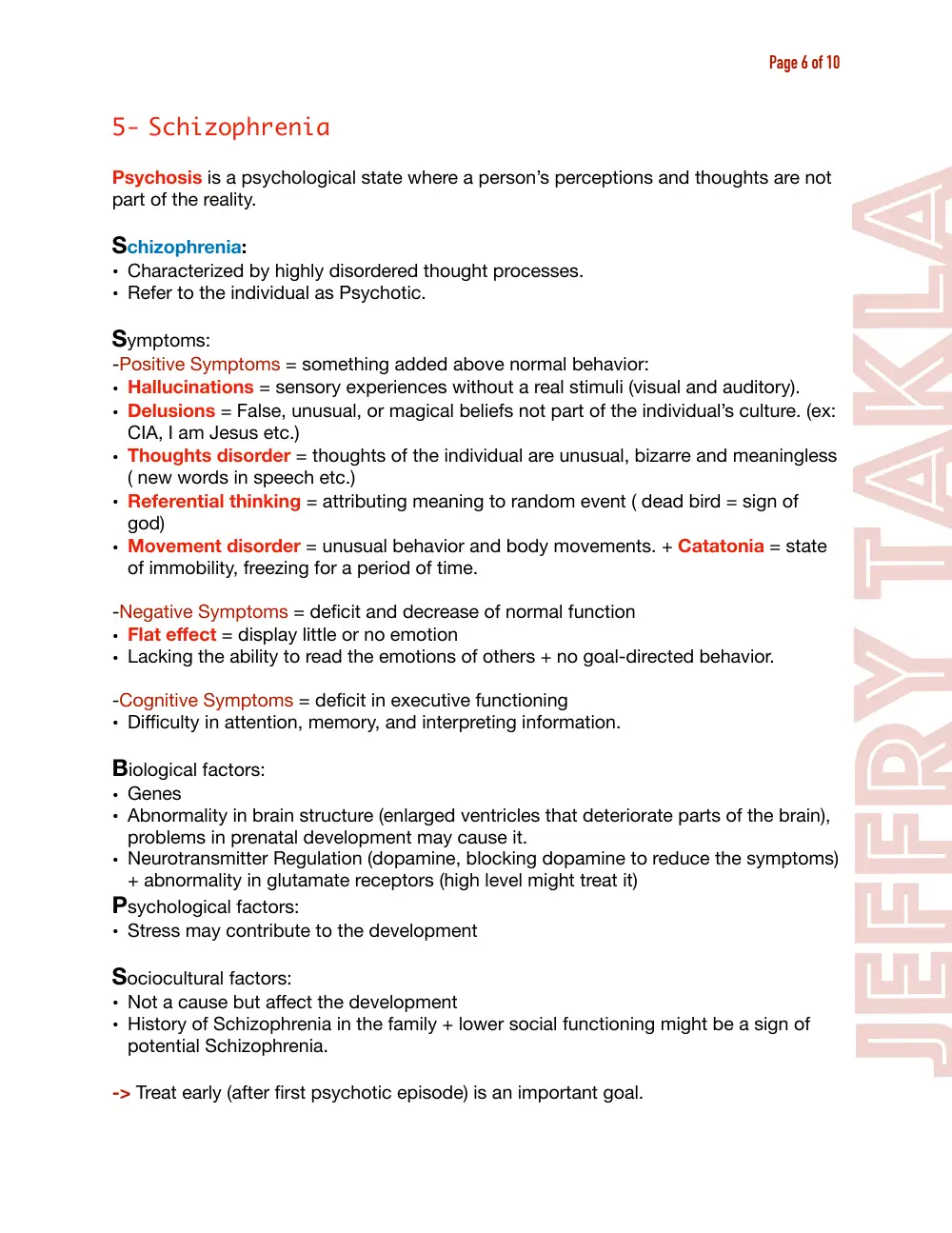
5- Schizophrenia
Psychosis is a psychological state where a person’s perceptions and thoughts are not
part of the reality.
Schizophrenia:
• Characterized by highly disordered thought processes.
• Refer to the individual as Psychotic.
Symptoms:
-Positive Symptoms = something added above normal behavior:
• Hallucinations = sensory experiences without a real stimuli (visual and auditory).
• Delusions = False, unusual, or magical beliefs not part of the individual’s culture. (ex:
CIA, I am Jesus etc.)
• Thoughts disorder = thoughts of the individual are unusual, bizarre and meaningless
( new words in speech etc.)
• Referential thinking = attributing meaning to random event ( dead bird = sign of
god)
• Movement disorder = unusual behavior and body movements. + Catatonia = state
of immobility, freezing for a period of time.
-Negative Symptoms = deficit and decrease of normal function
• Flat effect = display little or no emotion
• Lacking the ability to read the emotions of others + no goal-directed behavior.
-Cognitive Symptoms = deficit in executive functioning
• Difficulty in attention, memory, and interpreting information.
Biological factors:
• Genes
• Abnormality in brain structure (enlarged ventricles that deteriorate parts of the brain),
problems in prenatal development may cause it.
• Neurotransmitter Regulation (dopamine, blocking dopamine to reduce the symptoms)
+ abnormality in glutamate receptors (high level might treat it)
Psychological factors:
• Stress may contribute to the development
Sociocultural factors:
• Not a cause but affect the development
• History of Schizophrenia in the family + lower social functioning might be a sign of
potential Schizophrenia.
-> Treat early (after first psychotic episode) is an important goal.
Jeffry Takla
Page of
7
10
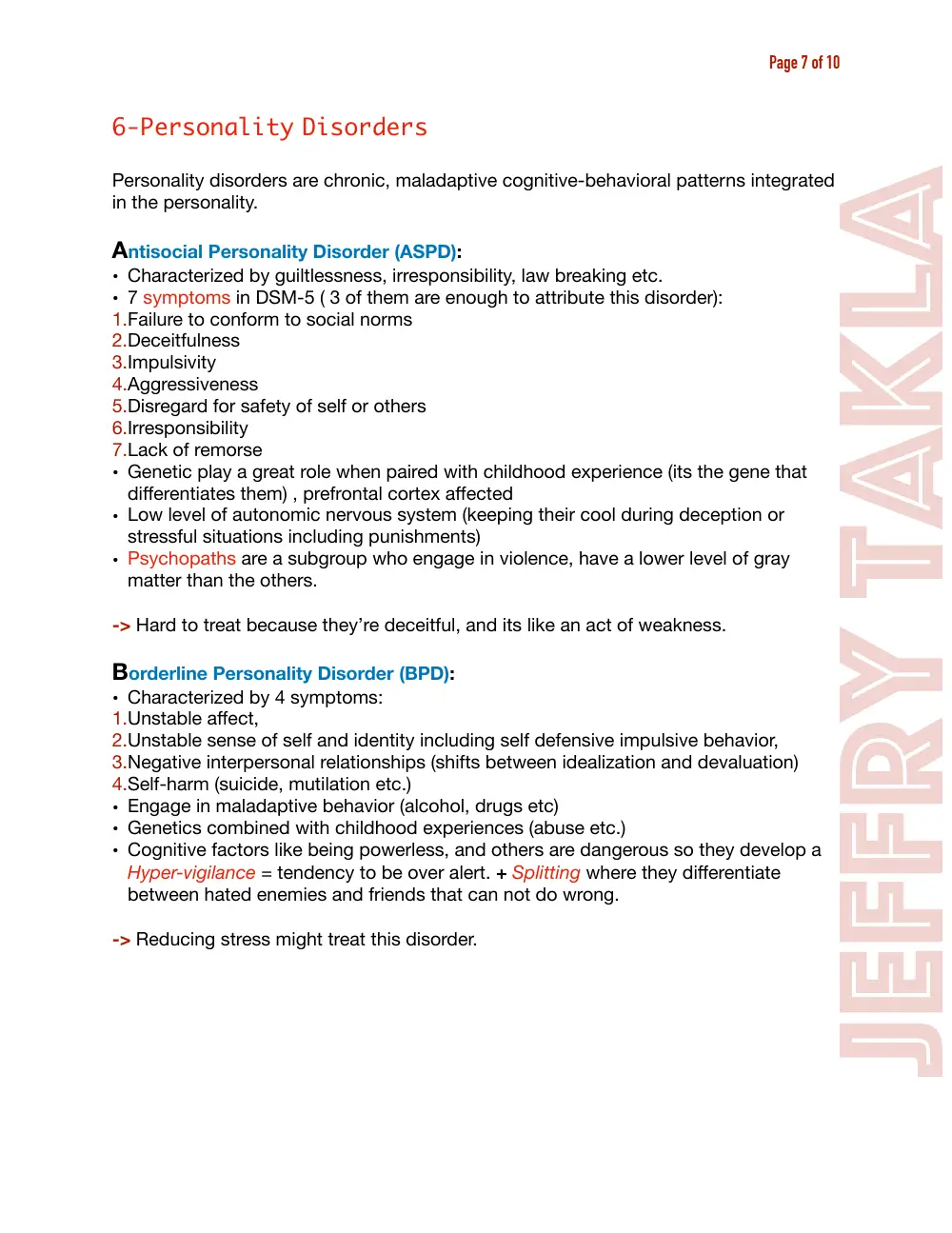
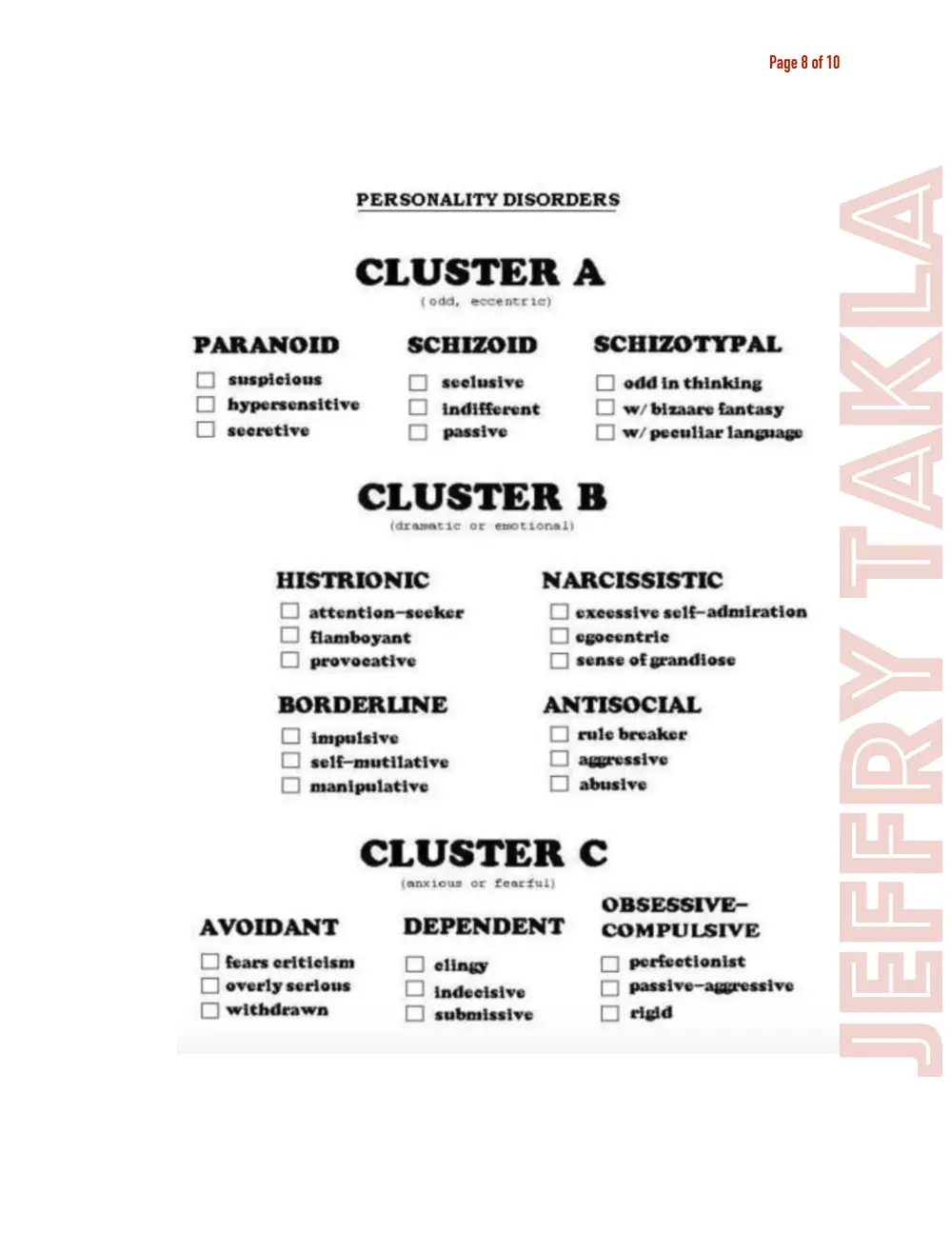
6-Personality Disorders
Personality disorders are chronic, maladaptive cognitive-behavioral patterns integrated
in the personality.
Antisocial Personality Disorder (ASPD):
• Characterized by guiltlessness, irresponsibility, law breaking etc.
• 7 symptoms in DSM-5 ( 3 of them are enough to attribute this disorder):
1.Failure to conform to social norms
2.Deceitfulness
3.Impulsivity
4.Aggressiveness
5.Disregard for safety of self or others
6.Irresponsibility
7.Lack of remorse
• Genetic play a great role when paired with childhood experience (its the gene that
differentiates them) , prefrontal cortex affected
• Low level of autonomic nervous system (keeping their cool during deception or
stressful situations including punishments)
• Psychopaths are a subgroup who engage in violence, have a lower level of gray
matter than the others.
-> Hard to treat because they’re deceitful, and its like an act of weakness.
Borderline Personality Disorder (BPD):
• Characterized by 4 symptoms:
1.Unstable affect,
2.Unstable sense of self and identity including self defensive impulsive behavior,
3.Negative interpersonal relationships (shifts between idealization and devaluation)
4.Self-harm (suicide, mutilation etc.)
• Engage in maladaptive behavior (alcohol, drugs etc)
• Genetics combined with childhood experiences (abuse etc.)
• Cognitive factors like being powerless, and others are dangerous so they develop a
Hyper-vigilance = tendency to be over alert. + Splitting where they differentiate
between hated enemies and friends that can not do wrong.
-> Reducing stress might treat this disorder.
Jeffry Takla
Page of
8
10
Jeffry Takla
Page of
9
10
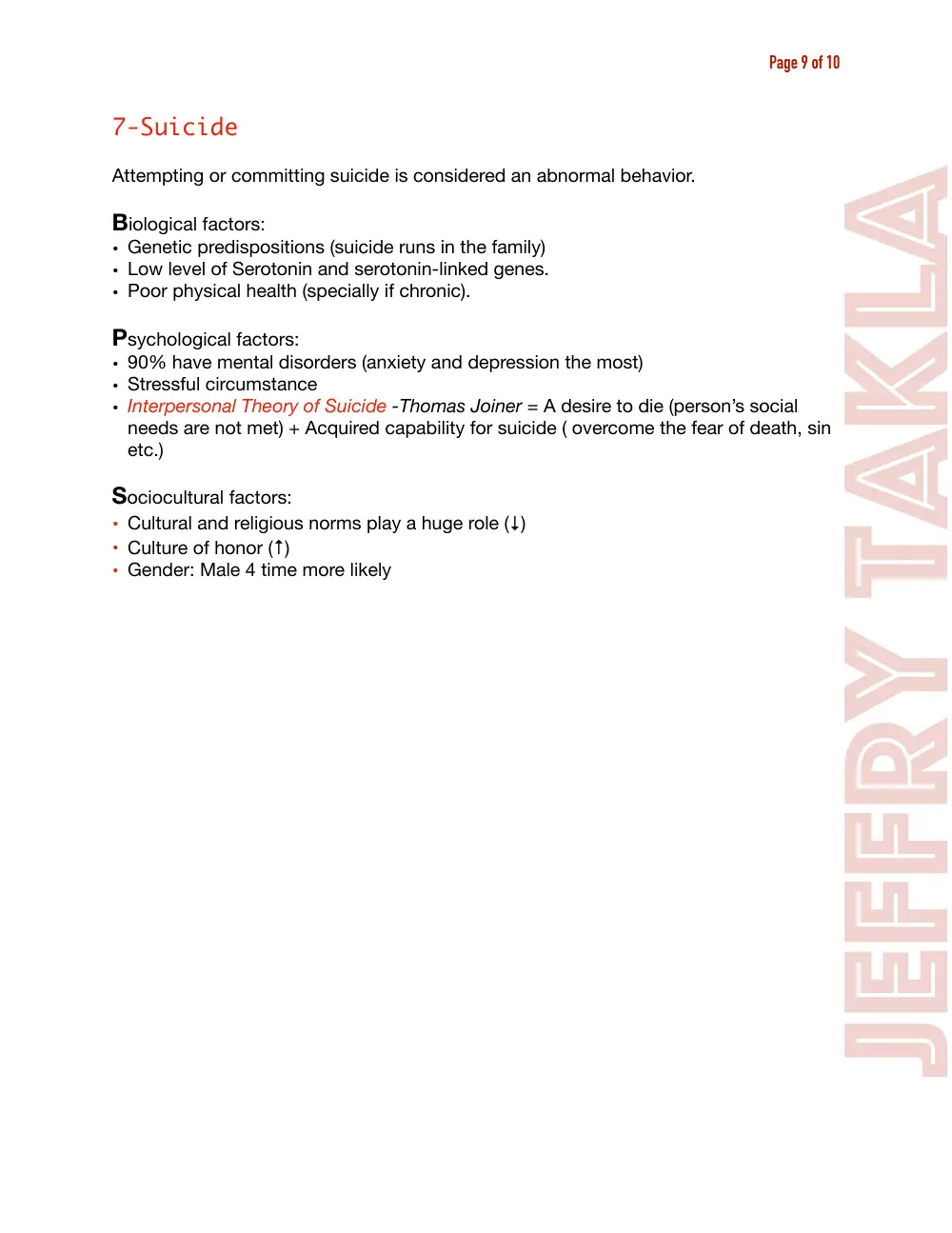
7-Suicide
Attempting or committing suicide is considered an abnormal behavior.
Biological factors:
• Genetic predispositions (suicide runs in the family)
• Low level of Serotonin and serotonin-linked genes.
• Poor physical health (specially if chronic).
Psychological factors:
• 90% have mental disorders (anxiety and depression the most)
• Stressful circumstance
• Interpersonal Theory of Suicide -Thomas Joiner = A desire to die (person’s social
needs are not met) + Acquired capability for suicide ( overcome the fear of death, sin
etc.)
Sociocultural factors:
• Cultural and religious norms play a huge role (↓)
• Culture of honor (↑)
• Gender: Male 4 time more likely
Jeffry Takla
Page of
10
10
8- Psychological Disorders and Health and Wellness
Labeling a psychological disorder (Stigma) like it only happens to others has many
consequences:
Prejudice and Discrimination:
-> Negative stereotypes like prone to violence or incompetent in all fields. This leads to
discrimination; as long as the individual can perform all the tasks required, he or she
should be paid/treated the same.
Physical health:
-> People with psychological disorders armor likely to be physically ill, obese, smoke,
drink etc. Despite that, they can still lead healthy lifestyles and make positive changes!!
Overcoming Stigma:
-> Individual suffering from psychological disorders should be more visible to society
and not be ashamed. We should not have a restricted, close minded idea about them.
Acknowledge that they have great potential and are not that different from us, a more
positive environment.
Jeffry Takla