
PSYC 201 Problems Chapter 7, Summer 2016
American University of Beirut · Psyc-201 · 101 pages
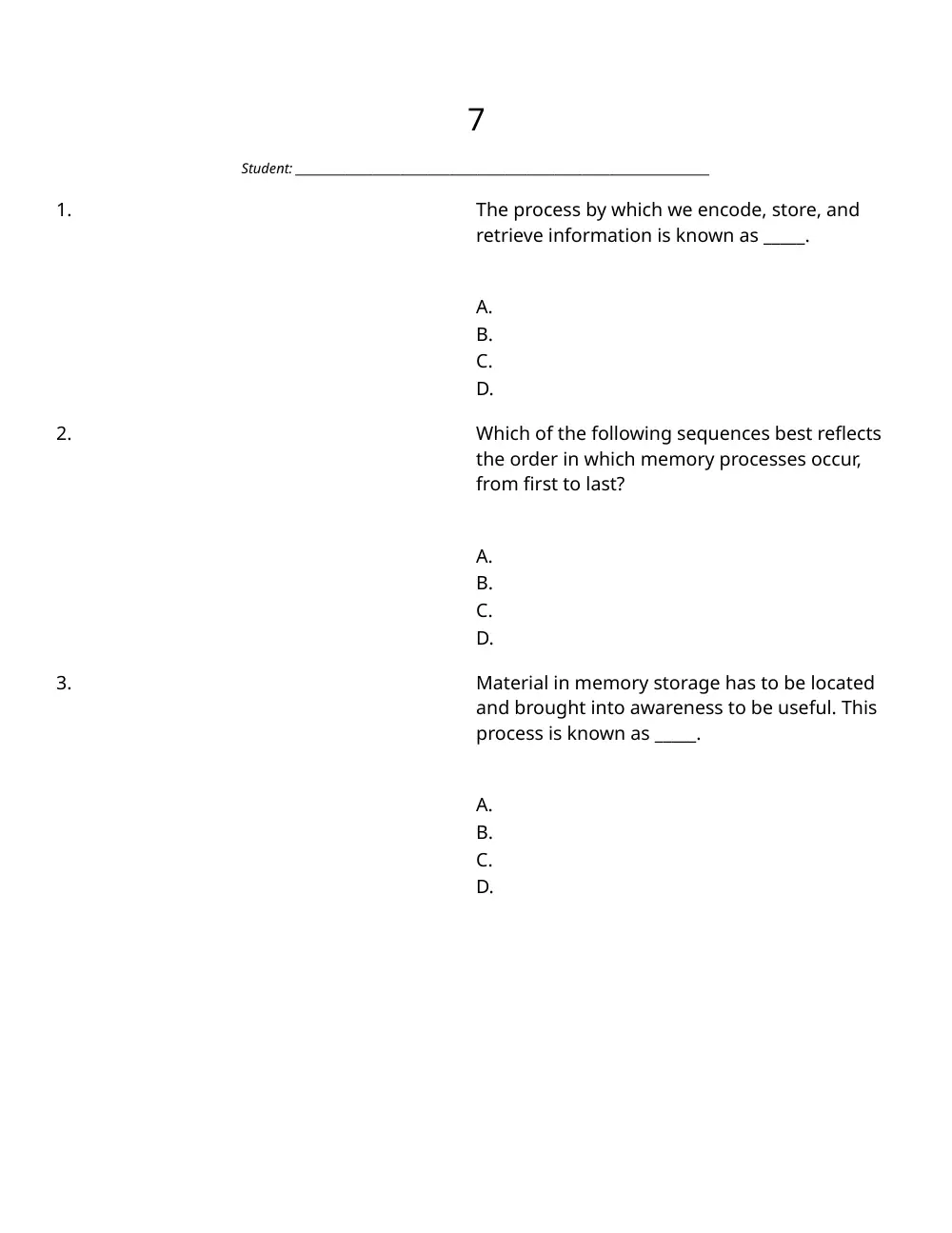
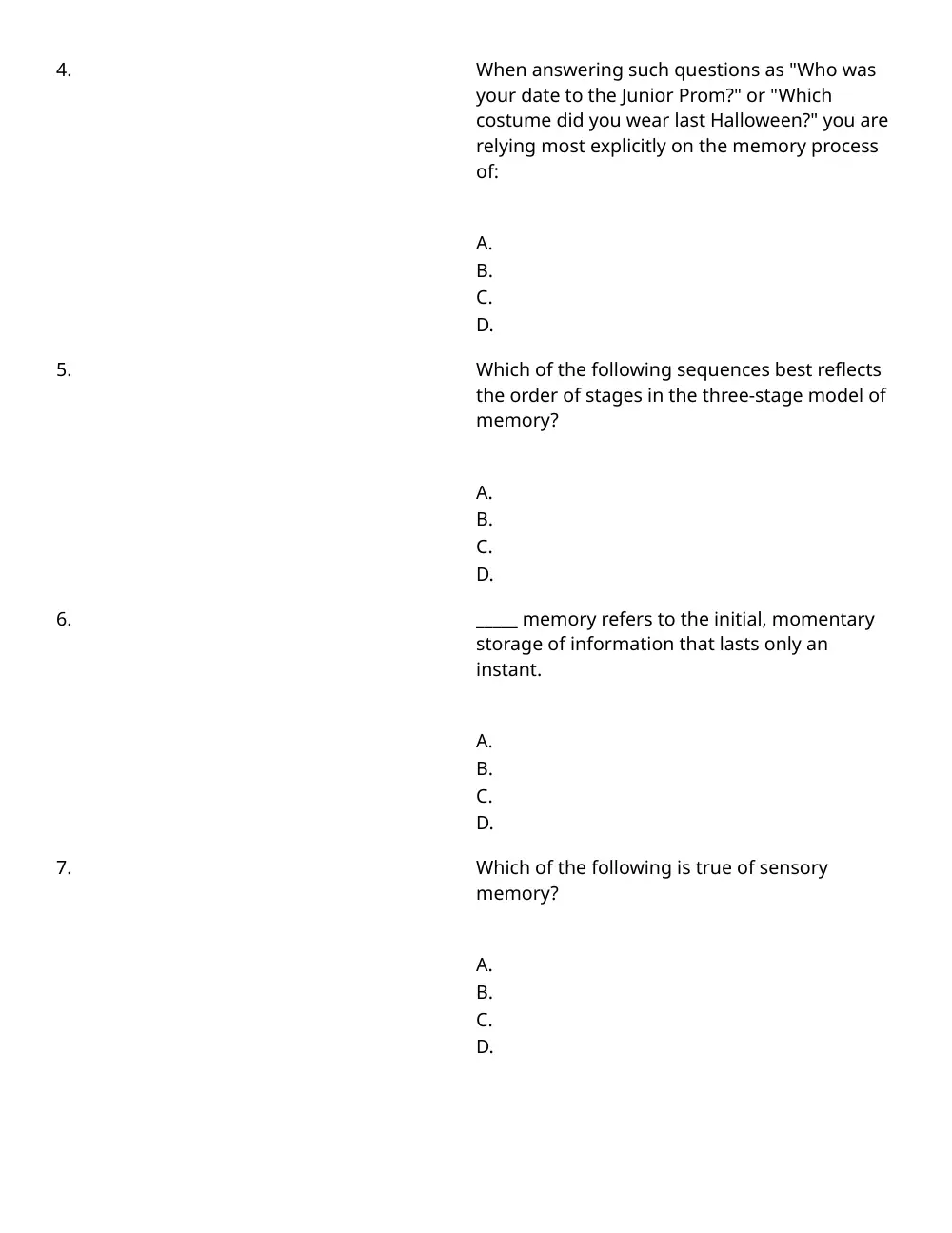
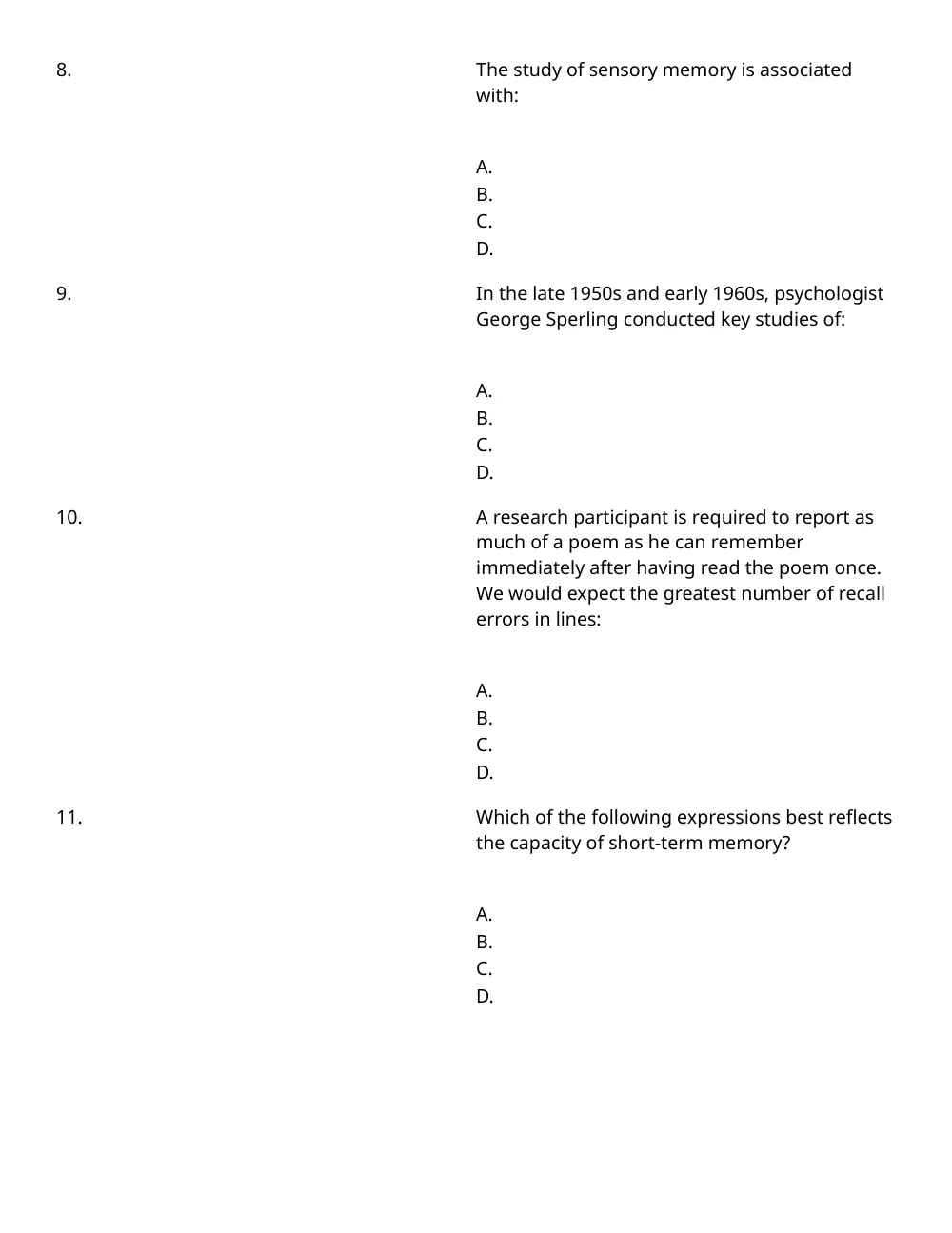
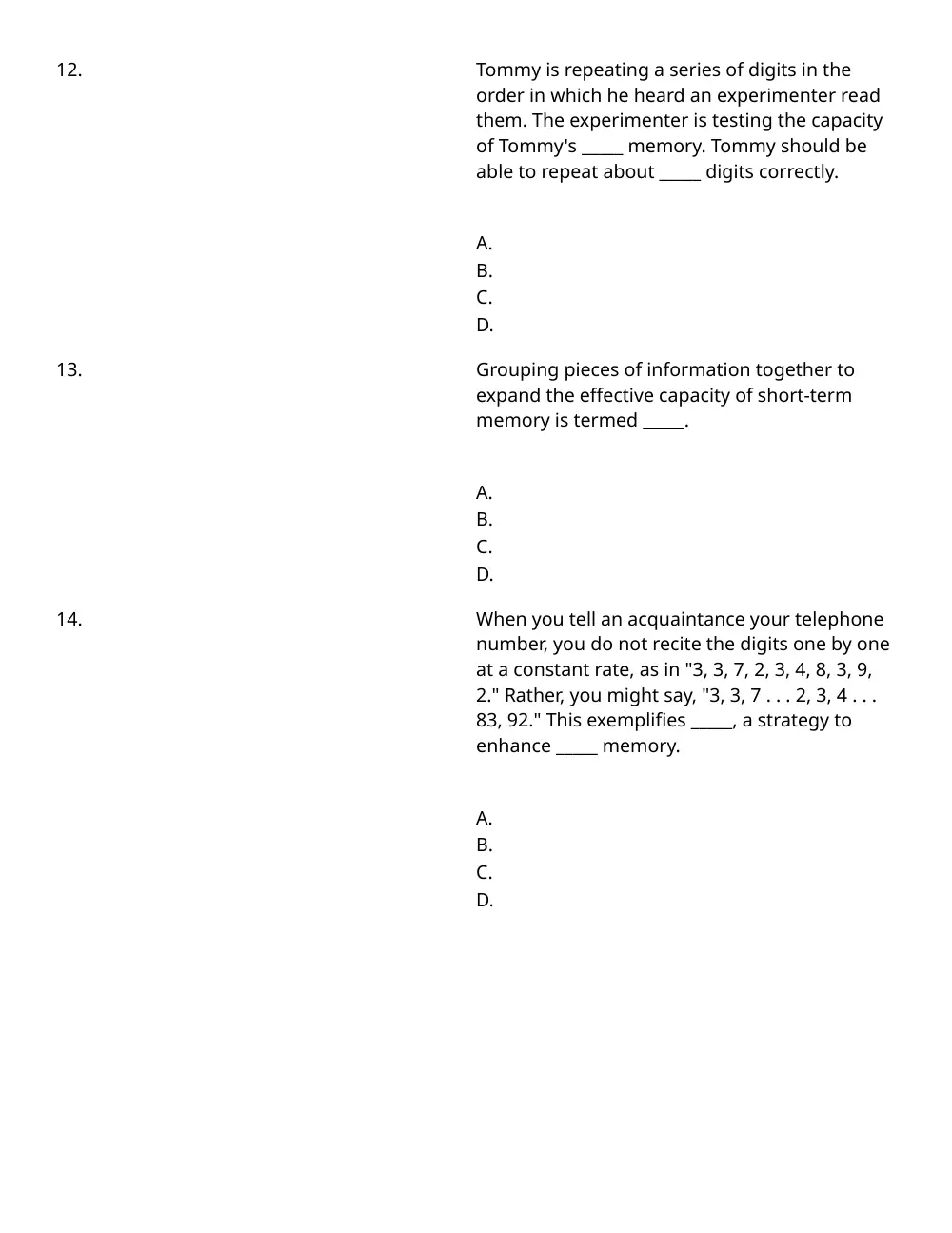

Showing the first 10 of 101 pages. Download the PDF to see all of it.
More PSYC 201 files
- Chapter 12 · Spring 2018ChapterView
- Chapter 13 · Spring 2018ChapterView
- Chapter 15 · Spring 2018ChapterView
- Chapter 17 · Spring 2018ChapterView
- Questions Chapter 1 Test Bank · Spring 2017ChapterView
- Questions Chapter 2 Test Bank · Spring 2017ChapterView
- Questions Chapter 12 · Fall 2015ChapterView
- Questions Chapter 10 · Spring 2015ChapterView
Show the text of this chapter
7
Student: ___________________________________________________________________________
1.
The process by which we encode, store, and
retrieve information is known as _____.
A.
B.
C.
D.
2.
Which of the following sequences best reflects
the order in which memory processes occur,
from first to last?
A.
B.
C.
D.
3.
Material in memory storage has to be located
and brought into awareness to be useful. This
process is known as _____.
A.
B.
C.
D.
4.
When answering such questions as "Who was
your date to the Junior Prom?" or "Which
costume did you wear last Halloween?" you are
relying most explicitly on the memory process
of:
A.
B.
C.
D.
5.
Which of the following sequences best reflects
the order of stages in the three-stage model of
memory?
A.
B.
C.
D.
6.
_____ memory refers to the initial, momentary
storage of information that lasts only an
instant.
A.
B.
C.
D.
7.
Which of the following is true of sensory
memory?
A.
B.
C.
D.
8.
The study of sensory memory is associated
with:
A.
B.
C.
D.
9.
In the late 1950s and early 1960s, psychologist
George Sperling conducted key studies of:
A.
B.
C.
D.
10.
A research participant is required to report as
much of a poem as he can remember
immediately after having read the poem once.
We would expect the greatest number of recall
errors in lines:
A.
B.
C.
D.
11.
Which of the following expressions best reflects
the capacity of short-term memory?
A.
B.
C.
D.
12.
Tommy is repeating a series of digits in the
order in which he heard an experimenter read
them. The experimenter is testing the capacity
of Tommy's _____ memory. Tommy should be
able to repeat about _____ digits correctly.
A.
B.
C.
D.
13.
Grouping pieces of information together to
expand the effective capacity of short-term
memory is termed _____.
A.
B.
C.
D.
14.
When you tell an acquaintance your telephone
number, you do not recite the digits one by one
at a constant rate, as in "3, 3, 7, 2, 3, 4, 8, 3, 9,
2." Rather, you might say, "3, 3, 7 . . . 2, 3, 4 . . .
83, 92." This exemplifies _____, a strategy to
enhance _____ memory.
A.
B.
C.
D.
15.
We look up a number in the phone book, push
the book away, and then begin to dial the
number. Why do we discourage an interruption
during this process?
A.
B.
C.
D.
16.
Rehearsal refers to the:
A.
B.
C.
D.
17.
Rehearsal serves to:
A.
B.
C.
D.
18.
The conscious repetition of information to
ensure its survival in short-term memory is
termed _____ rehearsal.
A.
B.
C.
D.
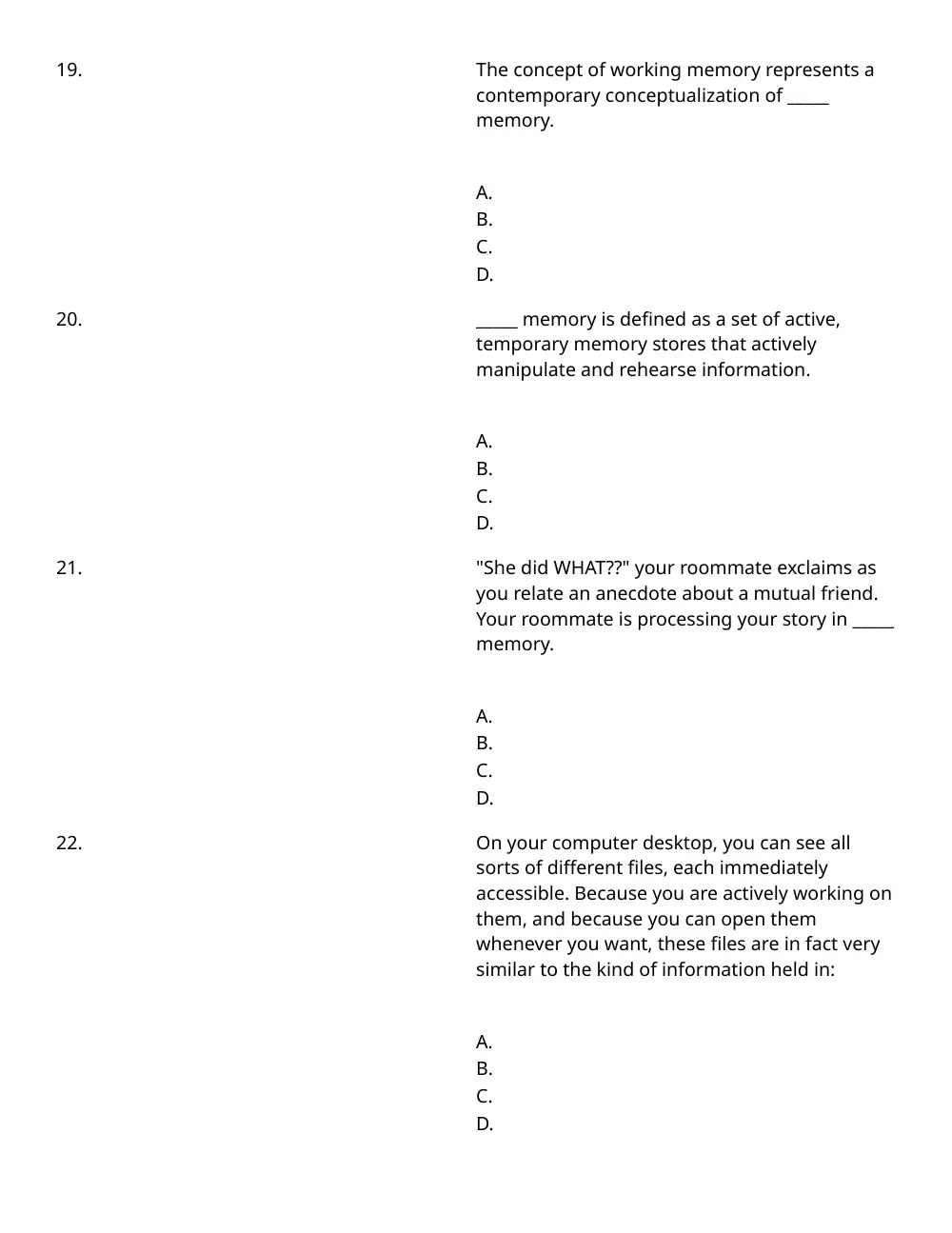
19.
The concept of working memory represents a
contemporary conceptualization of _____
memory.
A.
B.
C.
D.
20.
_____ memory is defined as a set of active,
temporary memory stores that actively
manipulate and rehearse information.
A.
B.
C.
D.
21.
"She did WHAT??" your roommate exclaims as
you relate an anecdote about a mutual friend.
Your roommate is processing your story in _____
memory.
A.
B.
C.
D.
22.
On your computer desktop, you can see all
sorts of different files, each immediately
accessible. Because you are actively working on
them, and because you can open them
whenever you want, these files are in fact very
similar to the kind of information held in:
A.
B.
C.
D.
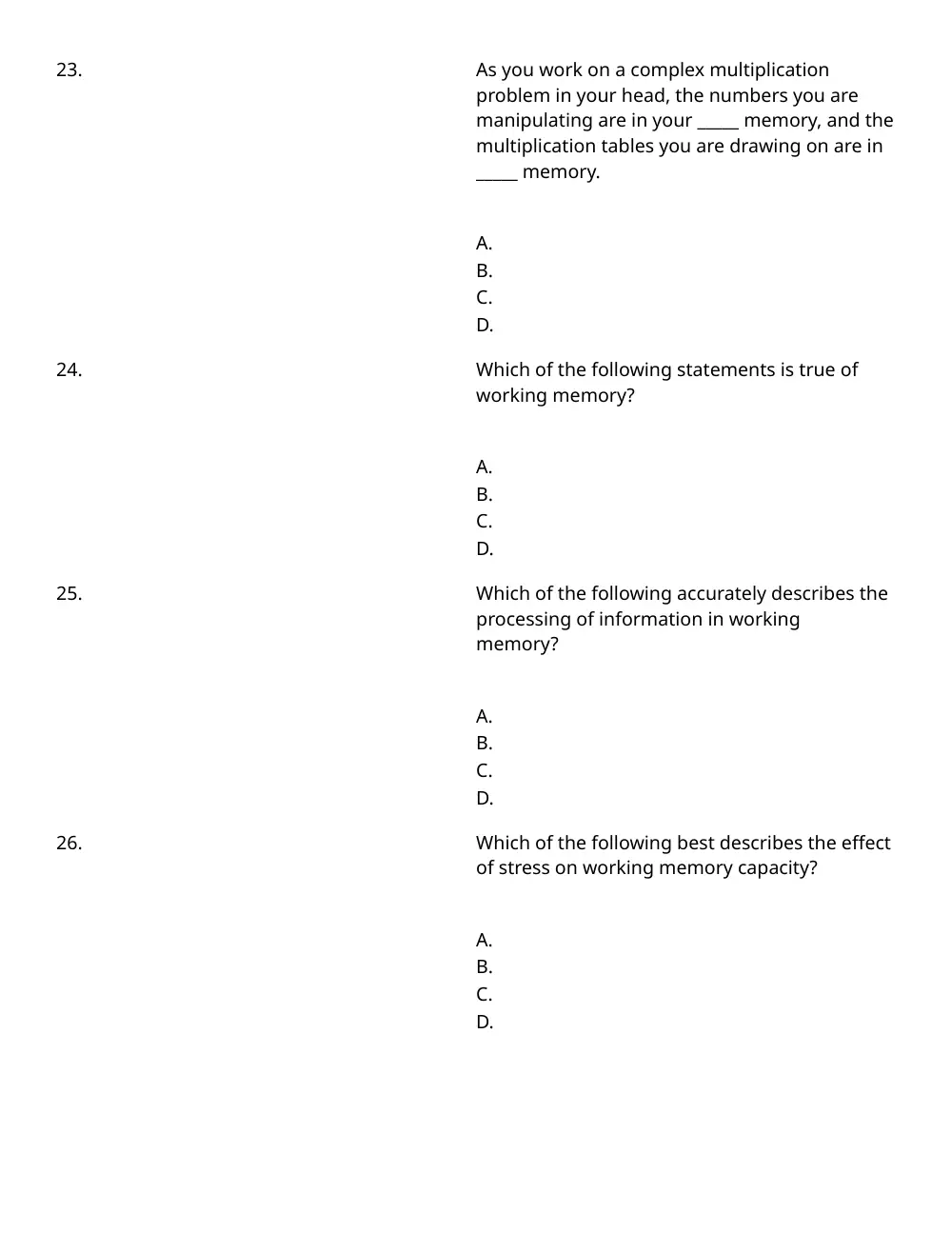
23.
As you work on a complex multiplication
problem in your head, the numbers you are
manipulating are in your _____ memory, and the
multiplication tables you are drawing on are in
_____ memory.
A.
B.
C.
D.
24.
Which of the following statements is true of
working memory?
A.
B.
C.
D.
25.
Which of the following accurately describes the
processing of information in working
memory?
A.
B.
C.
D.
26.
Which of the following best describes the effect
of stress on working memory capacity?
A.
B.
C.
D.
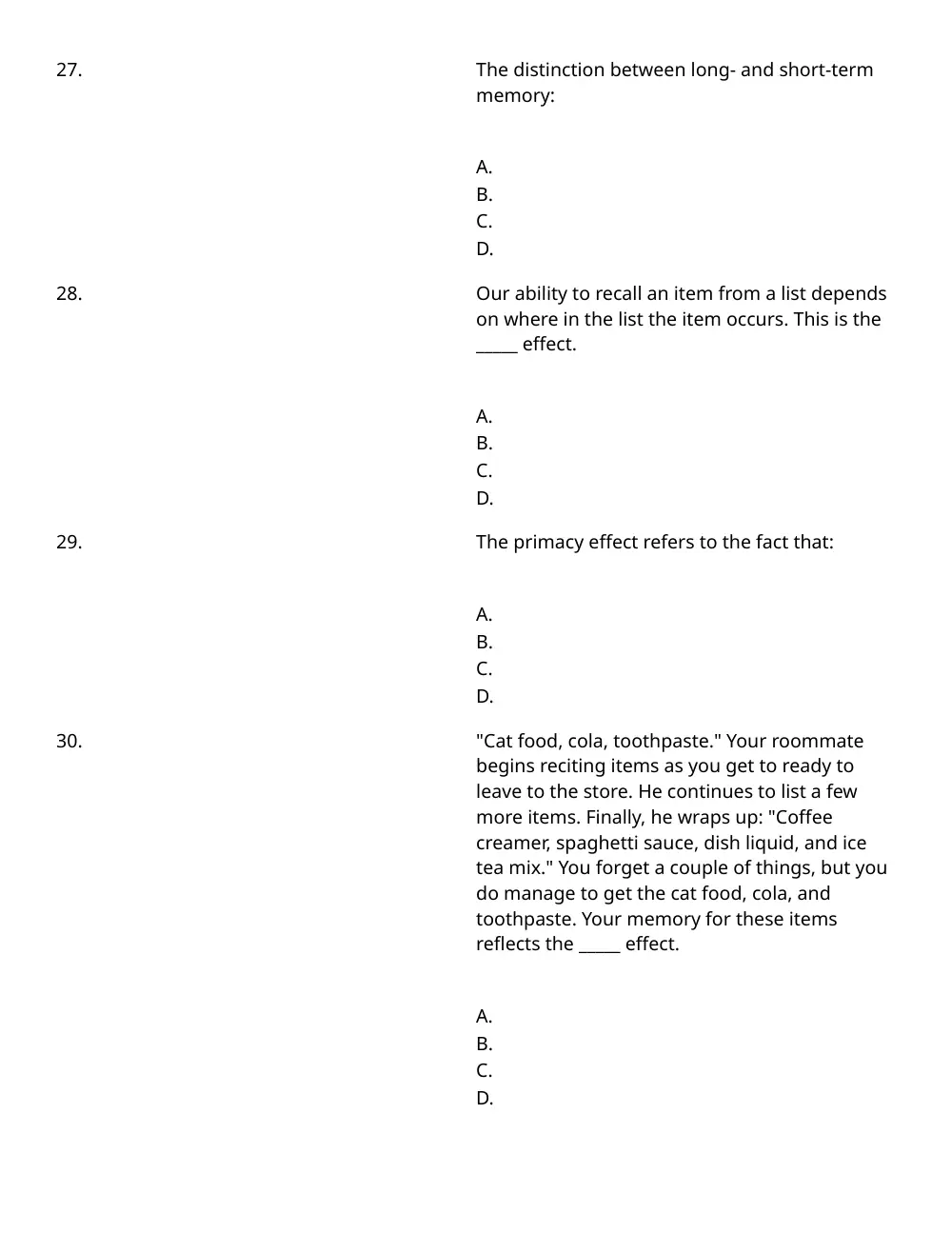
27.
The distinction between long- and short-term
memory:
A.
B.
C.
D.
28.
Our ability to recall an item from a list depends
on where in the list the item occurs. This is the
_____ effect.
A.
B.
C.
D.
29.
The primacy effect refers to the fact that:
A.
B.
C.
D.
30.
"Cat food, cola, toothpaste." Your roommate
begins reciting items as you get to ready to
leave to the store. He continues to list a few
more items. Finally, he wraps up: "Coffee
creamer, spaghetti sauce, dish liquid, and ice
tea mix." You forget a couple of things, but you
do manage to get the cat food, cola, and
toothpaste. Your memory for these items
reflects the _____ effect.
A.
B.
C.
D.
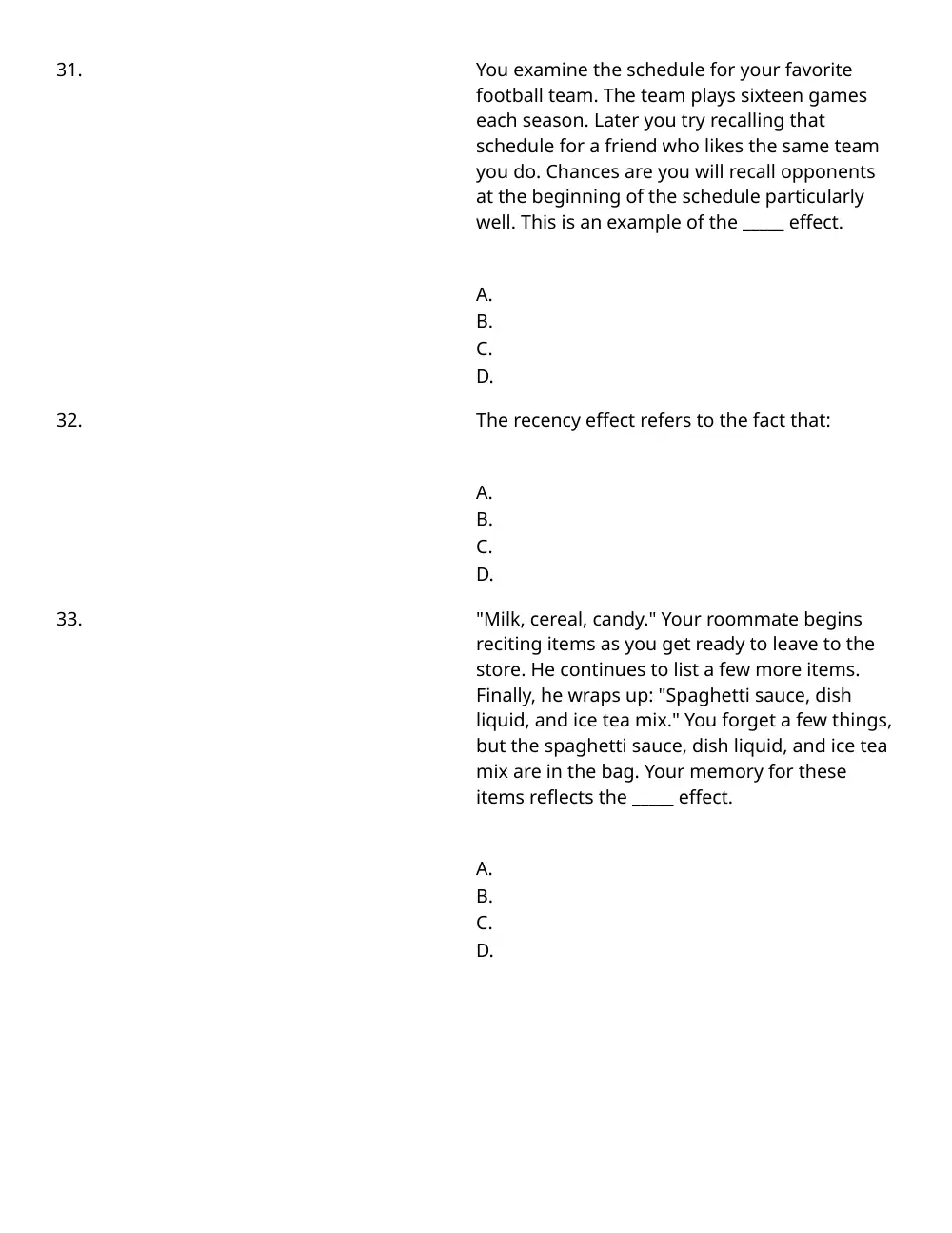
31.
You examine the schedule for your favorite
football team. The team plays sixteen games
each season. Later you try recalling that
schedule for a friend who likes the same team
you do. Chances are you will recall opponents
at the beginning of the schedule particularly
well. This is an example of the _____ effect.
A.
B.
C.
D.
32.
The recency effect refers to the fact that:
A.
B.
C.
D.
33.
"Milk, cereal, candy." Your roommate begins
reciting items as you get ready to leave to the
store. He continues to list a few more items.
Finally, he wraps up: "Spaghetti sauce, dish
liquid, and ice tea mix." You forget a few things,
but the spaghetti sauce, dish liquid, and ice tea
mix are in the bag. Your memory for these
items reflects the _____ effect.
A.
B.
C.
D.
34.
When you try to list all the classes you've ever
taken in college, chances are you will recall your
last few classes particularly well. What is this
phenomenon called?
A.
B.
C.
D.
35.
Which of the following refers to declarative
memory?
A.
B.
C.
D.
36.
Which of the following forms of memory refers
to memory for skills and habits?
A.
B.
C.
D.
37.
_____ memory is memory for general
knowledge and facts about the world, as well as
memory for the rules of logic that are used to
deduce other facts.
A.
B.
C.
D.
38.
Knowing how to serve a badminton birdie is an
example of a(n) _____ memory.
A.
B.
C.
D.
39.
Cory knows that the capital of Vermont is
Montpelier. This is an example of _____
memory.
A.
B.
C.
D.
40.
Having done "21 for 21" shots, Deanna barely
remembers her 21st birthday. That is, her _____
memory is sketchy.
A.
B.
C.
D.
41.
Which of the following statements accurately
captures the relationship among the modules
of long-term memory?
A.
B.
C.
D.
42.
Activating one memory triggers the activation
of related memories in a process known as:
A.
B.
C.
D.
43.
The hippocampus is located in the _____ lobe.
A.
B.
C.
D.
44.
Which of the following is true of the
neuroscience of memory?
A.
B.
C.
D.
45.
Which of the following is true of the
neuroscience of memory?
A.
B.
C.
D.
46.
Estelle remembers a night she was mugged
and brutally beaten. This memory probably
involves not only her hippocampus, but also
her:
A.
B.
C.
D.
47.
Long-term potentiation refers to the process
whereby:
A.
B.
C.
D.
48.
Maguire, Woollett, & Spiers conducted an fMRI
study of the role of the hippocampus in spatial
memory. The study showed that years of
experience driving a taxi in London was _____
correlated with the size of posterior portions of
the hypothalamus and _____ correlated with the
size of anterior portions of the hypothalamus.
A.
B.
C.
D.
49.
The term engram is generally discouraged by
psychologists studying memory. Why might this
be?
A.
B.
C.
D.
50.
"I know it! It's um . . . um . . . It starts with ‘G',"
begins a trivia game contestant excitedly. The
contestant is falling prey to the _____ effect.
A.
B.
C.
D.
51.
Almost everybody has had the feeling of
knowing the answer to a question, but not
being quite able to say it. This is called the "tip-
of-the-tongue" phenomenon, and is a failure
of:
A.
B.
C.
D.
52.
Mickey is about to take his psychology final. Just
before the exam, the person sitting next to
Mickey asks him the name of the physiologist
who worked on classical conditioning. Mickey
suddenly realizes that he cannot quite
remember the name, but he knows that it starts
with a P and is two syllables long. Mickey is
experiencing:
A.
B.
C.
D.
53.
Why is it so difficult to retrieve information
from long-term memory?
A.
B.
C.
D.
54.
A stimulus that facilitates the recall of
information from long-term memory is called
a:
A.
B.
C.
D.
55.
An "oldie" playing on the radio may remind you
of events that occurred when the song was
current. The song is acting as a(n):
A.
B.
C.
D.
56.
Chad is puzzling over a difficult question on a
multiple-choice sociology test. He re-reads the
question, scans the options beneath the
question, and glances at other questions on the
test. Most likely, Chad is looking for:
A.
B.
C.
D.
57.
Ralph is preparing a report on his academic
field trip to a manufacturing plant. He is trying
to remember each event of the trip in the order
in which it occurred to prepare an accurate
report in a presentable form. Which of the
following memory tasks is Ralph using?
A.
B.
C.
D.
58.
Three year-old Jane had learned the names of
fruits from a picture book. She was taken to a
grocery store and asked to identify apples and
melons kept in the store. Which of the following
memory tasks would be used by Jane to identify
the fruits?
A.
B.
C.
D.
59.
"Discuss several factors that contributed to the
economic collapse of late 2008," asks a
question on the midterm in an Economics
course. Such a question is a test of _____
memory.
A.
B.
C.
D.
60.
_____ is a memory task in which individuals are
presented with a stimulus and asked whether
they have been exposed to it in the past or to
identify it from a list of alternatives.
A.
B.
C.
D.
61.
The levels-of-processing approach:
A.
B.
C.
D.
62.
Which of the following is true of the levels-of-
processing theory?
A.
B.
C.
D.
63.
The levels-of-processing approach suggests:
A.
B.
C.
D.
64.
According to the levels-of-processing theory,
which of the following study techniques would
enhance memory best?
A.
B.
C.
D.
65.
According to the levels-of-processing theory,
which of the following students should retrieve
information more successfully on classroom
tests?
A.
B.
C.
D.
66.
A typical multiple-choice question on a
psychology test is an example of both a _____
and a(n) _____ test of memory.
A.
B.
C.
D.
67.
Which of the following searches explicit
memory?
A.
B.
C.
D.
68.
Julia is puzzling over a fill-in-the-blank question
on a sociology test. To answer the question
correctly, Julia has to use _____ memory.
A.
B.
C.
D.
69.
"I know it! It's um . . . um . . . ," begins a trivia
game contestant excitedly. The contestant is
engaged in a test of her _____ memory.
A.
B.
C.
D.
70.
Bart remembers the release date of his favorite
movie director's upcoming project. Which of the
following forms of memory would have helped
Bart?
A.
B.
C.
D.
71.
Memories of which we are not consciously
aware are called _____ memories.
A.
B.
C.
D.
72.
Which of the following is true of explicit
memory and implicit memory?
A.
B.
C.
D.
73.
_____ is a phenomenon in which exposure to a
word or concept later makes it easier to recall
related information, even when there is no
conscious memory of the word or concept.
A.
B.
C.
D.
74.
Some psychologists consider classical
conditioning to be a form of implicit memory.
Which of the following is probably the best
reason for suggesting that classical
conditioning is a type of implicit memory?
A.
B.
C.
D.
75.
The 9/11 attacks on the World Trade Center,
Princess Diana's death, and the 1986
Challenger explosion. People's memories for
the moment in which they learned of these
events are termed _____ memories.
A.
B.
C.
D.
76.
Flashbulb memories:
A.
B.
C.
D.
77.
Which of the following is true of flashbulb
memories?
A.
B.
C.
D.
78.
Christopher clearly remembers that he was
practicing his dialogues for his school play
when he heard that the governor of his state
had been assassinated. This is an example of
a(n) _____ memory.
A.
B.
C.
D.
79.
_____ amnesia occurs when an individual has a
memory for some material but cannot recall
where he or she encountered it.
A.
B.
C.
D.
80.
"I don't know who told me first, but I heard that
Kenny…" Lana begins, sharing gossip on the
phone to a friend. Lana is experiencing:
A.
B.
C.
D.
81.
During a conversation, Jerry told his friend that
their favorite rock band was coming to perform
in their city. However, he could not remember
the medium through which he got the
information about the show. Jerry was
experiencing:
A.
B.
C.
D.
82.
_____ is a process in which memories are
influenced by the meaning we give to events.
A.
B.
C.
D.
83.
The first psychologist to emphasize the
importance of constructive processes in
memory was:
A.
B.
C.
D.
84.
A schema is:
A.
B.
C.
D.
85.
How does use of a schema improve memory?
A.
B.
C.
D.
86.
Dr. Tranh has given so many lectures that he
gives little thought to what he expects might
happen: He assumes students will assemble,
take notes, and occasionally ask a question.
That Dr. Tranh finds the process so routine
reflects the development of:
A.
B.
C.
D.
87.
Loftus and Palmer (1974) conducted an
experiment in which participants estimated the
speed of a car described as either contacting or
smashing into another. To which of the
following conclusions regarding eyewitness
memory is this study most relevant?
A.
B.
C.
D.
88.
The unconscious process whereby disturbing
memories are prevented from entering
awareness is called:
A.
B.
C.
D.
89.
The idea that disturbing memories may be
repressed derives from:
A.
B.
C.
D.
90.
Which of the following alternatives best
expresses psychologist Elizabeth Loftus'
position on the validity of repressed
memories?
A.
B.
C.
D.
91.
Middle-aged Mrs. Lovett is recalling her first
Christmas as a young newlywed at her in-laws'
Wyoming ranch. This is a(n) _____ memory.
A.
B.
C.
D.
92.
Which of the following best encapsulates
autobiographical memory?
A.
B.
C.
D.
93.
One's culture is most likely to influence:
A.
B.
C.
D.
94.
With respect to the potential influence of a
written language on the recall ability of a
culture's members, research has:
A.
B.
C.
D.
95.
The first attempts to study forgetting
scientifically were made by the German
psychologist:
A.
B.
C.
D.
96.
Which of the following statements best
describes the forgetting function that
Ebbinghaus discovered?
A.
B.
C.
D.
97.
Which of the following best describes the
results of Ebbinghaus's work on forgetting?
A.
B.
C.
D.
98.
Jerry is at a party. He is introduced to three
different people in the span of a moment. Later,
he is approached by the first person he met
and cannot remember her name. Which of the
following is most likely the source of Jerry's
difficulty?
A.
B.
C.
D.
99.
Drew is unable to recall whether Lincoln's head
faces left or right on the penny. Which of the
following is probably the best explanation for
Drew's memory failure?
A.
B.
C.
D.
100.
Which of the following is the best reason that
we have trouble remembering the license plate
number of a car that we just passed ten
minutes ago?
A.
B.
C.
D.
101.
Which theory of forgetting is correctly matched
with its description?
A.
B.
C.
D.
102.
Which of the following statements best
describes the fate of the decay theory of
forgetting in psychology?
A.
B.
C.
D.
103.
In _____ interference, information learned
earlier disrupts the recall of information
learned more recently; in _____ interference,
recently learned information disrupts the recall
of information learned earlier.
A.
B.
C.
D.
104.
Owen has trouble remembering a friend's new
phone number; he keeps recalling the old
number instead. Completing a rental
application, Pippa finds she can't recall one of
her previous addresses, as she's had several
addresses since. Owen is experiencing _____
interference; Pippa is experiencing _____.
A.
B.
C.
D.
105.
_____, an illness characterized in part by severe
memory problems, is the fourth leading cause
of death among adults in the United States.
A.
B.
C.
D.
106.
In _____ amnesia, memory is lost for events
preceding an injury or accident; in _____
amnesia, memory is lost for events following an
injury or accident.
A.
B.
C.
D.
107.
Omar experienced a dissociative fugue state.
He suddenly snapped out of it in front of a pet-
supplies display in a discount store; he had no
memory whatsoever of his previous life in
Greensboro, NC. Omar's amnesia is best
described as:
A.
B.
C.
D.
108.
Rhonda can't remember anything about the
first several minutes immediately following a
car crash in which she was injured. Rhonda is
experiencing _____ amnesia.
A.
B.
C.
D.
109.
Pierre has been an alcoholic for several
decades. Now in his 50s, his intellectual abilities
are intact, but he suffers from memory deficits
and hallucinations. Based on this information,
you suspect that Pierre may be afflicted with:
A.
B.
C.
D.
110.
Dr. Ziemer is seeing a new patient, Mrs.
Aaronson. Mrs. Aaronson is experiencing
memory losses. Dr. Ziemer tests Mrs.
Aaronson's language and problem-solving
abilities. He also asks Mrs. Aaronson if she has
a history of alcohol abuse. What might the
language and problem-solving tests tell Dr.
Ziemer? What would the answer to the alcohol
abuse question tell him?
A.
B.
C.
D.
111.
While a computer's hard drive may be likened
to the memory process of storage, its keyboard
is analogous to the process of _____.
________________________________________
112.
You have just listened to your current favorite
song on your iPod. You can still hear traces of
the final chorus, even though the song has just
ended. For a few seconds, the song will be
represented in auditory sensory memory, or
_____ memory.
________________________________________
113.
A(n) _____ is a meaningful group of stimuli that
can be stored as a unit in short- term memory.
________________________________________
114.
When faced with a list of terms to memorize in
one of his college courses, Brendan creates an
acrostic—a sentence in which successive words
begin with the same letter as the
corresponding list word. Formal organizational
strategies such as this are termed _____.
________________________________________
115.
Mental arithmetic entails the activity of both
the visual and the verbal stores in working
memory; the _____ coordinates the operation of
these two subsystems.
________________________________________
116.
Semantic and episodic memory are
subdivisions of _____ memory.
________________________________________
117.
Rhoda is thinking of a family reunion last
summer. This reminds her that a close friend is
attending the same college in which her cousin
is enrolled; her thoughts then turn to the
reading assignments she has neglected in one
of her classes. The process of _____ describes
how one memory brings up another in our
network of mental representations.
________________________________________
118.
Dr. Sally acquired her neurosurgery degree at
an online college based in the West Indies.
Unfortunately, during her first brain surgery,
she inadvertently destroyed her patient's
hippocampus, impairing his process of _____,
whereby memories are stabilized in long-term
memory.
________________________________________
119.
A _____ is a stimulus that allows us to recall
more easily information that is in long-term
memory.
________________________________________
120.
"You'll probably do better on the test if you put
more effort into understanding what the
chapter's trying to say in the first place," one of
your professors admonishes the class. You are
reminded of the _____ theory of memory
retrieval.
________________________________________
121.
"It's like riding a bike; once you know how, you
don't forget." This adage suggests that
procedural memories do not require conscious
attempts at recall; that is, procedural memories
are often _____.
________________________________________
122.
Implicit memory is often studied through
experiments that use _____.
________________________________________
123.
I was a second-semester freshman. I was
eating French fries in the college cafeteria when
my friend Liz came up. She was wearing that
plaid coat with her yellow skirt, along with that
moss-green embroidered bag, the one with a
Grecian urn embroidered on it. She told me the
shuttle blew up. This is my _____ memory of the
1986 Challenger disaster.
________________________________________
124.
_____ processes are processes in which
memories are influenced by the meaning we
give to events.
________________________________________
125.
Organized bodies of information stored in
memory that bias the way new information is
interpreted, stored, and recalled are called
_____.
________________________________________
126.
_____ memories are recollections of events that
are initially so shocking that the mind responds
by pushing them into the unconscious.
________________________________________
127.
_____ memories are our recollections of
circumstances and episodes from our own
lives.
________________________________________
128.
The phenomenon by which information in
memory disrupts the recall of other information
is called _____.
________________________________________
129.
_____ is a memory disorder in which memory
losses occur in the absence of other cognitive
decrements.
________________________________________
130.
Trey is studying German vocabulary for an
upcoming test. He forms an image
corresponding to an English word that sounds
similar to the German word he is trying to
learn. Trey is using the _____ technique.
________________________________________
131.
Short-term memory is limited both in the
amount of information it can hold at one time,
and in how long it can hold information.
Describe several strategies one might use to
overcome the capacity and duration limitations
of short-term memory. How might one use
these strategies when studying for course
materials? Provide concrete examples.
132.
Compare and contrast the capacity and
duration of sensory and short-term memory.
Describe the experimental and
neuropsychological evidence supporting the
distinction between short- and long-term
memory.
133.
Describe working memory.
134.
Define and provide original examples from your
own experience of each of the following types
of long-term memory: declarative, procedural,
episodic, and semantic.
135.
"The Search for the Engram." Has this research
quest proven fruitful? Evaluate this question
with respect to what is known regarding the
brain basis of memory.
136.
Discuss retrieval cues, recognition vs. recall,
and levels of processing.
137.
Distinguish between explicit and implicit
memory. How is implicit memory studied in the
laboratory? How does implicit memory research
inform the continuing debate in psychology
regarding the unconscious determinants of
behavior? In your answer, make explicit
reference to behaviors that may have
important personal and social consequences.
138.
What are flashbulb memories?
139.
Our long-term memories are often inaccurate,
even when we are convinced we are correctly
remembering past events. Support this
statement making specific reference to
research on flashbulb, eyewitness, and false
and repressed memories.
140.
What are constructive processes in memory?
Explain.
141.
To what extent does culture influence basic
memory processes? Strategies for acquiring,
rehearsing, and retrieving information? Provide
as detailed a response as you can.
142.
Distinguish between the decay, interference,
and cue-dependent theories of forgetting.
Provide an example of each.
143.
Describe the two sorts of interference that
influence forgetting.
144.
Review the three organic memory dysfunctions
described in your text: Alzheimer's disease,
anterograde and retrograde amnesia, and
Korsakoff's syndrome. Provide as detailed a
response as you can.
145.
Describe three of the techniques your text
recommends for improving your memory.
Suggest how the techniques you describe could
be applied to improve your performance in one
or more specific college courses.
7 Key
1.
(p. 213)
The process by which we encode, store, and
retrieve information is known as _____.
A.
B.
C.
D.
APA Goal Outcome: 1.2
Blooms Taxonomy: Remember
Difficulty: Easy
Feldman - Chapter 07 #1
Learning Outcome: 20-1
2.
(p. 213)
Which of the following sequences best reflects
the order in which memory processes occur,
from first to last?
A.
B.
C.
D.
APA Goal Outcome: 1.2
Blooms Taxonomy: Remember
Difficulty: Easy
Feldman - Chapter 07 #2
Learning Outcome: 20-1
3.
(p. 213)
Material in memory storage has to be located
and brought into awareness to be useful. This
process is known as _____.
A.
B.
C.
D.
APA Goal Outcome: 1.2
Blooms Taxonomy: Remember
Difficulty: Easy
Feldman - Chapter 07 #3
Learning Outcome: 20-1
4.
(p. 213)
When answering such questions as "Who was
your date to the Junior Prom?" or "Which
costume did you wear last Halloween?" you are
relying most explicitly on the memory process
of:
A.
B.
C.
D.
APA Goal Outcome: 1.2, 4.4
Blooms Taxonomy: Apply
Difficulty: Easy
Feldman - Chapter 07 #4
Learning Outcome: 20-1
5.
(p. 214)
Which of the following sequences best reflects
the order of stages in the three-stage model of
memory?
A.
B.
C.
D.
APA Goal Outcome: 1.2
Blooms Taxonomy: Remember
Difficulty: Medium
Feldman - Chapter 07 #5
Learning Outcome: 20-2
6.
(p. 214)
_____ memory refers to the initial, momentary
storage of information that lasts only an
instant.
A.
B.
C.
D.
APA Goal Outcome: 1.2
Blooms Taxonomy: Remember
Difficulty: Easy
Feldman - Chapter 07 #6
Learning Outcome: 20-2
7.
(p. 214)
Which of the following is true of sensory
memory?
A.
B.
C.
D.
APA Goal Outcome: 1.2
Blooms Taxonomy: Remember
Difficulty: Medium
Feldman - Chapter 07 #7
Learning Outcome: 20-2
8.
(p. 215)
The study of sensory memory is associated
with:
A.
B.
C.
D.
APA Goal Outcome: 1.2
Blooms Taxonomy: Remember
Difficulty: Easy
Feldman - Chapter 07 #8
Learning Outcome: 20-2
9.
(p. 215)
In the late 1950s and early 1960s, psychologist
George Sperling conducted key studies of:
A.
B.
C.
D.
APA Goal Outcome: 1.2
Blooms Taxonomy: Remember
Difficulty: Easy
Feldman - Chapter 07 #9
Learning Outcome: 20-2
10.
(p. 215)
A research participant is required to report as
much of a poem as he can remember
immediately after having read the poem once.
We would expect the greatest number of recall
errors in lines:
A.
B.
C.
D.
APA Goal Outcome: 1.2
Blooms Taxonomy: Apply
Difficulty: Medium
Feldman - Chapter 07 #10
Learning Outcome: 20-2
11.
(p. 216)
Which of the following expressions best reflects
the capacity of short-term memory?
A.
B.
C.
D.
APA Goal Outcome: 1.2
Blooms Taxonomy: Remember
Difficulty: Easy
Feldman - Chapter 07 #11
Learning Outcome: 20-2
12.
(p. 216)
Tommy is repeating a series of digits in the
order in which he heard an experimenter read
them. The experimenter is testing the capacity
of Tommy's _____ memory. Tommy should be
able to repeat about _____ digits correctly.
A.
B.
C.
D.
APA Goal Outcome: 1.2, 4.4
Blooms Taxonomy: Apply
Difficulty: Medium
Feldman - Chapter 07 #12
Learning Outcome: 20-2
13.
(p. 216)
Grouping pieces of information together to
expand the effective capacity of short-term
memory is termed _____.
A.
B.
C.
D.
APA Goal Outcome: 1.2
Blooms Taxonomy: Remember
Difficulty: Easy
Feldman - Chapter 07 #13
Learning Outcome: 20-2
14.
(p. 217)
When you tell an acquaintance your telephone
number, you do not recite the digits one by one
at a constant rate, as in "3, 3, 7, 2, 3, 4, 8, 3, 9,
2." Rather, you might say, "3, 3, 7 . . . 2, 3, 4 . . .
83, 92." This exemplifies _____, a strategy to
enhance _____ memory.
A.
B.
C.
D.
APA Goal Outcome: 1.2, 4.4
Blooms Taxonomy: Apply
Difficulty: Medium
Feldman - Chapter 07 #14
Learning Outcome: 20-2
15.
(p. 217)
We look up a number in the phone book, push
the book away, and then begin to dial the
number. Why do we discourage an interruption
during this process?
A.
B.
C.
D.
APA Goal Outcome: 1.2, 4.4
Blooms Taxonomy: Apply
Difficulty: Difficult
Feldman - Chapter 07 #15
Learning Outcome: 20-2
16.
(p. 217)
Rehearsal refers to the:
A.
B.
C.
D.
APA Goal Outcome: 1.2, 4.4
Blooms Taxonomy: Apply
Difficulty: Difficult
Feldman - Chapter 07 #16
Learning Outcome: 20-2
17.
(p. 217)
Rehearsal serves to:
A.
B.
C.
D.
APA Goal Outcome: 1.2
Blooms Taxonomy: Remember
Difficulty: Medium
Feldman - Chapter 07 #17
Learning Outcome: 20-2
18.
(p. 217)
The conscious repetition of information to
ensure its survival in short-term memory is
termed _____ rehearsal.
A.
B.
C.
D.
APA Goal Outcome: 1.2
Blooms Taxonomy: Remember
Difficulty: Easy
Feldman - Chapter 07 #18
Learning Outcome: 20-2
19.
(p. 218)
The concept of working memory represents a
contemporary conceptualization of _____
memory.
A.
B.
C.
D.
APA Goal Outcome: 1.2
Blooms Taxonomy: Remember
Difficulty: Easy
Feldman - Chapter 07 #19
Learning Outcome: 20-2
20.
(p. 218)
_____ memory is defined as a set of active,
temporary memory stores that actively
manipulate and rehearse information.
A.
B.
C.
D.
APA Goal Outcome: 1.2
Blooms Taxonomy: Remember
Difficulty: Easy
Feldman - Chapter 07 #20
Learning Outcome: 20-2
21.
(p. 218)
"She did WHAT??" your roommate exclaims as
you relate an anecdote about a mutual friend.
Your roommate is processing your story in _____
memory.
A.
B.
C.
D.
APA Goal Outcome: 1.2, 4.4
Blooms Taxonomy: Apply
Difficulty: Medium
Feldman - Chapter 07 #21
Learning Outcome: 20-2
22.
(p. 218)
On your computer desktop, you can see all
sorts of different files, each immediately
accessible. Because you are actively working on
them, and because you can open them
whenever you want, these files are in fact very
similar to the kind of information held in:
A.
B.
C.
D.
APA Goal Outcome: 1.2
Blooms Taxonomy: Apply
Difficulty: Medium
Feldman - Chapter 07 #22
Learning Outcome: 20-2
23.
(p. 218-219)
As you work on a complex multiplication
problem in your head, the numbers you are
manipulating are in your _____ memory, and the
multiplication tables you are drawing on are in
_____ memory.
A.
B.
C.
D.
APA Goal Outcome: 1.2, 4.4
Blooms Taxonomy: Apply
Difficulty: Medium
Feldman - Chapter 07 #23
Learning Outcome: 20-2
24.
(p. 218)
Which of the following statements is true of
working memory?
A.
B.
C.
D.