
PSYC 201 Chapter 17, Spring 2018
American University of Beirut · Psyc-201 · 8 pages

More PSYC 201 files
- Chapter 12 · Spring 2018ChapterView
- Chapter 13 · Spring 2018ChapterView
- Chapter 15 · Spring 2018ChapterView
- Questions Chapter 1 Test Bank · Spring 2017ChapterView
- Questions Chapter 2 Test Bank · Spring 2017ChapterView
- Problems Chapter 7 · Summer 2016ChapterView
- Questions Chapter 10 · Spring 2015ChapterView
- Questions Chapter 12 · Fall 2015ChapterView
Show the text of this chapter
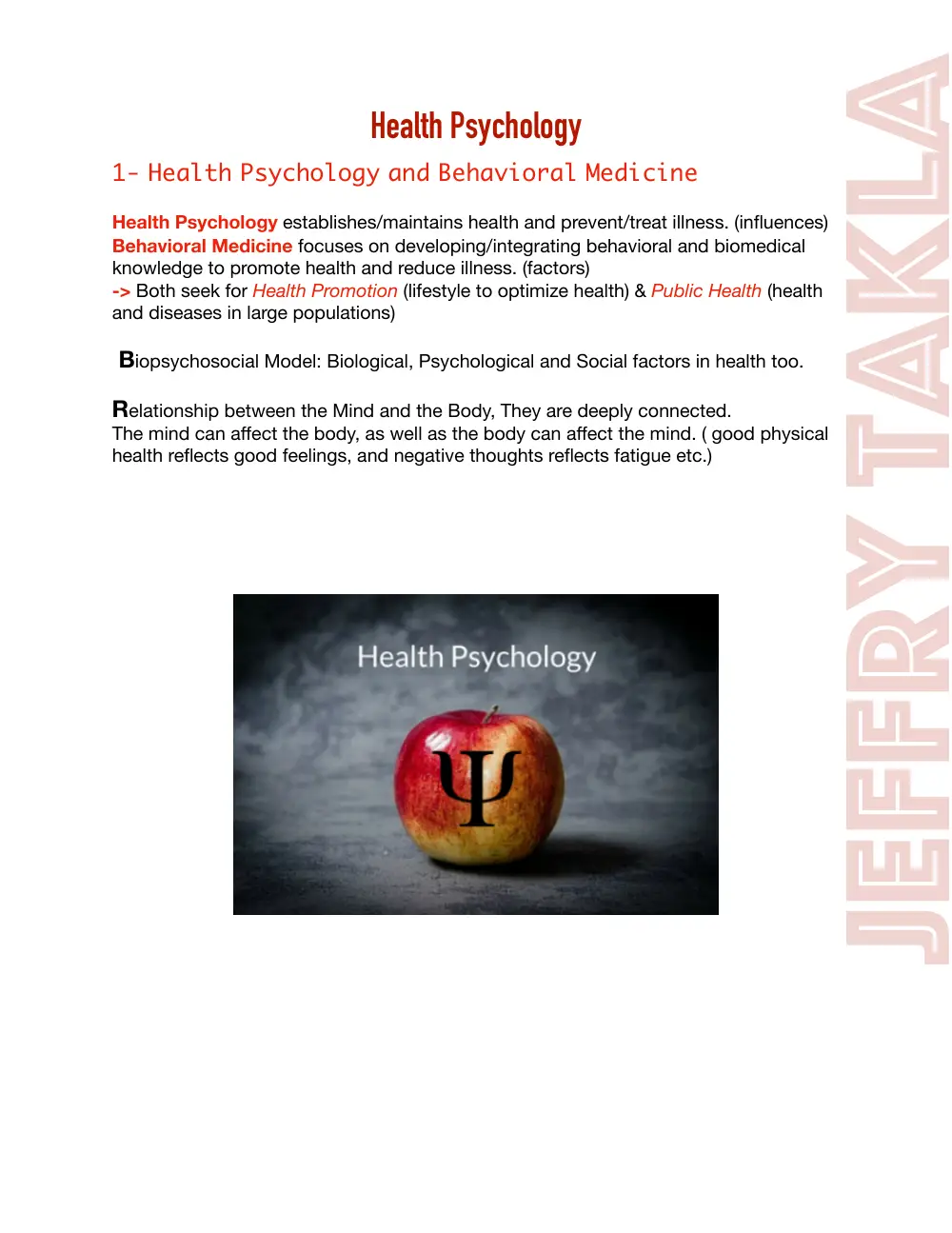
Health Psychology
1- Health Psychology and Behavioral Medicine
Health Psychology establishes/maintains health and prevent/treat illness. (influences)
Behavioral Medicine focuses on developing/integrating behavioral and biomedical
knowledge to promote health and reduce illness. (factors)
-> Both seek for Health Promotion (lifestyle to optimize health) & Public Health (health
and diseases in large populations)
Biopsychosocial Model: Biological, Psychological and Social factors in health too.
Relationship between the Mind and the Body, They are deeply connected.
The mind can affect the body, as well as the body can affect the mind. ( good physical
health reflects good feelings, and negative thoughts reflects fatigue etc.)
Jeffry Takla
2- Making Positive Life Changes
Health behaviors = practices that have an impact on physical well-being (coping with
stress, exercising, safe sex…)
Theoretical Model of Change, where changing behavior needs a change of attitude:
• Theory of reasoned action = effective change requires:
- specific intention about their behavior
- positive attitude about the new behavior
- favoring the new behavior by their social group
• Theory of planned behavior = above + person’s perception of control over the
outcome,
Critics of these theories -> Only rational process ( avoiding regret can be a strong
motive too).
Stages of Change Model = five steps process by which individuals give up bad habits
and adopt healthier life:
• Pre-contemplation
• Contemplation
• Preparation/determination
• Action/Willpower
• Maintenance ( transcendence = change the lifestyle accordingly)
Relapse is normal and does occur, we learn from our mistakes.
Critics: Some people might be in two stages at a time.
+ Refers more to attitudes than behavior changes.
Jeffry Takla
Preparation/
determination
/willpower
Jeffry Takla
3- Resources for Effective Life Change
The tools that can help us achieve effective change:
Motivation:
• Change is the most effective when we do it for ourselves.
• Implementation Intentions = specific strategies for dealing with challenges of the
change process, motivate people more and help them.
• Short term goals + monitoring progress does motivate and help people too.
Social Relationships:
• Makes a difference through social support = information and feedback from others
showing love, caring, understanding etc.
• Social support has three types of benefits:
- Tangible assistance = Providing goods and service in some situations.
- Information = Recommend actions and plan to help them coping more successfully.
- Emotional support = Showing love and caring
• Giving support is also beneficial.
Religious Faith:
• Promote moderation and frown excess.
• Warmer community (support)
• Sense of purpose and meaning in life
Jeffry Takla
4- Toward a Healthier Mind (& Body): Controlling Stress
Stress and its Stages:
• Stress = individual’s response to environmental stressors (usually implying significant
changes).
• Hans Selye, founder of stress research, any stimuli has the same stress symptoms:
- loss of appetite
- muscular weaknesses
- decreased interest in the world
• General Adaption Syndrome (GAS) = common effect of stressful demands on the
body, consisting of 3 stages respectively in order:
- Alarm stage = stage of shock, very weak against illness and stress quick release of
hormones.
- Resistance stage = Hormones to defend the body (those of inflammation too)
- Exhaustion stage = state of exhaustion, vulnerability to disease, heart attack or
death might increase.
• Hypothalamic-pituitary-adrenal axis (HPA axis), (plays the greatest role in GAS)
= interactions among the hypothalamus, the pituitary and adrenal glands that
regulate various body processes and controls reactions to stressful events. (along
acute stress -> cortisol hormone V/S chronic stress -> activation of the HPA axis can
remain activated over the long haul).
Stress and the Immune System:
• Psychoneuroimmunology = discuss the link between the immune system and
stress.
• Stress can influence the immune system, by weakening it…
• Stress causes disease because: low efficiency of the immune system, stress
promotes some disease, activates some dormant viruses.
• Sheldon Cohen, the greater the stress the greater the risk of having a disease.
Stress and Cardiovascular disease:
Stress increases the risk for cardiovascular disease due to adrenaline, blood clots…
But also due to stress-related behavior like overeating, smoking…
Stress and Cancer:
With poor health due to stress, cancer risk increases (low NK -cell activity)
1
Natural Killer, not abundant in patients with cancer
1
Jeffry Takla
Coping with stress can be done in 2 types:
• Problem-focused coping = coping strategy of facing the troubles and trying to solve
them.
• Emotion-focused coping = coping strategy of managing your own emotional
reaction (avoiding the source of stress, denying it, refer to religion like praying for
it…)
• The first one usually works best.
Strategies for Successful Coping:
• Sense of personal control, healthy immune system, personal resources, and positive
emotions.
• Optimism plays a great role.
• Hardiness = Coping with stress when considering it a challenge rather than stress.
Stress Management Program = Teach individuals how to develop skills for coping
with stress, an putting them into real-life use.
Jeffry Takla
5- Toward a Healthier Body (& Mind):
Behave as if you Life depends upon it
Becoming Physically Active:
• Increases your life expectancy
• Reduces cardiovascular problems and metabolic diseases like diabetes
• Reduces anxiety
• Improves cognition skills…
-> Why? Telomeres lose part of their chromosome with time (Biological clock) ,
physical activity preserve the telomere length.
-> Environmental factors that encourage physical activity are also associated with
health and wellness.
-> 30 minutes of Moderate exercise daily, is convenient for adults.
Eating Right:
• = Healthy Food, balanced meal, nutrition plan.
• Not only to lose weight.
• Provides more energy, lower blood pressure,
lessen the risk of cancer and tooth decay.
• Social proof Heuristics = informing what people
(other than us) would do in similar circumstances.
-> If it is applied as the majority would go for
healthy options, we would too. (bias can be
beneficial sometimes)
Quitting Smoking:
• Enormous health benefits, specially decreasing the risk of fatal lung cancer.
• How? Three common methods:
-
Going Cold Turkey = They simply stop (easier for lighter smokers).
-
Using a Substitute Source of Nicotine
-
Seeking Therapeutic Help
-> Combination of these methods is the best strategy.
Jeffry Takla
6- Psychology and your Good Life
BASIC BULLSHIT GOODBYE
-> All psychological areas converge to Health concerns.
-> ‘Placing even the most ordinary moment in the framework if a human life renders it
remarkably complex and undeniably fascinating.’
Jeffry Takla