
STAT 230 Problems Set 2, Fall 2012
American University of Beirut · Introduction to Probability and Random Variables · 1 page
Stuck on a question? A tutor can walk you through it.
More STAT 230 files
- Problems Set 1 · Fall 2012ProblemsView
- Problems · Summer 2011ProblemsView
- Chapter 2 · Spring 2020ChapterView
- Chapter 2 · Spring 2020ChapterView
- Syllabus · Spring 2020LabView
- Lecture 4- Examples About Chapters 2.4 · Spring 2019LabView
- Useful File Solution Manual · Spring 2019File · with solutionView
- Lecture 1- Chapter 1 · Spring 2019LabView
Show the text of this problems
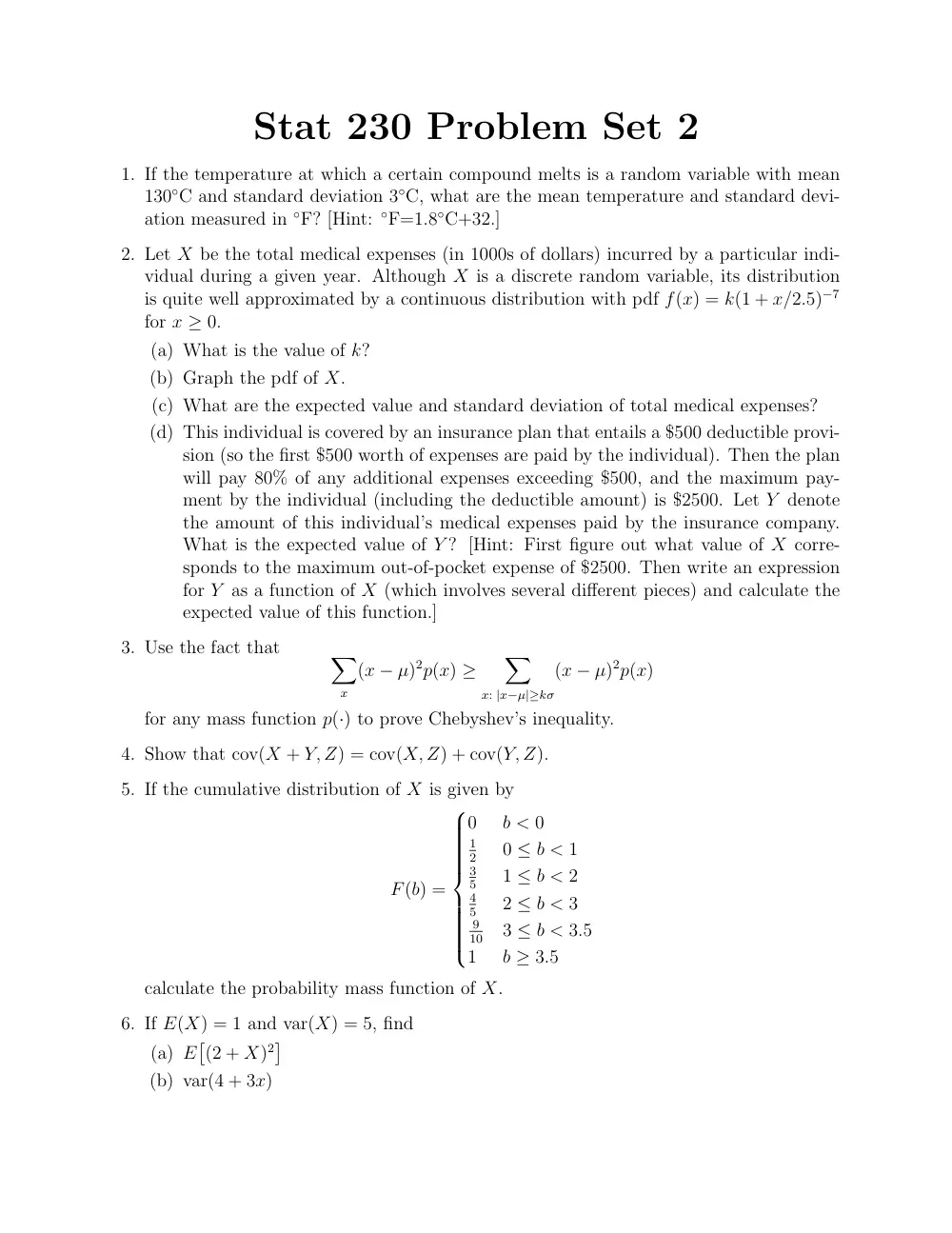
Stat 230 Problem Set 2
1. If the temperature at which a certain compound melts is a random variable with mean
130◦C and standard deviation 3◦C, what are the mean temperature and standard devi-
ation measured in ◦F? [Hint: ◦F=1.8◦C+32.]
2. Let X be the total medical expenses (in 1000s of dollars) incurred by a particular indi-
vidual during a given year. Although X is a discrete random variable, its distribution
is quite well approximated by a continuous distribution with pdf f(x) = k(1 + x/2.5)−7
for x ≥ 0.
(a) What is the value of k?
(b) Graph the pdf of X.
(c) What are the expected value and standard deviation of total medical expenses?
(d) This individual is covered by an insurance plan that entails a $500 deductible provi-
sion (so the first $500 worth of expenses are paid by the individual). Then the plan
will pay 80% of any additional expenses exceeding $500, and the maximum pay-
ment by the individual (including the deductible amount) is $2500. Let Y denote
the amount of this individual’s medical expenses paid by the insurance company.
What is the expected value of Y ? [Hint: First figure out what value of X corre-
sponds to the maximum out-of-pocket expense of $2500. Then write an expression
for Y as a function of X (which involves several different pieces) and calculate the
expected value of this function.]
3. Use the fact that
�
x
(x − µ)2p(x) ≥
�
x: |x−µ|≥kσ
(x − µ)2p(x)
for any mass function p(·) to prove Chebyshev’s inequality.
4. Show that cov(X + Y, Z) = cov(X, Z) + cov(Y, Z).
5. If the cumulative distribution of X is given by
F(b) =
0
b < 0
1
2
0 ≤ b < 1
3
5
1 ≤ b < 2
4
5
2 ≤ b < 3
9
10
3 ≤ b < 3.5
1
b ≥ 3.5
calculate the probability mass function of X.
6. If E(X) = 1 and var(X) = 5, find
(a) E
�
(2 + X)2�
(b) var(4 + 3x)