
CSI 212 Chapter 1 Slides, Spring 2012
American University of Science and Technology · Computer Organization And Assembly · 52 pages · Dr. Abbas Tarhini
Showing the first 10 of 52 pages. Download the PDF to see all of it.
More CSI 212 files
- Chapter 2 Slides · Spring 2012ChapterView
- Chapter 3 Slides · Spring 2012ChapterView
- Chapter 4 Slides · Spring 2012ChapterView
- Chapter 5 Slides · Spring 2012ChapterView
- Chapter 6 Slides Part I · Spring 2012ChapterView
- Chapter 6 Slides Part II · Spring 2012ChapterView
- Chapter 7 Slides · Spring 2012ChapterView
- Chapter 8 Slides · Spring 2012ChapterView
Show the text of this chapter
Assembly Language for Intel-Based
Assembly Language for Intel-Based
Computers, 5
Computers, 5th
th Edition
Edition
Chapter 1: Basic Concepts
(c) Pearson Education, 2006-2007. All rights reserved. You may modify and copy this slide show for your personal use,
or for use in the classroom, as long as this copyright statement, the author's name, and the title are not changed.
Slides prepared by the author
Revision date: June 3, 2006
Kip Irvine
Irvine, Kip R. Assembly Language for Intel-Based Computers 5/e, 2007.
Web site Examples
2
Chapter Overview
Chapter Overview
• Welcome to Assembly Language
• Virtual Machine Concept
• Data Representation
• Boolean Operations
Irvine, Kip R. Assembly Language for Intel-Based Computers 5/e, 2007.
Web site Examples
3
Welcome to Assembly Language
Welcome to Assembly Language
• Some Good Questions to Ask
• Assembly Language Applications
Irvine, Kip R. Assembly Language for Intel-Based Computers 5/e, 2007.
Web site Examples
4
Questions to Ask
Questions to Ask
• Why am I learning Assembly Language?
• What background should I have?
• What is an assembler?
• What hardware/software do I need?
• What types of programs will I create?
• What do I get with this book?
• What will I learn?
Irvine, Kip R. Assembly Language for Intel-Based Computers 5/e, 2007.
Web site Examples
5
Welcome to Assembly Language
Welcome to Assembly Language (cont)
(cont)
• How does assembly language (AL) relate to machine
language?
• How do C++ and Java relate to AL?
• Is AL portable?
• Why learn AL?
Irvine, Kip R. Assembly Language for Intel-Based Computers 5/e, 2007.
Web site Examples
6
Assembly Language Applications
Assembly Language Applications
• Some representative types of applications:
• Business application for single platform
• Hardware device driver
• Business application for multiple platforms
• Embedded systems & computer games
(see next panel)
Irvine, Kip R. Assembly Language for Intel-Based Computers 5/e, 2007.
Web site Examples
7
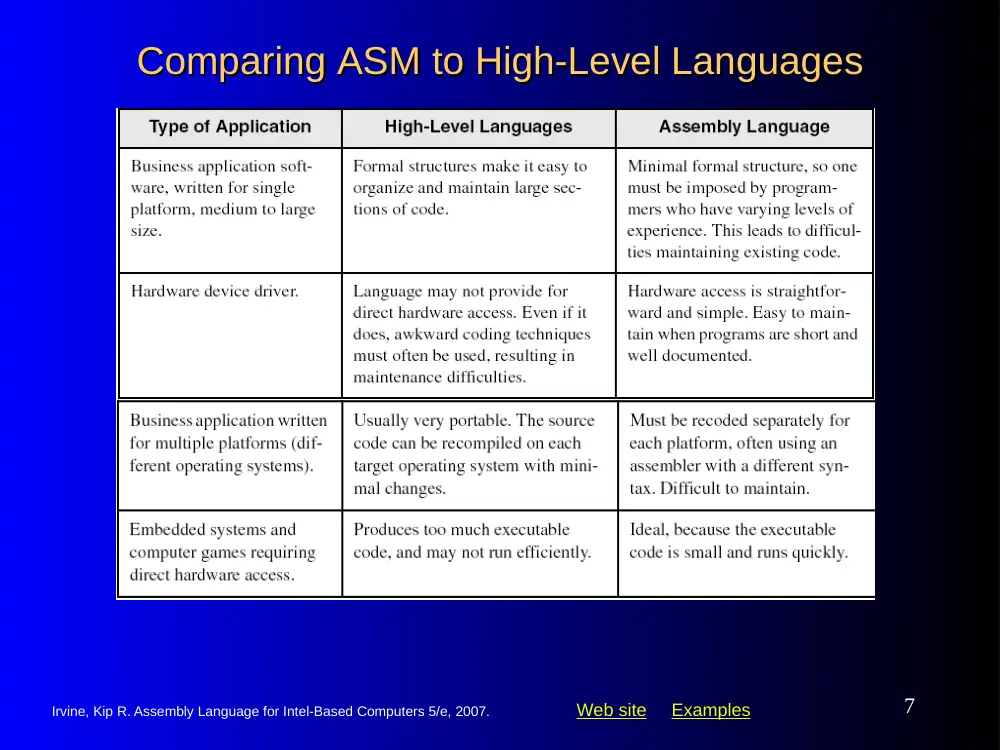
Comparing ASM to High-Level Languages
Comparing ASM to High-Level Languages
Irvine, Kip R. Assembly Language for Intel-Based Computers 5/e, 2007.
Web site Examples
8
What's Next
What's Next
• Welcome to Assembly Language
• Virtual Machine Concept
• Data Representation
• Boolean Operations
Irvine, Kip R. Assembly Language for Intel-Based Computers 5/e, 2007.
Web site Examples
9
Virtual Machine Concept
Virtual Machine Concept
• Virtual Machines
• Specific Machine Levels
Irvine, Kip R. Assembly Language for Intel-Based Computers 5/e, 2007.
Web site Examples
10
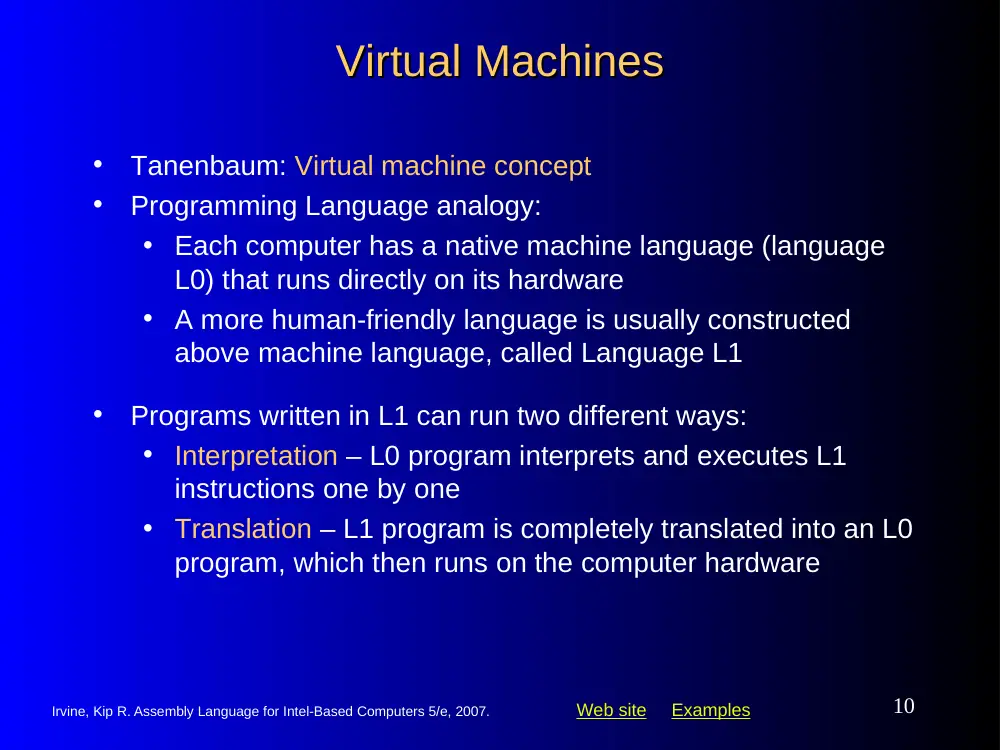
Virtual Machines
Virtual Machines
•
Tanenbaum: Virtual machine concept
•
Programming Language analogy:
• Each computer has a native machine language (language
L0) that runs directly on its hardware
• A more human-friendly language is usually constructed
above machine language, called Language L1
•
Programs written in L1 can run two different ways:
• Interpretation – L0 program interprets and executes L1
instructions one by one
• Translation – L1 program is completely translated into an L0
program, which then runs on the computer hardware
Irvine, Kip R. Assembly Language for Intel-Based Computers 5/e, 2007.
Web site Examples
11
Translating Languages
Translating Languages
English: Display the sum of A times B plus C.
C++: cout << (A * B + C);
Assembly Language:
mov eax,A
mul B
add eax,C
call WriteInt
Intel Machine Language:
A1 00000000
F7 25 00000004
03 05 00000008
E8 00500000
Irvine, Kip R. Assembly Language for Intel-Based Computers 5/e, 2007.
Web site Examples
12
Specific Machine Levels
Specific Machine Levels
(descriptions of individual levels
follow . . . )
Irvine, Kip R. Assembly Language for Intel-Based Computers 5/e, 2007.
Web site Examples
13
High-Level Language
High-Level Language
• Level 5
• Application-oriented languages
• C++, Java, Pascal, Visual Basic . . .
• Programs compile into assembly language
(Level 4)
Irvine, Kip R. Assembly Language for Intel-Based Computers 5/e, 2007.
Web site Examples
14
Assembly Language
Assembly Language
• Level 4
• Instruction mnemonics that have a one-to-
one correspondence to machine language
• Calls functions written at the operating
system level (Level 3)
• Programs are translated into machine
language (Level 2)
Irvine, Kip R. Assembly Language for Intel-Based Computers 5/e, 2007.
Web site Examples
15
Operating System
Operating System
• Level 3
• Provides services to Level 4 programs
• Translated and run at the instruction set
architecture level (Level 2)
Irvine, Kip R. Assembly Language for Intel-Based Computers 5/e, 2007.
Web site Examples
16
Instruction Set Architecture
Instruction Set Architecture
• Level 2
• Also known as conventional machine
language
• Executed by Level 1 (microarchitecture)
program
Irvine, Kip R. Assembly Language for Intel-Based Computers 5/e, 2007.
Web site Examples
17
Microarchitecture
Microarchitecture
• Level 1
• Interprets conventional machine instructions
(Level 2)
• Executed by digital hardware (Level 0)
Irvine, Kip R. Assembly Language for Intel-Based Computers 5/e, 2007.
Web site Examples
18
Digital Logic
Digital Logic
• Level 0
• CPU, constructed from digital logic gates
• System bus
• Memory
• Implemented using bipolar transistors
next: Data Representation
Irvine, Kip R. Assembly Language for Intel-Based Computers 5/e, 2007.
Web site Examples
19
What's Next
What's Next
• Welcome to Assembly Language
• Virtual Machine Concept
• Data Representation
• Boolean Operations
Irvine, Kip R. Assembly Language for Intel-Based Computers 5/e, 2007.
Web site Examples
20
Data Representation
Data Representation
• Binary Numbers
• Translating between binary and decimal
• Binary Addition
• Integer Storage Sizes
• Hexadecimal Integers
• Translating between decimal and hexadecimal
• Hexadecimal subtraction
• Signed Integers
• Binary subtraction
• Character Storage
Irvine, Kip R. Assembly Language for Intel-Based Computers 5/e, 2007.
Web site Examples
21
Binary Numbers
Binary Numbers
• Digits are 1 and 0
• 1 = true
• 0 = false
• MSB – most significant bit
• LSB – least significant bit
• Bit numbering:
0
15
1 0 1 1 0 0 1 0 1 0 0 1 1 1 0 0
MSB
LSB
Irvine, Kip R. Assembly Language for Intel-Based Computers 5/e, 2007.
Web site Examples
22
Binary Numbers
Binary Numbers
•
Each digit (bit) is either 1 or 0
•
Each bit represents a power of 2:
Every binary
number is a
sum of powers
of 2
Irvine, Kip R. Assembly Language for Intel-Based Computers 5/e, 2007.
Web site Examples
23
Translating Binary to Decimal
Translating Binary to Decimal
Weighted positional notation shows how to calculate the
decimal value of each binary bit:
dec = (Dn-1 2n-1) (Dn-2 2n-2) ... (D1 21) (D0 20)
D = binary digit
binary 00001001 = decimal 9:
(1 23) + (1 20) = 9
Irvine, Kip R. Assembly Language for Intel-Based Computers 5/e, 2007.
Web site Examples
24
Translating Unsigned Decimal to Binary
Translating Unsigned Decimal to Binary
• Repeatedly divide the decimal integer by 2. Each
remainder is a binary digit in the translated value:
37 = 100101
Irvine, Kip R. Assembly Language for Intel-Based Computers 5/e, 2007.
Web site Examples
25
Binary Addition
Binary Addition
• Starting with the LSB, add each pair of digits, include
the carry if present.
Irvine, Kip R. Assembly Language for Intel-Based Computers 5/e, 2007.
Web site Examples
26
Integer Storage Sizes
Integer Storage Sizes
What is the largest unsigned integer that may be stored in 20 bits?
Standard sizes:
Irvine, Kip R. Assembly Language for Intel-Based Computers 5/e, 2007.
Web site Examples
27
Hexadecimal Integers
Hexadecimal Integers
Binary values are represented in hexadecimal.
Irvine, Kip R. Assembly Language for Intel-Based Computers 5/e, 2007.
Web site Examples
28
Translating Binary to Hexadecimal
Translating Binary to Hexadecimal
• Each hexadecimal digit corresponds to 4 binary bits.
• Example: Translate the binary integer
000101101010011110010100 to hexadecimal:
Irvine, Kip R. Assembly Language for Intel-Based Computers 5/e, 2007.
Web site Examples
29
Converting Hexadecimal to Decimal
Converting Hexadecimal to Decimal
• Multiply each digit by its corresponding power of 16:
dec = (D3 163) + (D2 162) + (D1 161) + (D0 160)
•
Hex 1234 equals (1 163) + (2 162) + (3 161) + (4 160), or
decimal 4,660.
•
Hex 3BA4 equals (3 163) + (11 * 162) + (10 161) + (4 160), or
decimal 15,268.
Irvine, Kip R. Assembly Language for Intel-Based Computers 5/e, 2007.
Web site Examples
30
Powers of 16
Powers of 16
Used when calculating hexadecimal values up to 8 digits
long:
Irvine, Kip R. Assembly Language for Intel-Based Computers 5/e, 2007.
Web site Examples
31
Converting Decimal to Hexadecimal
Converting Decimal to Hexadecimal
decimal 422 = 1A6 hexadecimal
Irvine, Kip R. Assembly Language for Intel-Based Computers 5/e, 2007.
Web site Examples
32
Hexadecimal Addition
Hexadecimal Addition
•
Divide the sum of two digits by the number base (16). The quotient becomes the carry
value, and the remainder is the sum digit.
36
28
28
6A
42
45
58
4B
78
6D
80
B5
1
1
21 / 16 = 1, rem 5
Important skill: Programmers frequently add and subtract the
addresses of variables and instructions.
Irvine, Kip R. Assembly Language for Intel-Based Computers 5/e, 2007.
Web site Examples
33
Hexadecimal Subtraction
Hexadecimal Subtraction
•
When a borrow is required from the digit to the left, add
16 (decimal) to the current digit's value:
C6
75
A2
47
24
2E
1
16 + 5 = 21
Practice: The address of var1 is 00400020. The address of the next
variable after var1 is 0040006A. How many bytes are used by var1?
Irvine, Kip R. Assembly Language for Intel-Based Computers 5/e, 2007.
Web site Examples
34
Signed Integers
Signed Integers
The highest bit indicates the sign. 1 = negative,
0 = positive
If the highest digit of a hexadecimal integer is > 7, the value is
negative. Examples: 8A, C5, A2, 9D
Irvine, Kip R. Assembly Language for Intel-Based Computers 5/e, 2007.
Web site Examples
35
Forming the Two's Complement
Forming the Two's Complement
• Negative numbers are stored in two's complement
notation
• Represents the additive Inverse
Note that 00000001 + 11111111 = 00000000
Irvine, Kip R. Assembly Language for Intel-Based Computers 5/e, 2007.
Web site Examples
36
Binary Subtraction
Binary Subtraction
• When subtracting A – B, convert B to its two's
complement
• Add A to (–B)
0 0 0 0 1 1 0 0
0 0 0 0 1 1 0 0
– 0 0 0 0 0 0 1 1
1 1 1 1 1 1 0 1
0 0 0 0 1 0 0 1
Practice: Subtract 0101 from 1001.
Irvine, Kip R. Assembly Language for Intel-Based Computers 5/e, 2007.
Web site Examples
37
Learn How To Do the Following:
Learn How To Do the Following:
• Form the two's complement of a hexadecimal integer
• Convert signed binary to decimal
• Convert signed decimal to binary
• Convert signed decimal to hexadecimal
• Convert signed hexadecimal to decimal
Irvine, Kip R. Assembly Language for Intel-Based Computers 5/e, 2007.
Web site Examples
38
Ranges of Signed Integers
Ranges of Signed Integers
The highest bit is reserved for the sign. This limits the range:
Practice: What is the largest positive value that may be stored in 20 bits?
Irvine, Kip R. Assembly Language for Intel-Based Computers 5/e, 2007.
Web site Examples
39
Character Storage
Character Storage
• Character sets
• Standard ASCII
(0 – 127)
• Extended ASCII (0 – 255)
• ANSI (0 – 255)
• Unicode (0 – 65,535)
• Null-terminated String
• Array of characters followed by a null byte
• Using the ASCII table
• back inside cover of book
Irvine, Kip R. Assembly Language for Intel-Based Computers 5/e, 2007.
Web site Examples
40
Numeric Data Representation
Numeric Data Representation
• pure binary
• can be calculated directly
• ASCII binary
• string of digits: "01010101"
• ASCII decimal
• string of digits: "65"
• ASCII hexadecimal
• string of digits: "9C"
next: Boolean Operations
Irvine, Kip R. Assembly Language for Intel-Based Computers 5/e, 2007.
Web site Examples
41
What's Next
What's Next
• Welcome to Assembly Language
• Virtual Machine Concept
• Data Representation
• Boolean Operations
Irvine, Kip R. Assembly Language for Intel-Based Computers 5/e, 2007.
Web site Examples
42
Boolean Operations
Boolean Operations
• NOT
• AND
• OR
• Operator Precedence
• Truth Tables
Irvine, Kip R. Assembly Language for Intel-Based Computers 5/e, 2007.
Web site Examples
43
Boolean Algebra
Boolean Algebra
• Based on symbolic logic, designed by George Boole
• Boolean expressions created from:
• NOT, AND, OR
Irvine, Kip R. Assembly Language for Intel-Based Computers 5/e, 2007.
Web site Examples
44
NOT
NOT
• Inverts (reverses) a boolean value
• Truth table for Boolean NOT operator:
NOT
Digital gate diagram for NOT:
Irvine, Kip R. Assembly Language for Intel-Based Computers 5/e, 2007.
Web site Examples
45
AND
AND
• Truth table for Boolean AND operator:
AND
Digital gate diagram for AND:
Irvine, Kip R. Assembly Language for Intel-Based Computers 5/e, 2007.
Web site Examples
46
OR
OR
• Truth table for Boolean OR operator:
OR
Digital gate diagram for OR:
Irvine, Kip R. Assembly Language for Intel-Based Computers 5/e, 2007.
Web site Examples
47
Operator Precedence
Operator Precedence
• Examples showing the order of operations:
Irvine, Kip R. Assembly Language for Intel-Based Computers 5/e, 2007.
Web site Examples
48
Truth Tables
Truth Tables (1 of 3)
(1 of 3)
• A Boolean function has one or more Boolean inputs,
and returns a single Boolean output.
• A truth table shows all the inputs and outputs of a
Boolean function
Example: X Y
Irvine, Kip R. Assembly Language for Intel-Based Computers 5/e, 2007.
Web site Examples
49
Truth Tables
Truth Tables (2 of 3)
(2 of 3)
• Example: X Y
Irvine, Kip R. Assembly Language for Intel-Based Computers 5/e, 2007.
Web site Examples
50
Truth Tables
Truth Tables (3 of 3)
(3 of 3)
• Example: (Y S) (X S)
Two-input multiplexer
Irvine, Kip R. Assembly Language for Intel-Based Computers 5/e, 2007.
Web site Examples
51
Summary
Summary
• Assembly language helps you learn how software is
constructed at the lowest levels
• Assembly language has a one-to-one relationship
with machine language
• Each layer in a computer's architecture is an
abstraction of a machine
• layers can be hardware or software
• Boolean expressions are essential to the design of
computer hardware and software
Irvine, Kip R. Assembly Language for Intel-Based Computers 5/e, 2007.
Web site Examples
52
54 68 65 20 45 6E 64
54 68 65 20 45 6E 64
What do these numbers represent?