
CSI 312 Lecture 7, Fall 2011
American University of Science and Technology · Computer Architecture · 47 pages · Dr. Abbas Tarhini



Showing the first 10 of 47 pages. Download the PDF to see all of it.
More CSI 312 files
Show the text of this lab
ECE 313 - Computer Organization
Lecture 25 - Pipelined Processor Design 1
2011
Reading: 6.1-6.2
2
Roadmap for the term: major topics
Overview / Abstractions and Technology
Performance
Instruction sets
Logic & arithmetic
Processor Implementation
Single-cycle implemenatation
Multicycle implementation
Pipelined Implementation
Memory systems
Input/Output
3
Pipelining Outline
Introduction
Defining Pipelining
Pipelining Instructions
Hazards
Pipelined Processor Design
Datapath
Control
Advanced Pipelining
Superscalar
Dynamic Pipelining
Examples
4
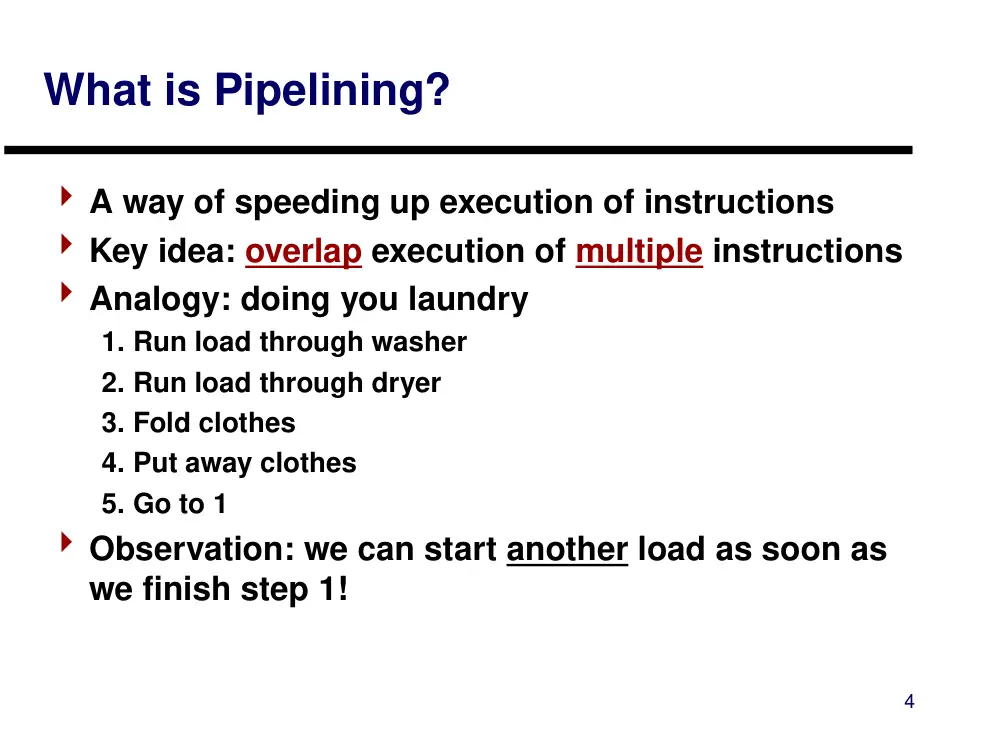
What is Pipelining?
A way of speeding up execution of instructions
Key idea: overlap execution of multiple instructions
Analogy: doing you laundry
1. Run load through washer
2. Run load through dryer
3. Fold clothes
4. Put away clothes
5. Go to 1
Observation: we can start another load as soon as
we finish step 1!
5
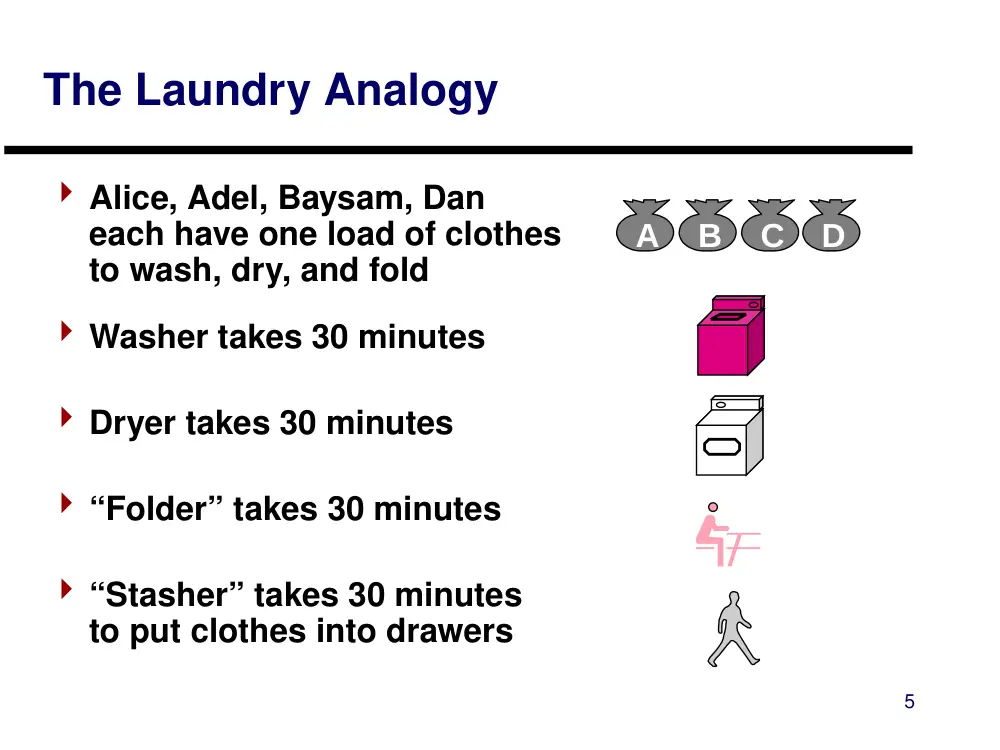
The Laundry Analogy
Alice, Adel, Baysam, Dan
each have one load of clothes
to wash, dry, and fold
Washer takes 30 minutes
Dryer takes 30 minutes
“Folder” takes 30 minutes
“Stasher” takes 30 minutes
to put clothes into drawers
A
B
C
D
6
If we do laundry sequentially...
30
T
a
s
k
O
r
d
e
r
Time
A
30 30
30
30
B
30
30
30
C
30 30
30
30
D
30 30
30
30
6 PM
7
8
9
10
11
12
1
2 AM
Time Required: 8 hours for 4 loads
7
12
2 AM
6 PM
7
8
9
10
11
1
Time
30
A
C
D
B
30 30
30 30
30 30
T
a
s
k
O
r
d
e
r
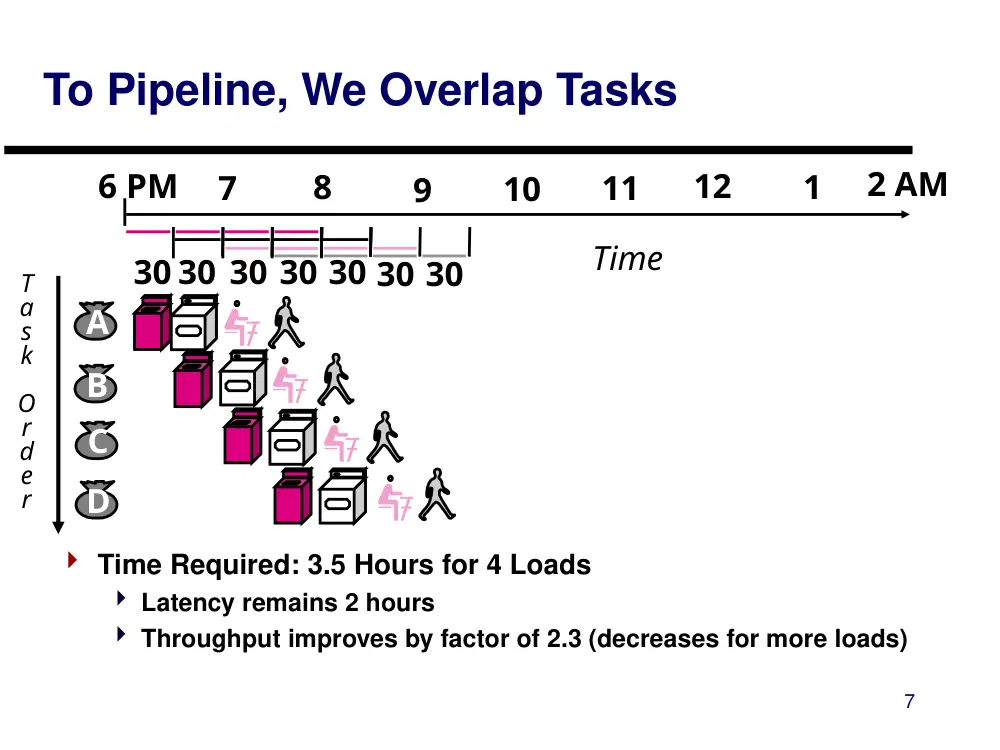
To Pipeline, We Overlap Tasks
Time Required: 3.5 Hours for 4 Loads
Latency remains 2 hours
Throughput improves by factor of 2.3 (decreases for more loads)
8
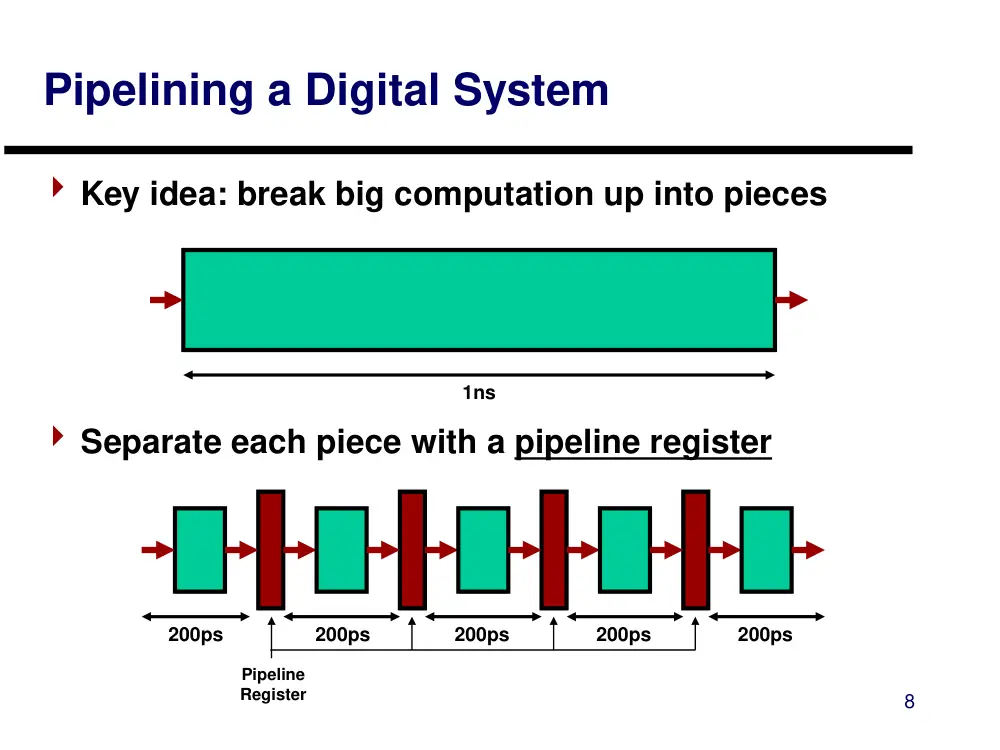
Pipelining a Digital System
Key idea: break big computation up into pieces
Separate each piece with a pipeline register
1ns
200ps
200ps
200ps
200ps
200ps
Pipeline
Register
9
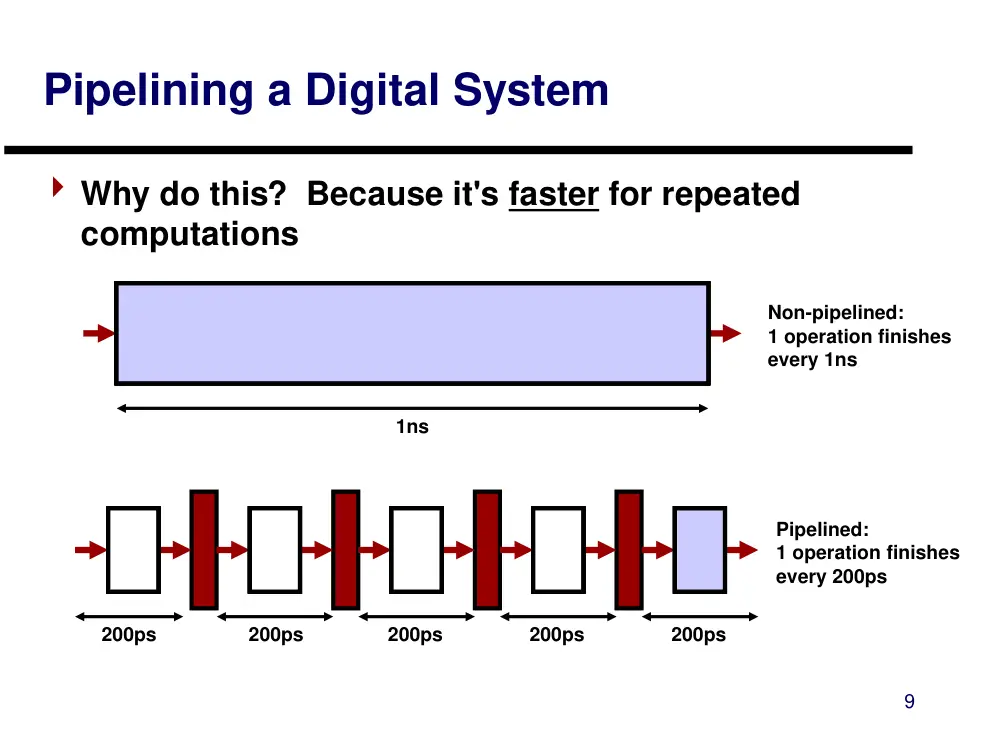
Pipelining a Digital System
Why do this? Because it's faster for repeated
computations
1ns
Non-pipelined:
1 operation finishes
every 1ns
200ps
200ps
200ps
200ps
200ps
Pipelined:
1 operation finishes
every 200ps
10
Comments about pipelining
Pipelining increases throughput, but not latency
Answer available every 200ps, BUT
A single computation still takes 1ns
Limitations:
Computations must be divisible into stage size
Pipeline registers add overhead
11
Pipelining Outline
Introduction
Defining Pipelining
Pipelining Instructions
Hazards
Pipelined Processor Design
Datapath
Control
Advanced Pipelining
Superscalar
Dynamic Pipelining
Examples
12
Pipelining a Processor
Recall the 5 steps in instruction execution:
1. Instruction Fetch
2. Instruction Decode and Register Read
3. Execution operation or calculate address
4. Memory access
5. Write result into register
Review: Single-Cycle Processor
All 5 steps done in a single clock cycle
Dedicated hardware required for each step
What happens if we break execution into multiple
cycles, but keep the extra hardware?
13
Review - Single-Cycle Processor
5
5
16
RD1
RD2
RN1
RN2
WN
WD
Register File
ALU
E
X
T
N
D
16
32
RD
WD
Data
Memory
ADDR
5
Instruction I
32
M
U
X
<<2
RD
Instruction
Memory
ADDR
PC
4
ADD
ADD
M
U
X
32
IF
Instruction Fetch
ID
Instruction Decode
EX
Execute/ Address Calc.
MEM
Memory Access
WB
Write Back
14
Pipelining - Key Idea
Question: What happens if we break execution into
multiple cycles, but keep the extra hardware?
Answer: in the best case, we can start executing a
new instruction on each clock cycle -
this is pipelining
Pipelining stages:
IF - Instruction Fetch
ID - Instruction Decode
EX - Execute / Address Calculation
MEM - Memory Access (read / write)
WB - Write Back (results into register file)
15
Basic Pipelined Processor
IF/ID
Pipeline Registers
5
5
16
RD1
RD2
RN1
RN2
WN
WD
Register File
ALU
E
X
T
N
D
16
32
RD
WD
Data
Memory
ADDR
5
Instruction I
32
M
U
X
<<2
RD
Instruction
Memory
ADDR
PC
4
ADD
ADD
M
U
X
32
ID/EX
EX/MEM
MEM/WB
16
Single-Cycle vs. Pipelined Execution
Non-Pipelined
0
200
400
600
800
1000
1200
1400
1600
1800
lw $1, 100($0)
Instruction
Fetch
REG
RD
ALU
REG
WR
MEM
lw $2, 200($0)
Instruction
Fetch
REG
RD
ALU
REG
WR
MEM
lw $3, 300($0)
Instruction
Fetch
Time
Instruction
Order
800ps
800ps
800ps
Pipelined
0
200
400
600
800
1000
1200
1400
1600
lw $1, 100($0)
Instruction
Fetch
REG
RD
ALU
REG
WR
MEM
lw $2, 200($0)
lw $3, 300($0)
Time
Instruction
Order
200ps
Instruction
Fetch
REG
RD
ALU
REG
WR
MEM
Instruction
Fetch
REG
RD
ALU
REG
WR
MEM
200ps
200ps
200ps
200ps
200ps
200ps
17
Comments about Pipelining
The good news
Multiple instructions are being processed at same time
This works because stages are isolated by registers
Best case speedup of N
The bad news
Instructions interfere with each other - hazards
• Example: different instructions may need the same piece of
hardware (e.g., memory) in same clock cycle
• Example: instruction may require a result produced by an
earlier instruction that is not yet complete
Worst case: must suspend execution - stall
18
Pipelined Example -
Executing Multiple Instructions
Consider the following instruction sequence:
lw $r0, 10($r1)
sw $r3, 20($r4)
add $r5, $r6, $r7
sub $r8, $r9, $r10
19
Executing Multiple Instructions
Clock Cycle 1
LW
5
RD1
RD2
RN1
RN2
WN
WD
Register
File
ALU
E
X
T
N
D
16
32
RD
WD
Data
Memory
ADDR
32
M
U
X
<<2
RD
Instruction
Memory
ADDR
PC
4
ADD
ADD
M
U
X
5
5
5
IF/ID
ID/EX
EX/MEM
MEM/WB
Zero
20
5
RD1
RD2
RN1
RN2
WN
WD
Register
File
ALU
E
X
T
N
D
16
32
RD
WD
Data
Memory
ADDR
32
M
U
X
<<2
RD
Instruction
Memory
ADDR
PC
4
ADD
ADD
M
U
X
5
5
5
IF/ID
ID/EX
EX/MEM
MEM/WB
Zero
Executing Multiple Instructions
Clock Cycle 2
LW
SW
21
5
RD1
RD2
RN1
RN2
WN
WD
Register
File
ALU
E
X
T
N
D
16
32
RD
WD
Data
Memory
ADDR
32
M
U
X
<<2
RD
Instruction
Memory
ADDR
PC
4
ADD
ADD
M
U
X
5
5
5
IF/ID
ID/EX
EX/MEM
MEM/WB
Zero
Executing Multiple Instructions
Clock Cycle 3
LW
SW
ADD
22
5
RD1
RD2
RN1
RN2
WN
WD
Register
File
ALU
E
X
T
N
D
16
32
RD
WD
Data
Memory
ADDR
32
M
U
X
<<2
RD
Instruction
Memory
ADDR
PC
4
ADD
ADD
M
U
X
5
5
5
IF/ID
ID/EX
EX/MEM
MEM/WB
Zero
Executing Multiple Instructions
Clock Cycle 4
LW
SW
ADD
SUB
23
Executing Multiple Instructions
Clock Cycle 5
5
RD1
RD2
RN1
RN2
WN
WD
Register
File
ALU
E
X
T
N
D
16
32
RD
WD
Data
Memory
ADDR
32
M
U
X
<<2
RD
Instruction
Memory
ADDR
PC
4
ADD
ADD
M
U
X
5
5
5
IF/ID
ID/EX
EX/MEM
MEM/WB
Zero
LW
SW
ADD
SUB
Lecture 17 - Pipelining 1
24
Executing Multiple Instructions
Clock Cycle 6
5
RD1
RD2
RN1
RN2
WN
WD
Register
File
ALU
E
X
T
N
D
16
32
RD
WD
Data
Memory
ADDR
32
M
U
X
<<2
RD
Instruction
Memory
ADDR
PC
4
ADD
ADD
M
U
X
5
5
5
IF/ID
ID/EX
EX/MEM
MEM/WB
Zero
SW
ADD
SUB
Lecture 17 - Pipelining 1
25
Executing Multiple Instructions
Clock Cycle 7
5
RD1
RD2
RN1
RN2
WN
WD
Register
File
ALU
E
X
T
N
D
16
32
RD
WD
Data
Memory
ADDR
32
M
U
X
<<2
RD
Instruction
Memory
ADDR
PC
4
ADD
ADD
M
U
X
5
5
5
IF/ID
ID/EX
EX/MEM
MEM/WB
Zero
ADD
SUB
Lecture 17 - Pipelining 1
26
Executing Multiple Instructions
Clock Cycle 8
5
RD1
RD2
RN1
RN2
WN
WD
Register
File
ALU
E
X
T
N
D
16
32
RD
WD
Data
Memory
ADDR
32
M
U
X
<<2
RD
Instruction
Memory
ADDR
PC
4
ADD
ADD
M
U
X
5
5
5
IF/ID
ID/EX
EX/MEM
MEM/WB
Zero
SUB
Lecture 17 - Pipelining 1
27
Alternative View - Multicycle Diagram
IM
REG
ALU
DM
REG
lw $r0, 10($r1)
sw $r3, 20($r4)
add $r5, $r6, $r7
CC 1
CC 2
CC 3
CC 4
CC 5
CC 6
CC 7
IM
REG
ALU
DM
REG
IM
REG
ALU
DM
REG
sub $r8, $r9, $r10
IM
REG
ALU
DM
REG
CC 8
Lecture 17 - Pipelining 1
28
Pipelining Outline
Introduction
Defining Pipelining
Pipelining Instructions
Hazards
Pipelined Processor Design
Datapath
Control
Advanced Pipelining
Superscalar
Dynamic Pipelining
Examples
Lecture 17 - Pipelining 1
29
Pipeline Hazards
Where one instruction cannot immediately follow
another
Types of hazards
Structural hazards - attempt to use same resource twice
Control hazards - attempt to make decision before
condition is evaluated
Data hazards - attempt to use data before it is ready
Can always resolve hazards by waiting
Lecture 17 - Pipelining 1
30
Structural Hazards
Attempt to use same resource twice at same time
Example: Single Memory for instructions and data
Accessed by IF stage
Accessed at same time by MEM stage
Solutions
Delay second access by one clock cycle, OR
Provide separate memories for instructions, data
• This is what the book does
• This is called a “Harvard Architecture”
• Real pipelined processors have separate caches
Lecture 17 - Pipelining 1
31
0
2
4
6
8
10
Time
12
IF
ID
EX
MEM
WB
14
IF
ID
EX
MEM
WB
IF
ID
EX
MEM
WB
IF
ID
EX
MEM
WB
14
Example Structural Hazard -
Single Memory
Memory Conflict
Lecture 17 - Pipelining 1
32
Control Hazards
Attempt to make a decision before condition is
evaluated
Example:
beq $s0, $s1, offset
Assume we add hardware to second stage to:
Compare fetched registers for equality
Compute branch target
This allows branch to be taken at end of second
clock cycle
But, this still means result is not ready when we
want to load the next instruction!
Lecture 17 - Pipelining 1
33
Control Hazard Solutions
Stall - stop loading instructions until result is
available
Predict - assume an outcome and continue fetching
(undo if prediction is wrong)
Delayed branch - specify in architecture that
following instruction is always executed
Lecture 17 - Pipelining 1
34
Control Hazard - Stall
beq
writes PC
here
new PC
used here
0
2
4
6
8
10
12
IF
ID
EX
MEM
WB
16
add $r4,$r5,$r6
beq $r0,$r1,tgt
IF
ID
EX
MEM
WB
IF
ID
EX
MEM
WB
sw $s4,200($t5)
18
BUBBLE
BUBBLE
BUBBLE
BUBBLE
BUBBLE
STALL
ECE 313 Fall 2006
Lecture 17 - Pipelining 1
35
Control Hazard - Correct Prediction
Fetch assuming
branch taken
0
2
4
6
8
10
12
IF
ID
EX
MEM
WB
16
add $r4,$r5,$r6
beq $r0,$r1,tgt
IF
ID
EX
MEM
WB
IF
ID
EX
MEM
WB
tgt:
sw $s4,200($t5)
18
ECE 313 Fall 2006
Lecture 17 - Pipelining 1
36
Control Hazard - Incorrect Prediction
“Squashed”
instruction
0
2
4
6
8
10
12
IF
ID
EX
MEM
WB
16
add $r4,$r5,$r6
beq $r0,$r1,tgt
IF
ID
EX
MEM
WB
IF
ID
EX
MEM
WB
18
BUBBLE
BUBBLE
BUBBLE
BUBBLE
tgt:
sw $s4,200($t5)
(incorrect - STALL)
IF
or $r8,$r8,$r9
ECE 313 Fall 2006
Lecture 17 - Pipelining 1
37
Control Hazard - Delayed Branch
always executes
correct PC avail. here
0
2
4
6
8
10
12
IF
ID
EX
MEM
WB
16
add $r4,$r5,$r6
beq $r0,$r1,tgt
IF
ID
EX
MEM
WB
IF
ID
EX
MEM
WB
18
Branch SLOT:
and $r6,$r6,$r7
tgt:
sw $s4,200($t5)
IF
ID
EX
MEM
WB
ECE 313 Fall 2006
Lecture 17 - Pipelining 1
38
Summary - Control Hazard Solutions
Stall - stop fetching instr. until result is available
Significant performance penalty
Hardware required to stall
Predict - assume an outcome and continue fetching
(undo if prediction is wrong)
Performance penalty only when guess wrong
Hardware required to "squash" instructions
Delayed branch - specify in architecture that
following instruction is always executed
Compiler re-orders instructions into delay slot
Insert "NOP" (no-op) operations when can't use (~50%)
This is how original MIPS worked
ECE 313 Fall 2006
Lecture 17 - Pipelining 1
39
Data Hazards
Attempt to use data before it is ready
Solutions
Stalling - wait until result is available
Forwarding- make data available inside datapath
Reordering instructions - use compiler to avoid hazards
Examples:
add $s0, $t0, $t1 ; $s0 = $t0+$t1
sub $t2, $s0, $t3 ; $t2 = $s0-$t3
lw $s0, 0($t0)
; $s0 = MEM[$t0]
sub $t2, $s0, $t3 ; $t2 = $s0-$t2
ECE 313 Fall 2006
Lecture 17 - Pipelining 1
40
Data Hazard - Stalling
0
2
4
6
8
10
12
IF
ID
EX
MEM
16
add $s0 ,$t0,$t1
STALL
18
sub $t2, $s0 ,$t3
IF
EX
MEM
STALL
BUBBLE
BUBBLE
BUBBLE
BUBBLE
BUBBLE
BUBBLE
BUBBLE
BUBBLE
BUBBLE
$s0
written
here
W
s0
WB
$s0 read
here
R
s0
BUBBLE
ECE 313 Fall 2006
Lecture 17 - Pipelining 1
41
Data Hazards - Forwarding
Key idea: connect new value directly to next stage
Still read s0, but ignore in favor of new result
Problem: what about load instructions?
ID
0
2
4
6
8
10
12
IF
ID
EX
MEM
16
add $s0 ,$t0,$t1
18
sub $t2, $s0 ,$t3
IF
EX
MEM
W
s0
WB
R
s0
new value
of s0
ECE 313 Fall 2006
Lecture 17 - Pipelining 1
42
Data Hazards - Forwarding
STALL still required for load - data avail. after MEM
MIPS architecture calls this delayed load, initial
implementations required compiler to deal with this
ID
0
2
4
6
8
10
12
IF
ID
EX
MEM
16
lw $s0 ,20($t1)
18
sub $t2, $s0 ,$t3
IF
EX
MEM
W
s0
WB
R
s0
new value
of s0
STALL
BUBBLE
BUBBLE
BUBBLE
BUBBLE
BUBBLE
ECE 313 Fall 2006
Lecture 17 - Pipelining 1
43
Data Hazards - Reordering Instructions
Assuming we have data forwarding, what are the
hazards in this code?
lw $t0, 0($t1)
lw $t2, 4($t1)
sw $t2, 0($t1)
sw $t0, 4($t1)
Reorder instructions to remove hazard:
lw $t0, 0($t1)
lw $t2, 4($t1)
sw $t0, 4($t1)
sw $t2, 0($t1)
Performance in Pipelining
45
Speed Up Equation for Pipelining
pipelined
d
unpipeline
Time
Cycle
CPI Pipeline stall CPI Cycle Time
Ideal
Ideal CPI Pipeline depth
Speedup
pipelined
d
unpipeline
Time
Cycle
Pipeline stall CPI Cycle Time
1
Pipeline depth
Speedup
per Inst
Stall cycles
CPI pipelined Ideal CPI Average
For simple RISC pipeline, CPI = 1:
46
Performance
Speed Up Pipeline Depth; if ideal CPI is 1,
then:
pipelined
d
unpipeline
Time
Cycle
Pipeline stall CPI Cycle Time
1
Pipeline depth
Speedup
CPU time= Seconds = Instructions x Cycles x Seconds
Program Program Instruction Cycle
CPU time= Seconds = Instructions x Cycles x Seconds
Program Program Instruction Cycle
° Time is measure of performance: latency or throughput
° CPI Law:
ECE 313 Fall 2006
Lecture 17 - Pipelining 1
47
Summary - Pipelining Overview
Pipelining increase throughput (but not latency)
Hazards limit performance
Structural hazards
Control hazards
Data hazards