
CSI 312 Lecture 8, Fall 2011
American University of Science and Technology · Computer Architecture · 10 pages · Dr. Abbas Tarhini


More CSI 312 files
Show the text of this lab
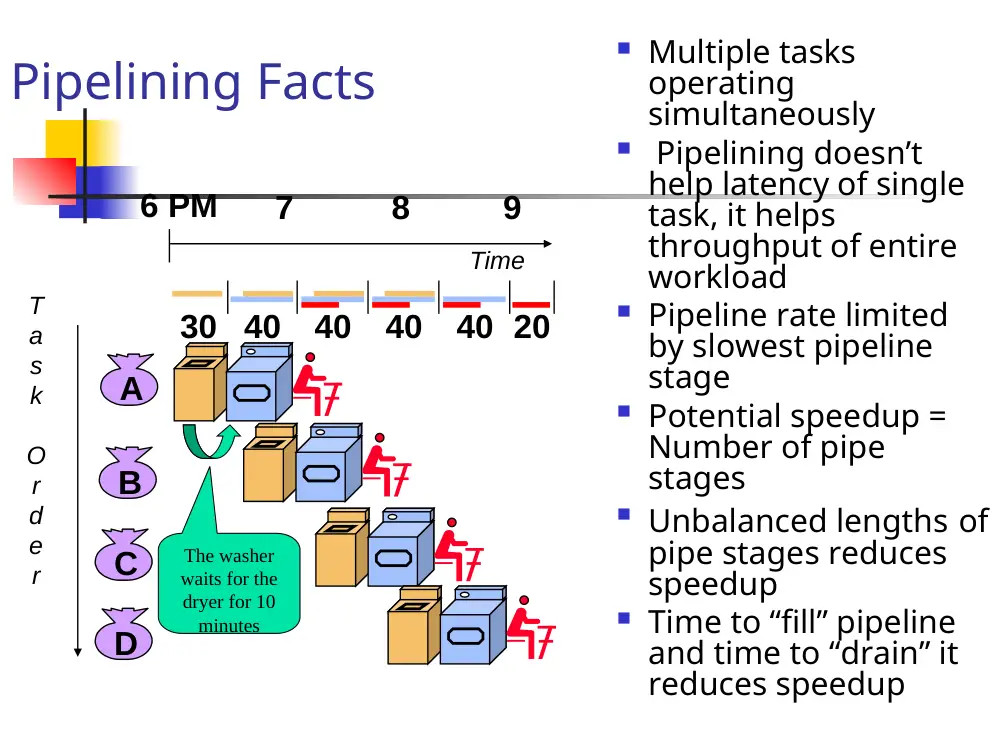
Pipelining Facts
Multiple tasks
operating
simultaneously
Pipelining doesn’t
help latency of single
task, it helps
throughput of entire
workload
Pipeline rate limited
by slowest pipeline
stage
Potential speedup =
Number of pipe
stages
Unbalanced lengths of
pipe stages reduces
speedup
Time to “fill” pipeline
and time to “drain” it
reduces speedup
A
B
C
D
6 PM
7
8
9
T
a
s
k
O
r
d
e
r
Time
30
40
40
40
40 20
The washer
waits for the
dryer for 10
minutes
9.2 Pipelining
Instruction execution is divided into k segments or
stages
Instruction exits pipe stage k-1 and proceeds
into pipe stage k
All pipe stages take the same amount of time;
called one processor cycle
Length of the processor cycle is determined by
the slowest pipe stage
k segments
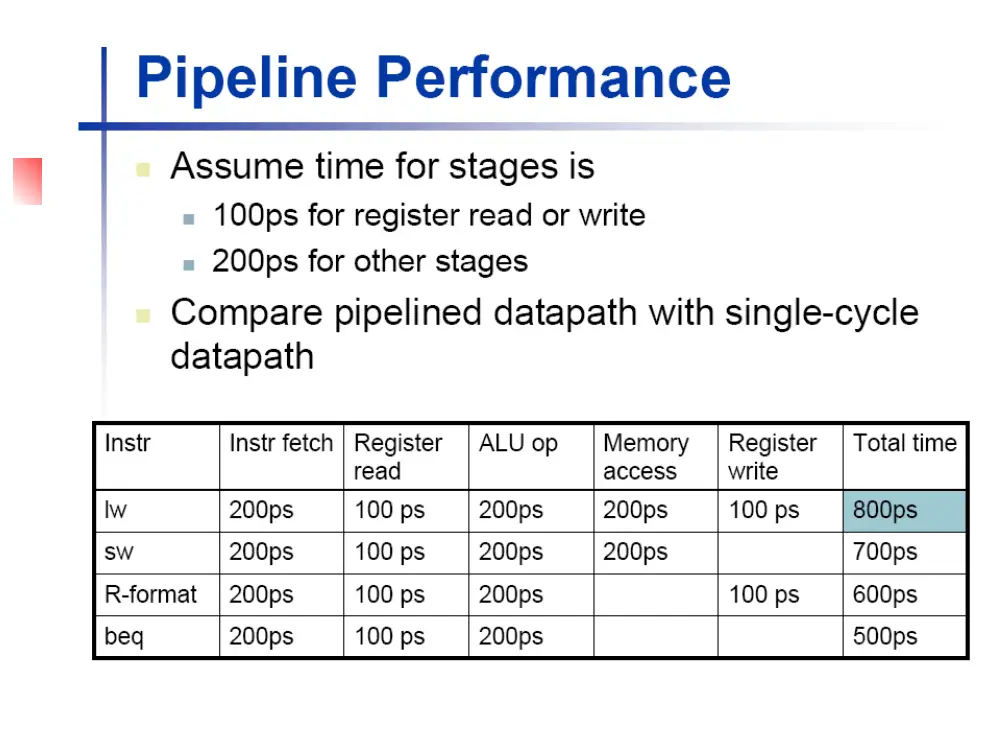
Pipeline Performance
n:instructions
k: stages in
pipeline
: clockcycle
Tk: total time
1))
(
(
n
k
Tk
)1
(
1
n
k
nk
T
T
Speedup
k
n is equivalent to number of loads in
the laundry example
k is the stages (washing, drying and
folding.
Clock cycle is the slowest task time
n
k
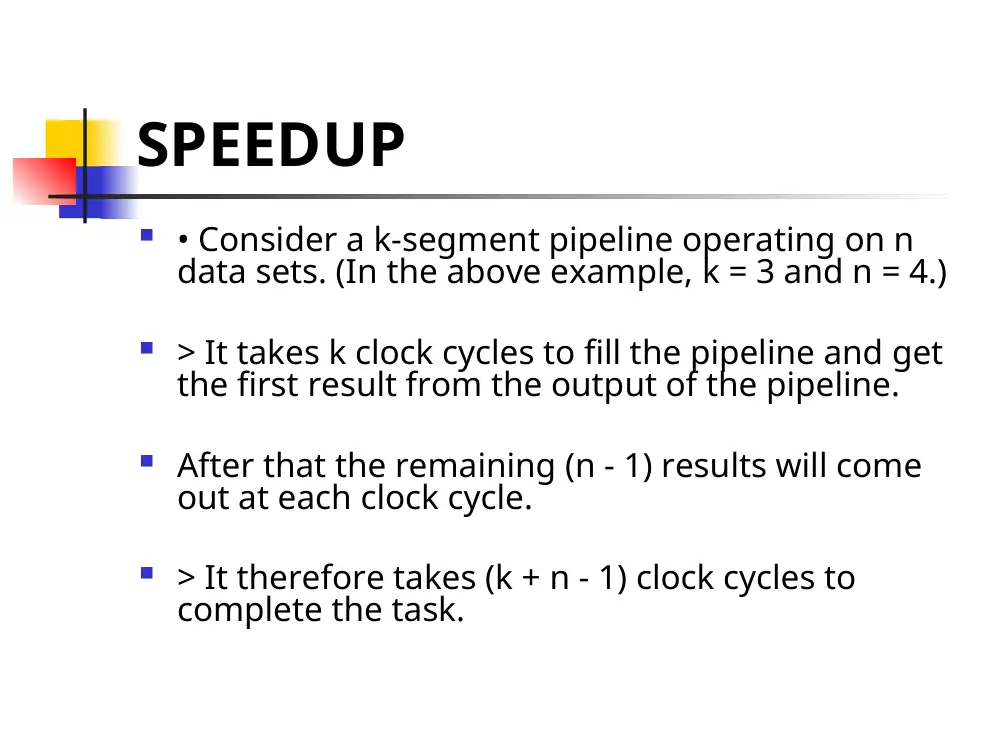
SPEEDUP
• Consider a k-segment pipeline operating on n
data sets. (In the above example, k = 3 and n = 4.)
> It takes k clock cycles to fill the pipeline and get
the first result from the output of the pipeline.
After that the remaining (n - 1) results will come
out at each clock cycle.
> It therefore takes (k + n - 1) clock cycles to
complete the task.
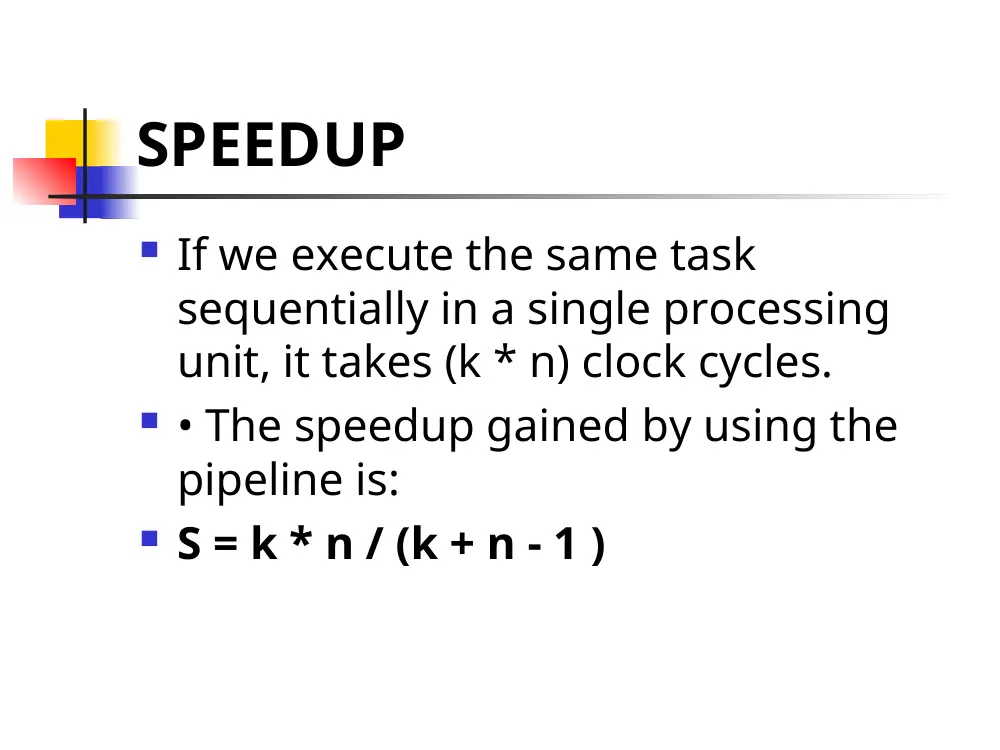
SPEEDUP
If we execute the same task
sequentially in a single processing
unit, it takes (k * n) clock cycles.
• The speedup gained by using the
pipeline is:
S = k * n / (k + n - 1 )
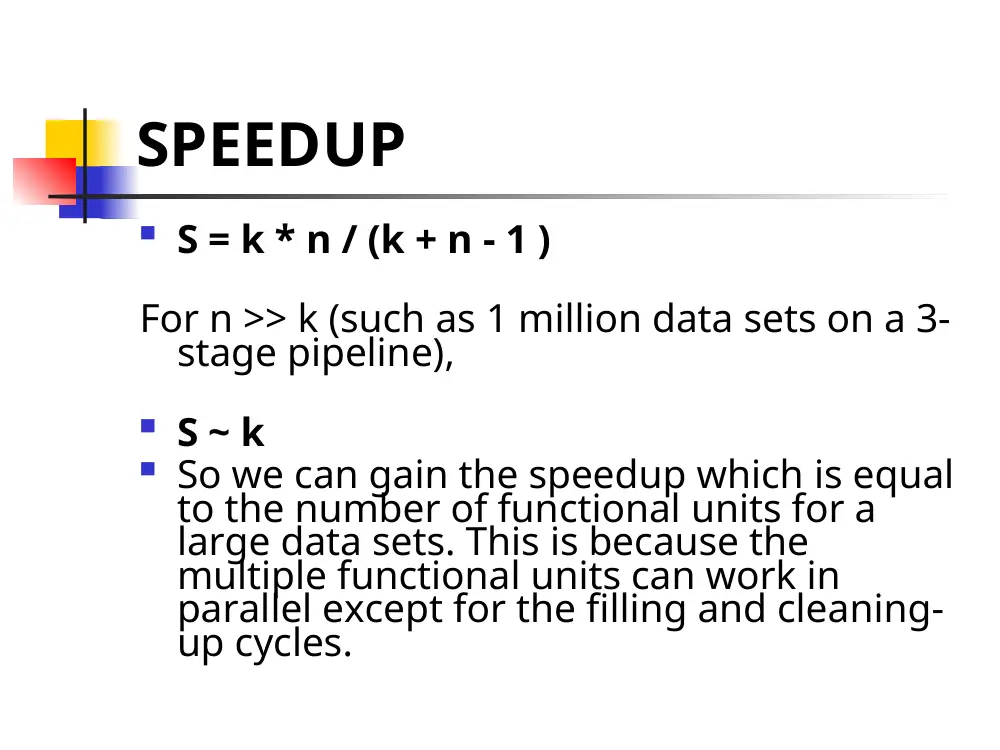
SPEEDUP
S = k * n / (k + n - 1 )
For n >> k (such as 1 million data sets on a 3-
stage pipeline),
S ~ k
So we can gain the speedup which is equal
to the number of functional units for a
large data sets. This is because the
multiple functional units can work in
parallel except for the filling and cleaning-
up cycles.
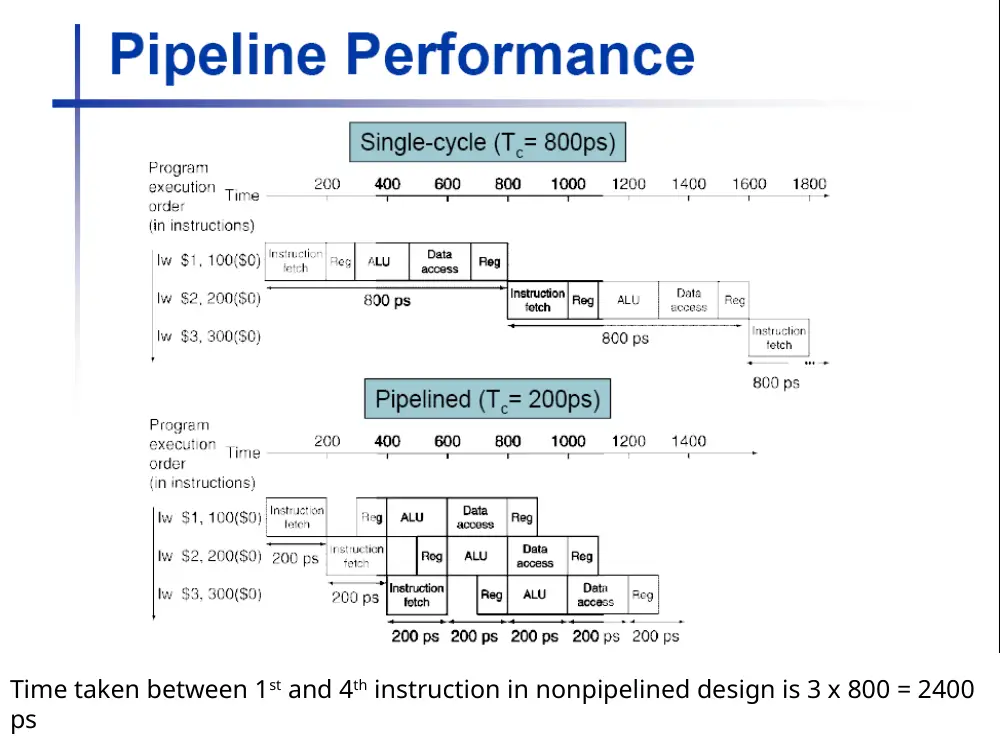
Time taken between 1st and 4th instruction in nonpipelined design is 3 x 800 = 2400
ps
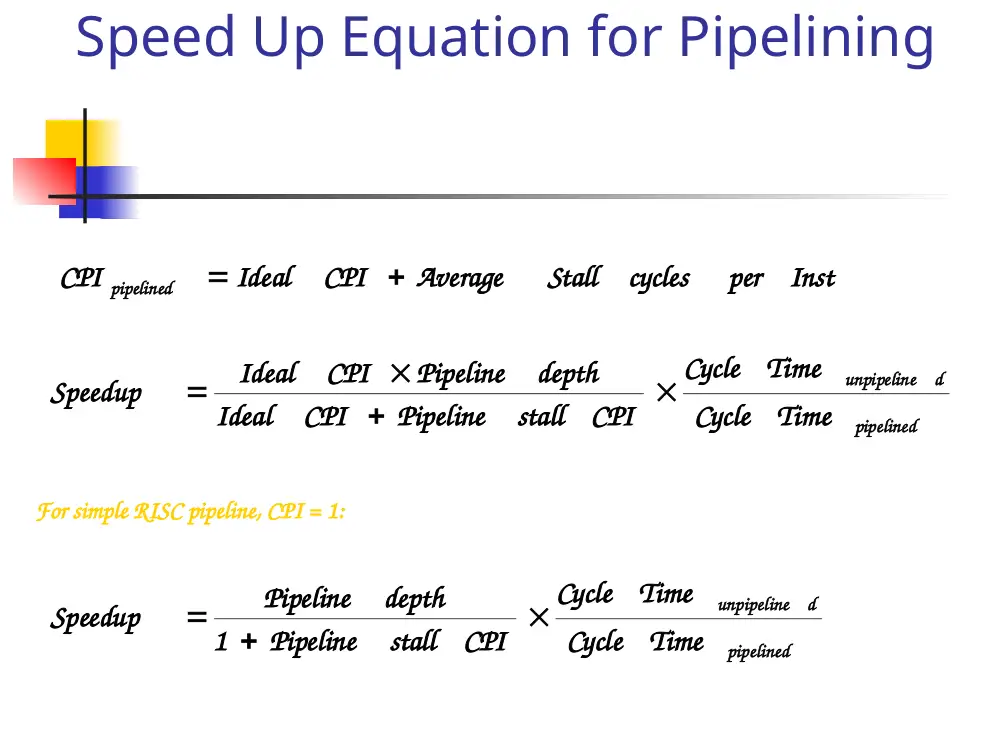
Speed Up Equation for Pipelining
pipelined
d
unpipeline
Time
Cycle
CPI Pipeline stall CPI Cycle Time
Ideal
Ideal CPI Pipeline depth
Speedup
pipelined
d
unpipeline
Time
Cycle
Pipeline stall CPI Cycle Time
1
Pipeline depth
Speedup
per Inst
Stall cycles
CPI pipelined Ideal CPI Average
For simple RISC pipeline, CPI = 1:
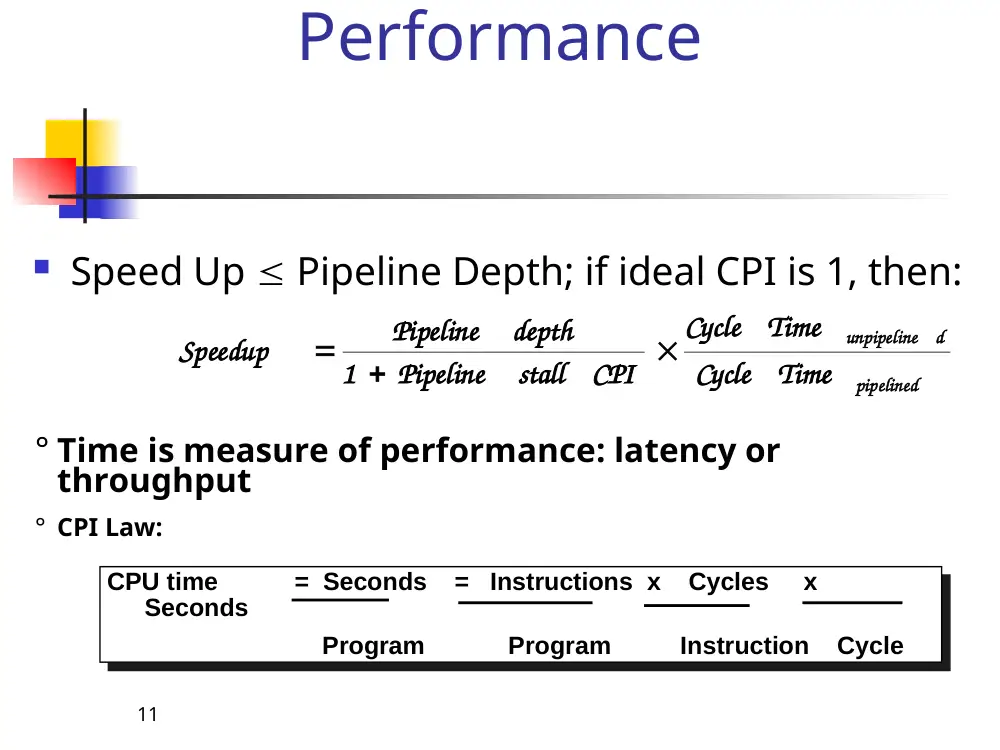
Performance
Speed Up Pipeline Depth; if ideal CPI is 1, then:
11
pipelined
d
unpipeline
Time
Cycle
Pipeline stall CPI Cycle Time
1
Pipeline depth
Speedup
CPU time
= Seconds = Instructions x Cycles x
Seconds
Program
Program Instruction Cycle
CPU time
= Seconds = Instructions x Cycles x
Seconds
Program
Program Instruction Cycle
° Time is measure of performance: latency or
throughput
° CPI Law: