
CSI 446 Lecture, Fall 2012
American University of Science and Technology · Advanced Networking · 10 pages · Mr. Joseph Khoury



More CSI 446 files
Show the text of this lab
OSPF
Lane -State ootine “Protocors
° Two TYPESs
- 3S-ITS
- OSPF
¢ Mamta THREE TABLES?
- NexcuRor TABLE
- “JT orotocr TABLE
- JQootiwe TABLE
° Ose Dasestre’s SHORTEST PATH FIRST Cs?F) ALGORITHM
° Suvp TRIGGERED OPDATES TO AYSNSOONCE NETWOTFK CHANGES
° Sep PENTODIC OPPATES CLS TREFPRESH) ON LONG INTERVALS
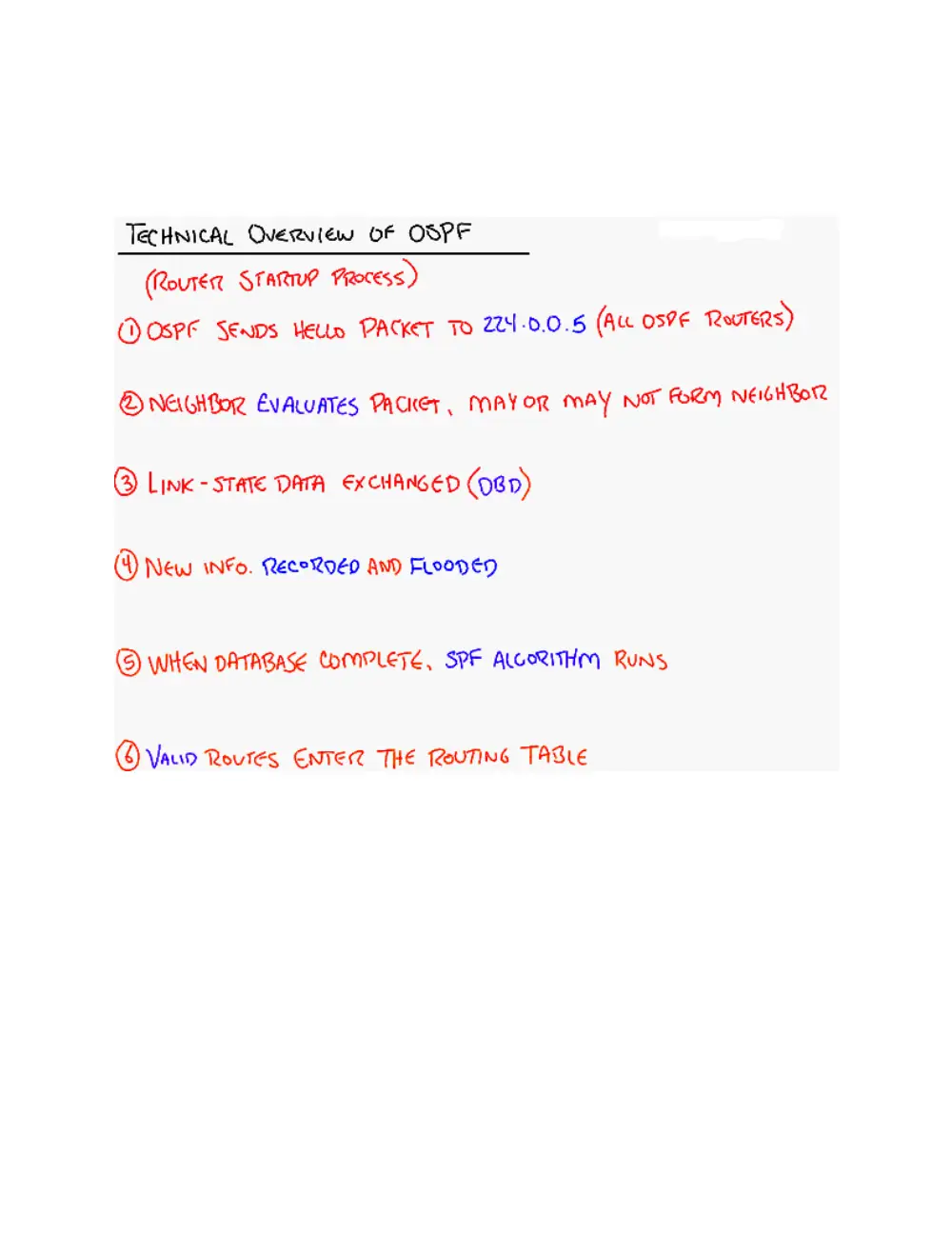
TecHmicac Qverviéw OF OSPF
(Rover Stan? Process)
QDOSPE Seups eu PACKET To 224-0.0.5 (Aue 0576 TowTeRs)
Q Naito EVAWATES PACKET, MAYOR MAY NOT Foemy veto
@ Link -state DATA ExcHAangeD (RD)
©) New INfo. RECORDED AND FLoopen
(3) WHEN DATABASE COMMPLET?, SPF ALLORITHM Runs
@ Vauo Rovies ENTE? THE fouTIné TALE
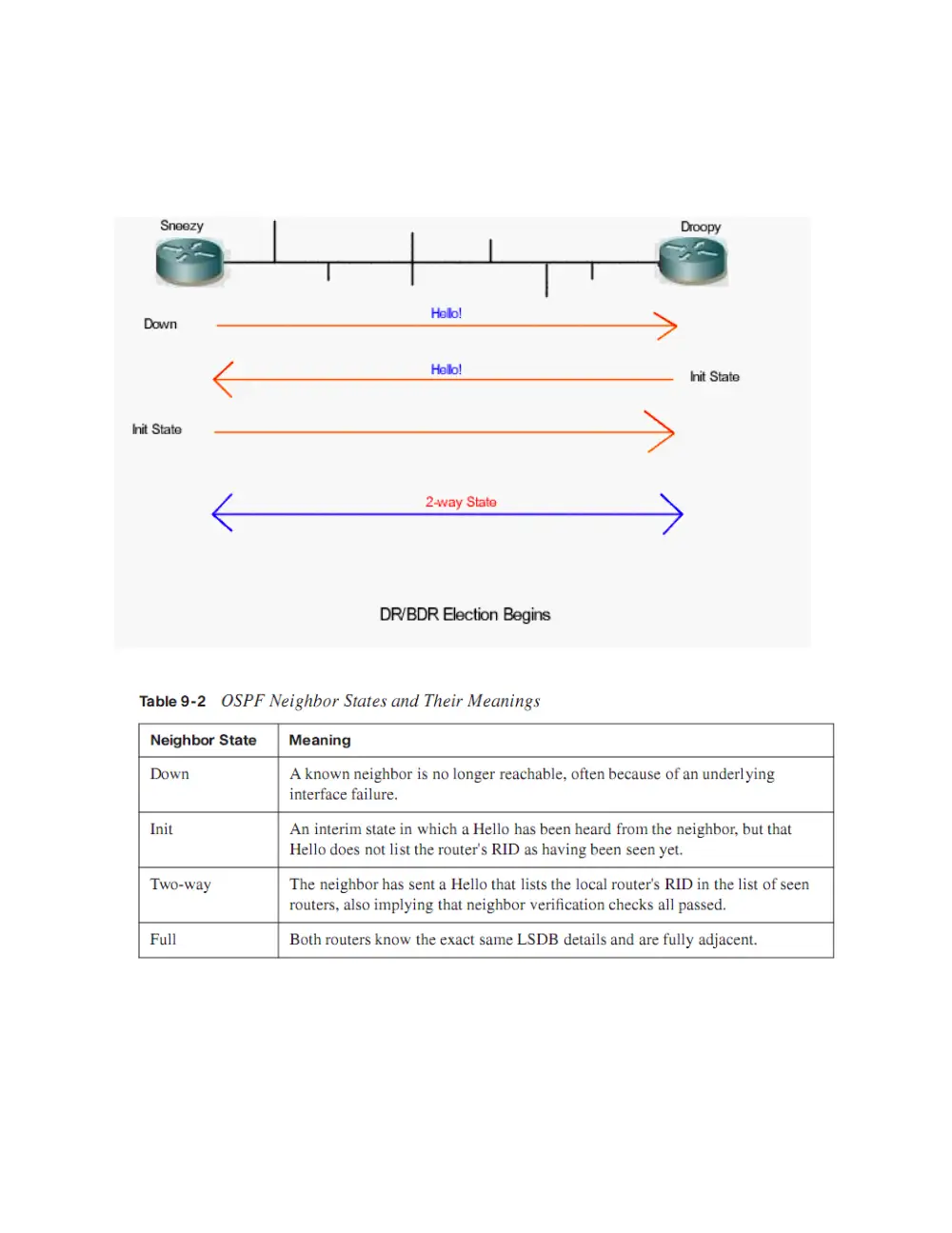
Sneezy
Hallo! S
Init State
Init State
>
g 2-way State ,
DRIBDR Election Begins
Table 9-2 OSPF Neighbor States and Their Meanings
Neighbor State Meaning
Down A known neighbor is no longer reachable, often because of an underlying
interface failure.
Init An interim state in which a Hello has been heard from the neighbor, but that
Hello does not list the router's RID as having been seen yet.
Two-way The neighbor has sent a Hello that lists the local router's RID in the list of seen
routers, also implying that neighbor verification checks all passed.
Full Both routers know the exact same LSDB details and are fully adjacent.
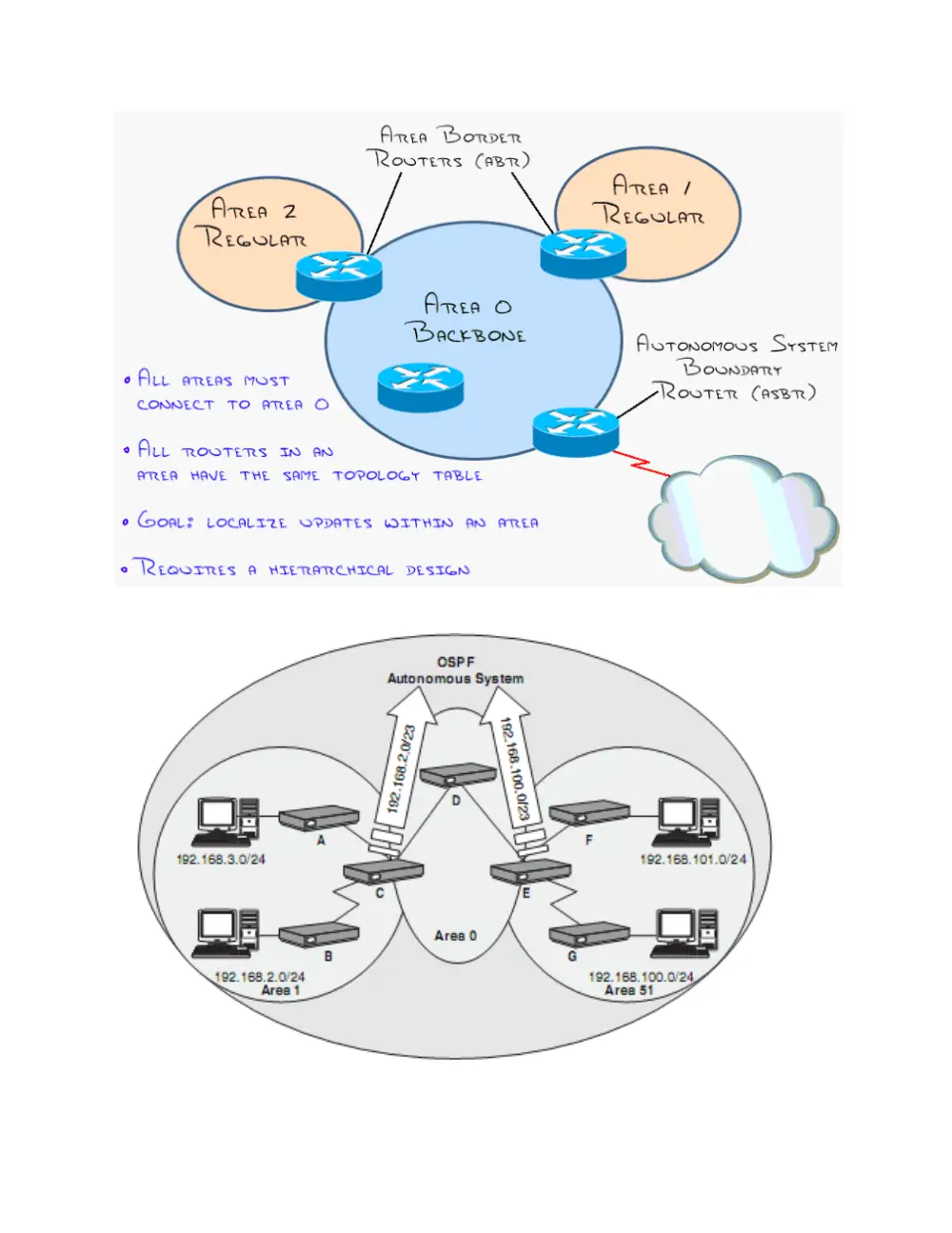
finta Bonen
Pooters Capen)
~ ACE BONE A OTONOMOOLS System
~D OONDET'T
oAt artas most
a PrRoottn CasBr)
CONNECT TO AREA O
I Alu TROOTERTS IN Ad
AREA HAVE THE SAME TOPOLOGY TABLE
° Goa: LOCALIZE OPDATES WITHIN AN AREA
© rates A WIERARCHICAL DESTGN
r
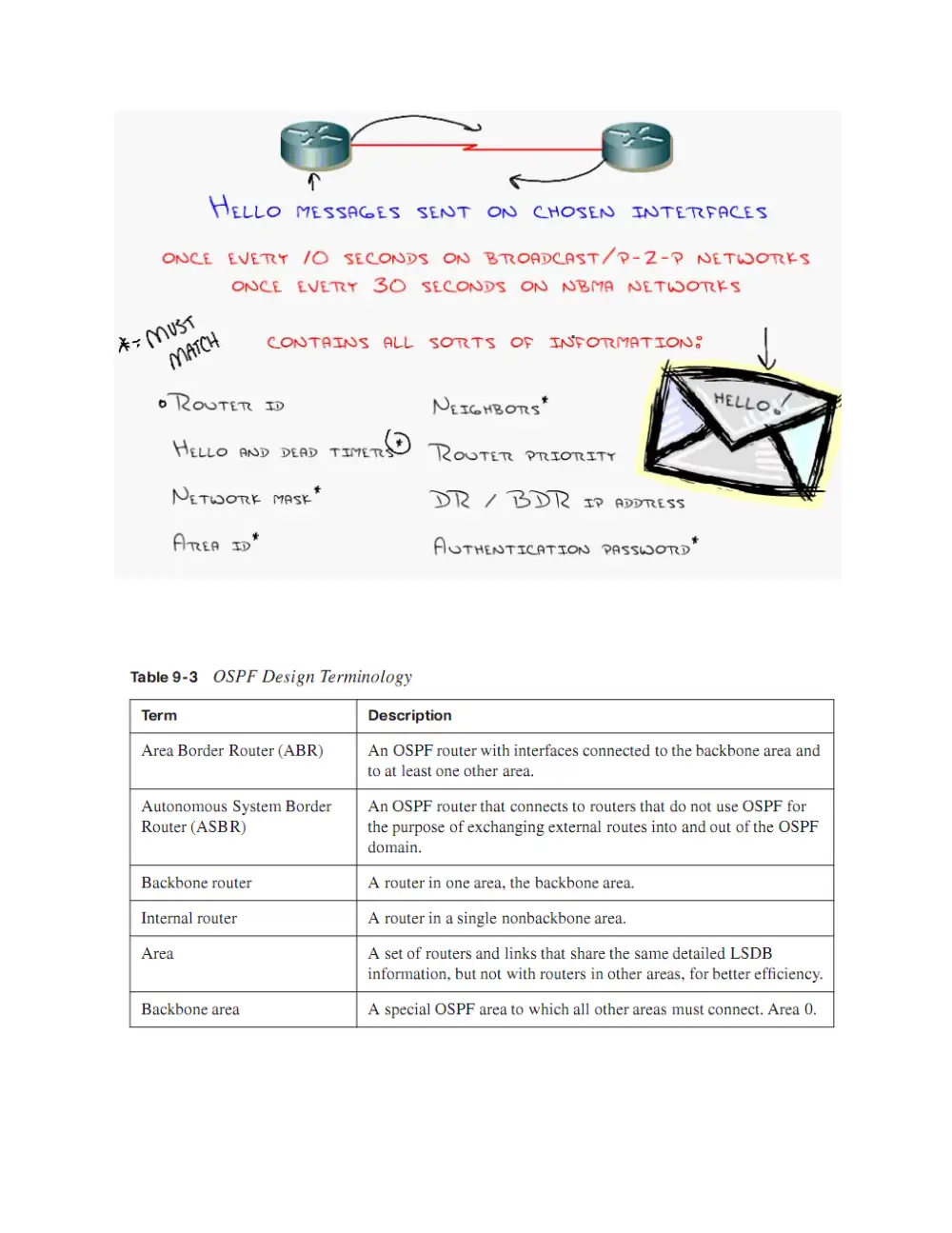
Vetto MESSAGES SENT ON CHOSEN INTERFACES
ONCE EVETT /O SECONDS ON BrROADCAST/?P-Z-? NETIORES
ONCE EVERY 3O SECONDS ON NBMA NETIOOTNES
cons : 2
pad vee CONTAINS ALL SORTS OF INFORMATION iy
iN
© Roottn ip Nescrzons*
*
Veto AND DLAD eave ee! “Roottr PRIORITY
+
Nitwoorr mast DR / WHR x avpness
*
Arta w AloTHENTIcATION PassiooRD*
Table 9-3. OSPF Design Terminology
Term Description
Area Border Router (ABR) An OSPF router with interfaces connected to the backbone area and
to at least one other area.
Autonomous System Border An OSPF router that connects to routers that do not use OSPF for
Router (ASBR) the purpose of exchanging external routes into and out of the OSPF
domain.
Backbone router A router in one area, the backbone area.
Internal router A router in a single nonbackbone area.
Area A set of routers and links that share the same detailed LSDB
information, but not with routers in other areas, for better efficiency.
Backbone area A special OSPF area to which all other areas must connect. Area 0.
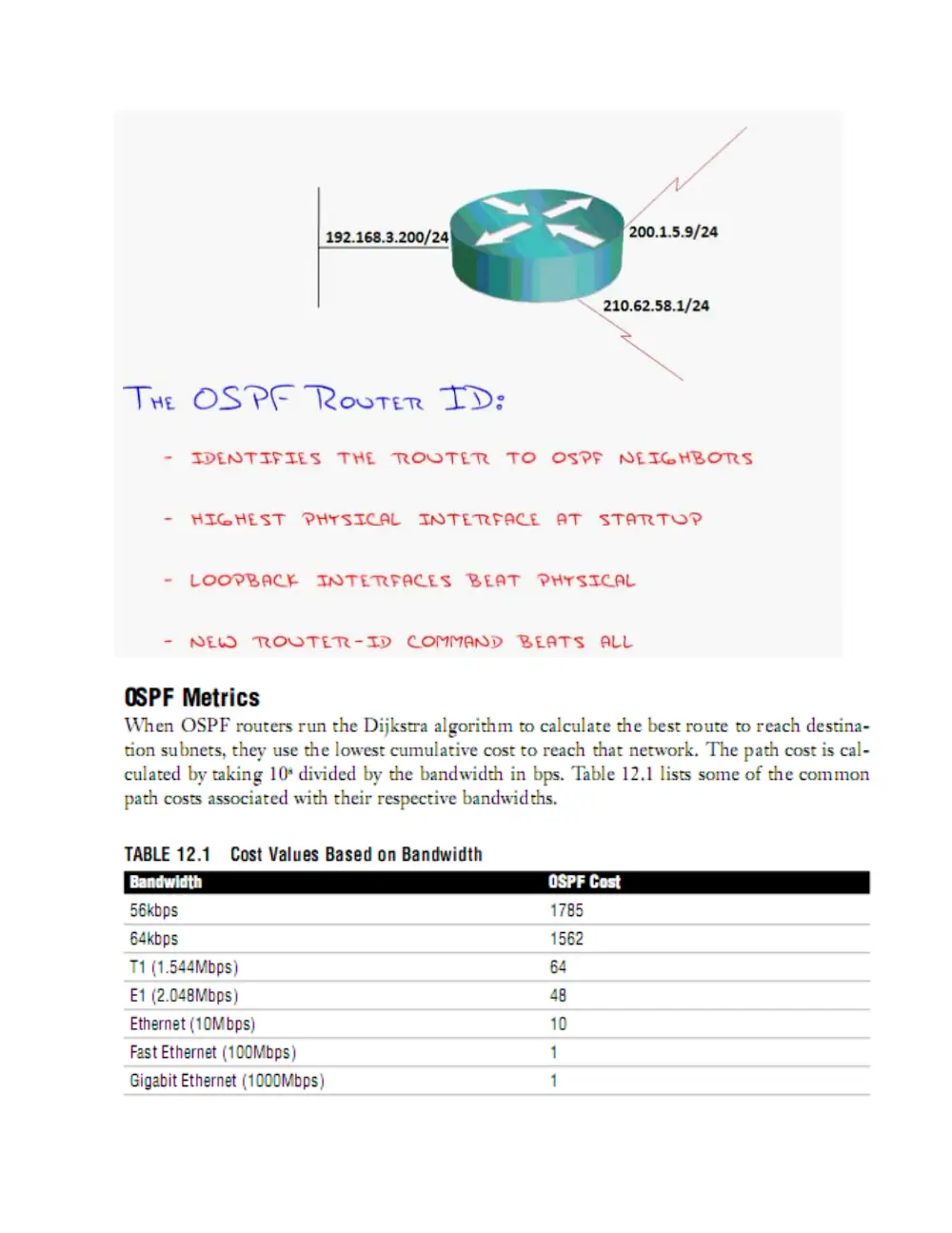
192.168.3.200/24 200.1.5.9/24
210.62.58.1/24
Tue OS PE Roottr TD:
- RZDENTIFIES THE ROOTETN TO OSPF NETGHBOTS
- WIGHEST PHTSICAL INOTETFACE AT STARTOP
- LOOPBACK ISTETFACES BEAT PHTSTCAL
- NEW ROOTEN-TD COMMAND BLATS ALL
OSPF Metrics
When OSPF routers run the Dijkstra algorithm to calculate the best route to reach destina-
tion subnets, they use the lowest cumulative cost to reach that network. The path cost is cal-
culated by taking 1(? divided by the bandwidth in bps. Table 12.1 lists some of the common
path costs associated with their respective bandwidths.
TABLE 12.1 Cost Values Based on Bandwidth
Bandwidth OSPF Cost
5Bkbps 1785
B4kbps 1562
Ti (1.544Mbps) 64
E1 (2.048Mbps} 46
Ethernet (10Mbps) 10
Fast Ethernet (100Mbps) 1
Gigabit Ethernet (1000Mbps) 1
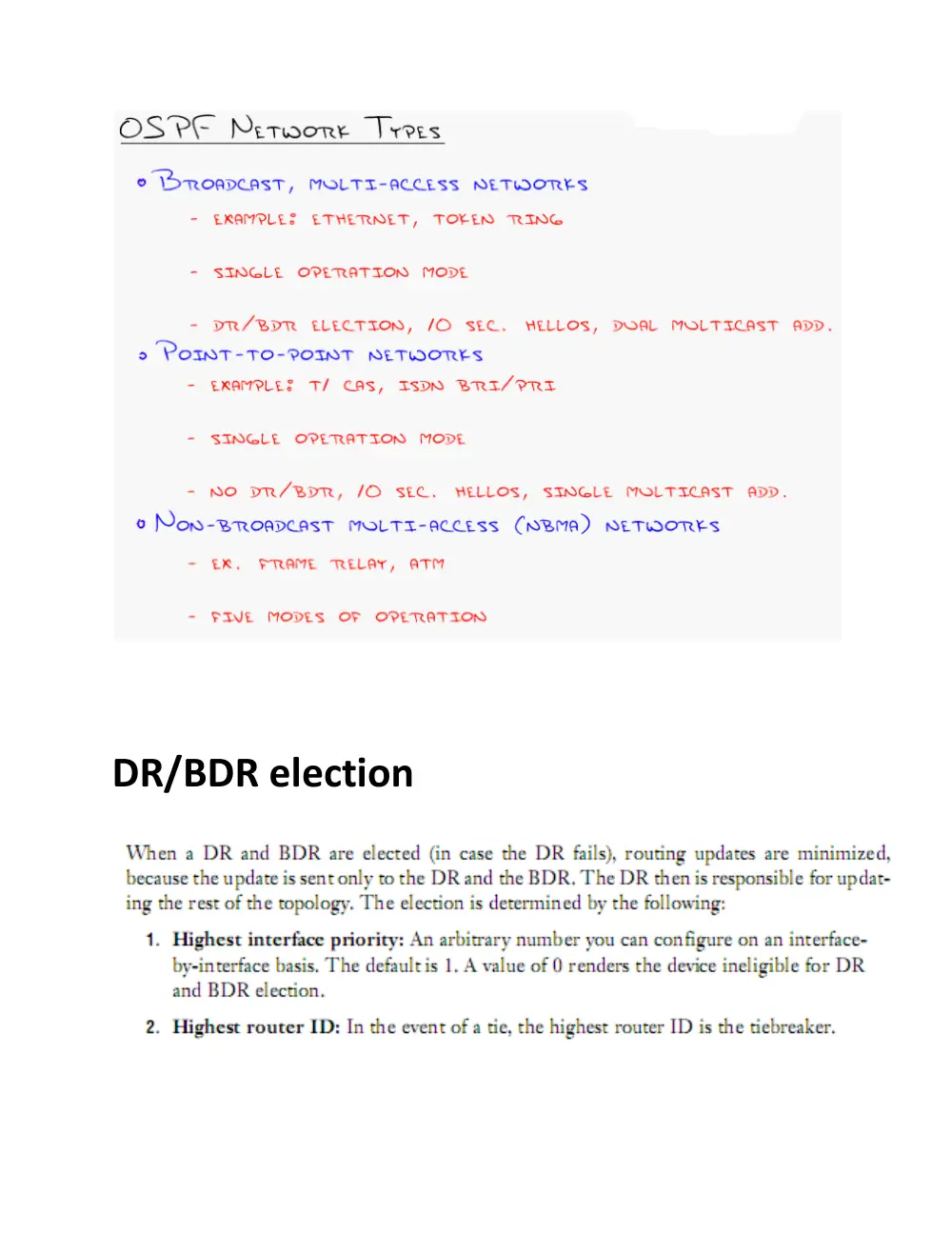
OS PE Network Tres
© Droancast, MOLTI-ACCESS NETWORKS
- ERAMPLEs ETHETRNET, TOFEN TRING
- SINGLE OPETATION MODE
- DR/BDR ELECTION, /O SEC. ELLOS, DOAL MOLTICAST ADD.
2 POINT-TO-POINT NETWORKS
- EXAMPLES T/ CAS, ISDN BRI/PRI
- SINGLE OPETRATION MODE
- NO DR/BDR, /O SEC. ELLOS, SINGLE MOLTICAST ADD.
0 Noy-Broapcast MOLTE-ACCESS COBMA) NETIORES
- EX. FRAME TELAT, ATM
- FINE MODES OF OPETATION
DR/BDR election
When a DR and BDR are elected (in case the DR fails), routing updates are minimized,
because the update is sentonly to the DR and the BDR. The DR then is responsible for updat-
ing the rest of the topology. The election is determined by the following:
1. Highest interface priority: An arbitrary number vou can configure on an interface-
by-interface basis. The defaultis 1. A value of 0 renders the device ineligible for DR
and BDR election.
2. Highest router ID: In the event of a tie, the highest router ID is the tiebreaker.
Pricirity: 23
RID: 10.1.42.25
DR
Priority: 1
RID: 10.1.42.105
Priority: 10
RID: 10.1.42.45
BDR
Priority: 1
FID: 10.1.42.21
Priority: 1
Area d RID: 10.1.42.50
Priority: 1
AID: 10.1.42.5
manner in which OSPF routers propagate LSAs and LSUs. Rather than broadcast this infer-
mation as RIPv1 does, OSPF sends updates to two different reserved multicast addresses, The
multicast address, 224.0.0.6, is reserved for the DR and BDR. When arouter needs to send an
update in a broadcast or nonbroadcast topology, it sends the LSU to 224.0.0.6, which only the
DR and BDR process. The DR then sends the LSU to the multicast address of 224.0.0.5,
which is the address to which all OSPF routers listen for updates and hello messages.
So now when Router B detects the link failure, it multicasts its LSU to 224.0.0.6, which only
Router D and Router F process. Because Router D is the DR, it disseminates the update to
everyone else in the topology by sending the update to 224.0.0.5.
Notes
Router OSPF “process id” (it doesn’t have to be the same on all routers, but its better to be the same to
remember it better)
Default-information originate (to distribute the default route to other routers via OSPF )
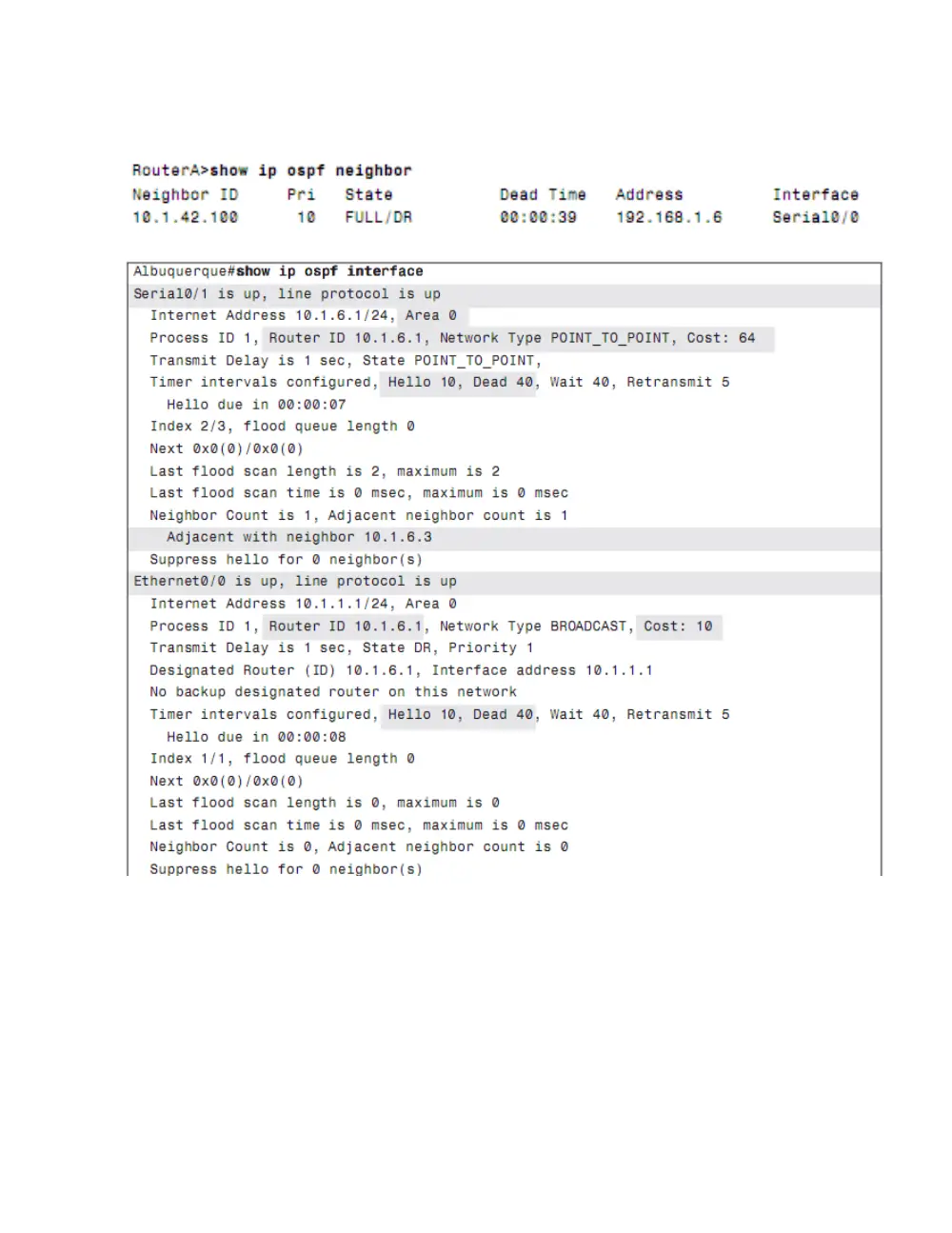
Troubleshooting
Show ip protocols
Show ip ospf interface
Show ip ospf neighbor
Debup ip ospf adjacency
AouterA*show ip ospf neighbor
Neighbor ID Pri State Dead Tite Address Interface
16.1.42.168 16 FULL, DA 86:60:39 192.168.1.6 Sariale/s
Albuquerque#show ip ospf interface
Serial0/1 is up, line protocol is up
Internet Address 10.1.6.1/24, Area 0
Process ID 1, Router ID 10.1.6.1, Network Type POINT_TO_POINT, Cost: 64
Transmit Delay is 1 sec, State POINT_TO_POINT,
Timer intervals configured, Hello 10, Dead 40, Wait 40, Retransmit 5
Hello due in 00:00:07
Index 2/3, flood queue length @
Next 0x0(0)/®x0(0)
Last flood scan length is 2, maximum is 2
Last flood scan time is ® msec, maximum is @ msec
Neighbor Count is 1, Adjacent neighbor count is 1
Adjacent with neighbor 10.1.6.3
Suppress hello for @ neighbor(s)
Ethernet0/®@ is up, line protocol is up
Internet Address 10.1.1.1/24, Area 0
Process ID 1, Router ID 10.1.6.1, Network Type BROADCAST, Cost: 10
Transmit Delay is 1 sec, State DR, Priority 1
Designated Router (ID) 10.1.6.1, Interface address 10.1.1.1
No backup designated router on this network
Timer intervals configured, Hello 10, Dead 40, Wait 40, Retransmit 5
Hello due in 00:00:08
Index 1/1, flood queue length @
Next 0x0(0)/0x0(0)
Last flood scan length is ®, maximum is 0
Last flood scan time is @ msec, maximum is ® msec
Neighbor Count is 0, Adjacent neighbor count is 0
Suppress hello for @ neighbor(s)
E0/4
E0/0
192.168.1.1/24 68.110.171.98/27
68.110.171.97/27
Fo/1
FO/0.10
bi 192.168.10.1/24
T
| F0/0.20
192.168.20.1/24
192.168.1.10/24
Fos 192.168.1.2/24
~ so/4/0 492.168.3.1/24
192.168.2.1/24 ae
_ 192.168.2.2/24 LJ
es “sae 1721600. 0/24
172.16.1,.0/24
172.16.2.0/24
172.16.3.0/24
172.16.4.0/24
172.16.5.0/24
172.16.6.0/24
172.16.7.0/24