
CSI 446 Syllabus, Fall 2012
American University of Science and Technology · Advanced Networking · 4 pages · Mr. Joseph Khoury


More CSI 446 files
Show the text of this lab
AMERICAN UNIVERSITY OF SCIENCE & TECHNOLOGY
DEPARTMENT OF COMPUTER SCIENCE
CSI 446 – Advanced Networking
Section A
Fall Term 2012-2013
Ashrafieh Campus
INSTRUCTOR
Joseph El-Khoury, M.S.
jkhoury@aust.edu.lb
LECTURE HOURS
T-TH
6:30 pm - 7:45 pm
Room:
Block A-2
OFFICE HOURS
Mon
5:00 pm – 6:00 pm
Otherwise by appointment
Room:
801, Block A
COURSE DESCRIPTION
This Course is an intermediate to advanced networking course, continuing what the computer
network CSI345 course started, in terms of completing the knowledge and skills required to
successfully install, operate, and troubleshoot a small to medium size enterprise branch
network. The Course covers topics on VLSM and IPv6 addressing; extending switched
networks with VLANs; configuring, verifying and troubleshooting Switches;
Several routing protocols are covered such as OSPF and EIGRP ; determining IP routes;
managing IP traffic with access lists; NAT and DHCP; establishing point-to- point
connections; and establishing Frame Relay connections.
Moreover, by the end of this course , students will be able to apply for the CCNA exam.
COURSE PREREQUISITES
CSI345 / MIS 310: Computer Networks
COURSE CREDITS
3 Credit Hours
GRADE DISTRIBUTION
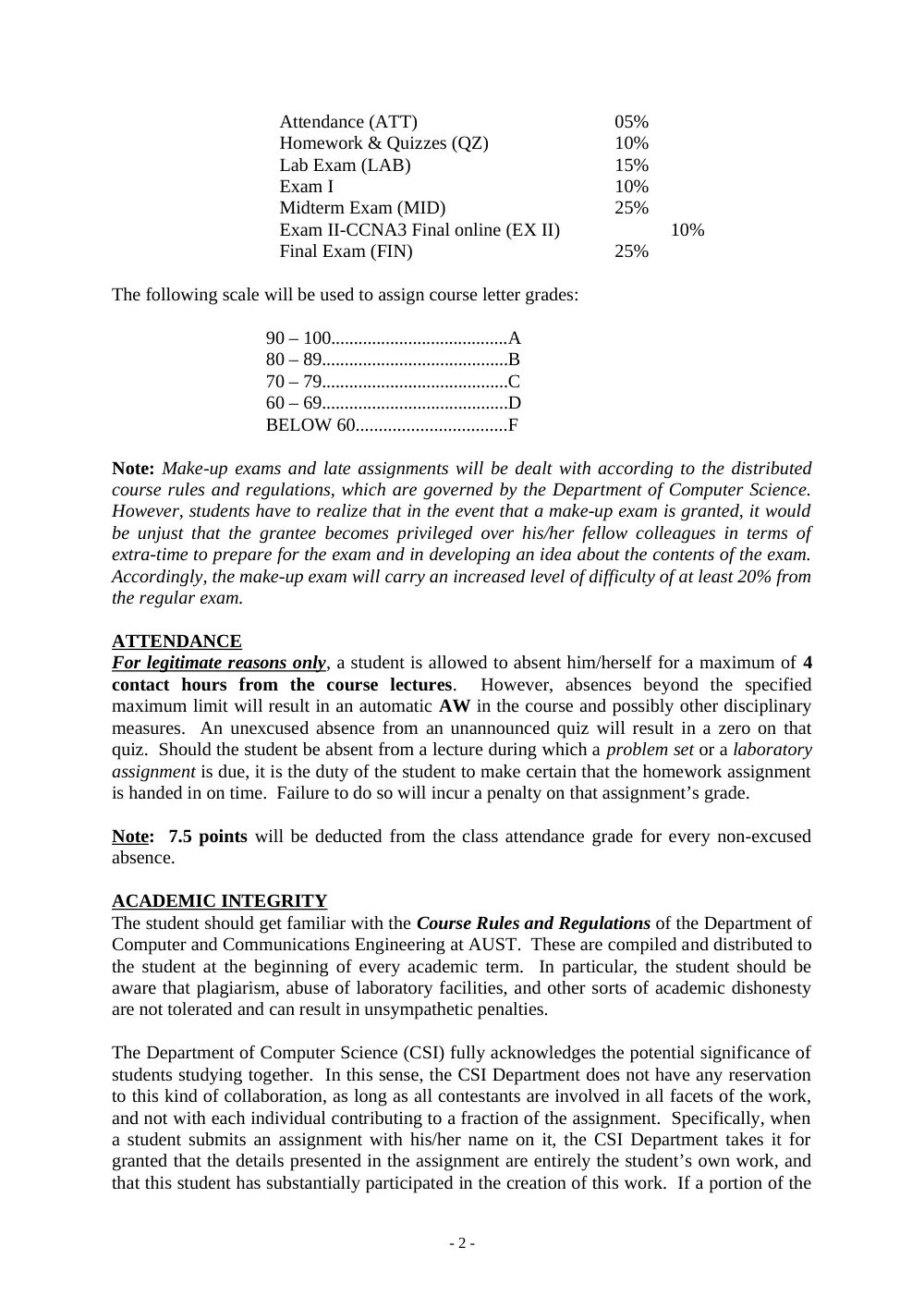
This course involves a number of didactic activities, ranging from lectures, problem sets, and
quizzes, to the midterm and final exams. All of these attributes of the course are intended to
help the student in developing his/her understanding of the material covered in CSI 446 and
in providing the department and the course instructor with information on how the student is
doing. Consequently, all of these activities are considered to be vital and will be taken into
consideration while assigning grades at the end of the term. When the student is being
assigned a course grade, it is imperative that this grade accurately reflects the student’s level
of achievement and his/her mastery of the material covered in CSI 345 / MIS 310. An
approximate breakdown of the weighting that will be used in making this assessment is as
follows:
- 1 -
Attendance (ATT)
05%
Homework & Quizzes (QZ)
10%
Lab Exam (LAB)
15%
Exam I
10%
Midterm Exam (MID)
25%
Exam II-CCNA3 Final online (EX II)
10%
Final Exam (FIN)
25%
The following scale will be used to assign course letter grades:
90 – 100.......................................A
80 – 89.........................................B
70 – 79.........................................C
60 – 69.........................................D
BELOW 60.................................F
Note: Make-up exams and late assignments will be dealt with according to the distributed
course rules and regulations, which are governed by the Department of Computer Science.
However, students have to realize that in the event that a make-up exam is granted, it would
be unjust that the grantee becomes privileged over his/her fellow colleagues in terms of
extra-time to prepare for the exam and in developing an idea about the contents of the exam.
Accordingly, the make-up exam will carry an increased level of difficulty of at least 20% from
the regular exam.
ATTENDANCE
For legitimate reasons only, a student is allowed to absent him/herself for a maximum of 4
contact hours from the course lectures. However, absences beyond the specified
maximum limit will result in an automatic AW in the course and possibly other disciplinary
measures. An unexcused absence from an unannounced quiz will result in a zero on that
quiz. Should the student be absent from a lecture during which a problem set or a laboratory
assignment is due, it is the duty of the student to make certain that the homework assignment
is handed in on time. Failure to do so will incur a penalty on that assignment’s grade.
Note: 7.5 points will be deducted from the class attendance grade for every non-excused
absence.
ACADEMIC INTEGRITY
The student should get familiar with the Course Rules and Regulations of the Department of
Computer and Communications Engineering at AUST. These are compiled and distributed to
the student at the beginning of every academic term. In particular, the student should be
aware that plagiarism, abuse of laboratory facilities, and other sorts of academic dishonesty
are not tolerated and can result in unsympathetic penalties.
The Department of Computer Science (CSI) fully acknowledges the potential significance of
students studying together. In this sense, the CSI Department does not have any reservation
to this kind of collaboration, as long as all contestants are involved in all facets of the work,
and not with each individual contributing to a fraction of the assignment. Specifically, when
a student submits an assignment with his/her name on it, the CSI Department takes it for
granted that the details presented in the assignment are entirely the student’s own work, and
that this student has substantially participated in the creation of this work. If a portion of the
- 2 -
work has been conceived by collaborative work, that section should be highlighted and the
names of the students involved in this collaboration should be listed next to that section.
PROBLEM SETS
For most part of the course, problem sets will be assigned on a weekly basis. A detailed
description of the problem set assignment timetable is compiled at the end of this handout.
All problem sets are graded on a five-point scale, from 0 to 5. The following table delineates
the effort required to achieve each of these grade points.
Grade Description
0
The student fails to turn in the homework assignment.
1
The student turns in the homework assignment, but basically, did nothing
worthwhile.
2
The student turns in the homework assignment, however most of the problems are
either incomplete or non-understandable.
3
The student completes most or all of the problems in the assignment; however, the
student still has some evident mistakes in the worked solution.
4
The student completes all of the problems in the assignment, with perhaps little
insignificant mistakes; however in general, the student demonstrates a solid
understanding of the material.
5
The student completes all of the problems in the assignment, with no mistakes.
COURSE COMPETENCIES
This course contributes primarily to the students' knowledge of data communication topics,
and does provide design experience. This course was designed to help the student to
understand:
1.
Configure, verify and troubleshoot a switch with VLANs and interswitch
communications
2.
Understanding and configuring the Spanning-Tree Protocol
3.
Implement an IP addressing scheme and IP Services to meet network
requirements in a medium-size Enterprise branch office network
4.
Configure and troubleshoot basic operation and routing on Cisco devices
5.
Configuring and understanding OSPF and EIGRP
6.
Implement, verify, and troubleshoot NAT in a medium-size Enterprise branch
office network.
7.
Implement, verify, and troubleshoot ACLs in a medium-size Enterprise branch
office network
8.
Implement and verify WAN links
9.
Implement Frame Relay links
10. Understand Virtual private Networks
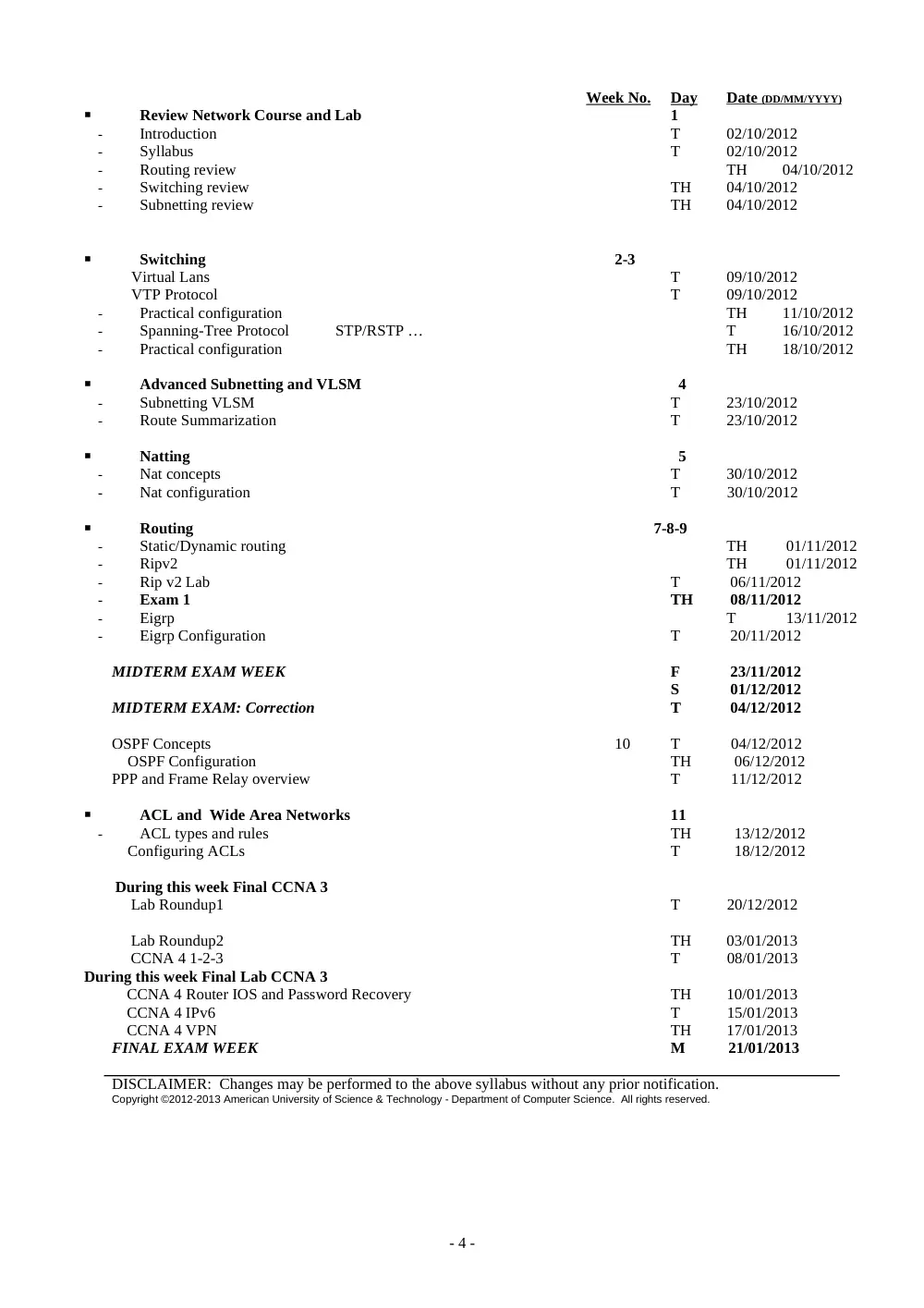
COURSE OUTLINE BY TOPIC
The day-to-day topics to be covered in the table below may be adjusted as the subject
proceeds, but all examination dates are fixed, and problem set due dates are unlikely to
change.
- 3 -
Week No.
Day
Date
(DD/MM/YYYY)
Review Network Course and Lab
1
-
Introduction
T
02/10/2012
-
Syllabus
T
02/10/2012
-
Routing review
TH
04/10/2012
-
Switching review
TH
04/10/2012
-
Subnetting review
TH
04/10/2012
Switching
2-3
Virtual Lans
T
09/10/2012
VTP Protocol
T
09/10/2012
-
Practical configuration
TH
11/10/2012
-
Spanning-Tree Protocol
STP/RSTP …
T
16/10/2012
-
Practical configuration
TH
18/10/2012
Advanced Subnetting and VLSM
4
-
Subnetting VLSM
T
23/10/2012
-
Route Summarization
T
23/10/2012
Natting
5
-
Nat concepts
T
30/10/2012
-
Nat configuration
T 30/10/2012
Routing
7-8-9
-
Static/Dynamic routing
TH
01/11/2012
-
Ripv2
TH
01/11/2012
-
Rip v2 Lab
T
06/11/2012
-
Exam 1
TH
08/11/2012
-
Eigrp
T
13/11/2012
-
Eigrp Configuration
T
20/11/2012
MIDTERM EXAM WEEK
F
23/11/2012
S
01/12/2012
MIDTERM EXAM: Correction
T
04/12/2012
OSPF Concepts
10
T 04/12/2012
OSPF Configuration
TH 06/12/2012
PPP and Frame Relay overview
T 11/12/2012
ACL and Wide Area Networks
11
-
ACL types and rules
TH
13/12/2012
Configuring ACLs
T
18/12/2012
During this week Final CCNA 3
Lab Roundup1
T 20/12/2012
Lab Roundup2
TH 03/01/2013
CCNA 4 1-2-3
T 08/01/2013
During this week Final Lab CCNA 3
CCNA 4 Router IOS and Password Recovery
TH 10/01/2013
CCNA 4 IPv6
T 15/01/2013
CCNA 4 VPN
TH 17/01/2013
FINAL EXAM WEEK
M 21/01/2013
DISCLAIMER: Changes may be performed to the above syllabus without any prior notification.
Copyright ©2012-2013 American University of Science & Technology - Department of Computer Science. All rights reserved.
- 4 -