
BUS 101 Lecture Chapter 2 PP, Fall 2014
Lebanese American University · Introduction To Business · 24 pages


Showing the first 10 of 24 pages. Download the PDF to see all of it.
More BUS 101 files
Show the text of this lab
2
chapte
r
Business Essentials, 8th Edition
Ebert/Griffin
Business Ethics and Social
Responsibility
Instructor Lecture PowerPoints
PowerPoint Presentation prepared by
Carol Vollmer Pope Alverno College
Copyright © 2011 Pearson Education, Inc. publishing as Prentice
Hall
L E A R N I N G O B J E C T I V E S
L E A R N I N G O B J E C T I V E S
After reading this chapter, you should be able to:
1. Explain how individuals develop their personal codes
of ethics and why ethics are important in the
workplace.
2. Distinguish social responsibility from ethics, identify
organizational stakeholders, and characterize social
consciousness today.
3. Show how the concept of social responsibility applies
both to environmental issues and to a firm’s
relationships with customers, employees, and
investors.
2-2
Copyright © 2011 Pearson Education, Inc. publishing as Prentice
Hall
L E A R N I N G O B J E C T I V E S (cont.)
L E A R N I N G O B J E C T I V E S (cont.)
After reading this chapter, you should be able to:
1. Identify four general approaches to social
responsibility and describe the four steps that a
firm must take to implement a social responsibility
program.
2. Explain how issues of social responsibility and ethics
affect small business.
2-3
Copyright © 2011 Pearson Education, Inc. publishing as Prentice
Hall
What’s in It for Me?
• By understanding the material in this chapter,
you’ll be better able to:
– Assess ethical and socially responsible issues
facing you as an employee and as a boss or
business owner.
– Understand the ethical and socially responsible
actions of businesses you deal with as a consumer
and as an investor.
2-4
Copyright © 2011 Pearson Education, Inc. publishing as Prentice
Hall
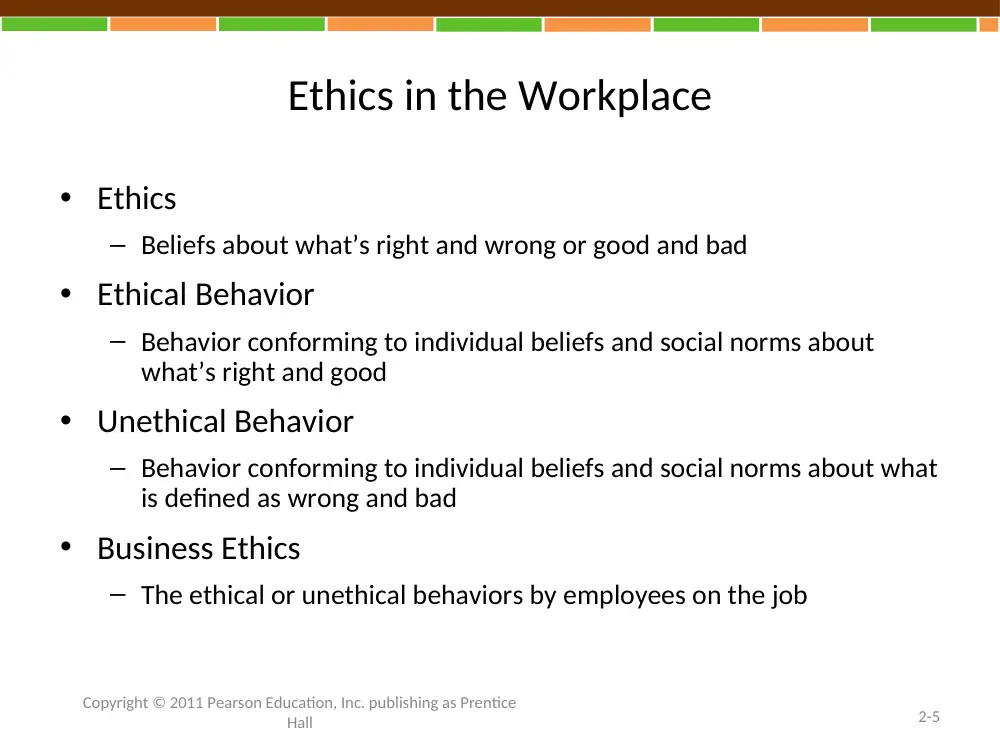
Ethics in the Workplace
• Ethics
– Beliefs about what’s right and wrong or good and bad
• Ethical Behavior
– Behavior conforming to individual beliefs and social norms about
what’s right and good
• Unethical Behavior
– Behavior conforming to individual beliefs and social norms about what
is defined as wrong and bad
• Business Ethics
– The ethical or unethical behaviors by employees on the job
2-5
Copyright © 2011 Pearson Education, Inc. publishing as Prentice
Hall
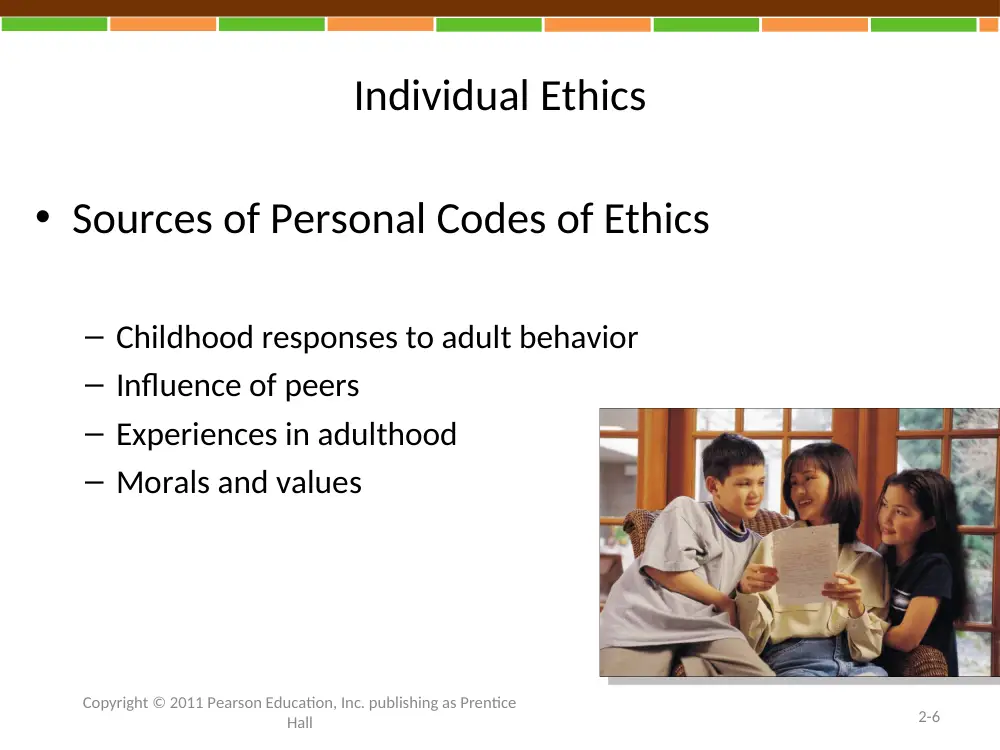
Individual Ethics
• Sources of Personal Codes of Ethics
– Childhood responses to adult behavior
– Influence of peers
– Experiences in adulthood
– Morals and values
2-6
Copyright © 2011 Pearson Education, Inc. publishing as Prentice
Hall
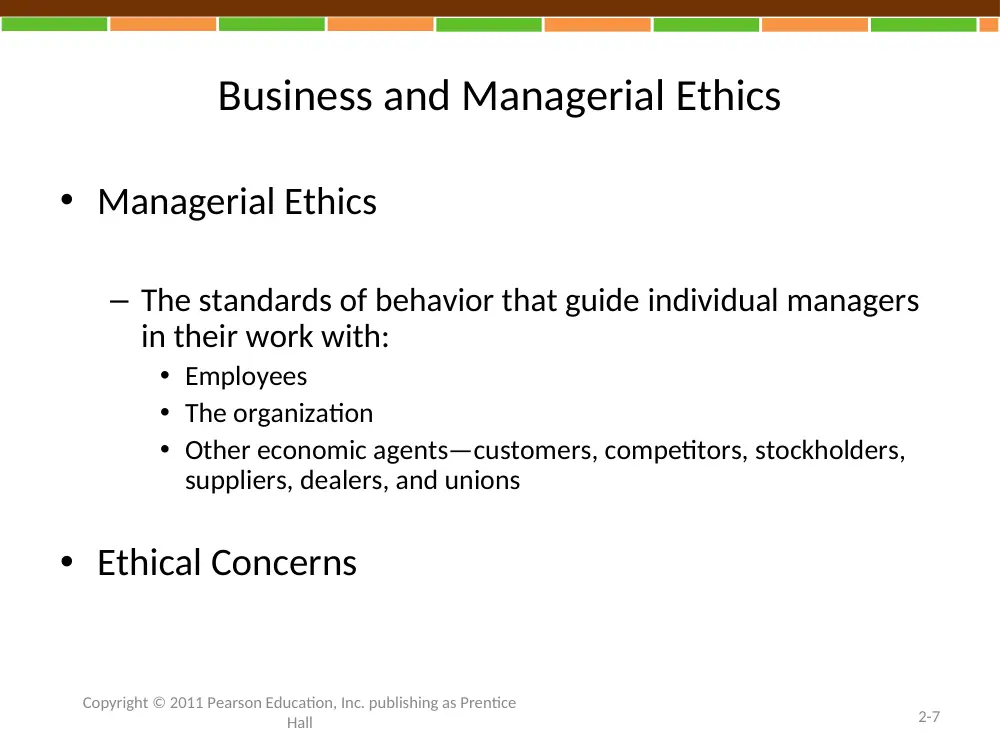
Business and Managerial Ethics
• Managerial Ethics
– The standards of behavior that guide individual managers
in their work with:
• Employees
• The organization
• Other economic agents—customers, competitors, stockholders,
suppliers, dealers, and unions
• Ethical Concerns
2-7
Copyright © 2011 Pearson Education, Inc. publishing as Prentice
Hall
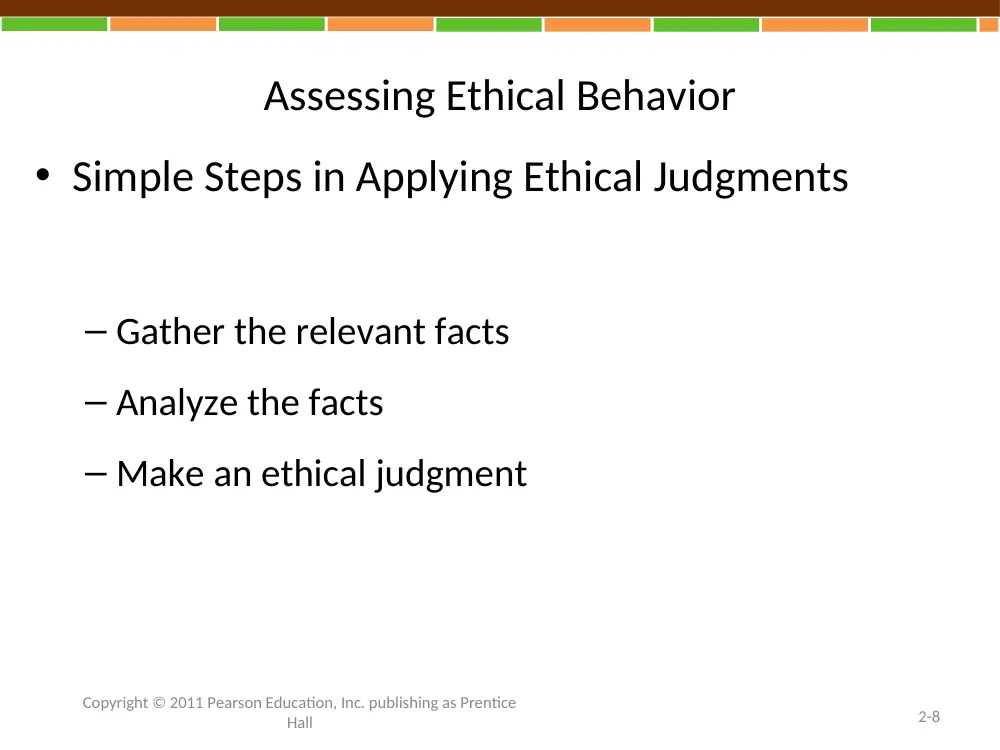
Assessing Ethical Behavior
• Simple Steps in Applying Ethical Judgments
– Gather the relevant facts
– Analyze the facts
– Make an ethical judgment
2-8
Copyright © 2011 Pearson Education, Inc. publishing as Prentice
Hall
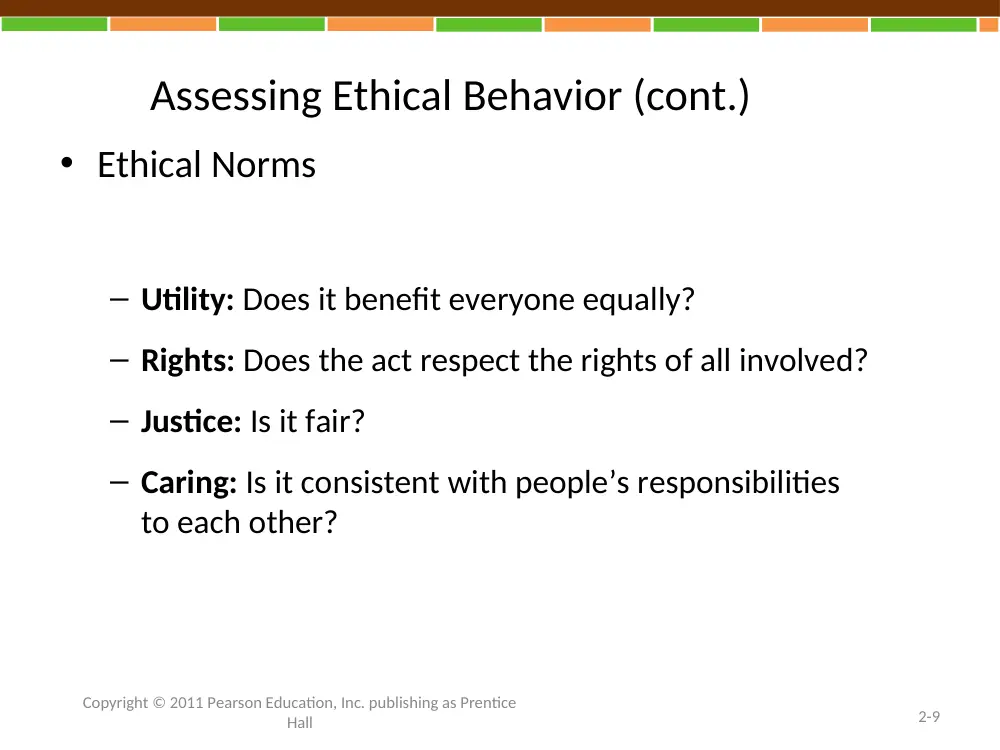
Assessing Ethical Behavior (cont.)
• Ethical Norms
– Utility: Does it benefit everyone equally?
– Rights: Does the act respect the rights of all involved?
– Justice: Is it fair?
– Caring: Is it consistent with people’s responsibilities
to each other?
2-9
Copyright © 2011 Pearson Education, Inc. publishing as Prentice
Hall
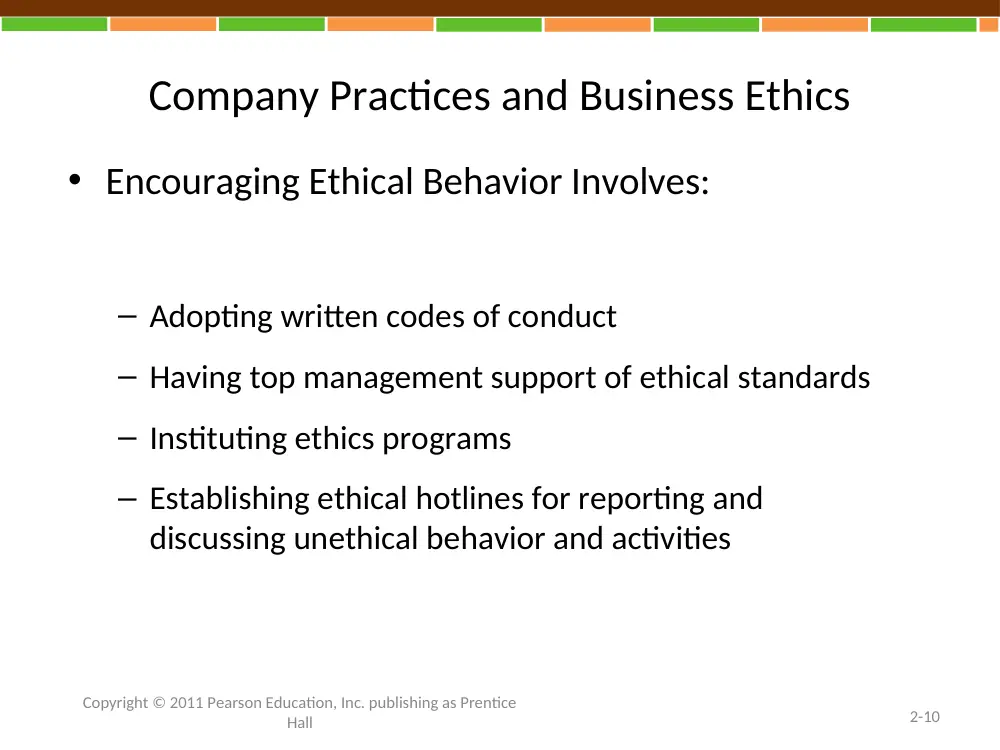
Company Practices and Business Ethics
• Encouraging Ethical Behavior Involves:
– Adopting written codes of conduct
– Having top management support of ethical standards
– Instituting ethics programs
– Establishing ethical hotlines for reporting and
discussing unethical behavior and activities
2-10
Copyright © 2011 Pearson Education, Inc. publishing as Prentice
Hall
Social Responsibility
• Social Responsibility
– Balancing the organization’s commitments to groups
and individuals (stakeholders) in society
• Organizational Stakeholders
– Any individual or group directly affected by the
practices of an organization and, therefore, have a
stake in its performance
2-11
Copyright © 2011 Pearson Education, Inc. publishing as Prentice
Hall
The Stakeholder Model of Responsibility
• Customers
– Treat customers fairly and honestly
• Employees
– Treat employees fairly and respect their dignity and basic
human needs
• Investors
– Follow proper accounting procedures; provide information
to shareholders about financial performance
• Suppliers
– Create mutually beneficial partnership arrangements with
suppliers
• Local and International Communities
– Involvement in programs and charities
2-12
Copyright © 2011 Pearson Education, Inc. publishing as Prentice
Hall
Contemporary Social Consciousness
• The Concept of Accountability
– The expectation of an expanded role for business
in protecting and enhancing the general welfare
of society
2-13
Copyright © 2011 Pearson Education, Inc. publishing as Prentice
Hall
Areas of Social Responsibility
• Responsibility Toward the Environment
– Disposal of toxic waste
– Recycle
– Control air, water, and land pollution
– Green Marketing
• Greenwashing: Using advertising to project a
green image without substantially altering
processes or products
2-14
Copyright © 2011 Pearson Education, Inc. publishing as Prentice
Hall
Areas of Social Responsibility (cont.)
• Responsibility Toward Customers
– Involves providing quality products and pricing products fairly
• Consumerism
– Protecting the rights of consumers in their dealings with businesses
•
Basic Consumer Bill of Rights
– The right to safe products; to be heard;
to be informed; to be educated about
purchases; to be treated courteously;
to choose what to buy
2-15
Copyright © 2011 Pearson Education, Inc. publishing as Prentice
Hall
Areas of Social Responsibility (cont.)
• Unfair Pricing
– Collusion: When two or more firms agree to collaborate
on such wrongful acts as price fixing
– Price gouging: Responding to increased demand with
overly steep (and often unwarranted) price increases
• Ethics in Advertising
– Truth in advertising
– Morally objectionable advertising
2-16
Copyright © 2011 Pearson Education, Inc. publishing as Prentice
Hall
Areas of Social Responsibility (cont.)
• Responsibility Toward Employees
– Legal and social commitments to:
• Not discriminate
• A safe workplace
• Provide opportunities to balance work and life
• Provide protection for whistleblowers
• Responsibility Toward Investors
– Proper financial management (no insider trading)
– Proper financial reporting
2-17
Copyright © 2011 Pearson Education, Inc. publishing as Prentice
Hall
Implementing Social Responsibility (SR)
Programs
• Arguments Against SR
– The cost of SR threatens profits.
– Business has too much control over which SR issues would
be addressed.
– Business lacks expertise in SR matters.
• Arguments For SR
– SR should take precedence over profits.
– Corporations as citizens should help others.
– Corporations have the resources to help.
– Corporations should solve problems they create.
2-18
Copyright © 2011 Pearson Education, Inc. publishing as Prentice
Hall
Approaches to Social Responsibility
• Obstructionist Stance
– A company does as little as possible and may attempt to
deny or cover up violations
• Defensive Stance
– A company does everything required of it legally but no
more
• Accommodative Stance
– A company meets its legal and ethical requirements and
may go further
• Proactive Stance
– A company actively seeks to contribute to the well-being
of groups and individuals
2-19
Copyright © 2011 Pearson Education, Inc. publishing as Prentice
Hall
FIGURE 2.4: Spectrum of Approaches to
Corporate Social Responsibility
2-20
Copyright © 2011 Pearson Education, Inc. publishing as Prentice
Hall
Managing Social Responsibility Programs
1.
Social responsibility must start at the top and be
part of strategic planning.
2.
Top managers must plan for the level of
management support.
3.
One executive must be put in charge of the firm’s
agenda.
4.
The organization must conduct occasional social
audits—systematic analyses of its success in using
funds earmarked for its social responsibility goals.
2-21
Copyright © 2011 Pearson Education, Inc. publishing as Prentice
Hall
Social Responsibility and the Small Business
• Large Business versus Small Business
– Differences are primarily differences of scale
– More issues are questions of individual ethics
• Ethics and social responsibility are decisions
faced by all managers in all organizations,
regardless of rank or size
2-22
Copyright © 2011 Pearson Education, Inc. publishing as Prentice
Hall
Key Terms
accommodative stance
business ethics
collusion
consumerism
defensive stance
ethical behavior
ethics
insider trading
managerial ethics
obstructionist stance
organizational stakeholders
proactive stance
social audit
social responsibility
unethical behavior
whistleblower
2-23
Copyright © 2011 Pearson Education, Inc. publishing as Prentice
Hall
All rights reserved. No part of this publication may be reproduced, stored in a
retrieval system, or transmitted, in any form or by any means, electronic,
mechanical, photocopying, recording, or otherwise, without the prior written
permission of the publisher. Printed in the United States of America.
2-24
Copyright © 2011 Pearson Education, Inc. publishing as Prentice
Hall