
BUS 101 Lecture Chapter 3, Fall 2014
Lebanese American University · Introduction To Business · 29 pages
Showing the first 10 of 29 pages. Download the PDF to see all of it.
More BUS 101 files
Show the text of this lab
3
chapte
r
Business Essentials, 8th Edition
Ebert/Griffin
Entrepreneurship, New
Ventures, and Business
Ownership
Instructor Lecture PowerPoints
PowerPoint Presentation prepared by
Carol Vollmer Pope Alverno College
Copyright © 2011 Pearson Education, Inc. publishing as Prentice Hall
After reading this chapter, you should be able to:
1.
Define small business, discuss its importance to the U.S.
economy, and explain popular areas of small business.
2.
Explain entrepreneurship and describe some key
characteristics of entrepreneurial personalities and
activities.
3.
Describe the business plan and the start-up decisions made
by small businesses and identify sources of financial aid
available to such enterprises.
4.
Discuss the trends in small business start-ups and identify
the main reasons for success and failure among small
businesses.
L E A R N I N G O B J E C T I V E S
L E A R N I N G O B J E C T I V E S
Copyright © 2011 Pearson Education, Inc. publishing as Prentice Hall
3-2
After reading this chapter, you should be able to:
1. Explain sole proprietorships, partnerships, and
cooperatives and discuss the advantages and
disadvantages of each.
2. Describe corporations, discuss their advantages and
disadvantages, and identify different kinds of
corporations.
3. Explain the basic issues involved in managing a
corporation and discuss special issues related to
corporate ownership.
L E A R N I N G O B J E C T I V E S (cont.)
L E A R N I N G O B J E C T I V E S (cont.)
Copyright © 2011 Pearson Education, Inc. publishing as Prentice Hall
3-3
What’s in It for Me?
•
By understanding the material discussed in
this chapter, you’ll be better prepared to:
1. Understand the keys to entrepreneurial success,
including business planning
2. Discuss the reasons for success or failure
3. Evaluate the advantages and disadvantages of
different kinds of ownership
Copyright © 2011 Pearson Education, Inc. publishing as Prentice Hall
3-4
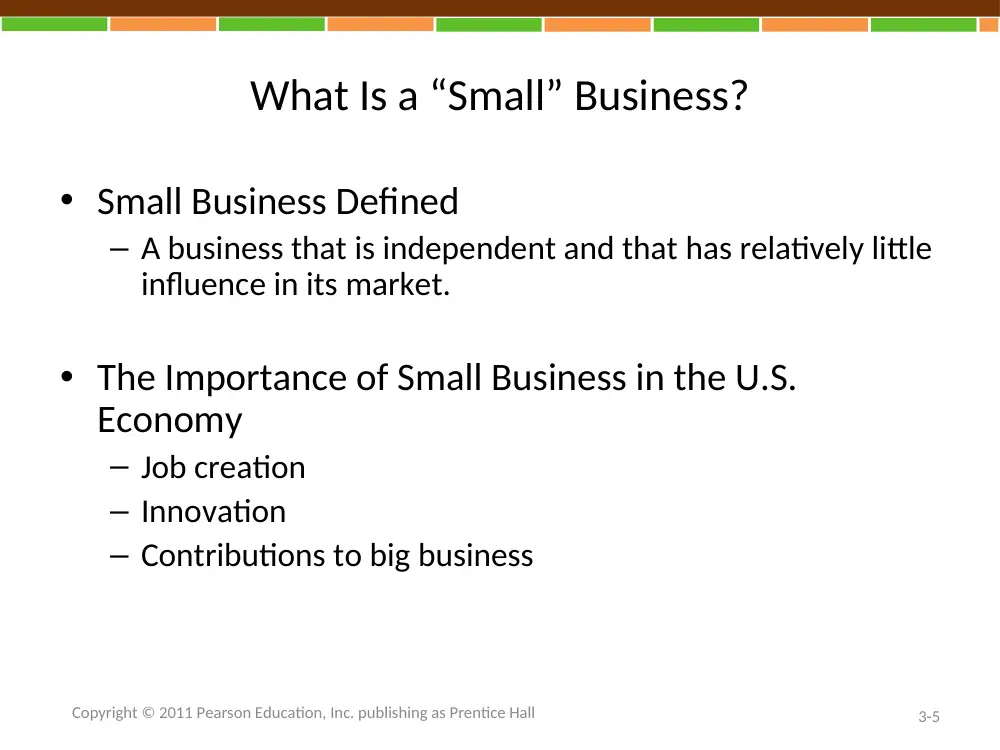
What Is a “Small” Business?
• Small Business Defined
– A business that is independent and that has relatively little
influence in its market.
• The Importance of Small Business in the U.S.
Economy
– Job creation
– Innovation
– Contributions to big business
Copyright © 2011 Pearson Education, Inc. publishing as Prentice Hall
3-5
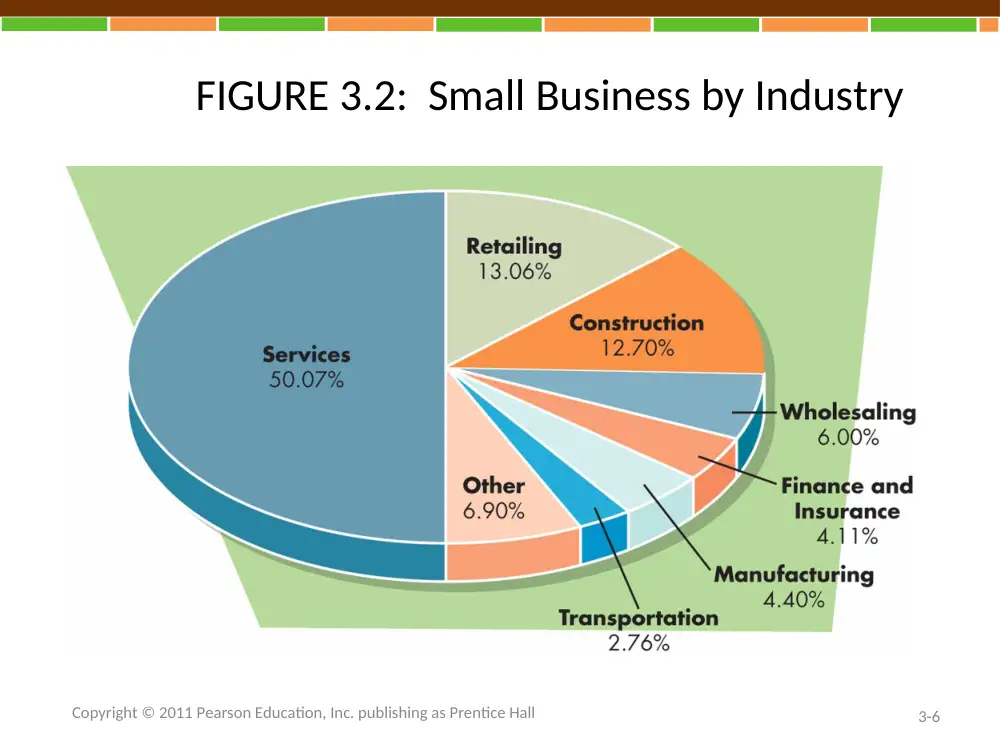
FIGURE 3.2: Small Business by Industry
Copyright © 2011 Pearson Education, Inc. publishing as Prentice Hall
3-6
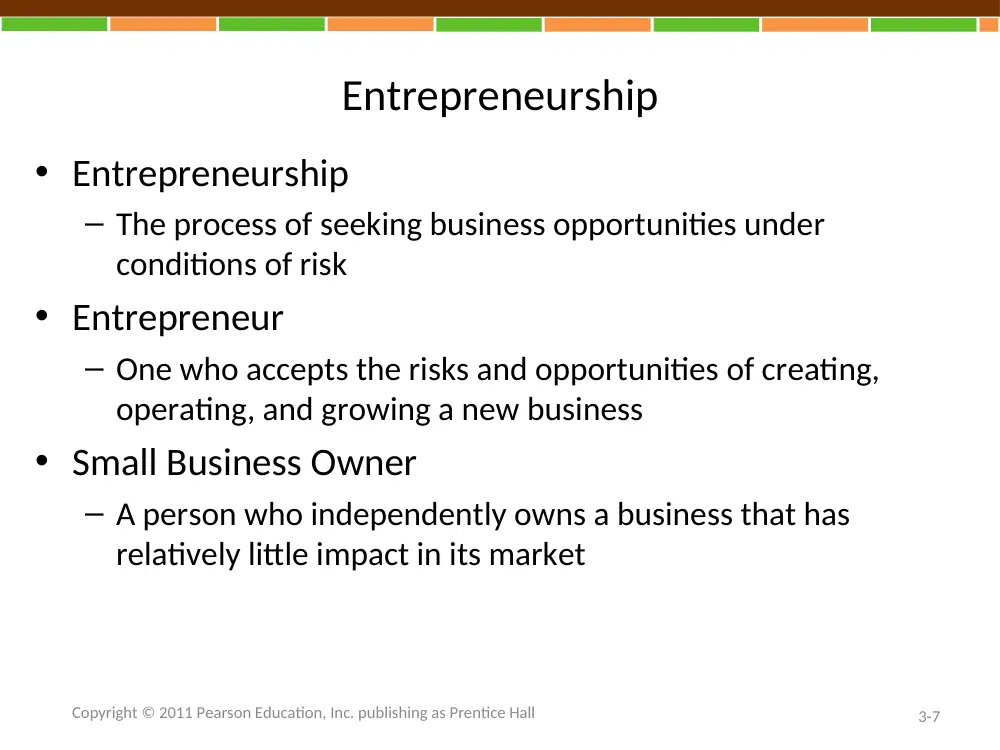
Entrepreneurship
• Entrepreneurship
– The process of seeking business opportunities under
conditions of risk
• Entrepreneur
– One who accepts the risks and opportunities of creating,
operating, and growing a new business
• Small Business Owner
– A person who independently owns a business that has
relatively little impact in its market
Copyright © 2011 Pearson Education, Inc. publishing as Prentice Hall
3-7
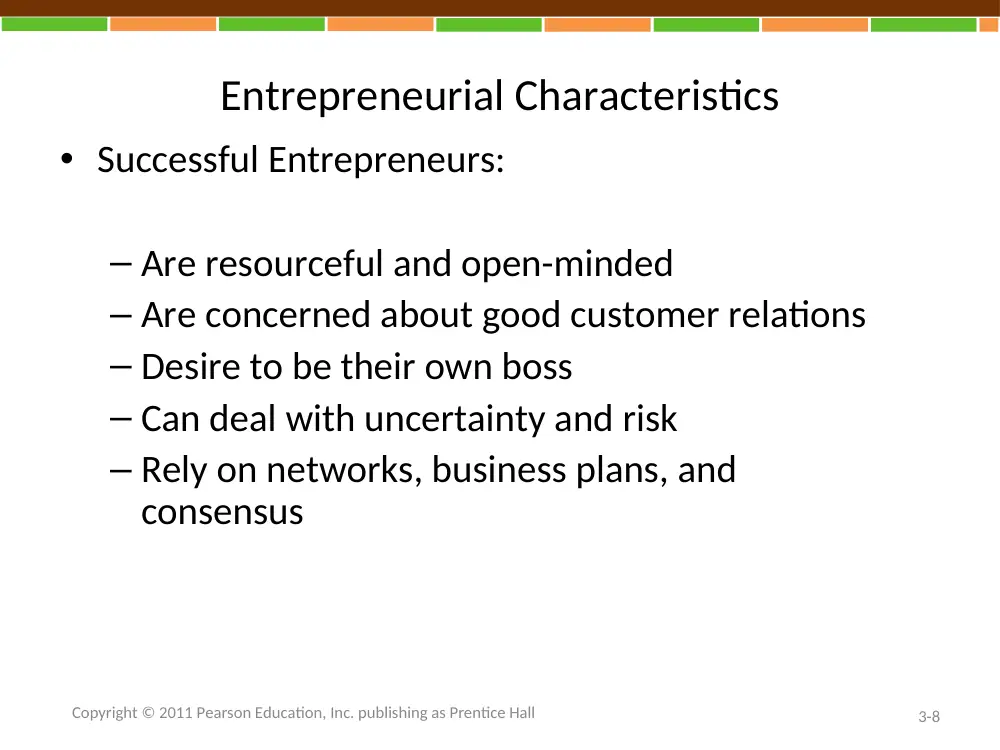
Entrepreneurial Characteristics
• Successful Entrepreneurs:
– Are resourceful and open-minded
– Are concerned about good customer relations
– Desire to be their own boss
– Can deal with uncertainty and risk
– Rely on networks, business plans, and
consensus
Copyright © 2011 Pearson Education, Inc. publishing as Prentice Hall
3-8
Starting and Operating a New Business
• Crafting a Business Plan
– State business plan and implementation
• Preparing a Business Plan
– Setting goals and objectives
– Sales forecasting
– Financial planning
Copyright © 2011 Pearson Education, Inc. publishing as Prentice Hall
3-9
Starting the Small Business
• Buying an Existing Business
– Less risk
• Franchising
– Advantages for franchisee
• Proven business opportunity
• Access to management expertise
– Disadvantages for franchisee
• Start-up costs
• Ongoing payments
• Management rules and restrictions
Copyright © 2011 Pearson Education, Inc. publishing as Prentice Hall
3-10
Starting the Small Business (cont.)
• Starting from Scratch
– Disadvantage: Higher risk of business failure
– Advantage: Avoids problems of an existing business
• Questions to Be Answered:
– Who and where are my customers?
– How much will they pay for my product?
– How much product can I expect to sell?
– Who are my competitors?
– Why will customers buy my product rather than the
competitors?
Copyright © 2011 Pearson Education, Inc. publishing as Prentice Hall
3-11
Financing the Small Business
• Personal Resources
• Loans from Family and Friends
• Bank Loans
• Venture Capital Companies
• Small-Business Investment Companies (SBICs)
• Minority Enterprise Small-Business Investment Companies
(MESBICs)
• SBA Financial Programs
Copyright © 2011 Pearson Education, Inc. publishing as Prentice Hall
3-12
Trends in Small-Business Startups
Emergence of
Emergence of
E-commerce
E-commerce
Crossovers from
Crossovers from
Big Business
Big Business
Opportunities for
Opportunities for
Minorities & Women
Minorities & Women
Global
Global
Opportunities
Opportunities
Better
Better
Survival Rates
Survival Rates
Copyright © 2011 Pearson Education, Inc. publishing as Prentice Hall
3-13
Reasons for Failure and Success
• Failure
– Poor management
– Neglect
– Weak control systems
– Insufficient capital
• Success
– Hard work, drive, and dedication
– Market demand
– Managerial competence
– Luck!!!
Copyright © 2011 Pearson Education, Inc. publishing as Prentice Hall
3-14
Business Ownership
• Forms of Legal Ownership
– Sole proprietorship: Owned and operated by one person
– Partnership: Sole proprietorship multiplied by the number
of partner-owners
– Corporation
• Choice of Ownership Form
– Based on the entrepreneur’s needs/desires for control,
ownership participation, financing sources, and
appropriateness of the chosen form for the industry in
which the firm will compete
Copyright © 2011 Pearson Education, Inc. publishing as Prentice Hall
3-15
Sole Proprietorships
• Advantages:
– Freedom
– Simple to form
– Low start-up costs
– Tax benefits
– Formation of
cooperatives
• Disadvantages:
– Unlimited liability:
Owners are responsible
for all debts
– Limited resources
– Limited fundraising
capability
– Lack of continuity
Copyright © 2011 Pearson Education, Inc. publishing as Prentice Hall
3-16
Partnerships
• Advantages:
– More talent and
money
– More fundraising
capability
– Relatively easy to
form
– Limited liability for
limited partners
– Tax benefits
• Disadvantages:
– Unlimited liability for
general partner(s)
– Disagreements
among partners
– Lack of continuity
Copyright © 2011 Pearson Education, Inc. publishing as Prentice Hall
3-17
Alternatives to General Partnerships
• Limited Partnership
– Allows for limited partners who invest money but are
liable for debts only to the extent of their investments
– General (or active) partner(s), runs the business
• Master Limited Partnership
– Organization sells shares (partnership interests) to
investors on public exchange; investors paid back from
profits
– Master partner has majority ownership and runs the
business; minority partners have no management voice
Copyright © 2011 Pearson Education, Inc. publishing as Prentice Hall
3-18
Cooperatives
• Combine the freedom of sole
proprietorships with the financial power of
corporations
• Groups of sole proprietorships or
partnerships agree to work together for
their common benefit
Copyright © 2011 Pearson Education, Inc. publishing as Prentice Hall
3-19
Corporations
• Corporation
– Legal status as separate entities
• Corporations may:
– Be small or large
– Sue and be sued
– Buy, hold, and sell property
– Make and sell products
– Commit crimes and be tried and punished for them
– Have limited liability for individuals who form them
Copyright © 2011 Pearson Education, Inc. publishing as Prentice Hall
3-20
Corporations (cont.)
• Advantages:
– Limited liability:
owners’ financial
responsibility is limited
to their investment
– Continuity
– Stronger fundraising
capability
• Disadvantages:
– Double taxation of
dividends
– Fluid control
– Complicated and
expensive to form
Copyright © 2011 Pearson Education, Inc. publishing as Prentice Hall
3-21
Types of Corporations
• Closely Held (Private) Corporation
• Publicly Held (Public) Corporation
• Subchapter S Corporation
• Limited Liability Corporation (LLC)
• Professional Corporation
• Multinational (Transnational) Corporation
Copyright © 2011 Pearson Education, Inc. publishing as Prentice Hall
3-22
Managing a Corporation
• Corporate Governance
– Who makes corporate decisions and who is accountable
– Established by the firm’s bylaws and involves three bodies:
• Stockholders (shareholders): Investors who buy ownership shares
in the form of stock
• Board of Directors: elected by stockholders to oversee corporate
management
• Corporate officers: Top managers hired by the board to run the
corporation
Copyright © 2011 Pearson Education, Inc. publishing as Prentice Hall
3-23
Stockholders: Owners of Corporations
• Stock: A share of ownership in a corporation
• Dividends: Profits distributed among stockholders
Copyright © 2011 Pearson Education, Inc. publishing as Prentice Hall
3-24
Special Issues in Corporate Ownership
• Joint Ventures and Strategic Alliances:
– Strategic alliance: Two or more organizations collaborate
on a project for mutual gain
– Joint venture: Partners share ownership of a new
enterprise
• Employee Stock Ownership Plans
– Allows employees to own a share of the corporation
through trusts established on their behalf
• Institutional Investors
– Control enormous resources and can buy huge blocks of
stock
Copyright © 2011 Pearson Education, Inc. publishing as Prentice Hall
3-25
Special Issues in Corporate Ownership (cont.)
• Mergers, Acquisitions, Divestitures, and Spin-
Offs:
– Merger: Two firms combine to create a new
company
– Acquisition: One firm buys another
– Divestiture: A firm sells one or more of its
business units
– Spin-off: A firm sells part of itself to raise capital
Copyright © 2011 Pearson Education, Inc. publishing as Prentice Hall
3-26
Key Terms
acquisition
board of directors
business plan
chief executive officer (CEO)
closely held (or private)
corporation
cooperative
corporate governance
corporation
divestiture
double taxation
employee stock ownership
plan (ESOP)
entrepreneur
entrepreneurship
franchise
general (or active) partner
general partnership
institutional investor
joint venture
limited liability
limited liability corporation
(LLC)
Copyright © 2011 Pearson Education, Inc. publishing as Prentice Hall
3-27
Key Terms (cont.)
limited partner
limited partnership
master limited partnership
merger
multinational (or transnational)
corporation
officers
professional corporation
publicly held (or public)
corporation
S corporation
small business
Small Business Administration
(SBA)
Small Business Development
Center (SBDC)
small-business investment
company (SBIC)
sole proprietorship
spin-off
stockholder (or shareholder)
strategic alliance
tender offer
unlimited liability
venture capital company
Copyright © 2011 Pearson Education, Inc. publishing as Prentice Hall
3-28
All rights reserved. No part of this publication may be reproduced, stored in a
retrieval system, or transmitted, in any form or by any means, electronic,
mechanical, photocopying, recording, or otherwise, without the prior written
permission of the publisher. Printed in the United States of America.
Copyright © 2011 Pearson Education, Inc. publishing as Prentice Hall
3-29