
BUS 101 Lecture Chapter 4 PP, Fall 2014
Lebanese American University · Introduction To Business · 35 pages

Showing the first 10 of 35 pages. Download the PDF to see all of it.
More BUS 101 files
Show the text of this lab
Business Essentials
9e
Ebert/Griffin
The Global
The Global
Context
Context
of Business
of Business
chapter four
chapter four
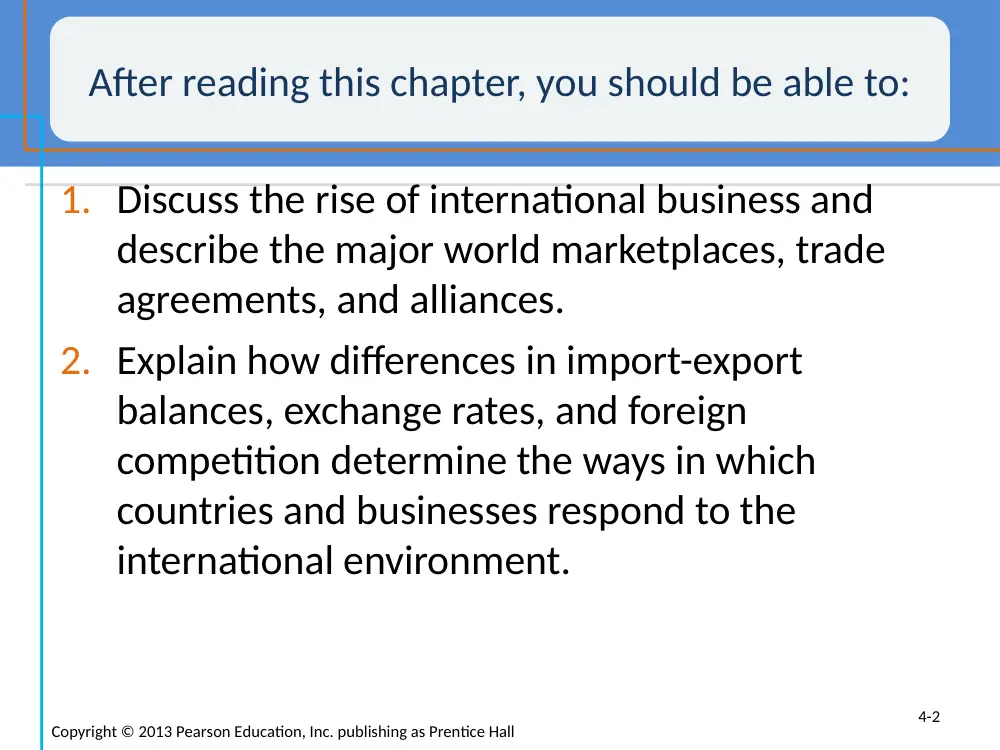
After reading this chapter, you should be able to:
1. Discuss the rise of international business and
describe the major world marketplaces, trade
agreements, and alliances.
2. Explain how differences in import-export
balances, exchange rates, and foreign
competition determine the ways in which
countries and businesses respond to the
international environment.
4-2
Copyright © 2013 Pearson Education, Inc. publishing as Prentice Hall
After reading this chapter, you should be able to:
3. Discuss the factors involved in deciding to do
business internationally and in selecting the
appropriate levels of international involvement
and international organizational structure.
4. Describe some of the ways in which social,
cultural, economic, legal, and political
differences among nations affect international
business.
Copyright © 2013 Pearson Education, Inc. publishing as Prentice Hall
4-3
The Contemporary Global
Economy
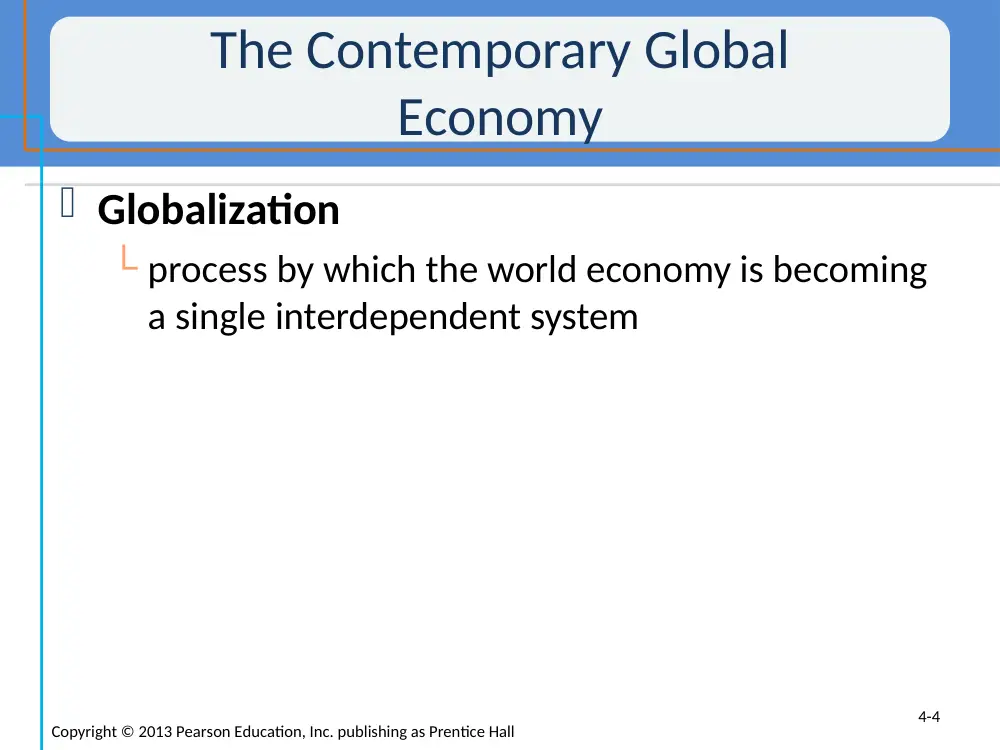
Globalization
└ process by which the world economy is becoming
a single interdependent system
Copyright © 2013 Pearson Education, Inc. publishing as Prentice Hall
4-4
The Contemporary Global
Economy
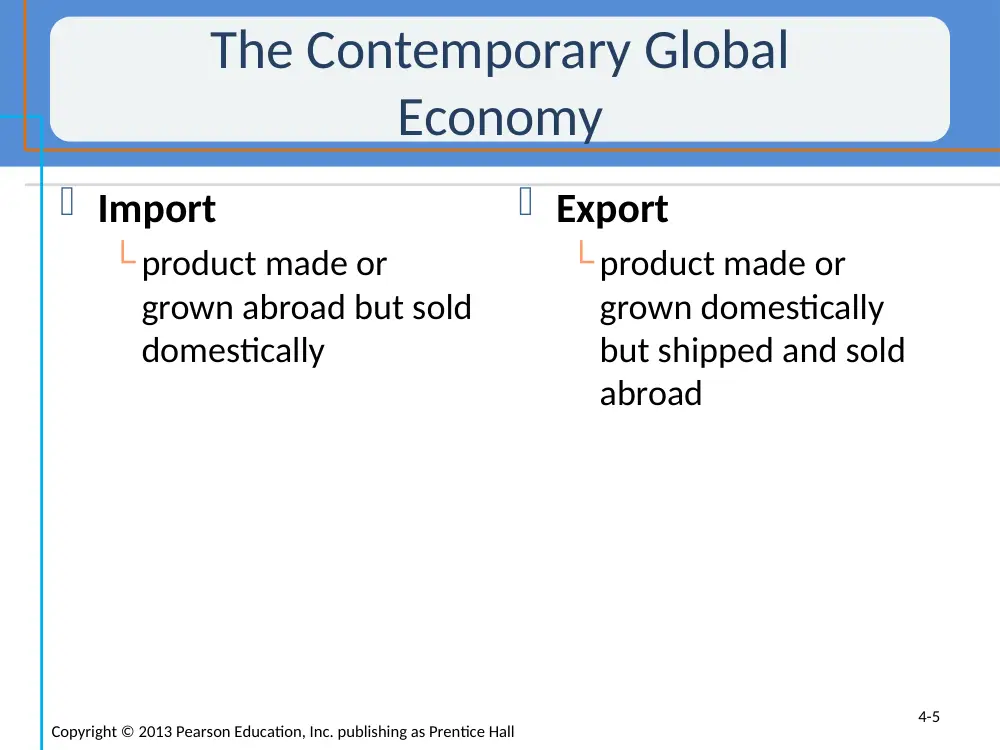
Import
└ product made or
grown abroad but sold
domestically
Export
└ product made or
grown domestically
but shipped and sold
abroad
Copyright © 2013 Pearson Education, Inc. publishing as Prentice Hall
4-5
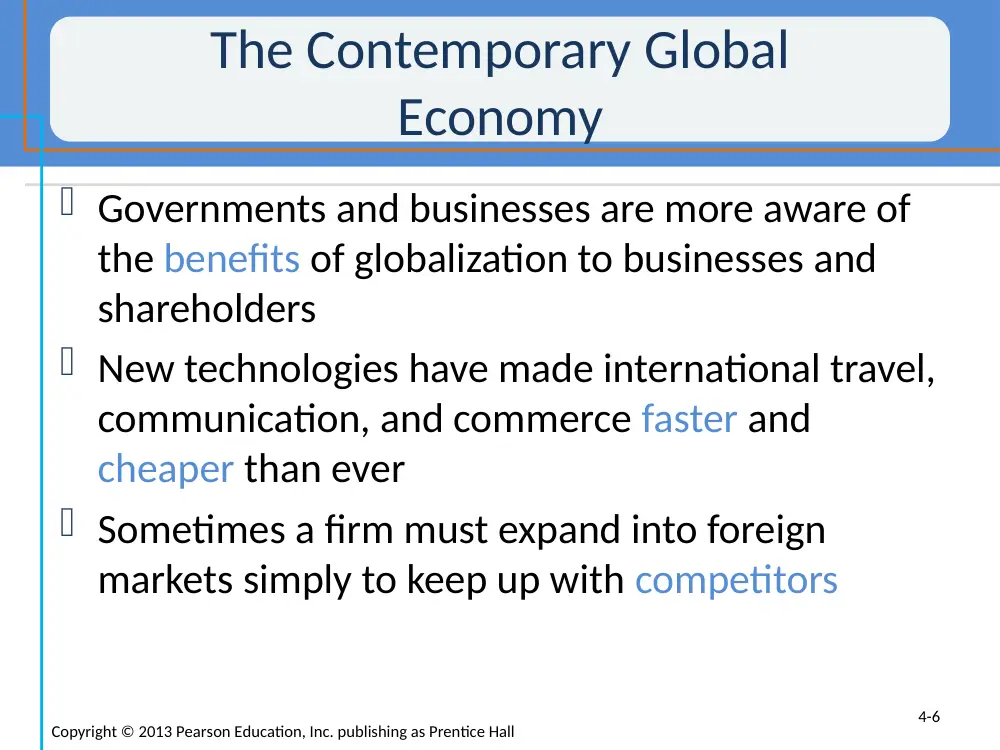
The Contemporary Global
Economy
Governments and businesses are more aware of
the benefits of globalization to businesses and
shareholders
New technologies have made international travel,
communication, and commerce faster and
cheaper than ever
Sometimes a firm must expand into foreign
markets simply to keep up with competitors
Copyright © 2013 Pearson Education, Inc. publishing as Prentice Hall
4-6
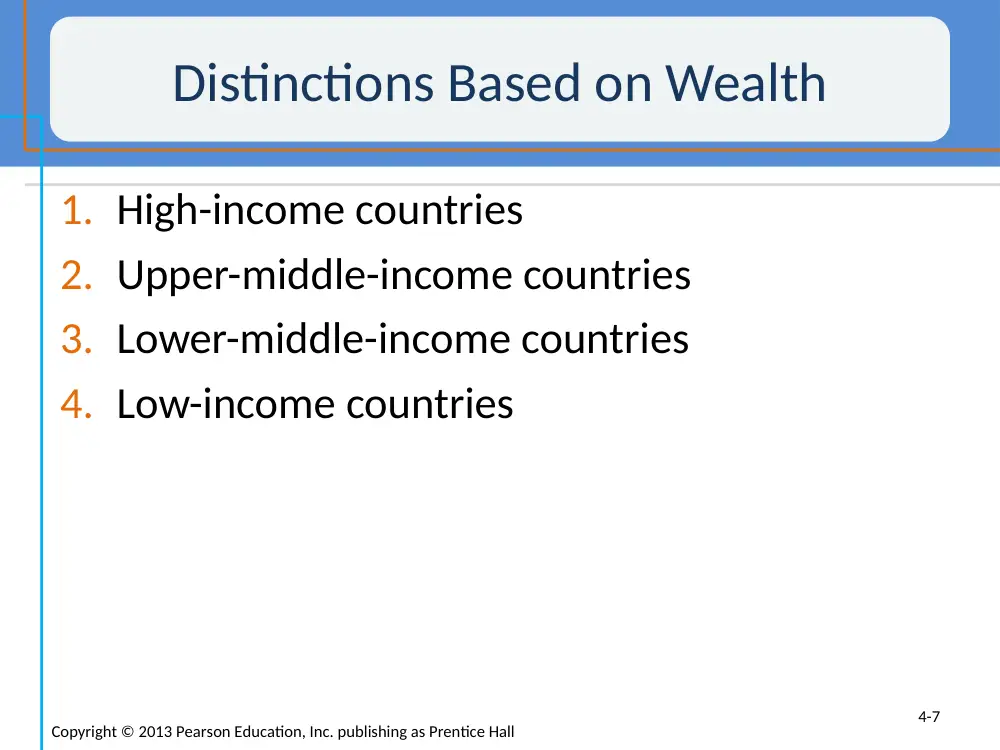
Distinctions Based on Wealth
1. High-income countries
2. Upper-middle-income countries
3. Lower-middle-income countries
4. Low-income countries
Copyright © 2013 Pearson Education, Inc. publishing as Prentice Hall
4-7
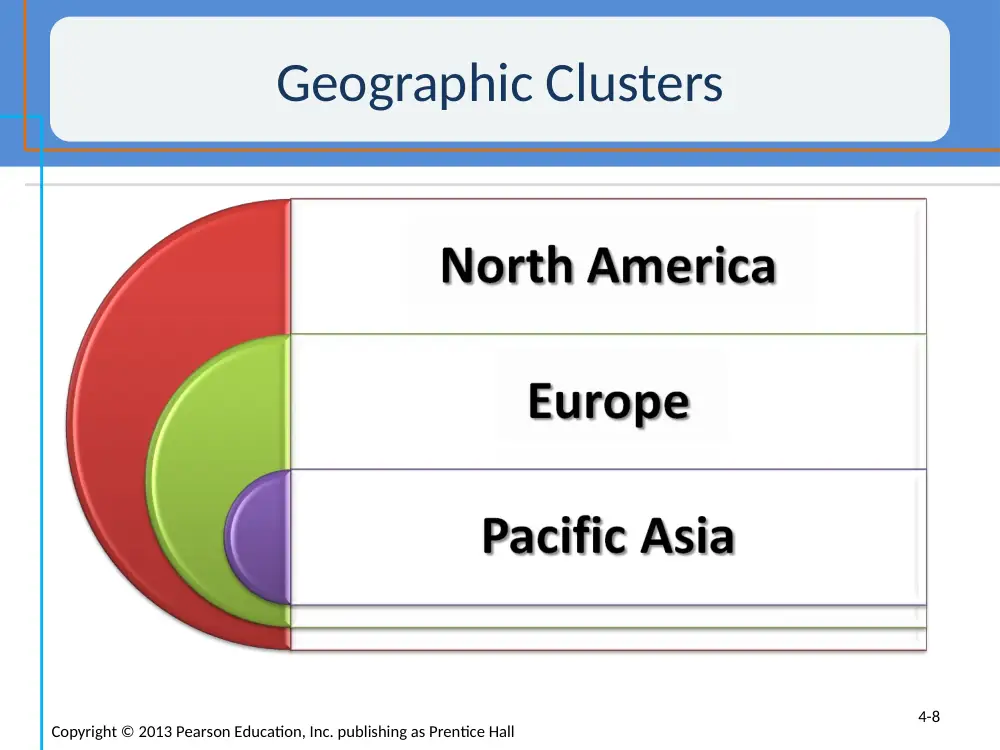
Geographic Clusters
Copyright © 2013 Pearson Education, Inc. publishing as Prentice Hall
4-8
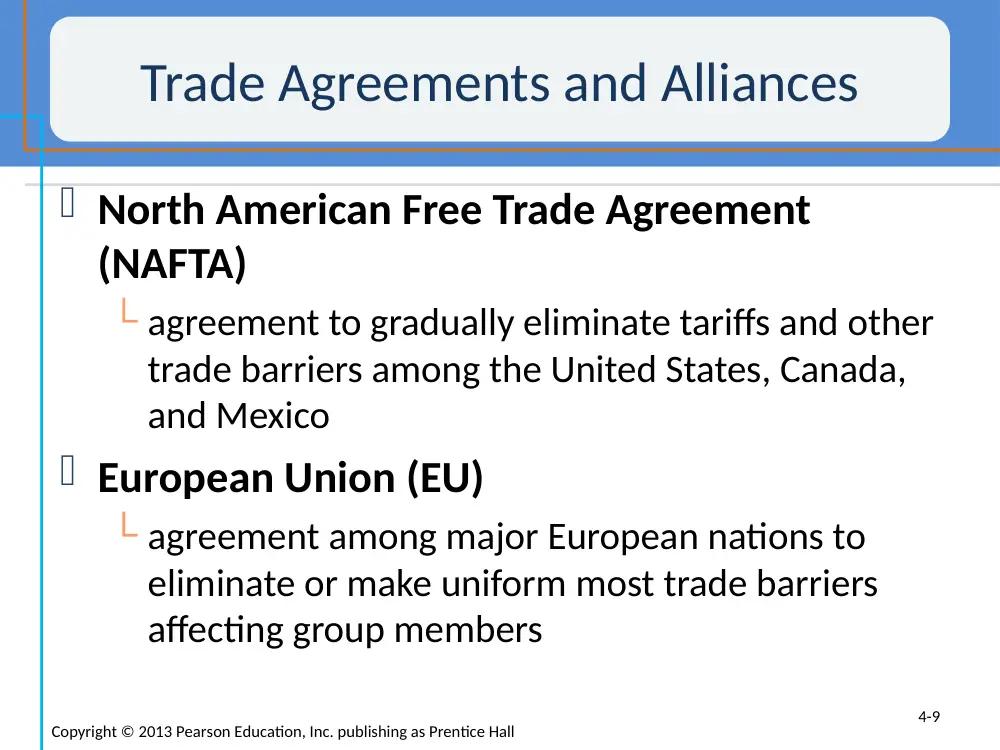
Trade Agreements and Alliances
North American Free Trade Agreement
(NAFTA)
└ agreement to gradually eliminate tariffs and other
trade barriers among the United States, Canada,
and Mexico
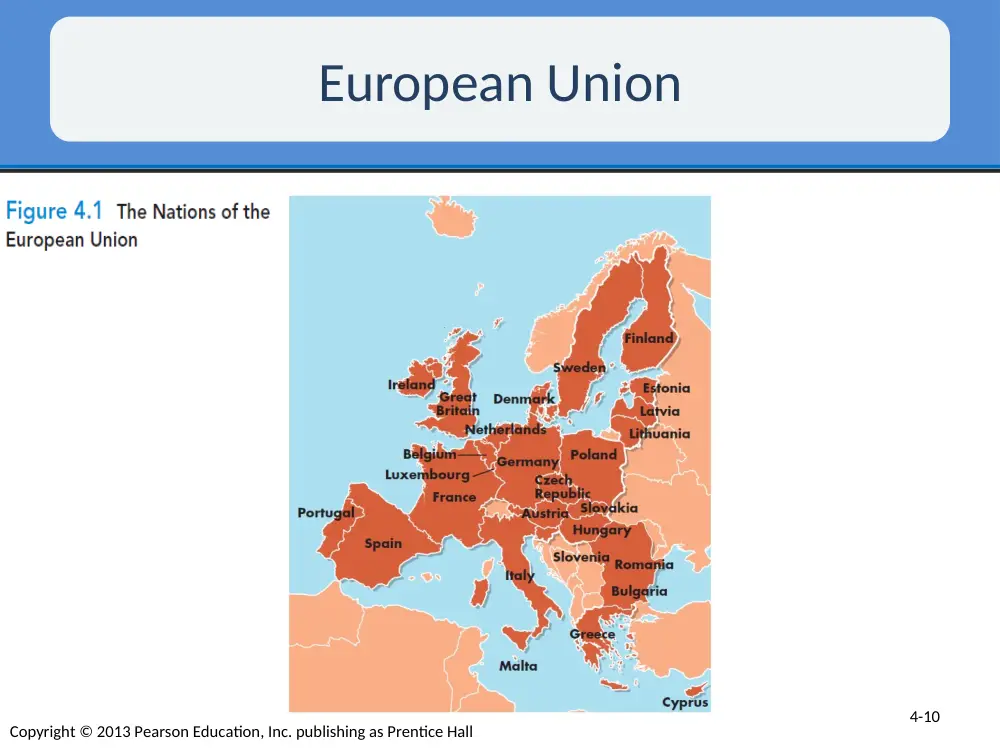
European Union (EU)
└ agreement among major European nations to
eliminate or make uniform most trade barriers
affecting group members
Copyright © 2013 Pearson Education, Inc. publishing as Prentice Hall
4-9
European Union
Copyright © 2013 Pearson Education, Inc. publishing as Prentice Hall
4-10
Trade Agreements and Alliances
Association of Southeast Asian Nations
(ASEAN)
└ organization for economic, political, social, and
cultural cooperation among Southeast Asian
nations
Copyright © 2013 Pearson Education, Inc. publishing as Prentice Hall
4-11
Association of Southeast
Asian Nations
Copyright © 2013 Pearson Education, Inc. publishing as Prentice Hall
4-12
Trade Agreements and Alliances
General Agreement on Tariffs and Trade
(GATT)
└ international trade agreement to encourage the
multilateral reduction or elimination of trade
barriers
World Trade Organization (WTO)
└ organization through which member nations
negotiate trade agreements and resolve disputes
about trade policies and practices
Copyright © 2013 Pearson Education, Inc. publishing as Prentice Hall
4-13
Goals of the WTO
1. Promote trade by encouraging members to
adopt fair trade practices
2. Reduce trade barriers by promoting
multilateral negotiations
3. Establish fair procedures for resolving
disputes among members
Copyright © 2013 Pearson Education, Inc. publishing as Prentice Hall
4-14
International Trade
Balance of Trade
└ economic value of all products a country exports
minus the economic value of all products it
imports
Copyright © 2013 Pearson Education, Inc. publishing as Prentice Hall
4-15
Major Trading Partners of the U.S.
Copyright © 2013 Pearson Education, Inc. publishing as Prentice Hall
4-16
International Trade
Trade Deficit
└ situation in which a
country’s imports
exceed its exports,
creating a negative
balance of trade
Copyright © 2013 Pearson Education, Inc. publishing as Prentice Hall
4-17
International Trade
Trade Surplus
└ situation in which a
country’s exports
exceed its imports,
creating a positive
balance of trade
Balance of Payments
└ flow of all money into
or out of a country
Copyright © 2013 Pearson Education, Inc. publishing as Prentice Hall
4-18
Exchange Rates
Exchange Rate
└ rate at which the
currency of one nation
can be exchanged for
the currency of
another nation
Euro
└ a common currency
shared among most of
the members of the
European Union
(excluding Denmark,
Sweden, and the
United Kingdom)
Copyright © 2013 Pearson Education, Inc. publishing as Prentice Hall
4-19
Forms of Competitive Advantage
Absolute Advantage
└ the ability to produce something more efficiently
than any other country can
Comparative Advantage
└ the ability to produce some products more
efficiently than others
Copyright © 2013 Pearson Education, Inc. publishing as Prentice Hall
4-20
Forms of Competitive Advantage
National Competitive Advantage
└ International competitive advantage stemming
from a combination of factor conditions, demand
conditions, related and supporting industries, and
firm strategies, structures, and rivalries
Copyright © 2013 Pearson Education, Inc. publishing as Prentice Hall
4-21
Going International
Copyright © 2013 Pearson Education, Inc. publishing as Prentice Hall
4-22
Levels of International Involvement
Exporter
└ firm that distributes
and sells products to
one or more foreign
countries
Importer
└ firm that buys
products in foreign
markets and then
imports them for
resale in its home
country
Copyright © 2013 Pearson Education, Inc. publishing as Prentice Hall
4-23
Levels of International Involvement
International Firm
└ firm that conducts a
significant portion of
its business in foreign
countries
Multinational Firm
└ firm that designs,
produces, and markets
products in many
nations
Copyright © 2013 Pearson Education, Inc. publishing as Prentice Hall
4-24
International Organization Structures
Independent Agent
└ foreign individual or organization that agrees to
represent an exporter’s interests
Licensing Arrangement
└ arrangement in which firms choose foreign
individuals or organizations to manufacture or
market their products in another country
Copyright © 2013 Pearson Education, Inc. publishing as Prentice Hall
4-25
International Organization Structures
Strategic Alliance
└ arrangement in which a company finds a foreign
partner to contribute approximately half of the
resources needed to establish and operate a new
business in the partner’s country
└ also called joint venture
Foreign Direct Investment (FDI)
└ Arrangement in which a firm buys or establishes
tangible assets in another country
Copyright © 2013 Pearson Education, Inc. publishing as Prentice Hall
4-26
Barriers to International Trade
Copyright © 2013 Pearson Education, Inc. publishing as Prentice Hall
4-27
Quotas, Tariffs, and Subsidies
Quota
└ restriction on the number of products of a certain
type that can be imported into a country
Embargo
└ government order banning exportation and/or
importation of a particular product or all products
from a particular country
Copyright © 2013 Pearson Education, Inc. publishing as Prentice Hall
4-28
Quotas, Tariffs, and Subsidies
Tariff
└ tax levied on imported products
Subsidy
└ government payment to help a domestic business
compete with foreign firms
Copyright © 2013 Pearson Education, Inc. publishing as Prentice Hall
4-29
The Protectionism Debate
Protectionism
└ the practice of protecting domestic business at
the expense of free market competition
Critics charge that protectionism drives up
prices by reducing competition
Copyright © 2013 Pearson Education, Inc. publishing as Prentice Hall
4-30
Legal and Political Differences
Local Content Law
└ law requiring that products sold in a particular
country be at least partly made there
Business Practice Law
└ law or regulation governing business practices in
given countries
Copyright © 2013 Pearson Education, Inc. publishing as Prentice Hall
4-31
Legal and Political Differences
Cartel
└ association of
producers whose
purpose is to control
supply and prices
Dumping
└ practice of selling a
product abroad for less
than the cost of
production
Copyright © 2013 Pearson Education, Inc. publishing as Prentice Hall
4-32
Applying What You’ve Learned
1. Discuss the rise of international business and
describe the major world marketplaces, trade
agreements, and alliances.
2. Explain how differences in import-export
balances, exchange rates, and foreign
competition determine the ways in which
countries and businesses respond to the
international environment.
4-33
Copyright © 2013 Pearson Education, Inc. publishing as Prentice Hall
Applying What You’ve Learned
3. Discuss the factors involved in deciding to do
business internationally and in selecting the
appropriate levels of international involvement
and international organizational structure.
4. Describe some of the ways in which social,
cultural, economic, legal, and political
differences among nations affect international
business.
Copyright © 2013 Pearson Education, Inc. publishing as Prentice Hall
4-34
35
4-35
Copyright © 2013 Pearson Education, Inc. publishing as Prentice Hall